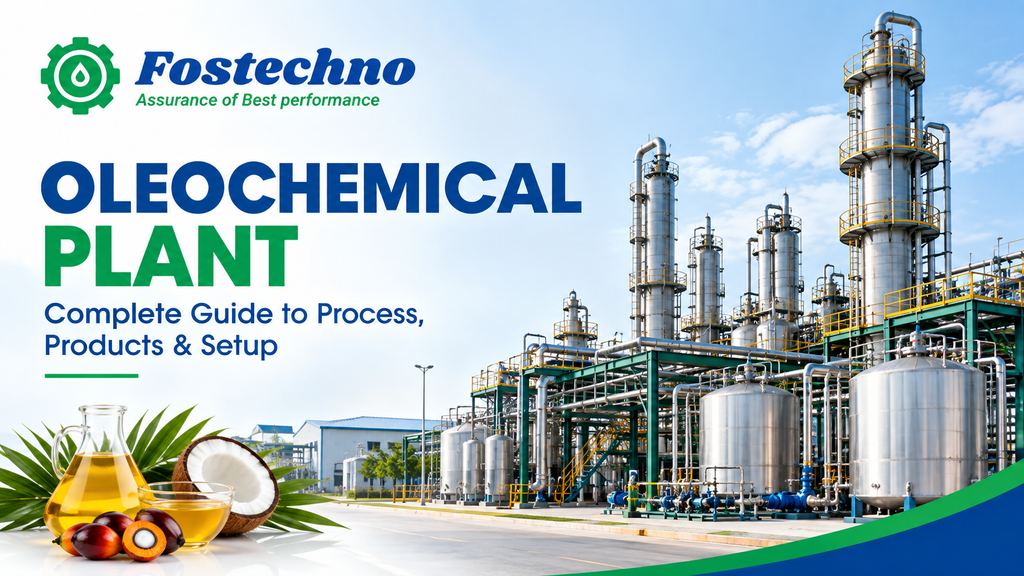
Look around you for ten seconds. The toothpaste in your bathroom, the soap by your sink, the moisturizer on your shelf, the detergent that washed your clothes this morning, even the tablet coating on the medicine in your cabinet — almost none of it exists without one thing: an oleochemical plant quietly converting palm oil, coconut oil, or animal fat into the chemical building blocks that modern industry runs on.
Most people have never heard the word “oleochemical.” Yet few industrial facilities touch daily life as directly, or as invisibly, as this one does.
That invisibility is exactly why the oleochemical plant is becoming one of the most closely watched pieces of industrial infrastructure in India today. As global manufacturers race to replace petroleum-based inputs with renewable, bio-based alternatives, the humble oleochemical plant has moved from a niche processing facility to a strategic asset — one that investors, FMCG giants, and first-time entrepreneurs are all betting on.
This guide breaks down everything that matters: what an oleochemical plant actually does, how the process works step by step, what products come out of it, why 2026 is shaping up to be a pivotal year for investment, and what it genuinely takes to set one up in India. Whether you are evaluating an investment, exploring backward integration for your FMCG business, or simply trying to understand the supply chain behind everyday products, you will find the full picture here.
What Is an Oleochemical Plant?
An oleochemical plant is an industrial facility that converts natural fats and oils — sourced from plants or animals — into chemical derivatives called oleochemicals. These derivatives become the raw materials for products used across personal care, pharmaceuticals, food processing, detergents, lubricants, and agrochemicals.
The word oleochemical comes from the Latin oleum, meaning oil. Where petrochemicals are derived from fossil fuels, oleochemicals are derived from renewable biological feedstock — palm oil, coconut oil, soybean oil, tallow, and similar sources. This single distinction is what makes the oleochemical plant central to the global shift toward sustainable, bio-based manufacturing.
Put simply: what petroleum is to the petrochemical industry, natural oils and fats are to the oleochemical industry.
The Global Oleochemical Market: Size, Growth, and What’s Driving It
The global oleochemical market touched an estimated USD 25.8 billion in 2023, according to industry research from the IMARC Group. With a projected compound annual growth rate of roughly 5.9% between 2024 and 2032, the market is expected to approach USD 44 billion by the end of that period. Separate research from Mordor Intelligence points to the Asia-Pacific region as the fastest-growing and most dominant geography for oleochemical production, driven largely by abundant palm and coconut oil feedstock in countries like Indonesia, Malaysia, and India.
Three forces are driving this growth:
Sustainability commitments. FMCG, cosmetics, and packaging companies worldwide are locking in bio-based sourcing targets. As “green” and “natural” labeling becomes a genuine commercial advantage rather than a marketing footnote, demand for oleochemical inputs rises in parallel.
Abundant regional feedstock. India, Indonesia, Malaysia, and Brazil collectively produce enormous volumes of palm oil, coconut oil, and tallow. This gives oleochemical manufacturers in these regions a structural cost and supply-chain advantage over producers dependent on imported feedstock.
Expanding downstream demand. Detergents, surfactants, cosmetics, and specialty chemical industries are all growing steadily, and each pulls more fatty acids, glycerine, and fatty alcohols through the supply chain.
The Oleochemical Industry in India
India’s oleochemical market was valued at approximately USD 1.76 billion in 2023, according to TechSci Research, with a forecast CAGR of around 3.76% through 2029. Growth here mirrors the global story — sustainability pressure, feedstock access, and downstream demand — but with a distinctly Indian dimension: government support through initiatives like Aatmanirbhar Bharat, and a domestic FMCG sector that consumes oleochemicals at enormous scale.
India is home to several established oleochemical manufacturers, including Godrej Industries, one of the country’s pioneers in the space since 1963, VVF (India), Fine Organic Industries — the country’s largest producer of oleochemical-based specialty additives — along with 3F Industries, Indo Amines, and Universal Biofuels. Godrej Industries alone announced a plan in early 2024 to invest roughly INR 600 crore over four years to expand oleochemical production at its Valia facility in Gujarat, a signal of just how seriously established players are scaling up domestic capacity.
The Solvent Extractors’ Association (SEA) of India has also highlighted significant capacity expansion in the sector over the past decade, driven by rising disposable incomes, population growth, and steady industrial demand. That said, the industry isn’t without friction — feedstock availability fluctuates with global agricultural cycles, and India still imports a meaningful share of the crude palm oil that feeds its oleochemical plants.
How an Oleochemical Plant Works: The Core Chemistry
At the heart of every oleochemical plant is a deceptively simple transformation: breaking down triglycerides — the molecular structure of natural fats and oils — into their component parts. Two industrial reactions make this possible.
Hydrolysis (splitting): Triglycerides react with water under high temperature and pressure, splitting the molecule into fatty acids and crude glycerine. This is the dominant route in large-scale oleochemical production.
Transesterification: A triglyceride reacts with an alcohol — typically methanol — in the presence of a catalyst, producing fatty acid methyl esters (FAME) and glycerine. FAME is widely used as biodiesel and as a feedstock for further chemical processing.
From here, manufacturers separate the resulting fatty acids into individual fractions — lauric, myristic, palmitic, stearic, and oleic — each suited to different industrial applications, while refiners purify the glycerine byproduct to food, pharmaceutical, or industrial-grade specifications. Additional processes such as hydrogenation, ethoxylation, and sulphonation convert these intermediates into higher-value specialty chemicals.
This layered value-addition is what makes an oleochemical plant financially compelling in the first place. Through integrated processing, a single tonne of crude palm oil can be converted into products worth three to five times the value of the original feedstock.
Key Process Steps Inside an Oleochemical Plant
Understanding the plant process step by step is essential for anyone planning capacity, utilities, or downstream integration.
Step 1 — Feedstock receipt and storage. Crude vegetable oils and fats arrive by road or rail tanker and are stored in temperature-controlled tanks; palm oil, for instance, requires heated storage to stay liquid. Quality teams test incoming feedstock for free fatty acid content, moisture, and iodine value immediately on arrival.
Step 2 — Pre-treatment and refining. Crude oils carry impurities — gums, free fatty acids, pigments, trace metals — that must be removed before downstream processing. This typically involves degumming, neutralization, bleaching, and deodorization.
Step 3 — Splitting / hydrolysis. The refined oil enters a continuous high-pressure fat splitting unit — commonly operating around 250°C and 50 bar — where it reacts with water to yield crude fatty acid and sweet water (a dilute glycerine solution).
Step 4 — Fatty acid distillation. Crude fatty acids are distilled under vacuum and separated into different chain-length fractions. This step effectively shapes the plant’s product portfolio, since engineers can design the distillation train to yield C12, C14, C16, C18, or blended fatty acid cuts depending on market demand.
Step 5 — Glycerine recovery and refining. The sweet water from splitting is evaporated and passed through ion exchange to produce crude glycerine, which is then distilled and treated with activated carbon to reach 99.5–99.7% purity.
Step 6 — Downstream conversion (optional). Depending on plant design, fatty acids can be processed further into fatty alcohols via hydrogenation, into methyl esters via transesterification (with methanol rectification recovering and purifying excess methanol), or into soap noodles by neutralizing with caustic soda. Each downstream unit adds capital cost but meaningfully improves product value.
Step 7 — Storage, quality control, and dispatch. Finished products are stored in dedicated tanks or silos, tested against customer or international specifications, and dispatched by bulk tanker, drum, or flexibag.
Raw Materials: What Feeds an Oleochemical Plant
Feedstock choice depends heavily on geography, cost, and the desired carbon chain length in the final product. Common raw materials include:
- Palm oil and palm kernel oil — the dominant feedstock across Asia, valued for cost-efficiency and yield
- Coconut oil — rich in lauric acid, essential for soaps and personal care surfactants
- Soybean oil — widely available in India, used across multiple oleochemical streams
- Tallow — an animal-fat feedstock still significant in fatty acid and soap production
- Castor oil — used for specialty esters and industrial applications
- Acid oil and fatty acid distillate — byproducts recovered from oil refining operations, increasingly used to reduce dependence on virgin feedstock
An emerging trend worth watching: as edible oil demand puts pressure on traditional oleochemical feedstock, manufacturers are increasingly turning to non-edible oils, industrial byproducts, and even microbial lipids from oleaginous yeasts as alternative raw materials — sidestepping the competition between food and industrial feedstock entirely.
Top Products Made in an Oleochemical Plant
Fatty acids are the primary output of most oleochemical plants, produced by splitting oils or fats through hydrolysis. Lauric acid (from coconut and palm kernel oil) drives soaps and detergents; stearic acid (from palm or tallow) is used in rubber, cosmetics, and pharmaceuticals; oleic acid (from palm or sunflower oil) serves lubricants and specialty chemicals; and palmitic acid (from palm oil) finds use in food applications and soap manufacturing.
Glycerine (glycerol) is generated as a co-product of fatty acid production and remains one of the most commercially valuable oleochemical outputs, refined to 99.7% purity for pharmaceutical, food, personal care, and tobacco applications. The global glycerine market alone exceeds USD 2 billion annually.
Fatty alcohols, produced by hydrogenating fatty acids or their methyl esters, are key raw materials for surfactants, emollients, and emulsifiers — cetyl alcohol, stearyl alcohol, and lauryl alcohol among the most widely used.
Methyl esters (FAME) serve a dual purpose as biodiesel feedstock and as intermediates for surfactants and lubricants, with demand expanding alongside biofuel mandates across India, the EU, and Southeast Asia.
Surfactants — including sodium lauryl sulphate, sodium laureth sulphate, and alkyl polyglucosides — are the workhorses of the detergent and shampoo industries, and bio-based versions command a premium wherever “natural” labeling carries commercial weight.
Soap noodles, a direct downstream product of fatty acid neutralization with caustic soda, remain a major export category, with India and Southeast Asia supplying bar-soap manufacturers across Africa and the Middle East.
Applications Across Industries
FMCG and home care rely on oleochemicals as the backbone of nearly every laundry detergent, dish soap, and floor cleaner, with coconut- and palm-kernel-derived surfactants consumed at enormous volumes.
Personal care and cosmetics use fatty alcohols as emollients, thickeners, and emulsifiers in creams and lotions; glycerine as a universal humectant; and specialty esters like isopropyl myristate as skin-feel modifiers in premium formulations.
Pharmaceuticals depend on pharmaceutical-grade glycerine as a solvent, humectant, and excipient in tablets, syrups, and topical preparations, while stearic acid derivatives appear in tablet coatings — a demanding, high-margin segment.
Lubricants and industrial applications increasingly favor oleochemical-based fluids over mineral oil for their biodegradability, with fatty acid esters used in hydraulic fluids, textile lubricants, and food-grade machinery lubricants.
Agrochemicals use oleochemical derivatives as emulsifiers, adjuvants, and spray carriers in pesticide and herbicide formulations — a smaller but steadily growing application area.
Why Businesses Are Investing in Oleochemical Plants in 2026
Several converging forces make 2026 a particularly active year for oleochemical investment.
Regulatory tailwinds are real and accelerating. The EU’s Green Deal, India’s extended producer responsibility norms, and comparable policy shifts in the US all favor bio-based chemical production, while synthetic-chemical suppliers face rising compliance costs.
Backward integration is a major driver for large FMCG companies. Firms like Hindustan Unilever, Dabur, and Godrej Consumer are strengthening upstream control over surfactant and fatty acid supply to stabilize margins and reduce raw material exposure — a strategy that only works with reliable in-house or partnered oleochemical production.
Export opportunity continues to grow. India’s chemical exports are expanding steadily, and oleochemicals represent a high-value, relatively underexplored category, with African detergent manufacturers and Middle Eastern personal care companies increasing demand for Indian-made product.
Import substitution adds another layer of incentive. India still imports significant volumes of refined fatty alcohols and specialty esters from Malaysia and Europe, and domestic capacity remains below demand — a gap that policy incentives are actively trying to close.
How Oleochemical Plants Support Sustainable, Bio-Based Manufacturing
Sustainability has shifted from marketing language to procurement criteria for major global buyers, and oleochemical plants sit directly in that shift.
Lower carbon footprint: Bio-based chemicals generally carry lower life-cycle carbon intensity than petrochemical equivalents, giving producers a documentable advantage for customers tracking Scope 3 emissions.
Circular economy integration: Glycerine, a byproduct of fatty acid production, serves food, pharmaceutical, and personal care industries instead of becoming waste, while spent bleaching earth from refining is increasingly repurposed as fuel or soil amendment. Modern plants are also adopting zero-liquid-discharge systems and recovering energy from process heat.
RSPO certification: The Roundtable on Sustainable Palm Oil offers a globally recognized framework for sustainable feedstock sourcing, and oleochemical plants using RSPO-certified oils can access premium markets in Europe and North America.
Petrochemical displacement: Every tonne of oleochemical surfactant or lubricant that replaces a fossil-fuel-derived equivalent reduces dependence on non-renewable resources — a substitution story that resonates strongly with investors, regulators, and end customers alike.
Oleochemical Plant vs. Petrochemical Plant: Why the Distinction Matters
It’s worth pausing on why an oleochemical plant is treated so differently from a conventional petrochemical facility, because the distinction drives almost every investment decision in this sector.
A petrochemical plant starts with crude oil or natural gas — finite, geopolitically sensitive, and increasingly expensive to extract and refine. An oleochemical plant starts with palm oil, coconut oil, or tallow — renewable, regionally abundant, and replenished on an annual agricultural cycle rather than a geological one. That single difference in feedstock origin cascades into everything else: carbon footprint, supply chain resilience, regulatory treatment, and customer perception.
Chemically, the two industries actually converge at several points. Fatty alcohols, for example, can be produced from either petrochemical or oleochemical feedstock, and the resulting molecule is functionally similar in many applications. But in a market where “bio-based,” “renewable,” and “sustainably sourced” have become genuine purchasing criteria — not just marketing language — the oleochemical route increasingly wins on commercial grounds, even when production costs are comparable. This is precisely why FMCG majors are willing to pay a premium for oleochemical-derived surfactants and why regulatory frameworks like the EU Green Deal explicitly favor bio-based chemical inputs over their petrochemical equivalents.
For an investor, this matters because it changes the long-term risk profile of the asset. A petrochemical-dependent facility is exposed to crude oil price volatility and tightening carbon regulation. An oleochemical plant is exposed to agricultural commodity cycles instead — a different risk, but one that’s arguably easier to hedge through feedstock diversification, and one that benefits rather than suffers from the global regulatory direction of travel.
Future Trends Shaping Oleochemical Plants Through 2030
A few structural shifts are worth watching closely if you’re planning a plant with a 20-to-30-year operating horizon.
Feedstock diversification is accelerating. As edible oil demand competes for the same palm and soy supply that oleochemical plants rely on, manufacturers are increasingly designing flexibility into their splitting and distillation units — enabling a single plant to switch between palm, coconut, tallow, and even non-edible or waste-derived oils depending on price and availability in a given quarter.
Specialty and high-purity segments are growing faster than commodity ones. While commodity fatty acids and standard glycerine remain the volume backbone of the industry, the fastest margin growth is showing up in pharmaceutical-grade glycerine, cosmetic-grade esters, and specialty surfactants — segments that reward technical precision and quality certification over raw production scale.
Energy efficiency is becoming a competitiveness issue, not just a sustainability one. With high-pressure steam and continuous heating central to splitting and distillation, plants that invest in waste-heat recovery and captive power generation are increasingly out-competing those that don’t, simply on operating cost — independent of any environmental incentive.
Traceability and certification are moving from optional to expected. RSPO certification, once a differentiator, is becoming close to a baseline requirement for oleochemical exports into Europe and North America, and buyers are asking for increasingly granular supply chain documentation.
Consolidation is likely among smaller producers. As capital costs rise and compliance requirements tighten, expect continued consolidation activity, with larger, well-capitalized players like Godrej Industries and Fine Organic Industries expanding capacity while smaller, undercapitalized operations face pressure to merge, partner, or exit.
Setting Up an Oleochemical Plant in India: What to Consider
Feedstock strategy. India produces meaningful volumes of soybean, cottonseed, and castor oil, but domestic palm oil output is limited, and significant crude palm oil is imported from Malaysia and Indonesia. A realistic feedstock plan — covering import logistics, price hedging, and flexibility across multiple oil types — needs to be locked in before finalizing plant design.
Location and infrastructure. Proximity to ports like Kandla, Mundra, Hazira, or Kakinada significantly eases crude oil import logistics, while access to reliable power, water, steam, and effluent treatment infrastructure reduces both setup cost and operating risk.
Regulatory compliance. Oleochemical plants in India require clearance from the Ministry of Environment, Forest and Climate Change (MoEFCC), along with State Pollution Control Board approvals, factory licenses, and fire safety certification. Working with a consultant experienced in chemical-plant regulatory processes can meaningfully shorten approval timelines.
Scale and product mix. Techno-economic viability typically starts around 50–100 tonnes per day of feedstock processing capacity; smaller plants are possible but carry higher unit costs. Whether the plant targets commodity fatty acids, refined glycerine, or specialty esters will shape both profitability and target customers.
Utility requirements. Oleochemical plants are energy-intensive, requiring high-pressure steam, cooling water, compressed air, and substantial electrical power. Plants that integrate captive power generation or waste-heat recovery consistently show better operating economics.
Challenges in Oleochemical Plant Projects
Feedstock price volatility is the single biggest operating risk — palm oil prices, tied to global commodity markets, can swing 30–40% within a year. Plants capable of processing multiple feedstock types (palm, coconut, tallow, castor) build in a natural hedge against single-commodity exposure.
High capital cost remains a real barrier to entry. A mid-scale integrated plant covering fatty acid, glycerine, and soap noodle units can require anywhere from INR 50 to 150 crore, depending on capacity and configuration — and securing debt financing typically demands a detailed, bankable project report from experienced technical consultants.
Environmental compliance is non-negotiable and getting stricter. Effluent treatment, air emission controls, and solid waste management need to be designed in from day one; retrofitting these systems after commissioning is significantly more expensive.
Technical manpower with genuine oleochemical processing experience remains relatively scarce in India, making a manufacturing partner that offers training and ongoing operational support a meaningful risk reducer.
Choosing the Right Oleochemical Plant Manufacturer
The choice of plant manufacturer or EPC partner may be the single most consequential decision in any oleochemical plant project — arguably more important than the site itself.
A credible manufacturer should have a demonstrable track record across multiple product configurations, with references from plants that are actually operating, not just conceptual proposals. Buyers should ask for process guarantee data, energy consumption benchmarks, and product quality specifications from live facilities, ideally verifiable independently.
Turnkey vs. component-based supply is a key structural decision. Turnkey manufacturers take responsibility for the entire project from engineering through commissioning, reducing coordination risk but requiring careful contracting around performance guarantees and warranty terms. Component-based supply offers more flexibility but demands significant in-house project management capability.
After-sales support matters more than most first-time investors expect. Oleochemical plants typically operate for 20–30 years or longer with proper maintenance, so easy access to spare parts, technical troubleshooting, and process optimization support directly affects long-term profitability.
Local customization rounds out the picture. Indian conditions — feedstock variability, utility costs, power reliability, domestic product specifications — differ meaningfully from European or Southeast Asian markets, and a manufacturer with genuine Indian project experience will design around those realities rather than applying a generic global template.
Frequently Asked Questions About Oleochemical Plants
What is an oleochemical plant used for? An oleochemical plant converts natural oils and fats into industrial chemical derivatives — fatty acids, glycerine, fatty alcohols, methyl esters, and surfactants — that serve as raw materials for soaps, detergents, cosmetics, pharmaceuticals, lubricants, and agrochemicals.
What raw materials does an oleochemical plant use? Most plants run on palm oil, palm kernel oil, coconut oil, soybean oil, castor oil, or tallow, with the specific mix depending on regional availability, cost, and the target product portfolio.
How much does it cost to set up an oleochemical plant in India? A small to mid-scale fatty acid and glycerine plant typically requires an investment in the range of INR 30–60 crore, while larger integrated plants with soap noodle, methyl ester, or hydrogenation units can run from INR 80–200 crore or more, depending on capacity and configuration. An accurate figure depends on a detailed, site-specific project report.
How long does it take to set up an oleochemical plant? Depending on scale, regulatory approvals, and equipment lead times, a mid-sized oleochemical plant project in India typically takes anywhere from 12 to 24 months from feasibility study to commissioning.
Is an oleochemical plant profitable? Profitability depends heavily on feedstock cost management, product mix, and scale, but integrated plants that convert crude oil into multiple refined derivatives can generate three to five times the value of the raw feedstock — making well-run, well-capitalized operations genuinely attractive investments.
Conclusion
The economics behind an oleochemical plant are compelling, the market tailwinds are strong, and the case for investing in India has rarely been clearer — abundant feedstock, growing downstream demand, active government support, and a global shift toward bio-based inputs are all pointing the same direction at once. But none of that changes the fact that this is still a capital-intensive, technically demanding, long-horizon investment. Getting the feedstock strategy right, choosing a location with the right infrastructure, navigating environmental compliance properly, and — above all — partnering with a manufacturer who has actually commissioned working plants rather than just proposals, will determine whether a project becomes a durable, profitable asset or an expensive lesson.
Whether you’re entering the oleochemical space for the first time or expanding existing capacity, the decision deserves the same rigor as any major capital commitment: clear product strategy, sound feedstock planning, a defined regulatory pathway, and an experienced engineering partner from day one.
Where does your own project stand right now — are you still evaluating feedstock and location, or already looking for the right engineering partner to take it from paper to commissioning?
About FOSTECHNO Process & Engineering Private Limited
FOSTECHNO Process & Engineering Private Limited designs, engineers, and delivers turnkey oil and oleochemical processing plants for clients across India and beyond — from oilseed preparation and solvent extraction, through refining stages like degumming, neutralization, and bleaching, to full oleochemical production including fat splitting, glycerine refining, fatty acid distillation, and transesterification for biodiesel. Our team also supports fat modification processes such as interesterification, hydrogenation, and dry fractionation, along with value-addition units like lecithin plants and bakery shortening and margarine production.
From feasibility studies to commissioning, our engineering team works closely with investors and manufacturers to design plants suited to Indian feedstock realities, utility constraints, and regulatory requirements.
Looking to set up an oleochemical plant, or expand existing capacity? Talk to our engineering team for customized plant design and turnkey project support, or get in touch here.



Leave a Reply