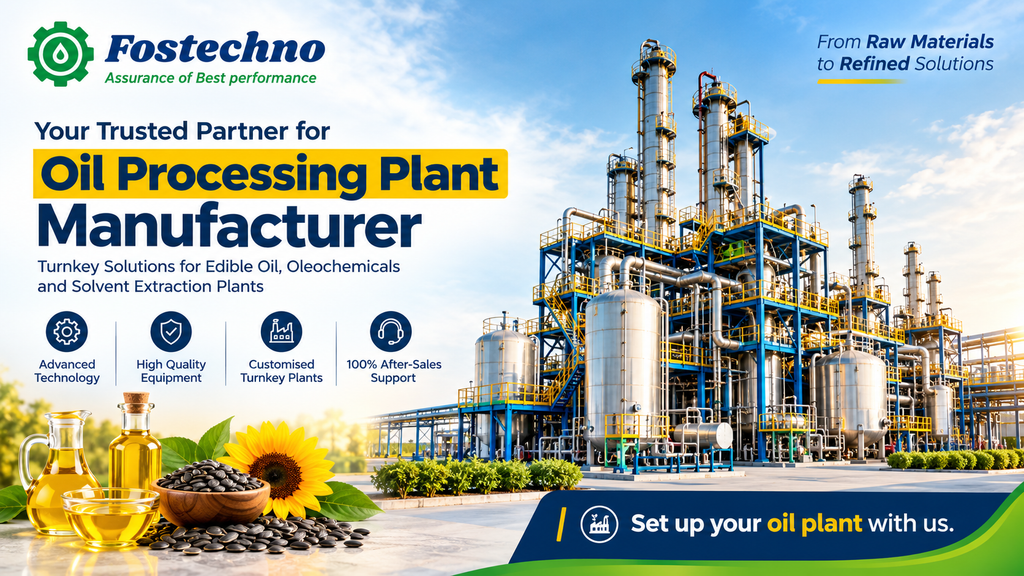
If you are planning to set up an edible oil business, choosing the right oil processing plant manufacturer is the most important decision you will make. The plant determines your oil yield, refining losses, power and steam bills,product quality, and how many years the machinery runs without trouble.
This guide explains how an oil processing plant works, what each section does, how to compare manufacturers, what affects cost, and what compliance you need. It is written for first-time investors, existing oil millers who want to expand, and project managers comparing quotations.
FOSTECHNO Process & Engineering Private Limited is a Delhi-based project engineering company that designs, manufactures and supplies turnkey oil processing plants from 5 to 500 tons per day (TPD). The guide draws on the kind of engineering questions we handle on real projects.
What Is an Oil Processing Plant?
An oil processing plant is an integrated set of machines and equipment that converts raw oilseeds or crude oil into clean, stable, edible or industrial oil. Depending on the project, it can include one or more of these sections:
- Seed preparation: cleaning, destoning, dehulling, cracking, flaking and cooking.
- Oil extraction: mechanical expellers, solvent extraction, or both.
- Oil refining: degumming, neutralization, bleaching, dewaxing and deodorization.
- Value addition: lecithin, fractionation, shortening, margarine, vanaspati and similar products.
- Oleochemicals: fat splitting, fatty acid distillation, glycerine refining and biodiesel.
A manufacturer designs and fabricates the critical equipment itself. A pure trader or dealer only sources machines from others. This difference matters because a manufacturer controls material quality, welding, tolerances and after-sales support.
Types of Oil Processing Plants
1. Oil Mill Plant (Expeller-Based)
Best for mustard, groundnut, sesame, sunflower, cottonseed and copra. Seeds are cleaned, conditioned and pressed in a screw press (expeller). Capacity ranges from small 5 TPD units to larger multi-expeller lines. Investment is lower and operation is simpler, but some oil stays in the cake.
2. Solvent Extraction Plant
Used for soybean, rice bran, cottonseed, sunflower and expeller cake. Hexane dissolves the remaining oil, and the solvent is then recovered and reused. This is the most efficient extraction method and suits medium and large capacities.
3. Edible Oil Refinery
Takes crude oil and turns it into refined, odourless, light-coloured oil that meets food-grade standards. Refineries are either batch type (small capacity, lower investment) or continuous type (high capacity, lower operating cost per ton).
4. Integrated Plant
Combines seed preparation, extraction and refining in one project. This is the most profitable model at scale because you control the whole value chain from seed to packed oil.
5. Oleochemical and Specialty Fat Plants
For fat splitting, fatty acid distillation, glycerine refining, biodiesel, lecithin and fat modification.
How an Oil Processing Plant Works: Step by Step
Stage 1: Seed Preparation
Good preparation directly improves oil yield. Poor preparation cannot be fixed later.
- Cleaning: Vibrating screens and magnetic separators remove dust, straw, metal and other foreign matter.
- Destoning: Removes stones and heavy particles that would damage expellers and extractors.
- Decortication/Dehulling: Removes hulls from seeds like sunflower and groundnut. Hulls absorb oil and reduce yield.
- Cracking and Flaking: Breaks seeds and rolls them into thin flakes. Thin flakes have more surface area, so oil comes out more easily.
- Cooking/Conditioning: Heats and moistens the material. The right temperature and moisture make cell walls rupture, oil viscosity drop, and proteins coagulate for clean pressing.
Stage 2: Mechanical Oil Extraction (Expeller)
Cooked material is fed into a screw press. The screw shaft pushes material against a barrel, and pressure squeezes the oil out through fine gaps. The output is crude oil (with fine solids) and oilseed cake.
Crude oil then goes through a vibro screen and a filter press or pressure leaf filter to remove suspended solids. For mustard oil, many producers use cold or low-temperature pressing to preserve the traditional pungent flavour.
Expellers typically leave a noticeable amount of residual oil in the cake. That is why higher-volume plants send the cake to solvent extraction.
Stage 3: Solvent Extraction
In a solvent extraction plant, prepared flakes or cake move through an extractor where food-grade hexane flows counter-current to the material. The oil-rich solution (miscella) is separated from the meal.
The process has four main parts:
- Extractor: where hexane contacts the material.
- Desolventizer-Toaster (DT): removes hexane from the meal using steam and heat, and toasts it for feed use (important for soybean meal).
- Distillation/Evaporation: separates oil from hexane in the miscella.
- Solvent recovery: condensers and absorbers recover hexane so it can be reused and losses stay low.
Solvent extraction typically brings residual oil in the meal down to around 1% or lower, which is far below what a standalone expeller achieves. Because hexane is flammable, the design must follow strict safety norms: proper earthing, explosion-proof electricals, gas detection, ventilation and safe solvent storage.
Stage 4: Edible Oil Refining
Crude oil contains gums (phospholipids), free fatty acids (FFA), colour pigments, waxes, trace metals and odour compounds. Refining removes these while keeping as much neutral oil as possible.
Degumming: Water or acid (such as phosphoric or citric acid) is added to hydrate phosphatides so they can be separated. Soybean and rice bran oils need good degumming.
Neutralization (chemical refining): Caustic soda reacts with FFA to form soapstock, which is separated. This step also removes some colour and other impurities.
Bleaching: Bleaching earth (and sometimes activated carbon) is mixed with oil under vacuum at controlled temperature. It adsorbs colour pigments, traces of soap and oxidation products. The oil is then filtered through a pressure leaf filter or similar unit.
Dewaxing/Winterization: Oils like sunflower, rice bran and corn contain waxes that make oil cloudy at low temperatures. The oil is chilled so wax crystallizes, then filtered out.
Deodorization: The final and critical step. Oil is heated to high temperature under deep vacuum while stripping steam removes volatile odour compounds and residual FFA. It gives refined oil its neutral taste and smell and improves shelf life.
Physical vs Chemical Refining
| Factor | Chemical Refining | Physical Refining |
|---|---|---|
| FFA removal | By caustic soda (soapstock) | By steam distillation in the deodorizer |
| Best suited for | Oils with lower FFA, or where gum removal is heavy | High-FFA oils such as palm and rice bran |
| Byproduct | Soapstock (needs treatment) | Fatty acid distillate (saleable) |
| Effluent load | Higher | Lower |
| Pre-treatment need | Standard degumming | Very good degumming and bleaching |
The right choice depends on your raw material, FFA level and product plan. A good manufacturer will ask about these before quoting.
Stage 5: Value Addition and Oleochemicals
Once you have a refinery, you can add:
- Lecithin plant to recover lecithin from gums (used in food, feed and pharma).
- Fractionation to separate palm oil into olein and stearin.
- Bakery shortening and margarine lines.
- Fat splitting and fatty acid distillation for soap, cosmetics and industrial use.
- Glycerine refining from soap and oleochemical streams.
- Biodiesel from suitable feedstock.
These lines raise your margin per ton and make your business less dependent on one product price.
Capacity Planning: Which Plant Size Is Right for You?
Capacity is measured in TPD (tons per day) of seed or oil processed.
| Scale | Typical Capacity | Typical Setup | Who It Suits |
|---|---|---|---|
| Small | 5 to 20 TPD | Expeller unit and batch refinery | New entrepreneurs, regional brands, local supply |
| Medium | 20 to 100 TPD | Continuous refinery, expellers, possibly solvent extraction | Growing brands, wholesale suppliers |
| Large | 100 to 500 TPD | Integrated seed prep, solvent extraction, continuous refinery | Large processors, exporters, institutional supply |
Treat this as a planning guide, not a fixed rule. Your actual choice depends on raw material availability within reasonable transport distance, working capital, land and utility supply, and your target market.
A practical tip: design for phased expansion. Ask your manufacturer to leave layout space, utility margin and header capacity so you can double the plant later without rebuilding.
How to Choose an Oil Processing Plant Manufacturer: 12-Point Checklist
1. Is it a real manufacturer or a trader?
Ask where critical equipment is fabricated. Visit the workshop if possible. Look for equipment such as deodorizers, bleachers, crystallizers, heat exchangers, extractors, cookers, distillation columns and reactors being made in-house.
2. Do they provide process guarantees?
A serious supplier states guaranteed parameters, such as residual oil in meal, refining loss, steam and power consumption, and final oil quality. Insist that these are written into the contract.
3. Do they offer complete EPC/EPCC?
Turnkey means design, procurement, fabrication, civil guidance, erection, commissioning and training under one responsibility. When one party is accountable, you avoid finger-pointing between vendors.
4. Can they handle your specific oilseed or crude?
Mustard, soybean, rice bran, sunflower, palm, cottonseed and groundnut all behave differently. Ask for a process explanation for your raw material, not a generic brochure.
5. What materials do they use?
Ask which parts are stainless steel and which are mild steel, and which grade. Contact parts in the deodorizer, bleacher and heat exchange zones need proper stainless steel grades to resist corrosion and protect oil quality.
6. What is the energy design?
Heat recovery in refining, efficient steam use and good insulation reduce your running cost for years. Ask for expected steam and electricity consumption per ton.
7. Safety and compliance design
Especially for solvent extraction: explosion-proof electricals, gas detection, safe layout distances, pressure vessel standards and clear documentation.
8. Automation level
Options range from manual to PLC/SCADA. Automation improves consistency and reduces labour dependence, but must match your team’s skills.
9. Reference projects
Ask for details of running plants and, where possible, speak to existing customers. Ask about commissioning time, problems faced and how the supplier responded.
10. After-sales support and spares
Confirm commissioning support, operator training, spare parts availability and response time for breakdowns.
11. Transparent quotation
Compare quotes line by line: scope of supply, exclusions, utilities, taxes, packing, freight, erection and commissioning charges. The lowest price often hides the biggest exclusions.
12. Payment terms and delivery schedule
Milestone-based payments linked to fabrication and dispatch protect both sides. Ask for a realistic schedule with clear responsibilities.
Why Choose FOSTECHNO as Your Oil Processing Plant Manufacturer?
FOSTECHNO Process & Engineering Private Limited is a project engineering company engaged in the design, manufacture and supply of plant and machinery for seed processing, oil extraction, solvent extraction, crude edible oil refining, oleochemicals, fat modification and value addition plants on a turnkey basis.
What We Offer
- Capacity range from 5 to 500 TPD, so we can support both first-time entrepreneurs and larger processors.
- Turnkey EPC and EPCC projects covering design, procurement, fabrication, installation and commissioning.
- In-house fabrication of critical equipment such as deodorizers, bleachers, crystallizers, heat exchangers, high-pressure columns, extractors, cookers, distillation columns and reactors.
- Complete process coverage: seed preparation, expeller plants, solvent extraction, edible oil refining, lecithin, fractionation, biodiesel, glycerine refining, fatty acid distillation and fat splitting.
- After-sales support for commissioning, training and spares.
Our Engineering Approach
1. Process first, machine second. We start with your raw material, target capacity, quality requirement and budget. Only then do we finalise equipment and layout.
2. Right-sized design. We do not push a bigger plant than you need. A well-sized plant with room for expansion protects your cash flow better than an oversized one running half empty.
3. Fabrication quality. Critical vessels and heat exchange equipment are built with attention to weld quality, material selection and testing before dispatch.
4. Clear scope and documentation. You receive a defined scope of supply, layout drawings, P&IDs where applicable, operating guidance and equipment lists, so nothing is left to assumption.
5. Support beyond commissioning. Plants need routine attention. We stay available for troubleshooting, spare parts and optimisation.
Note for FOSTECHNO team: Add your real project photos, workshop images, certifications (ISO, etc.), completed project names, and client permissions here. Real proof will improve both rankings and enquiry conversion.
Turnkey Project Journey: From Enquiry to Commissioning
Step 1: Requirement study. Raw material, capacity, location, utilities available, budget and product plan.
Step 2: Process selection and proposal. Choice of expeller, solvent extraction, chemical or physical refining, batch or continuous, and level of automation. You receive a technical and commercial offer.
Step 3: Layout and engineering. Plot layout, equipment arrangement, utility requirement, and civil and structural inputs.
Step 4: Procurement and fabrication. Manufacturing of critical equipment, procurement of bought-out items like pumps, motors, instruments and valves.
Step 5: Inspection and dispatch. Quality checks and testing before equipment leaves the workshop.
Step 6: Erection and installation. Mechanical, piping, electrical and instrumentation work at your site.
Step 7: Commissioning and trial runs. Utility checks, dry runs, then trial with actual raw material and adjustment of parameters.
Step 8: Training and handover. Operator and supervisor training, operating manuals and performance verification.
Cost Factors: What Decides the Price of an Oil Processing Plant?
Prices vary widely, so any single number without your specifications is unreliable. These are the real cost drivers:
- Capacity (TPD): the biggest driver.
- Type of extraction: expeller only, solvent only, or both.
- Refining route: batch or continuous, physical or chemical.
- Raw material: high-FFA oils and gummy oils need extra treatment.
- Material of construction: stainless steel grade and extent.
- Automation: manual, semi-automatic or full PLC/SCADA.
- Utilities: boiler, thermic fluid heater, cooling tower, compressed air, effluent treatment.
- Civil and building work: foundations, structures, storage tanks.
- Location: transport, erection, and local labour cost.
- Value-added units: lecithin, fractionation, packaging and so on.
Ways to control cost without hurting quality:
- Phase your project: start with expellers and a refinery, add solvent extraction later.
- Give an accurate raw material analysis so the design is not over-engineered.
- Compare complete scope, not only headline price.
- Plan utilities carefully, because boilers and effluent systems are frequently under-budgeted.
Compliance and Approvals to Plan For
Requirements vary by state, capacity and product, so confirm current rules with the relevant authorities and your consultant. Commonly involved areas include:
- Business registration: company/firm registration, GST and MSME (Udyam) registration where applicable.
- FSSAI licence for edible oil manufacturing and packing.
- Pollution control board consent to establish and to operate, since oil plants create effluent, emissions and solid waste.
- Boiler approval under Indian Boiler Regulations for steam boilers.
- Explosives/petroleum safety licences for hexane storage and handling in solvent extraction plants.
- Factory licence and fire safety approval from the state authorities.
- Electrical and pressure vessel safety inspections as applicable.
- Weights and measures and labelling compliance when selling packed oil.
Start these approvals early. Delays in licensing often hold projects up longer than machinery fabrication does.
Common Mistakes First-Time Buyers Make
- Choosing only on price. A cheap plant with poor yield or high steam use costs far more over 5 years.
- Ignoring raw material variation. Designing for perfect seed quality and then running average seed.
- Underestimating utilities. Boiler, water, power and effluent capacity are often an afterthought.
- Skipping operator training. Good machines produce poor results in untrained hands.
- No plan for spares. Keep critical spares like filter cloths, screws, bearings and gaskets in stock.
- Weak effluent planning. Soapstock, wash water and spent bleaching earth need a legal disposal route.
- Buying a bigger plant than the market can absorb. Match capacity to your raw material supply and sales network.
- Not visiting a running plant. Seeing a working installation tells you more than any brochure.
Trends Shaping Oil Processing Plants Today
- Energy efficiency: better heat recovery and insulation to cut fuel and steam use.
- Automation and data: PLC-based control for consistent quality and easier troubleshooting.
- Physical refining: growing use for suitable oils because of lower effluent and byproduct value.
- Value addition: lecithin, specialty fats and oleochemicals to improve margins.
- Sustainability: waste heat use, effluent treatment and byproduct utilisation.
- Modular and phased plants: easier financing and faster startup.
Frequently Asked Questions
1. What is an oil processing plant?
It is a set of machines that extracts oil from oilseeds and refines it into clean, food-grade oil. It may include seed preparation, expellers, solvent extraction, refining and value-addition units.
2. Who is the best oil processing plant manufacturer in India?
There is no single answer, because the best supplier depends on your raw material, capacity and budget. Compare manufacturers on in-house fabrication, process guarantees, reference plants, after-sales support and transparent scope. FOSTECHNO offers turnkey plants from 5 to 500 TPD.
3. What is the difference between an oil expeller and solvent extraction?
An expeller mechanically presses oil out and leaves more oil in the cake. Solvent extraction uses hexane to recover almost all remaining oil, making it more efficient at larger scale but requiring stricter safety systems.
4. What capacity should I start with?
Many new investors start between 5 and 50 TPD and expand later. Choose capacity based on raw material supply, market demand and working capital, and ask for a design that allows expansion.
5. What is the difference between physical and chemical refining?
Chemical refining removes free fatty acids with caustic soda, producing soapstock. Physical refining removes them by steam distillation in the deodorizer, and works best for high-FFA oils when pre-treatment is good.
6. Can one plant process different oils?
Often yes, with the right design. Seed preparation and refining parameters change for each oil, so tell your manufacturer all the oils you plan to process at the start.
7. What is a turnkey oil processing plant?
A turnkey project means the supplier takes responsibility for design, manufacturing, supply, installation and commissioning, and hands over a working plant.
8. How long does it take to set up a plant?
Timelines depend on capacity, scope and approvals. Fabrication and erection often take several months, and licences may run in parallel. Ask for a written schedule with milestones.
9. What licences are needed to start an edible oil plant?
Typically business and GST registration, FSSAI, pollution control consent, boiler approval, factory and fire approvals, and safety licences for hexane where solvent extraction is used. Check current requirements locally.
10. Do you supply oleochemical and biodiesel plants?
Yes. FOSTECHNO supplies fat splitting, fatty acid distillation, glycerine refining and biodiesel solutions along with edible oil plants.
11. Do you provide after-sales support?
Yes. Support includes commissioning assistance, operator training, troubleshooting and spare parts.
12. How do I get a quotation?
Share your raw material, target capacity (TPD), final product, location and budget range. Our engineers will study it and send a technical and commercial proposal.
Conclusion
A good oil processing plant is not just a set of machines. It is a process designed around your raw material, market and budget, and built by a manufacturer who stays accountable after commissioning.
Before you choose, compare in-house fabrication, guaranteed process parameters, energy design, safety, complete scope and after-sales support. Visit running plants, ask hard questions, and read the quotation line by line.
FOSTECHNO Process & Engineering Private Limited designs, manufactures and supplies turnkey seed processing, solvent extraction, edible oil refining, oleochemical and value-addition plants from 5 to 500 TPD.
Get Your Free Project Consultation
📞 Call/WhatsApp: +91 9696177472
📧 Email: info@fostechnos.com
🌐 Website: fostechnos.com
Share your raw material, capacity, and location, and our engineers will suggest the right plant configuration.



Leave a Reply