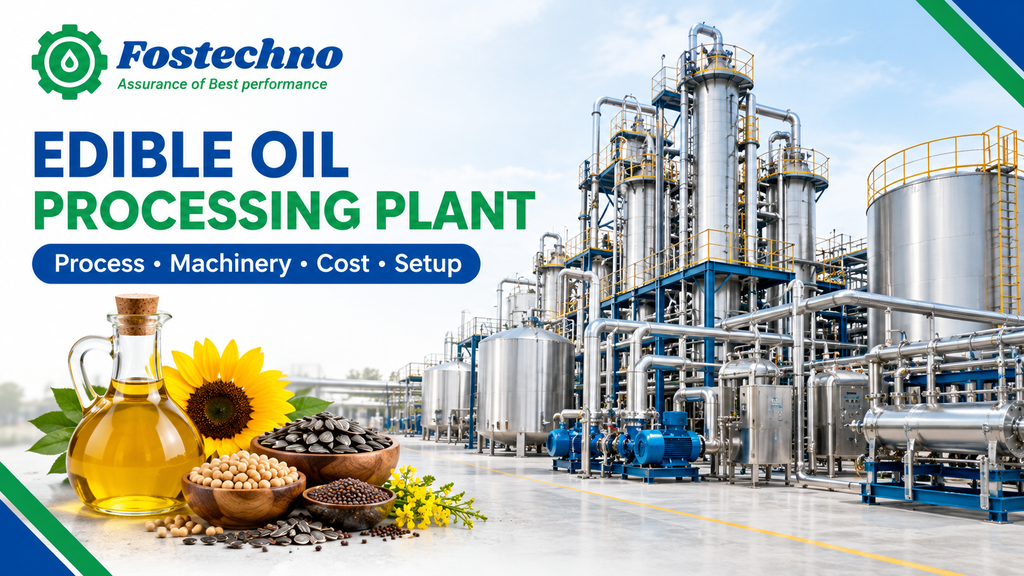
Every kitchen in India uses cooking oil every single day. Very few people ask where that oil actually comes from. Behind every bottle of sunflower, soybean or mustard oil is an edible oil processing plant that turns dusty, unpredictable raw seeds into a clear, stable, safe product.
If you are a trader, an oil mill owner, an investor or a food entrepreneur, that plant may be the most profitable decision you make. It can also be the most expensive mistake if you choose the wrong capacity, technology or partner.
This guide explains how an edible oil processing plant works, stage by stage. It covers the machinery, capacity options, cost drivers, compliance and timelines, plus the mistakes that quietly destroy margins. Read it before you sign any purchase order.
What Is an Edible Oil Processing Plant?
An edible oil processing plant is an integrated industrial facility that converts oilseeds (or crude vegetable oil) into refined, packaged cooking oil. It also recovers valuable by-products such as oilseed meal, lecithin, soapstock and fatty acid distillate.
A complete facility usually has four main sections:
- Seed preparation: cleaning, dehulling, cracking, conditioning and flaking
- Oil extraction: mechanical pressing (expellers) and/or solvent extraction
- Oil refining: degumming, neutralization, bleaching, dewaxing and deodorization
- Packing and storage: filling lines, tanks and warehouse handling
Not every business needs all four sections. Some owners buy crude oil and only refine and pack it. Others crush seeds and sell crude oil. Larger players run the full chain from seed to shelf.
Why Demand for Edible Oil Plants Keeps Growing
Cooking oil is a staple. It is consumed by households, restaurants, bakeries, snack makers and packaged-food companies every day. India also imports a large share of its edible oil, so domestic processing capacity has strong economic and policy support. Population growth, rising incomes and the growth of packaged and branded oils all add to demand.
For a business owner, this means three things:
- Steady demand: oil sells in every economic cycle.
- Multiple revenue lines: refined oil, meal, lecithin, soapstock and fatty acids.
- Brand opportunity: private-label oils earn much better margins than loose commodity trading.
The margin is not automatic, though. It depends heavily on how well the plant is designed and run.
How an Edible Oil Processing Plant Works: The Big Picture
Here is the flow at a glance:
Seed receiving → Cleaning → Preparation → Extraction (Expeller / Solvent) → Crude oil filtration → Degumming → Neutralization → Bleaching → Dewaxing (if required) → Deodorization → Polishing filtration → Storage → Packing
Now let’s walk through each stage in detail.
Stage 1: Seed Receiving and Cleaning
Raw seeds arrive with sand, stones, dust, straw, leaves, metal fragments and broken seeds. If these enter the machines, they wear out equipment, lower oil yield and contaminate the oil.
Typical cleaning equipment includes:
- Vibrating or rotary screen cleaners to remove coarse and fine impurities
- Destoners to separate stones and heavy particles
- Magnetic separators to catch metal pieces before they damage expellers or flakers
- Aspiration systems to lift away light dust and husk
Why it matters: cleaner seed means longer machine life, better oil quality and higher yield. Many plants lose money quietly at this first stage because they under-invest in cleaning.
Stage 2: Seed Preparation
Preparation makes the oil easy to release. The exact steps depend on the seed.
Dehulling and Decorticating
Seeds like sunflower carry a hard hull. Removing it improves oil quality and raises the protein content of the meal. It also increases effective plant capacity. Our detailed guide on oil seed preparation covers this in depth.
Cracking
Cracking rolls break seeds into smaller pieces so that heat and moisture can penetrate evenly.
Conditioning and Cooking
Seeds are heated to a controlled temperature and moisture level. This ruptures oil cells, lowers oil viscosity and prepares the material for pressing or flaking.
Flaking
For solvent extraction, seeds are rolled into thin flakes. Thin flakes have a larger surface area, so the solvent reaches the oil more easily.
Practical tip: poor preparation is one of the biggest hidden causes of high residual oil in meal. A well-designed prep section pays back quickly.
Stage 3: Oil Extraction
This is the heart of the edible oil processing plant. There are two main routes.
Mechanical Pressing (Expeller)
Screw presses squeeze oil out of the prepared seed under pressure. The result is crude oil and press cake.
Best for:
- Mustard, groundnut, sesame, coconut and similar oils
- Small and medium plants
- Businesses that want lower initial investment and simpler operation
Limitation: an expeller leaves a noticeable amount of oil in the cake, so overall recovery is lower than solvent extraction.
Solvent Extraction
Prepared flakes or pre-pressed cake are washed with food-grade hexane in a closed system. The solvent dissolves the oil, and the mixture (called miscella) is then distilled to separate the oil from the solvent. The solvent is recovered and reused.
Best for:
- Soybean, sunflower, rice bran and cottonseed
- Large-scale, high-volume plants
- Businesses focused on maximum yield
Advantage: very low residual oil in the meal, which is significant at scale. To understand the design in detail, read our solvent extraction plant guide.
Expeller vs Solvent Extraction: Quick Comparison
| Factor | Mechanical Expeller | Solvent Extraction |
|---|---|---|
| Typical scale | Small to medium | Medium to large |
| Oil recovery | Moderate | Very high |
| Residual oil in cake/meal | Higher | Very low |
| Initial investment | Lower | Higher |
| Operational complexity | Simple | Requires trained staff and safety systems |
| Suitable seeds | Oil-rich seeds (mustard, groundnut) | Low-oil seeds (soybean) and pre-pressed cake |
| Meal value | Cake for feed | High-quality meal for feed and protein |
Many efficient plants combine both. They pre-press oil-rich seeds like sunflower with an expeller and then solvent-extract the cake for the remaining oil.
Stage 4: Crude Oil Filtration and Storage
Crude oil from extraction carries fine seed particles (foots). These are removed by filtration or settling before the oil goes to storage tanks or straight into refining. Proper crude oil handling prevents quality loss and avoids blocking downstream equipment.
Stage 5: Edible Oil Refining
Crude oil is not fit for cooking. It contains gums, free fatty acids (FFA), pigments, waxes, trace metals and odour compounds. Refining removes them while protecting the oil’s natural stability and nutrition. This is the section where a plant’s quality reputation is made.
Degumming
Degumming removes phospholipids (gums) such as lecithin. The oil is heated and treated with hot water or acid so that gums separate out. Skipping or under-doing this step causes trouble in every later stage. See our degumming plant page for more.
Bonus: recovered gums can be processed into lecithin, a valuable by-product. Learn more about our lecithin plant.
Neutralization (Deacidification)
In chemical refining, free fatty acids are converted into soap using caustic soda. The soap phase (soapstock) is separated from the oil and washed. Soapstock is sold to soap and biodiesel makers. For process details, see our neutralization plant guide.
Bleaching
The oil is mixed with activated bleaching earth under vacuum. The earth adsorbs colour pigments, trace metals, oxidation products and residual gums. The earth is then filtered out through pressure leaf filters, and the oil goes through polish filters. Our bleaching plant guide explains how dosing and temperature affect quality.
Dewaxing and Winterization
Sunflower, corn germ, rice bran and some cottonseed oils contain natural waxes. These make the oil turn cloudy when it is cold or refrigerated. Dewaxing chills the oil so that wax crystals form, and then filters them out. If your customers expect crystal-clear oil in all weather, this step is essential. Read more on dewaxing and winterization.
Deodorization
Deodorization is the final purification step. The oil is heated to a high temperature under deep vacuum, and stripping steam carries away odour compounds, remaining free fatty acids and other volatile substances. This step gives the oil its neutral taste and smell. It also affects shelf life and the level of unwanted process by-products, so design and control matter a great deal. Explore physical refining and deodorization for the full picture.
Physical Refining vs Chemical Refining
This is one of the most important design decisions you will make.
Chemical refining uses caustic soda to remove FFA. It suits oils with low FFA and high gum content, such as soybean, sunflower and rapeseed. It handles crude oil that varies in quality.
Physical refining removes FFA by steam distillation during deodorization, so no caustic soda is used. It suits high-FFA oils like palm and rice bran. It typically generates less effluent and can lower oil losses, but it needs excellent pre-treatment because gums and metals must be removed before deodorization.
| Parameter | Chemical Refining | Physical Refining |
|---|---|---|
| Best for | Soft oils with low FFA | High-FFA oils (palm, rice bran) |
| FFA removal | Caustic soda neutralization | Steam stripping in deodorizer |
| Soapstock | Generated | Not generated |
| Effluent load | Higher | Lower |
| Pre-treatment need | Standard | Very strict |
| Flexibility with variable crude | Better | Lower |
Rule of thumb: let your crude oil quality decide the route. Always send crude samples for laboratory analysis before finalizing technology.
Batch vs Continuous Refining
The second big design choice is how the oil moves through the plant.
| Feature | Batch Refinery | Continuous Refinery |
|---|---|---|
| Typical capacity | Small (roughly up to 25 TPD) | Medium to large (30 TPD and above) |
| Operation | Manual, batch by batch | Automated, continuous flow |
| Quality consistency | Varies with operator | Highly consistent |
| Manpower | Higher | Lower |
| Heat recovery | Limited | High, through heat exchangers |
| Utility and chemical use | Higher per ton | Lower per ton |
| Initial investment | Lower | Higher |
| Long-term operating cost | Higher | Lower |
Batch plants are a sensible starting point for small businesses and pilot operations. Continuous plants make more sense once volumes grow, because lower operating costs and stable quality compound over years.
Stage 6: Packing, Storage and By-Products
Packing
Refined oil goes to storage tanks and then to filling lines. Common formats include:
- Retail pouches
- PET bottles and jars
- Tins and jerry cans
- Bulk drums and tankers for industrial buyers
Automatic filling, weighing and sealing lines reduce give-away, spillage and labour.
By-Products That Add to Profit
A well-run edible oil processing plant treats by-products as revenue, not waste:
- Oilseed meal or cake: animal and poultry feed, or protein products
- Lecithin: from degumming gums, used in food, feed and industry
- Soapstock and acid oil: for soap and biodiesel
- Fatty acid distillate: for oleochemicals, animal feed and tocopherol recovery
- Wax: from dewaxing, used in industrial applications
- Spent bleaching earth: can be processed for oil recovery in some cases
Businesses that plan by-product handling from day one earn noticeably better returns than those that treat it as an afterthought.
Which Oils Can an Edible Oil Processing Plant Handle?
| Oil | Common Extraction | Typical Refining Notes |
|---|---|---|
| Soybean | Solvent extraction | Chemical refining; strong lecithin recovery |
| Sunflower | Pre-press + solvent | Dewaxing usually needed |
| Mustard / Rapeseed / Canola | Expeller (often pre-press + solvent at scale) | Chemical refining |
| Groundnut | Expeller | Mild refining or filtered; refined variants available |
| Rice bran | Solvent extraction | High FFA; physical refining and dewaxing |
| Cottonseed | Pre-press + solvent | Needs gossypol handling; dewaxing in cooler markets |
| Palm | Milling at source, then refining | Physical refining; fractionation possible |
| Corn germ | Pre-press + solvent | Dewaxing typically required |
A flexible plant design can handle more than one oil. That protects you when raw material prices swing between seasons.
Choosing the Right Plant Capacity
Capacity is measured in tons per day (TPD) of seed processed or oil refined. Choosing wrongly is expensive both ways.
| Capacity | Typical User | Typical Configuration |
|---|---|---|
| 5–20 TPD | Startups, local brands, traders entering manufacturing | Expeller and batch/semi-continuous refinery |
| 20–50 TPD | Regional brands | Pre-treatment, pressing, continuous refinery |
| 50–100 TPD | Growing manufacturers | Pre-press and solvent extraction plus continuous refinery |
| 100–500+ TPD | Large commercial and industrial players | Fully integrated seed-to-pack plants |
Before finalizing, answer these questions:
- How much raw material can you reliably source within a reasonable distance?
- What market volume can you actually sell in the first two years?
- Do you plan to expand later? If so, design the layout and utilities with expansion space.
- Will you run one oil or several?
Oversizing leaves expensive equipment idle. Undersizing forces a costly expansion within a few years.
Main Machinery in an Edible Oil Processing Plant
- Seed handling: hoppers, conveyors, elevators
- Cleaning: vibrating screens, destoners, magnetic separators
- Preparation: decorticators and dehullers, crackers, conditioners, flaking mills
- Extraction: expellers, extractor, desolventizer-toaster, distillation and solvent recovery
- Meal handling: meal dryers, coolers, bagging systems (see meal cooling and bagging)
- Refining: degumming reactors, neutralizers, centrifugal separators, bleachers, pressure leaf filters, crystallizers, deodorizer, vacuum system, heat exchangers
- Utilities: boiler, thermic fluid heater, cooling tower, chilled water, compressed air, water treatment plant
- Effluent treatment plant
- Automation and control: PLC or DCS systems and instrumentation
- Packing: filling, capping, labelling and carton packing lines
- Storage: crude, refined and intermediate tanks; seed and meal storage
Edible Oil Processing Plant Cost: What Decides Your Investment
There is no single price for an edible oil processing plant. Two plants with identical capacity can differ hugely in investment. The main cost drivers are:
1. Capacity and scope. Refinery only, pressing only, or the full chain from seed to pack.
2. Extraction route. Solvent extraction needs more equipment, safety systems and civil work than a simple expeller line.
3. Refining technology. Batch or continuous, chemical or physical.
4. Level of automation. A fully automated plant costs more up front but lowers labour cost and gives consistent quality.
5. Materials of construction. Stainless steel grades and equipment quality affect both price and lifespan.
6. Utilities. Boiler, thermic fluid system, cooling and effluent treatment can be a significant share of the project.
7. Civil and infrastructure. Land preparation, buildings, foundations, roads, storage and warehouse.
8. Statutory and compliance needs. Licences, safety systems and environmental clearances.
Indicative ranges seen in the market: small plants of around 5 TPD are often quoted in the range of several lakh rupees up to about ten lakh, while medium plants of 10–30 TPD commonly move into the tens of lakhs and higher, depending on automation. Large plants of 50 TPD and above run into crores. Treat these numbers only as rough guidance. Actual pricing depends on scope, technology and current equipment costs, so always request a detailed technical and commercial proposal.
Capital Cost vs Operating Cost
A cheaper machine is not always the cheaper decision. Compare suppliers on the total cost of ownership:
- Steam and power consumption per ton
- Chemical and bleaching earth consumption
- Refining loss and oil recovery
- Manpower needs
- Maintenance cost and spare parts availability
A slightly costlier plant that saves even a small percentage of oil loss or utilities can recover the extra price quickly.
Utilities, Environment and Safety
Utilities
Reliable steam, power, water and cooling are non-negotiable. Heat recovery through regenerative heat exchangers cuts energy use significantly.
Effluent Treatment
Refining produces wastewater containing oil, soap and chemicals. An effluent treatment plant is both a legal necessity and a community-relations issue.
Solvent Safety
If you use solvent extraction, safety design is critical. This includes solvent-proof electricals, gas detection, proper grounding, fire-fighting systems, controlled solvent storage and trained operators. Choose engineers who treat safety as a core design principle, not an add-on.
Licences and Compliance (India)
Requirements vary by state and project type, but typically include:
- Factory registration and local approvals
- Pollution control board consent
- FSSAI licence for edible oil manufacturing and packing
- Boiler approval and inspection
- Permissions for solvent or hazardous material storage where applicable
- GST and other business registrations
Always confirm current requirements with your state authorities and consultants before construction.
Timeline: How Long Does It Take to Set Up an Edible Oil Processing Plant?
Timelines depend on size and scope, but a typical project looks like this:
| Phase | Typical Duration |
|---|---|
| Feasibility and market study | 2–4 weeks |
| Process design and engineering | 4–8 weeks |
| Equipment fabrication | 8–16 weeks |
| Civil work (parallel) | Runs alongside fabrication |
| Installation and erection | 4–12 weeks |
| Commissioning and trials | 2–6 weeks |
Small plants can be commissioned in a few months, while large integrated projects may take a year or more. Starting civil work and statutory approvals early is the best way to avoid delays.
What Drives Profit in an Edible Oil Processing Plant?
Oil recovery. Even a fractional improvement in yield adds up to a large annual gain on high volumes.
Refining loss. Poor degumming, neutralization or bleaching increases oil losses directly.
Energy efficiency. Steam and power are among the biggest operating costs after raw material.
By-product sales. Meal, lecithin, soapstock and distillate can meaningfully improve returns.
Plant uptime. Preventive maintenance and spare parts availability keep production running.
Raw material buying. Buying seed at the right time and holding sensible stock protects margins.
Brand and packaging. Private-label oil gives better realization than bulk commodity sales.
Common Mistakes to Avoid
- Choosing capacity without checking raw material supply. A large plant with insufficient seed supply loses money every day.
- Skipping laboratory trials. Every crude oil behaves differently. Test before you design.
- Ignoring pre-treatment. Weak degumming or cleaning shows up as high losses and poor colour later.
- Buying the cheapest machine. Low price often hides high operating cost and weak after-sales support.
- No plan for by-products. Unsold meal or soapstock blocks cash flow.
- Underestimating utilities and effluent treatment. These are essential and expensive to fix later.
- Untrained operators. Even the best plant underperforms without skilled people.
- Ignoring future expansion. Layout and utilities should allow growth.
How to Choose the Right Edible Oil Processing Plant Manufacturer
Use this checklist when you evaluate suppliers:
- Process expertise: can they design for your specific oil and crude quality?
- Turnkey capability: do they handle engineering, manufacturing, installation and commissioning?
- In-house fabrication: this improves quality control and delivery timelines.
- Performance guarantees: ask for written guarantees on oil loss, colour, FFA, utilities and capacity.
- Reference plants: visit installations, talk to operators and check how the plant runs after years of use.
- Safety standards: especially critical for solvent extraction.
- After-sales support: spare parts, remote support, operator training and service visits.
- Transparent documentation: P&IDs, layout drawings, equipment lists and clear scope.
A reliable partner reduces project risk, shortens commissioning time and protects your margins for years.
Why Business Owners Choose FOSTECHNO for Edible Oil Plants
FOSTECHNO Process & Engineering Private Limited designs and supplies complete process plants for the edible oil and fats industry. Our solutions include:
- Solvent extraction: oil seed preparation, solvent extraction plants and meal cooling and bagging
- Oil refinery: degumming, neutralization, bleaching, dewaxing and winterization, physical refining and deodorization
- Fat modification: interesterification, hydrogenation and dry fractionation of palm oil
- Value addition: lecithin plants, bakery shortening and margarine and CBS from palm kernel oil
- Oleochemical plants: fat splitting, glycerine refining, fatty acid distillation and biodiesel
Whether you are a trader planning your first refinery or an established processor upgrading capacity, we work with you from feasibility and process design through installation, commissioning and operator training. If you are still deciding between trading and manufacturing, our guide on how sellers can move from trading to manufacturing and our edible oil refinery plant guide are good next reads.
Talk to our engineers: info@fostechnos.com | +91 96961 77472 | WhatsApp
Frequently Asked Questions
1. What is an edible oil processing plant?
It is a facility that cleans, prepares and extracts oil from seeds, then refines and packs it into safe cooking oil. It may also include by-product recovery.
2. What is the difference between an oil mill and an edible oil refinery?
An oil mill extracts crude oil from seeds. A refinery purifies crude oil into edible-grade oil. Many businesses combine both in one edible oil processing plant.
3. Which is better, expeller or solvent extraction?
Expellers suit small and medium plants and oil-rich seeds. Solvent extraction gives much higher recovery and suits large plants and low-oil seeds like soybean. Many plants combine pre-pressing with solvent extraction.
4. What are the main steps of edible oil refining?
Degumming, neutralization (in chemical refining), bleaching, dewaxing (for certain oils) and deodorization.
5. Which refining method is better, physical or chemical?
It depends on the oil. High-FFA oils like palm and rice bran suit physical refining. Low-FFA, high-gum oils like soybean and sunflower usually suit chemical refining.
6. What is a good starting capacity for a new plant?
Small startups often begin at 5–20 TPD, while regional brands commonly choose 20–50 TPD. The right choice depends on raw material supply, market demand and budget.
7. How much does an edible oil processing plant cost?
Cost depends on capacity, scope, technology, automation and utilities. Small plants can cost a few lakh to around ten lakh rupees, medium plants tens of lakhs and above, and large plants crores. Get a detailed proposal for accurate figures.
8. How long does it take to build a plant?
Small plants can be ready in a few months. Large integrated projects can take a year or longer.
9. Can I start with only refining and packing?
Yes. Many traders buy crude oil, refine and pack it, then add extraction later.
10. What by-products can I sell?
Oilseed meal, lecithin, soapstock, acid oil, fatty acid distillate and wax.
11. Is solvent extraction safe?
Yes, when the plant is designed, built and operated with proper safety systems and trained staff.
12. Can one plant process multiple oils?
Yes, with a flexible design. Some oils need extra steps like dewaxing, so discuss your full oil range with your engineer at the design stage.
Conclusion
A successful edible oil processing plant is more than a set of machines. It is a carefully engineered system where seed preparation, extraction, refining and utilities all work together. When capacity, technology and by-product plans match your raw material and market, the plant delivers consistent quality, healthy margins and a brand you can grow for decades. When they don’t, small design errors turn into large daily losses.
The best time to fix mistakes is before the first piece of equipment is ordered. Start with clear numbers on raw material supply and market demand, test your crude oil, choose technology for your product mix, and work with an engineering partner who will stay with you long after commissioning.
Now a question for you as a business owner: is your current oil business earning the margin it should, or is it time to build a plant that gives you control over quality, cost and your own brand?
Share your capacity target and oil type with the FOSTECHNO team, and we will help you plan the right edible oil processing plant for your business.



Leave a Reply