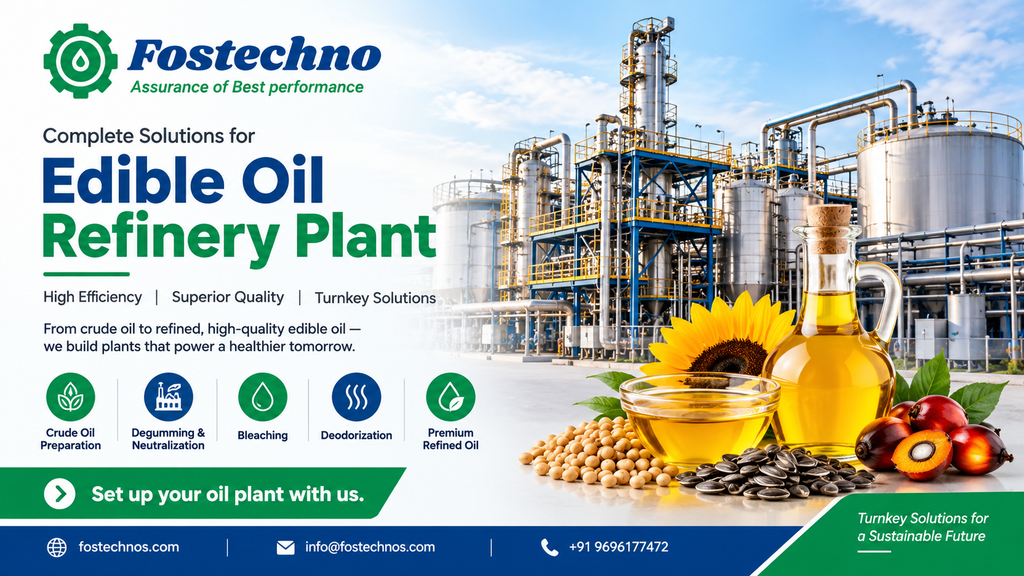
By the engineering team at FOSTECHNO Process & Engineering Private Limited
What Is an Edible Oil Refinery Plant?
An edible oil refinery plant is an industrial facility that converts crude vegetable oil into clear, stable, safe cooking oil by removing gums, free fatty acids, pigments, odours, waxes and other impurities. The core steps are degumming, neutralization, bleaching and deodorization, with dewaxing (winterization) and fractionation added for certain oils.
The result is oil with a light colour, neutral taste, long shelf life and a composition that meets food safety standards.
At FOSTECHNO Process & Engineering Private Limited, we design and build refinery plants, and this guide reflects what we see on real plant floors: how the process works, what equipment matters, what drives cost, and where new investors most often lose money. Whether you run an oil mill, plan to enter the edible oil business, or are comparing suppliers, use it as a working reference.
Why Crude Oil Cannot Be Sold as It Is
Crude oil from an expeller, cold press or solvent extraction plant is dark, cloudy and often smelly. It carries several groups of unwanted substances:
Phospholipids (gums). These make oil cloudy, cause foaming and darkening on heating, and settle out during storage.
Free fatty acids (FFA). They form when seeds are damaged, wet or enzyme-active. High FFA gives a sharp, soapy taste and speeds up spoilage.
Pigments. Chlorophyll, carotenoids and gossypol give green, red or brown tones that consumers reject.
Odour and flavour compounds. Aldehydes, ketones and other volatiles create the raw, beany smell.
Waxes. Sunflower, rice bran and corn oil carry natural waxes that turn oil hazy in cool weather.
Trace metals and oxidation products. Iron and copper accelerate rancidity, and peroxides signal that oxidation has already started.
Other contaminants. Depending on source and handling, crude oil may hold soap traces, pesticide residues or polycyclic aromatic hydrocarbons.
A good refinery removes these while losing as little neutral oil as possible and, where practical, keeping useful nutrients such as vitamin E.
Which Oils Can an Edible Oil Refinery Plant Process?
Most refineries are designed as multi-seed plants. Common oils include soybean, sunflower, palm and palm olein, rapeseed (canola) and mustard, groundnut, cottonseed, rice bran, corn, sesame, coconut, palm kernel and safflower.
Each oil behaves differently:
- Palm oil is low in gums but high in FFA and carotene, so it is usually physically refined.
- Soybean oil is rich in phospholipids and needs strong degumming.
- Rice bran oil contains wax and oryzanol and needs careful dewaxing.
- Cottonseed oil needs specific treatment to handle gossypol pigments.
- Sunflower oil needs effective dewaxing to stay clear in cool conditions.
A plant tuned for one oil often performs poorly on another, so decide early whether you need flexibility. If you do, the design must be multi-oil from day one, not patched later.
The Edible Oil Refining Process, Step by Step
Exact settings vary with oil type and equipment, but the sequence is broadly the same everywhere.
Step 1: Pre-Treatment and Degumming
Crude oil is first filtered and heated to remove dirt, meal particles and moisture. Degumming then removes phospholipids by one of three methods:
- Water degumming. Hot water (roughly 2–3% of oil weight) is mixed in at about 60–80°C. Hydratable gums swell, become heavy and are removed by centrifuge. This removes only the hydratable fraction.
- Acid degumming. Phosphoric or citric acid converts non-hydratable phospholipids into a removable form. It is widely used for soybean, sunflower and rapeseed oil.
- Enzymatic degumming. Phospholipase enzymes break down stubborn gums and can improve oil yield. Upfront cost is higher, but oil loss is often lower.
The recovered gums are not waste. Lecithin from soybean and sunflower gums is a valuable product for food, feed and pharma uses.
Step 2: Neutralization (Chemical Refining)
Neutralization removes free fatty acids. Caustic soda (sodium hydroxide) reacts with FFA to form soap, called soapstock, which is separated by centrifuge. The oil is then washed with hot water to remove residual soap and dried under vacuum.
Dosing is critical. Too little caustic leaves FFA behind. Too much saponifies neutral oil and raises losses. Skilled operators calculate the dose from lab titration of each batch, not from habit.
Step 3: Bleaching
Bleaching does not use chemical bleach. Oil is heated (typically about 90–110°C) under vacuum and mixed with bleaching earth, a natural or acid-activated clay, sometimes with a little activated carbon.
The clay adsorbs pigments, soap traces, phosphorus, metals and oxidation products. Dosage typically falls between 0.5% and 2% of oil weight, depending on crude quality and target colour. The mixture then passes through a filter, commonly a pressure leaf filter, which separates clean oil from spent earth.
Two practical points:
- Vacuum during bleaching protects oil from oxidation at high temperature.
- Spent earth holds a meaningful amount of oil, so recovering it can noticeably improve plant economics.
Step 4: Deodorization
Deodorization is the final and most energy-intensive stage. It is steam distillation: oil is heated to high temperature (often around 230–270°C) under strong vacuum (a few millibar) while stripping steam passes through it.
Volatile compounds, including remaining FFA, aldehydes and ketones, are carried away. This gives oil its neutral taste and smell, and heat also breaks down some remaining pigments.
Modern deodorizers use structured packing, tray designs and heat recovery to cut steam and energy use. Temperature and residence time matter because excessive heat can create unwanted compounds such as trans fatty acids, 3-MCPD esters and glycidyl esters. Good design keeps temperature and time as low as the quality target allows.
Step 5: Winterization and Dewaxing
Oils rich in wax or high-melting fractions turn cloudy when cooled, which is typical of sunflower, rice bran, corn and cottonseed oil. Winterization cools the oil slowly so wax and stearin crystals form, then filters them out. The finished oil stays clear in a refrigerator or cool climate.
Step 6: Fractionation (Optional)
Fractionation separates oil into liquid (olein) and solid (stearin) fractions by controlled crystallization. Palm oil is the best-known case: olein is sold as liquid cooking oil, while stearin goes to shortening, margarine and soap applications.
Step 7: Polishing, Blending and Storage
After deodorization, oil is cooled, polish-filtered and often protected with permitted antioxidants or nitrogen blanketing. It is then stored in stainless steel or suitably lined tanks, ready for packing.
Note: Hydrogenation and interesterification (for vanaspati, shortening and margarine fats) are separate processes with their own equipment and safety needs, and fall outside a standard liquid-oil refinery.
Physical Refining vs Chemical Refining
This is one of the most important design choices, and one of the most searched questions about edible oil refining.
| Feature | Chemical Refining | Physical Refining |
|---|---|---|
| FFA removal | Caustic soda neutralization | Steam stripping in deodorizer |
| By-product | Soapstock | Fatty acid distillate (FAD) |
| Best for | High-gum oils (soybean, sunflower, rapeseed) | Low-gum, high-FFA oils (palm, coconut, well-degummed rice bran) |
| Pre-treatment need | Standard degumming | Very thorough degumming and bleaching |
| Neutral oil loss | Usually higher | Usually lower |
| Main chemicals | Caustic soda, acid | Mainly acid and bleaching earth |
| Effluent load | Higher (soapy water) | Lower |
Chemical refining is more forgiving of poorer crude. Physical refining is cleaner and can be more economical, but only if pre-treatment is excellent. Many modern plants are built as dual-route plants so operators can respond to crude quality and market conditions.
Batch, Semi-Continuous and Continuous Refineries
| Type | Typical capacity | Best for | Advantage | Limitation |
|---|---|---|---|---|
| Batch | About 1–30 tons/day | Startups, small brands, trials | Low investment, simple operation | More labour, more oil loss, less consistency |
| Semi-continuous | About 30–100 tons/day | Growing mills | Balance of cost and performance | Some manual handling |
| Fully continuous | About 100 to 1,000+ tons/day | Large refiners | Highest efficiency, lowest cost per ton, consistent quality | High capital cost, needs skilled team |
These boundaries are approximate, and suppliers describe them differently. What matters is matching the design to your real, sustainable throughput, not the largest plant you can afford.
Main Machinery in an Edible Oil Refinery Plant
A complete plant typically includes:
- Crude oil receiving and storage tanks
- Degumming reactor and mixing system
- Centrifugal separators for gum and soapstock
- Neutralizer with agitator and heating coils
- Washing and drying vessels
- Bleaching vessel with vacuum system
- Bleaching filters (pressure leaf or candle)
- Deodorizer or stripping column with heat exchangers
- Vacuum system (steam ejectors, liquid-ring pumps or dry systems)
- Winterization crystallizers and filters
- Polish filters
- Heat exchangers and economizers
- Boiler and, often, a thermic fluid heater
- Cooling tower and chilled water unit
- Effluent treatment system
- PLC control panel and instrumentation
- Finished oil storage and packing line
Contact surfaces are usually stainless steel (SS304 or SS316 depending on the section). The deodorizer and hot-oil sections deserve the best grade because of temperature and corrosion.
How to Choose the Right Plant Capacity
Capacity is a business decision as much as an engineering one. Ask:
- How much crude oil can you source reliably? A plant running at 40% because supply is short loses money however efficient it is.
- How much can you sell at a fair margin? Match capacity to your market plus a growth buffer.
- One oil or many? Multi-oil plants need flexible design and careful cleaning between runs.
- How many shifts will you run? A 24-hour plant behaves very differently from an 8-hour one.
- What is your expansion plan? Leaving space and utility headroom for later capacity is far cheaper than replacing a plant.
A useful rule: design for the volume you will actually achieve in year two, with room to grow, not the volume you hope for in year ten.
Utilities, Layout and Site Requirements
A refinery is only as good as its supporting systems. Plan these before buying machinery:
Steam. Heating and stripping need steady steam at adequate pressure. Boiler size, fuel type (coal, biomass, gas, oil) and emission rules all matter.
Electricity. Pumps, centrifuges, vacuum systems and controls are significant loads. Check connected load, backup power and power factor.
Water. Process, boiler feed and cooling water needs are substantial, and water quality affects boiler life and washing performance.
Vacuum and cooling. Bleaching and deodorization depend on stable vacuum. A leaking or undersized vacuum system quietly ruins quality and raises steam use.
Effluent treatment. Refining produces soapy, oily wastewater with a high organic load. A properly sized treatment plant is a legal requirement in most places and protects your licence to operate.
Layout and safety. Follow the process flow, keep hot and cold sections manageable, allow maintenance access, and include fire protection, ventilation and safe storage for caustic soda and phosphoric acid.
Civil work. Foundations, oil-resistant flooring, drainage and tank bunding are easy to underestimate and expensive to fix later.
By-Products of Edible Oil Refining
Treat by-products as products, because they can reduce your net refining cost:
- Soapstock and acid oil. Soapstock is acidulated into acid oil, sold to soap makers, feed manufacturers and biodiesel producers.
- Fatty acid distillate (FAD). From physical refining, used in feed, soap, oleochemicals and biodiesel.
- Lecithin. Recovered from gums and sold to food, feed and pharma users.
- Spent bleaching earth. Contains recoverable oil. Store it carefully, since it can self-heat, and dispose of it according to local rules.
- Wax and stearin. Recovered from dewaxing and fractionation for cosmetics, coatings and food uses.
Quality Control and Food Safety Standards
A refinery without a proper laboratory is running blind. At minimum, measure:
- Free fatty acid (FFA)
- Colour (Lovibond scale)
- Peroxide value (PV)
- Moisture and volatile matter
- Phosphorus content after degumming
- Soap content after neutralization
- Iodine value and melting point
- Contaminants and trans fat where required
In India, edible oils fall under the FSSAI framework and manufacturers need appropriate licensing. Exporters must meet destination-country rules, and buyers often ask for ISO 22000, HACCP or FSSC 22000 certification. Regulations change, so confirm current limits with your regulator.
Best practice is to test at every stage, not just finished oil. Checking after degumming, after bleaching and before deodorization lets you fix problems while they are still cheap.
What Does an Edible Oil Refinery Plant Cost?
Anyone who quotes one price without asking questions is guessing. Cost depends on:
- Capacity (tons per day)
- Automation level (manual, semi-automatic, PLC)
- Process route (chemical, physical or dual)
- Number of oils it must handle
- Material grade (SS304 vs SS316) and insulation
- Energy recovery features
- Effluent treatment and compliance systems
- Land, building, boiler, utilities and installation
- Duties, freight and taxes
A small batch plant costs a fraction of a large continuous plant, and the gap can be an order of magnitude or more. Treat any online figure as indicative only, and request itemised quotations based on your oil, capacity and site.
The Costs People Forget
- Working capital for buying crude oil, usually the largest ongoing need
- Licences, approvals and consultants
- Laboratory equipment and skilled staff
- Packing line and storage
- Boiler fuel and utility connections
- Spare parts and maintenance
- Operator training
What Drives Profit
Refinery margin per kilogram is thin, so discipline matters:
- Refining loss. Each extra 1% of neutral oil lost is money leaving the plant.
- Energy per ton. Steam and power are major operating costs.
- Bleaching earth and chemical consumption.
- Crude sourcing. Buying well and timing purchases matter as much as running well.
- By-product sales.
- Uptime. A stopped plant earns nothing.
How to Choose an Edible Oil Refinery Plant Manufacturer
The supplier is the decision you will live with longest. Use this checklist:
- Proven references. Ask for running plants of similar capacity and oil type, and visit one if possible. Talk to operators, not only owners.
- Written process guarantees. Steam, power, bleaching earth, chemical use, refining loss and oil quality should be stated in the offer.
- Engineering depth. Ask who designs the deodorizer and vacuum system, the most critical and most often poorly executed parts.
- Material and build quality. Request material certificates and fabrication standards.
- Automation. PLC/SCADA reduces operator error and gives repeatable quality.
- After-sales support. Commissioning, training, spares and response time matter more than a slightly lower quotation.
- Transparent quotation. An itemised scope prevents “extras” later.
- Compliance support. A good partner helps with layout for approvals, effluent design and safety norms.
Be cautious of anyone who promises unrealistic yield, claims one plant handles every oil without modification, or will not show a working installation.
Why Choose FOSTECHNO Process & Engineering for Your Refinery Plant
Every point in the checklist above is something we build our projects around at FOSTECHNO Process & Engineering Private Limited:
- Custom-designed plants. We size the refinery to your crude quality, oil type and daily capacity, not to a fixed catalogue model.
- Chemical, physical or dual-route design. You can respond to crude price and quality without rebuilding the plant.
- Turnkey scope. Process design, fabrication, installation, commissioning and operator training from one team.
- Performance data in writing. Consumption and loss figures are stated in the offer, not left vague.
- Utilities and compliance support. Boiler, vacuum, effluent treatment and layout planning for approvals.
- After-sales service. Spare parts, maintenance support and troubleshooting after commissioning.
- [Add real strengths: number of plants installed, capacity range, years of experience, certifications, countries served.]
Planning a refinery? Share your oil type, daily capacity, and location with our engineers, and we will suggest a suitable process route.
Common Mistakes When Setting Up a Refinery
1. Buying oversized capacity. Running far below rated capacity raises unit cost and wastes energy.
2. Ignoring crude quality. A refinery cannot economically fix badly damaged oil. Set clear purchase specifications.
3. Skimping on degumming. Weak pre-treatment causes problems through bleaching and deodorization, especially in physical refining.
4. Weak vacuum system. Poor vacuum raises deodorization temperature and steam use and hurts quality.
5. No effluent plan. A regulatory shutdown costs far more than proper treatment.
6. Untrained operators. Refining is chemistry as much as machinery. A working lab and skilled operators repay their salaries many times.
7. Neglecting maintenance. Filter cloths, gaskets, pumps and heat exchangers need scheduled care.
8. Choosing on price alone. The cheapest quotation often becomes the most expensive plant after years of high consumption and downtime.
Trends Shaping Modern Edible Oil Refining
Lower contaminants. Buyers and regulators increasingly watch 3-MCPD esters and glycidyl esters. Milder deodorization, better bleaching and careful crude selection help.
Energy efficiency. Heat recovery, better vacuum systems and optimised steam use cut cost and emissions.
Automation and data. Real-time monitoring and PLC control reduce variation and simplify audits.
Gentler processing. Enzymatic degumming and other mild techniques can improve yield and reduce chemical use.
Sustainability. Buyers ask more about traceable sourcing, waste handling and carbon footprint.
Flexible plants. With volatile crude prices, plants that switch between oils and between chemical and physical routes are especially valuable.
Frequently Asked Questions
What is an edible oil refinery plant?
It is an industrial facility that purifies crude vegetable oil by removing gums, free fatty acids, pigments, odours, waxes and other impurities, producing clear, stable, safe oil for cooking and food manufacturing.
What are the main steps in edible oil refining?
The core steps are degumming, neutralization (or physical FFA stripping), bleaching and deodorization. Depending on the oil, winterization and fractionation may also be included.
What is the difference between physical and chemical refining?
Chemical refining removes free fatty acids with caustic soda and creates soapstock. Physical refining removes them by steam distillation in the deodorizer and yields fatty acid distillate. Physical refining suits low-gum, high-FFA oils like palm, while chemical refining suits high-gum oils like soybean and sunflower.
How long does refining take?
In a continuous plant, oil passes through all stages within a few hours. Batch plants take longer per lot because each stage finishes before the next begins.
What capacity should a beginner choose?
Many beginners start with a small batch or semi-continuous plant and scale up as supply and market grow. Choose based on reliable crude supply and sales volume, not the largest plant you can finance.
Is refined oil less healthy than unrefined oil?
Refining removes impurities and gives longer shelf life and a higher smoke point, but it also reduces some natural compounds such as certain antioxidants. The healthier choice depends on how you use the oil and its fatty acid profile, not only the refining method.
Why does deodorization need such high temperatures?
Heat under vacuum lets volatile odour and taste compounds evaporate and be carried off by steam. The vacuum makes this possible at temperatures the oil can tolerate, and good design keeps heat exposure as short and low as quality permits.
What is soapstock and what happens to it?
Soapstock is the soap formed when caustic soda neutralizes free fatty acids. It is separated from the oil and usually acidulated into acid oil for soap, feed and biodiesel use.
Can one plant refine different oils?
Yes, many plants are built for multiple oils, but each oil has its own requirements. Multi-oil operation needs flexible design, careful cleaning between oils and operators who understand each oil.
What licences are needed to run a refinery?
Requirements vary by country and state. Typically you need business registration, food safety licensing (FSSAI in India), pollution control approval, factory and fire safety permissions, and boiler certification. Check with local authorities before investing.
How can I reduce refining loss?
Start with better crude quality, precise degumming and caustic dosing, efficient centrifuge separation, good bleaching earth management, and oil recovery from soapstock and spent earth. Regular lab checks and trained operators make the biggest difference.
How much space does a refinery need?
It depends on capacity, layout and whether storage, boiler and effluent treatment are on site. Small plants fit in a modest industrial shed, while large continuous refineries need substantial land for tanks, utilities and expansion.
Who can supply a turnkey edible oil refinery plant in India?
FOSTECHNO Process & Engineering Private Limited designs and supplies edible oil refinery plants, including process engineering, equipment manufacturing, installation and commissioning. [Add capacity range and location.]
How do I get a quotation from FOSTECHNO?
Share your oil type, required capacity (tons per day), crude quality and site details through the contact page, phone or email. Our engineers will prepare a technical proposal and itemised quotation.
Final Thoughts
An edible oil refinery plant is more than tanks and pumps. It is a chain of chemistry, engineering and operating discipline in which each stage protects the next. Good degumming makes bleaching easier. Good bleaching makes deodorization gentler. Good deodorization gives oil customers trust.
If you take one lesson from this guide, let it be this: match the plant to your crude, your market and your team. Choose realistic capacity, insist on a strong vacuum and effluent system, verify references before signing, and treat quality control and by-products as part of the business.
FOSTECHNO Process & Engineering Private Limited helps you choose the right capacity, process and layout, from a small batch refinery to a fully continuous plant. Contact us today to discuss your project.



Leave a Reply