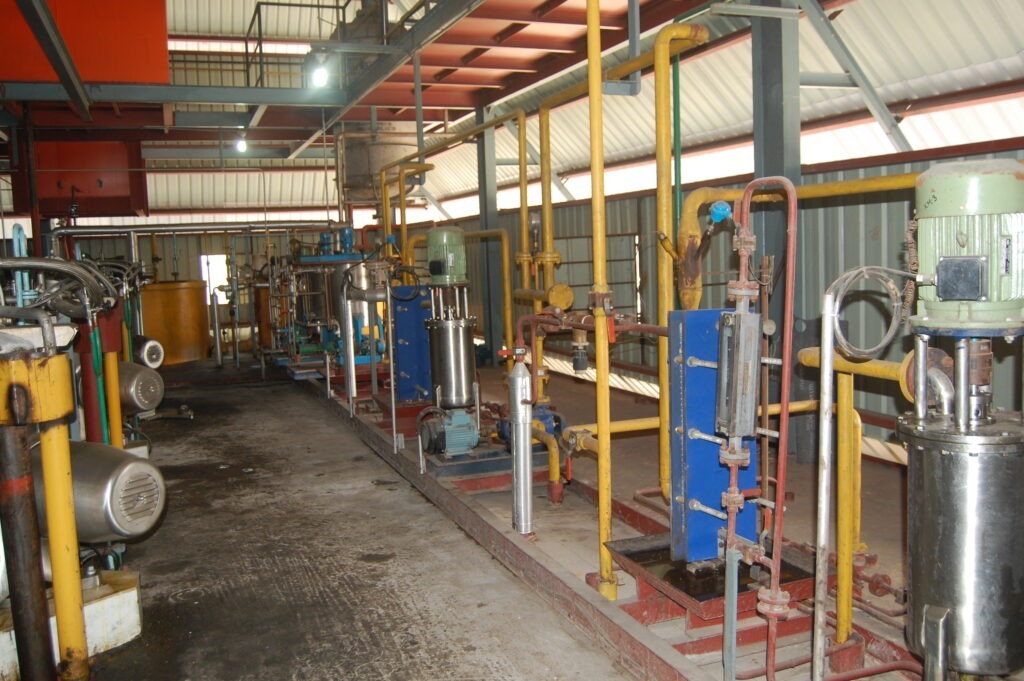
If you’ve spent any time around an edible oil refinery, a chemical processing unit, or an effluent treatment facility, you’ve probably heard the word “neutralization” thrown around like it’s a minor housekeeping step. It isn’t. Get this stage wrong, and you’re looking at oxidized oil, corroded pipework, failed effluent norms, or a batch that simply doesn’t meet spec — and none of that is cheap to fix after the fact.
I’ve spent close to a decade and a half around process plants — some in edible oil refining, some in chemical manufacturing, a few in wastewater compliance — and the pattern is always the same. Plant owners either treat neutralization as an afterthought during the design phase, or they over-engineer it and blow their capex budget on automation they don’t need yet. Both mistakes are avoidable if you understand what the process is actually doing.
This guide walks through what a neutralization plant actually does, how the process works step by step, what equipment matters and why, what it costs to build one, how long it takes to pay for itself, and the mistakes that trip up first-time investors most often. Whether you’re evaluating a neutralization system for an edible oil refinery or an acid neutralization system for chemical effluent, the underlying engineering logic is similar — I’ll flag the differences where they matter.
What Is a Neutralization Plant, Really?
At its core, a neutralization plant is a processing unit designed to bring a substance from an undesirable acidic or alkaline state to a stable, usable, or dischargeable state — usually by reacting it with a counter-agent under controlled conditions.
Two industries use this term most often, and it’s worth being precise about which one you mean:
- Edible oil refining — Here, “neutralization” refers to removing free fatty acids (FFAs) from crude vegetable oil using an alkali, typically caustic soda (sodium hydroxide). This is one of the earliest and most critical stages of the refining process, sitting right after degumming and before bleaching.
- Chemical and wastewater treatment — Here, an acid neutralization system treats effluent with a pH outside the permissible discharge range (usually 6–9), dosing it with acid or alkali until it’s compliant.
Both share the same chemistry principle — acid plus base yields a neutral salt and water — but the equipment, dosing precision, and scale differ quite a bit. Since a large share of buyers searching for this topic are evaluating oil refinery projects, I’ll use edible oil neutralization as the primary example throughout, with effluent-side notes where the two diverge.
The Problem: Why Crude Oil (or Effluent) Can’t Skip This Step
Crude vegetable oil straight out of the expeller or solvent extraction plant isn’t fit for consumption. It carries free fatty acids, phospholipids, trace metals, and color bodies. Free fatty acids in particular are a problem for three reasons:
- They lower the smoke point of the finished oil, making it unstable at cooking temperatures.
- They accelerate rancidity, cutting shelf life dramatically.
- Most food safety regulations (FSSAI in India, Codex Alimentarius internationally) cap acceptable FFA content, so oil with high FFA simply can’t be sold as edible-grade.
On the effluent side, discharging acidic or alkaline wastewater without treatment corrodes downstream infrastructure, kills aquatic life, and violates pollution control board norms almost everywhere in the world — inviting fines or plant shutdowns.
The solution in both cases is the same in principle: introduce a controlled reagent, let the reaction run to completion, separate the resulting byproduct, and verify the output meets spec before it moves downstream. That’s the entire job of a neutralization plant, even though the hardware that does it can range from a single stirred tank to a fully automated, PLC-controlled continuous line.
Technical Process: How a Neutralization Plant Actually Works
Let’s walk through the process the way it happens on the shop floor, stage by stage. I’ll describe this as an edible oil neutralization plant (the more complex and more commonly searched version), then note where an effluent-side acid neutralization system differs.
Step-by-Step Process Flow
Step 1 — Oil Preheating Degummed crude oil is pumped into a preheater and brought up to around 70–90°C. Warmer oil is less viscous, which means the alkali disperses more evenly and the reaction runs faster and more completely. Skip this step, or run it inconsistently, and you get patchy neutralization with pockets of unreacted FFA.
Step 2 — Caustic Soda Dosing A calculated dose of caustic soda solution (concentration and volume depend on the oil’s FFA percentage, determined by lab titration beforehand) is metered into the oil stream. Dosing accuracy here directly determines both oil yield and finished quality — under-dosing leaves FFA behind; over-dosing saponifies good neutral oil, which is pure yield loss.
Step 3 — Mixing and Reaction The oil-caustic mixture passes through a high-shear mixer or a series of static mixers. This is where the actual chemical reaction happens: FFA plus sodium hydroxide produces soap (sodium salts of fatty acids) and water. Reaction time is short — typically a few minutes — but thorough mixing is non-negotiable.
Step 4 — Retention/Reaction Tank The mixture holds in a retention vessel for a set period to let the reaction go to completion and allow soap particles to begin agglomerating into larger, separable flocs.
Step 5 — Centrifugal Separation This is the step that separates a good plant from a mediocre one. High-speed disc-stack centrifuges spin the mixture to separate neutral oil from the soap stock (heavier, water-rich) and gums. Modern plants run this in two stages — a primary separator for the bulk soap stock, and a secondary separator after a small water wash to strip residual traces.
Step 6 — Water Washing and Drying The separated neutral oil still carries trace soap and moisture. It’s washed with hot water, re-centrifuged, and then vacuum-dried to bring moisture down to acceptable limits (typically under 0.1%) before moving to the bleaching stage.
Step 7 — Soap Stock Handling The byproduct soap stock isn’t waste — it’s typically acidified separately (using sulfuric acid) to “split” it into acid oil and spent acid water, and the acid oil is sold as a byproduct used in soap manufacturing, animal feed, or biodiesel feedstock. This recovery stream materially affects plant economics.
Effluent-Side Acid Neutralization System — Where It Differs
For a wastewater application, the flow simplifies considerably:
- Effluent collection sump with pH sensor
- Automated dosing pump adds acid (typically dilute sulfuric or hydrochloric) or alkali (lime or caustic) based on real-time pH feedback
- Flash mixer for rapid, even dispersion
- Flocculation/retention tank to allow the reaction to stabilize
- Clarifier or filter press to separate any precipitated solids
- Final pH verification before discharge or further treatment stages
The core difference: oil neutralization is about product recovery and quality, while effluent neutralization is purely about compliance. That distinction matters when you’re deciding how much automation to invest in — I’ll come back to this in the cost section.
Why Each Piece of Equipment Matters
| Equipment | Function | Consequence If Undersized/Skipped |
|---|---|---|
| Preheater | Reduces oil viscosity for even dosing | Uneven reaction, higher FFA carryover |
| Dosing pump/system | Meters exact caustic/acid quantity | Over-saponification (yield loss) or incomplete neutralization |
| High-shear mixer | Ensures reagent contacts entire oil mass | Localized under/over-reaction, poor separation later |
| Retention tank | Allows reaction and floc formation to complete | Soap carried into oil, poor centrifuge performance |
| Disc-stack centrifuge | Separates neutral oil from soap stock | Highest-value equipment; failure here means unusable output |
| Water wash system | Removes residual soap traces | Higher moisture, poor oxidative stability in final oil |
| Vacuum dryer | Brings oil to spec moisture level | Rancidity risk, rejection at bleaching stage |
| pH monitoring & dosing control (effluent) | Real-time compliance verification | Discharge violations, regulatory penalties |
Manual vs. Automated Neutralization Systems: A Comparison
This is usually the first big decision a factory owner has to make, and it’s worth being honest about the trade-offs rather than assuming automation is always the answer.
| Parameter | Manual/Semi-Automatic System | Fully Automated System |
|---|---|---|
| Capital cost | Lower (30–50% less upfront) | Higher, but drops per-ton over larger capacities |
| Dosing accuracy | Operator-dependent, variable | Consistent, PLC/sensor-controlled |
| Labor requirement | Higher — needs skilled operators per shift | Lower — one operator can monitor multiple stages |
| Yield consistency | Fluctuates batch to batch | Stable, minimizes saponification losses |
| Suitable capacity | Best under 20–30 TPD | Economical from 50 TPD upward |
| Downtime risk | Higher — human error, delayed response | Lower — real-time alarms and correction |
| Payback relevance | Lower capex, good for constrained budgets | Yield savings offset higher capex over 18–30 months |
| Data/compliance logging | Manual record-keeping | Automatic, audit-ready logs (useful for ISO/FSSAI audits) |
My honest take, having seen both sizes of operation: if you’re running under 20–30 tons per day, a well-designed semi-automatic plant with good centrifuges is usually the smarter capital allocation. Automation earns its cost back through consistency and reduced FFA-related yield loss once you’re operating at a scale where even a 0.2% yield difference translates into real money — generally north of 50 TPD.
Business & Cost Module
What Actually Drives Plant Cost
Buyers new to this space often ask for “the cost of a neutralization plant” as if it’s a fixed number. It isn’t — the following variables swing the number by a factor of three or four:
- Capacity (TPD) — the single biggest driver. Cost per ton drops meaningfully as capacity scales, but total capex rises linearly-ish with size.
- Automation level — PLC/SCADA-controlled dosing and separation adds cost but reduces labor and yield loss over time.
- Equipment quality and origin — stainless steel grade, centrifuge brand, and fabrication precision materially affect both price and lifespan.
- Land and civil work — foundation, tankage, effluent handling infrastructure, and utility connections (steam, power, water) vary hugely by site.
- Byproduct recovery infrastructure — whether you’re also installing a soap-splitting unit for acid oil recovery adds cost but improves payback.
- Local vs. imported equipment — imported centrifuges and control systems cost more but often carry better efficiency and longer service intervals.
- Utilities and steam generation — preheating and drying stages are energy-intensive; boiler capacity needs to be sized alongside the neutralization line, not as an afterthought.
ROI Analysis: How Long Until Payback?
For an edible oil neutralization plant, ROI is driven primarily by two levers: reduced neutral oil loss (every fraction of a percent saved on saponification is direct margin) and byproduct recovery from soap stock.
As a general planning range — and this varies with local oil prices, capacity utilization, and FFA levels in incoming crude — most well-run, right-sized plants recover their capital investment within 18 to 36 months of steady operation. Plants running below capacity, or those skimping on separation equipment and losing neutral oil into the soap stock, stretch well past that window. The single biggest lever owners underestimate is how much a good centrifuge (versus a cheap one) affects long-run yield — it’s often the difference between a 2-year payback and a 4-year one.
For effluent-side acid neutralization systems, ROI isn’t about yield — it’s about avoided cost: penalties, plant shutdown risk, and in many jurisdictions, eligibility for operating licenses and export certifications that require documented compliance.
Trust & Authority: What Experience Teaches You
Common Mistakes First-Time Investors Make
- Undersizing the centrifuge stage to save capex. This is the single most common and most expensive mistake. A cheap or undersized separator bottlenecks the entire line and quietly eats your yield every single day the plant runs.
- Ignoring FFA variability in incoming crude oil. Dosing systems calibrated for one FFA level struggle when raw material quality shifts — which it will, seasonally and by source. Build in dosing flexibility from day one.
- Skipping proper effluent planning. Soap stock splitting and wastewater from washing stages need a treatment path. Retrofitting this after commissioning is far more expensive than designing for it upfront.
- Underestimating steam and utility load. Preheating and vacuum drying are energy-hungry. Owners who size the boiler for “just the neutralization section” often find themselves short once bleaching and deodorization sections come online.
- Choosing equipment purely on lowest quote. Fabrication quality in stainless steel grade, weld integrity, and centrifuge bowl balance directly affects both output quality and maintenance frequency. The cheapest quote rarely stays cheapest.
- Not budgeting for commissioning and operator training. A plant is only as good as the people running it. Skimping on commissioning support leads to months of suboptimal operation while operators learn by trial and error.
Maintenance: Keeping the Plant Operational
A neutralization plant is a relatively low-maintenance section of a refinery if it’s respected on a schedule. The practices that actually prevent downtime:
- Centrifuge bowl cleaning and balancing on a fixed interval (typically every 250–500 operating hours, depending on oil type and solids load) — this is the most failure-prone component if neglected.
- Dosing pump calibration checks monthly, since even small drift compounds into significant yield loss over weeks.
- Piping and valve inspection for caustic corrosion, particularly at dosing points and mixer inlets where concentration is highest.
- Instrumentation calibration — pH probes, flow meters, and temperature sensors drift over time and need periodic recalibration against lab reference standards.
- Preventive lubrication schedules for centrifuge motors and gearboxes, logged and tracked rather than done reactively.
- Spare parts inventory for high-wear items (centrifuge discs, gaskets, dosing pump diaphragms) so a routine failure doesn’t become an extended shutdown.
Sustainability and Waste Management
Modern neutralization plant design increasingly treats sustainability as a design input, not an afterthought:
- Soap stock and acid oil recovery turns a disposal problem into a revenue stream (biodiesel feedstock, soap manufacturing, animal feed additive).
- Water reuse loops for wash water reduce fresh water intake and effluent volume.
- Energy recovery from preheating stages, where heat exchangers recapture thermal energy from hot process streams rather than venting it.
- Effluent treatment integration ensures wash water and soap-splitting byproducts are treated on-site rather than discharged untreated.
- Reduced caustic consumption through precise, automated dosing — less chemical used means both lower cost and lower effluent chemical load.
Quality Standards: ISO and CE Compliance
For buyers evaluating turnkey vendors, equipment and plant design should align with recognized standards:
- ISO 9001 for quality management systems in fabrication and project execution.
- CE marking where equipment is destined for or built to European mechanical and electrical safety directives.
- FSSAI/Codex Alimentarius compliance for finished edible oil quality parameters (relevant specifically to oil neutralization plant).
- Pressure vessel and welding codes (ASME/IBR, depending on jurisdiction) for tanks and pressure-rated components.
Ask any serious turnkey vendor for documentation against these standards before finalizing a contract — it’s a reasonable and standard request, not an unusual one.
Frequently Asked Questions
What is the difference between a neutralization plant and a neutralization system?
In practice, the terms are used interchangeably. “Plant” typically refers to the full facility or process line, while “system” often refers to a specific equipment package (like a dosing and mixing system) that can be installed as part of a larger plant.
How much does a neutralization plant cost?
Cost depends heavily on capacity, automation level, and equipment quality, and varies by region and current material prices. Rather than relying on general figures, request a capacity-specific quotation from a turnkey vendor based on your actual crude oil FFA levels and target throughput.
How long does it take to build a neutralization plant?
Typical timelines from order confirmation to commissioning range from a few months for smaller semi-automatic units to closer to a year for larger, fully automated, multi-capacity refinery lines — depending on civil work, equipment lead times, and site readiness.
Can an existing edible oil refinery add a neutralization section later?
Yes, though it requires careful integration with existing degumming and bleaching sections, plus adequate utility (steam, power) capacity. Retrofitting is common but should be engineered by someone familiar with your existing plant layout.
What causes poor separation in the centrifuge stage?
Usually a combination of insufficient preheating, incorrect caustic dosing, inadequate retention time before separation, or a centrifuge that’s undersized or poorly maintained for the throughput being run.
Is automation worth it for a small-capacity plant?
Generally, automation pays for itself faster at higher capacities (50 TPD and above) where consistency gains translate into meaningful yield savings. For smaller operations, a well-designed semi-automatic system is often the more sensible investment.
Get a Turnkey Neutralization Plant Built Right — Talk to Fostechno
A neutralization plant is only as good as the engineering behind it — the dosing precision, the separation equipment, the utility integration, and the people who commission and support it after handover. That’s the gap Fostechno Process & Engineering Pvt. Ltd. is built to close.
Fostechno designs, manufactures, and supplies plant and machinery for seed processing, oil extraction, solvent extraction, crude edible oil refining, and fat modification on a complete turnkey basis — with the technical capability to fabricate critical equipment like centrifugal separators, heat exchangers, reactors, and high-pressure columns in-house, not just assemble bought-out parts. Capacities range from 5 tons per day up to 500 tons per day, so whether you’re setting up a first small-scale unit or scaling an existing refinery, the plant is engineered around your actual throughput and FFA profile rather than a generic template.
If you’re evaluating a new neutralization plant, upgrading an existing manual system to automated dosing, or simply want an honest capacity-and-cost assessment before you commit capital — get in touch with Fostechno Process & Engineering for a consultation built around your project, not a sales pitch.
neutralization plant
neutralization plant
neutralization plant
neutralization plant
neutralization plant
neutralization plant
neutralization plant
neutralization plant
neutralization plant
neutralization plant
neutralization plant
neutralization plant



Leave a Reply