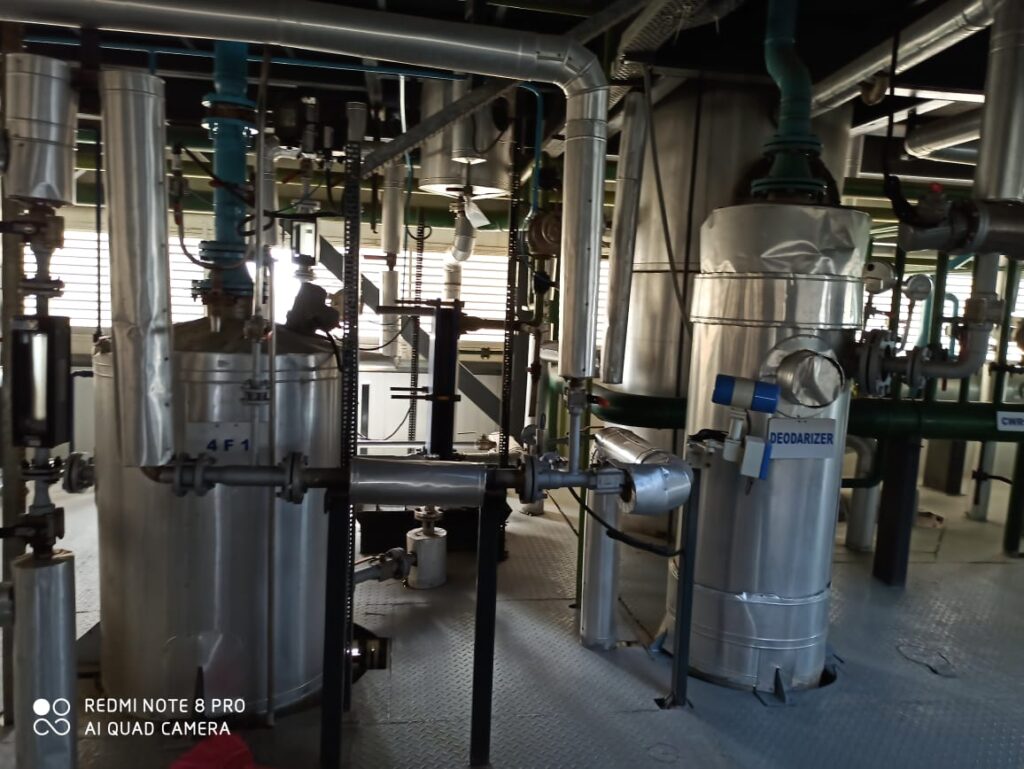
A glycerine plant is an industrial unit that purifies crude glycerine, a by-product of biodiesel, soap and fatty acid manufacturing, into refined glycerine of technical or pharmaceutical grade. It removes water, salts, methanol, soap and colour through evaporation, vacuum distillation, bleaching and deodorisation. Refined glycerine reaches 99.5% purity or higher, which is what medicines, cosmetics and food products need.
If you run a biodiesel unit, a soap factory or an oleochemical plant, you already know the problem. Every tonne of product leaves behind a stream of crude glycerine that is dark, salty and hard to sell. Sold as it is, it fetches a low price. Refined, it becomes one of the most versatile chemicals in the market. A glycerine plant is the step that closes that gap.
At FOSTECHNO Process & Engineering Private Limited, we design and build glycerine refining and distillation plants. This guide explains, in plain language, how these plants work, what drives their cost, how to size one, and what to ask before you sign an order. Whether you are planning your first plant or upgrading an old one, you should finish this article knowing what to look for.
What Is a Glycerine Plant?
Glycerine (also spelled glycerin, and called glycerol in its pure chemical form) is a colourless, odourless, sweet-tasting, syrupy liquid. It forms whenever fats and oils are split apart, which happens in three main industries: biodiesel production, soap making and fat splitting for fatty acids.
The glycerine that comes out of these processes is not pure. It carries water, inorganic salts, leftover soap, traces of methanol or fatty matter and a lot of colour. A glycerine plant, also called a glycerine refining plant, glycerine distillation plant or glycerine purification plant, takes that impure liquid through a series of steps until it meets a defined quality standard.
Think of it as the difference between crude oil and petrol. The raw material has value, but the refined product is what customers actually buy.
Why Refining Glycerine Makes Business Sense
Crude glycerine is sold at a heavy discount, and buyers often set a low price because they must refine it themselves. Refined glycerine opens up several markets:
- Pharmaceuticals: cough syrups, suppositories, tablets, ointments and injectables
- Personal care: soaps, creams, lotions, toothpaste, shampoos and deodorants
- Food and beverages: sweeteners, humectants, flavour carriers and baked goods
- Industrial uses: resins, alkyd paints, polyols for foam, antifreeze, lubricants and tobacco processing
- Chemical derivatives: a raw material for other chemicals
The price gap between crude and refined depends on the market and the grade, so we won’t quote a number here. The direction is always the same. Refining adds value, and pharmaceutical-grade glycerine adds the most.
There is also an operational benefit. If you produce biodiesel, glycerine is a by-product you have to deal with. Many plants find that disposing of or discounting crude glycerine drains margin, and a refining unit turns that cost into income.
Where Does Crude Glycerine Come From?
The feed you have decides how your plant should be designed. Not all crude glycerine is the same.
| Source | Name of crude | Typical glycerol content* | What it usually needs |
|---|---|---|---|
| Fat splitting (fatty acid plants) | Sweet water | Around 10–15% | Filtration, then concentration by evaporation |
| Soap making (saponification) | Spent lye | Roughly 8–15%, with a lot of salt | Neutralisation, filtration, salt removal, evaporation |
| Biodiesel (transesterification) | Crude glycerine | Roughly 80–90% | Methanol recovery, neutralisation, then distillation |
*These are broad industry ranges. Your own feed can differ, so always get it tested in a laboratory before finalising a design.
Sweet water is very dilute. Most of it is water, so a large evaporation section is needed before you can distil anything.
Spent lye comes from soap making. It carries a lot of salt, mostly sodium chloride, and that salt affects both the design and the maintenance of the plant. Salt can foul heat-transfer surfaces if the plant isn’t designed to handle it.
Biodiesel crude glycerine is the most concentrated of the three, but it carries methanol, catalyst residues and soap. Once methanol is recovered and the pH is corrected, it can often go directly to the distillation stage, which keeps the plant simpler.
A good manufacturer will ask you about your feed before talking about equipment. If someone quotes a plant without asking, that is a warning sign.
How a Glycerine Refining Plant Works: Step by Step
Most refining plants follow the same basic route. The details change with feedstock, but the logic is the same: remove the easy things first, then separate glycerine from what remains, then polish it.
Step 1: Pre-treatment and Filtration
The first job is to clean up the crude. For soap lye and sweet water, acid is often added to convert dissolved soaps into free fatty acids, which can then be separated. The stream is filtered to remove solids. For spent lye, filtration may happen both before and after neutralisation.
For biodiesel glycerine, this stage focuses on neutralising leftover catalyst, separating fatty matter and recovering methanol. Methanol removal matters for both safety and product quality.
Skipping or rushing pre-treatment is the most common cause of later trouble. Impurities that enter the distillation column cause fouling, colour problems and lower yield.
Step 2: Evaporation and Concentration
Dilute streams such as sweet water have to be concentrated before distillation. Multi-effect evaporators, which reuse the vapour from one stage to heat the next, are commonly used because they save a lot of steam. Salt is separated at this stage where necessary.
The aim is to bring the glycerine concentration up to a level where distillation is efficient. Trying to distil a dilute stream wastes energy and reduces capacity.
Step 3: Drying and De-aeration
Before the liquid enters the distillation section, remaining water and dissolved gases are removed. Air in the system causes oxidation and colour, and moisture upsets the vacuum. A drier or de-aerator handles both.
Step 4: Vacuum Distillation
This is the heart of the plant. Glycerine boils at a very high temperature at normal pressure, in the region of 290°C, and it starts to decompose before it gets there. Heating it that hard would produce acrolein and other unwanted compounds and would ruin the product.
The solution is vacuum. When pressure is lowered sharply, glycerine boils at a much lower temperature, typically somewhere around 160–200°C depending on the vacuum level. At those temperatures, it can be evaporated and condensed without breaking down.
Most modern plants use packed columns. Packing gives a large surface area for vapour and liquid to contact, which means good separation with a low pressure drop, and low pressure drop helps you hold a deep vacuum. The crude is heated, the glycerine vapour rises through the column, and it is condensed and collected. Heavy impurities stay behind as residue, often called pitch or bottoms. Lighter compounds leave as a separate fraction.
A well-designed system recovers as much glycerine as possible from the residue, because every percent of yield matters over a year of operation.
Step 5: Deodorisation
Distilled glycerine can still carry a slight odour from volatile compounds. A stripping or deodorisation stage, usually under vacuum with a small amount of steam, removes those traces. This is especially important for pharmaceutical and cosmetic grades, where any odour is a quality failure.
Step 6: Bleaching
Colour is measured against strict limits in pharmaceutical grades. Activated carbon is commonly used to adsorb colour bodies. The glycerine is mixed with carbon for a set contact time and then filtered.
The quality of carbon, the contact time and the temperature all affect the result, and a designer has to balance them so you get a clear product without burning through carbon and filter media.
Step 7: Polishing Filtration, Cooling and Storage
The bleached glycerine passes through fine filters to remove carbon particles, gets cooled and goes to storage tanks. Storage is often overlooked, but glycerine is hygroscopic, meaning it absorbs moisture from the air. Tanks need appropriate breathers, and pharmaceutical grade needs suitable materials of construction and clean handling.
Optional: Salt Decanter or Wiped-Film Evaporator
Some plants add a salt decanter or a wiped-film evaporator to recover more glycerine from the residue and cut waste. This is worth considering when your feed is high in salt or when your yield targets are tight. It adds cost, but it can pay for itself where volumes are large.
Glycerine Grades and Standards
The word “purity” gets used loosely, so here is how the grades usually break down.
| Grade | Typical purity | Where it’s used |
|---|---|---|
| Crude | About 80–90% | Feed for refining, some animal feed uses |
| Technical / industrial | About 95–99% | Resins, paints, antifreeze, lubricants |
| Pharmaceutical (USP / IP / BP / Ph. Eur.) | 99.5% and above | Medicines, cosmetics, oral care, food |
A few points matter here.
First, the standard your customer follows decides the grade, not the marketing name. USP, IP, BP and Ph. Eur. each publish their own limits. Always check the current edition of the pharmacopoeia your buyers use and design against it.
Second, pharmaceutical glycerine has tight limits for impurities, including chlorides, sulphates, heavy metals, fatty acids and esters, and diethylene glycol and related compounds. Colour, odour, water content and acidity are also tested. Your plant has to be capable of reaching these numbers reliably, not just on a good day.
Third, a plant that can make 99.5% on paper may need better vacuum, better bleaching or extra polishing to do it consistently. Ask any manufacturer how the plant was designed to hold the specification, and ask what tests are done at commissioning.
Key Equipment in a Glycerine Plant
A typical plant includes:
- Feed tanks and pre-treatment vessels with agitators and heating
- Filters, such as pressure leaf filters, bag filters or candle filters
- Evaporators for dilute feeds, often multi-effect
- Drier or de-aerator to remove water and gases
- Distillation column with structured or random packing
- Reboiler or heater, sized for the feed and vacuum
- Condensers, including a main condenser and vent condensers
- Vacuum system, using steam ejectors, liquid ring pumps or a combination
- Deodoriser or stripping section
- Activated carbon bleaching vessel and polishing filters
- Heat exchangers for heat recovery between hot and cold streams
- Pumps, piping and valves suited to viscous, hot fluid
- Cooling water system
- Storage tanks for crude, refined product and residue
- Instrumentation and PLC control to hold temperature, pressure and flow steady
Material of construction matters. Stainless steel is usually selected for product-contact parts, and grades such as SS 304 or SS 316L are common depending on the feed and the grade of glycerine you want. Salty feeds can attack the wrong steel over time, so material choice is a real engineering decision and not a way to trim cost.
Batch vs Continuous Glycerine Plants
Both designs work. The right one depends on your volume and how consistent your feed is.
| Factor | Batch plant | Continuous plant |
|---|---|---|
| Best for | Small volumes, varying feed | Steady, larger volumes |
| Initial investment | Lower | Higher |
| Labour need | More operator involvement | Less, highly automated |
| Energy use per tonne | Higher | Lower, with heat recovery |
| Product consistency | Depends on operator skill | Generally more stable |
| Flexibility | Easy to change feeds | Designed around a set range |
A small biodiesel producer with a few tonnes a day may do well with a batch or semi-continuous system. A large soap or oleochemical complex running around the clock will usually justify a continuous plant, because the energy savings and steady quality add up quickly.
Some buyers start with a smaller plant and plan for expansion. If you think you will grow, tell your manufacturer at the start so the layout, utilities and foundations can allow for it.
How to Decide the Right Capacity
Capacity is normally stated in tonnes per day (TPD) of crude glycerine processed, though some buyers quote refined output. Make sure you and your supplier are using the same basis.
Here is a practical way to work it out.
- Estimate your crude output. As a rule of thumb, biodiesel production yields roughly 10% glycerine by weight, but check against your own production data. For soap and fat splitting, use your actual sweet water or lye volumes and concentrations.
- Test the feed. Get a laboratory analysis of glycerol content, moisture, salt, ash, methanol, pH and organic matter non-glycerol (MONG). This is the base for every design decision.
- Set the target grade. Technical grade and pharmaceutical grade need different levels of investment.
- Plan for growth. If production may double in three years, discuss it now.
- Check your utilities. Steam, cooling water, electricity and a place to send effluent all need to be available at the required rate.
- Ask for guarantees. A good supplier will state yield, purity and utility consumption per tonne in writing.
An oversized plant wastes capital and runs inefficiently at low load. An undersized plant becomes a bottleneck. A sensible design sits close to your real needs with room to expand.
What Decides the Cost of a Glycerine Plant?
Buyers often ask for a price before they have shared any details. The honest answer is that there isn’t a fixed number, because the cost depends on several things.
Capacity. Larger plants cost more overall, though cost per tonne usually falls as size increases.
Feedstock. Dilute sweet water and salty spent lye need evaporation and salt handling. Biodiesel glycerine is simpler. More stages mean more equipment.
Target grade. Pharmaceutical grade needs better vacuum, more careful bleaching and cleaner materials than a technical grade.
Materials of construction. Higher stainless steel grades cost more but last longer in aggressive service.
Automation. Manual operation is cheapest to buy but depends heavily on skilled operators. A full PLC system with data logging costs more up front and gives steadier quality.
Energy recovery. Heat exchangers and multi-effect evaporation add cost but cut steam consumption for the life of the plant. Over several years, that saving can be large.
Utilities and civil work. Boilers, cooling towers, vacuum systems, tanks, building and foundations may or may not be in a supplier’s scope. Always clarify what is included.
Effluent treatment. Wastewater from a glycerine plant contains organic load and salt. Handling it properly is part of the real project cost.
When you compare quotes, compare the scope line by line. A lower price often means something has been left out, such as vacuum equipment, storage, commissioning or spares.
Rather than guess, ask for a proposal based on your feed analysis and target grade. That is the only way to get a figure you can rely on.
Common Problems in Glycerine Refining and How to Avoid Them
Even a good plant can run into trouble. These are the issues we see most often, and what usually causes them.
Dark or yellow product. This normally points to overheating, air leaking into the system, or too little bleaching. Check vacuum integrity, temperature control and carbon dosage.
Low yield. Causes include high salt or soap in the feed, poor vacuum, or too much glycerine left in the residue. Better pre-treatment and, where justified, a residue recovery stage help.
Odour in the final product. Deodorisation is incomplete. Look at stripping conditions and steam quality.
Fouling in the column or heaters. Poor pre-treatment or salt carry-over is the usual reason. Regular cleaning and a properly designed salt removal step reduce downtime.
Unstable vacuum. Leaks, undersized ejectors or warm cooling water are typical causes. A steady vacuum is the backbone of a stable process.
Failing pharmacopoeia tests. If chlorides, acidity or other limits fail, the cause is usually upstream. Trace it back through the process instead of only adjusting the last stage.
The best protection is good design at the start, followed by disciplined operation: trained operators, planned maintenance and regular laboratory checks.
Safety and Environmental Considerations
A glycerine plant handles hot fluids, vacuum systems and, in biodiesel setups, methanol, which is flammable and toxic. Safe design is not optional.
- Methanol areas need proper ventilation, flameproof electricals and gas detection where applicable.
- Pressure and vacuum equipment should be designed and tested to the applicable codes.
- Hot surfaces need insulation and guarding.
- Operators need training in handling acids, alkalis and hot product.
- Wastewater has to be treated to meet local pollution-control norms before discharge.
- Pitch and residue must be stored and disposed of responsibly. Some plants recover more product from it or use it as fuel, depending on composition and regulations.
A good supplier builds these points into the design and documentation. They should also help you with the information you need for statutory approvals.
How to Choose a Glycerine Plant Manufacturer
Choosing a supplier is the biggest decision in the whole project. A plant runs for many years, so you want a partner who will still be around and who understands your process. Here is a checklist you can use with any manufacturer, including us.
1. Do they ask about your feed? A serious supplier will want your analysis and your production figures first.
2. Can they show relevant experience? Ask about plants built for feeds like yours and for the grade you want. If possible, visit a running plant.
3. Will they guarantee performance? Look for written guarantees on purity, yield and utility consumption, and clear terms for how these are tested at commissioning.
4. Is the scope clear? Get a full list of what is supplied, what is excluded and who is responsible for civil, electrical and utilities.
5. Who does the engineering? Ask whether design, fabrication and commissioning are done in-house or outsourced. In-house control usually means fewer surprises.
6. What is the quality process? Ask about material certificates, inspection, testing and documentation.
7. What happens after installation? Training, spares, service visits and a quick response when something goes wrong all matter.
8. Is the design open to your needs? A rigid, one-size-fits-all offer is a poor fit for feeds that vary.
Why Buyers Talk to FOSTECHNO
FOSTECHNO Process & Engineering Private Limited is a glycerine plant manufacturer focused on process design and turnkey delivery. We work with biodiesel producers, soap makers and oleochemical units who need a dependable way to turn crude glycerine into a saleable, specification-grade product.
Here is how we approach a project:
- We start with your feed. We ask for your lab analysis and production data, and we design around them, not around a catalogue.
- We size the plant to your business. That means the right capacity, with room for expansion if you plan it.
- We design for the grade you need. Whether you target technical or pharmaceutical grade, the plant is built and tested to that standard.
- We think about running cost. Heat recovery, vacuum design and yield are considered from day one, because they decide your profit over the years.
- We keep the scope clear. You will know exactly what is included in our supply and what is not.
- We stay with you after commissioning. Training, spares and technical support are part of the relationship.
If you are comparing suppliers, we welcome that. Send us your feed details and your target, and we will tell you plainly what the project needs.
Frequently Asked Questions
What is a glycerine plant?
A glycerine plant is an industrial facility that refines crude glycerine from biodiesel, soap or fat splitting into technical or pharmaceutical grade glycerine. It does this through pre-treatment, evaporation, vacuum distillation, deodorisation and bleaching.
What is the difference between crude and refined glycerine?
Crude glycerine contains water, salts, methanol, soap and colour, and is usually 80–90% glycerol or much lower in dilute streams. Refined glycerine has these removed and meets a stated grade, such as 99.5% or higher for pharmaceutical use.
Can I use biodiesel glycerine in a glycerine plant?
Yes. Biodiesel glycerine is one of the most common feeds. After methanol recovery and pH correction, it can often go directly to distillation.
Why is vacuum used in glycerine distillation?
Glycerine has a very high boiling point at normal pressure and starts to break down before it boils. Vacuum lowers the boiling temperature so it can be distilled safely without damaging the product.
What purity can a glycerine plant achieve?
A properly designed plant can produce pharmaceutical grade glycerine of 99.5% or higher, provided the feed is pre-treated well and the plant is designed against the relevant standard.
What capacity glycerine plant should I buy?
It depends on how much crude glycerine you produce and how much you expect to produce in future. Have your feed analysed, decide your target grade, and ask your manufacturer to size the plant with room for expansion.
Is a batch or continuous plant better?
Batch plants suit small volumes and changing feeds. Continuous plants suit steady, larger volumes and use less energy per tonne. The right choice depends on your scale and how much automation you want.
How much does a glycerine plant cost?
The price depends on capacity, feedstock, target grade, materials, automation, energy recovery and what is included in the scope. A reliable figure comes only from a proposal based on your feed analysis and requirements.
How long does it take to set up a glycerine plant?
The timeline depends on capacity, complexity and site readiness. Ask your manufacturer for a written schedule covering engineering, fabrication, delivery, installation and commissioning.
What utilities does a glycerine plant need?
Typically steam, cooling water, electricity, a vacuum system, compressed air where needed, and an arrangement for effluent treatment. Your supplier should give you utility figures per tonne of product.
How do I keep glycerine from turning yellow?
Avoid overheating, prevent air leaks in the vacuum system, control temperature closely and make sure bleaching is adequate. Colour problems can also start upstream, in the pre-treatment stage.
What happens to the residue from distillation?
The heavy residue, often called pitch, still holds some glycerine and other compounds. Some plants recover more product from it with additional equipment, and the rest is handled according to local environmental rules.
Can a glycerine plant handle different feedstocks?
It can if it is designed for that range. If you use more than one type of crude, tell your manufacturer at the start so the pre-treatment and evaporation sections can be planned for it.
Final Thoughts
A glycerine plant does something simple in principle and demanding in practice. It takes an impure, low-value by-product and turns it into a clean product that pharmaceutical, cosmetic and industrial buyers will pay for. The difference between a plant that earns well and one that struggles usually comes down to three things: how well the design matches the feed, how steady the vacuum and temperature control are, and how much support you get after the plant is running.
If you are planning a new plant or looking to improve an existing one, start with your data. Know your feed, decide your grade, and be clear about your capacity. Then talk to manufacturers who ask you the right questions before they quote.
Ready to discuss your project?
Contact FOSTECHNO Process & Engineering Private Limited with your feed analysis, production volume and target grade, and our team will come back with a practical proposal.
info@fostechnos.com contact us


