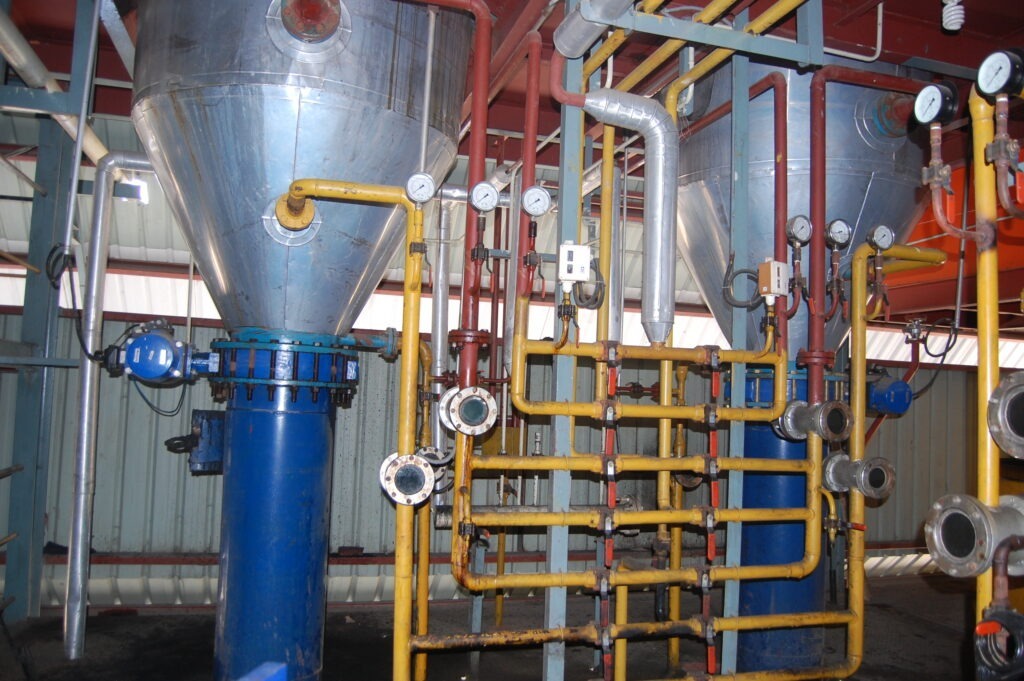
If you’ve searched for “bleaching plant,” you’ve probably noticed something frustrating — most pages either talk only about edible oil refining, or only about textile bleaching, or they throw in a patent document that reads like a legal contract. Nobody actually sits down and explains the whole picture in one place.
That’s what this guide does. Whether you’re an oil miller looking to add a bleaching unit, a textile processor comparing J-box systems, a hospital-supply manufacturer researching surgical cotton kiers, or a student trying to understand the science behind decolorization — you’ll find it here, explained the way an engineer would explain it to a colleague over chai, not the way a brochure would.
What Exactly Is a Bleaching Plant?
A bleaching plant is an industrial setup built to strip away color, odor-causing compounds, or unwanted impurities from a raw material, turning it into something usable, sellable, or safe for further processing. The term gets used loosely across at least four very different industries, and that’s honestly where most of the confusion online comes from.
In broad strokes, you’ll run into these categories:
- Edible oil bleaching plant — remove pigments (mainly chlorophyll and carotenoids), trace metals, and oxidation products from crude vegetable oils like soybean, sunflower, palm, mustard, or rice bran oil.
- Textile bleaching plant — treat woven or knitted fabric (and sometimes yarn) to remove natural coloring matter, waxes, and impurities so the fabric takes dye evenly or stays pure white.
- Surgical cotton bleaching plant — use high-temperature, high-pressure (HTHP) kiers to scour and bleach raw cotton so it meets pharmacopoeial purity standards for absorbent cotton wool, gauze, and bandages.
- Pulp and paper bleaching systems — remove lignin and residual color from wood pulp to achieve the bright white paper stock used in printing and packaging.
Each of these runs on a different chemistry and a different set of machines, but the underlying goal is identical: take something dull, colored, or contaminated, and make it clean, bright, and consistent.
Why Bleaching Matters in Manufacturing
It’s easy to think of bleaching as a cosmetic step — just making things “look” better. In reality, it’s often a quality and safety requirement, not a beauty treatment.
- In edible oils, unbleached crude oil carries pigments that darken during frying and storage, along with trace metals (iron, copper) that speed up rancidity. Skipping bleaching means a shorter shelf life and an oil that fails quality specs.
- In surgical cotton, natural cotton fiber contains waxes, pectins, and coloring matter that must be removed for the fiber to absorb fluid properly — a non-negotiable requirement for anything used on a wound.
- In textiles, uneven bleaching shows up as patchy dyeing later in the process, which is one of the most common (and expensive) causes of fabric rejection.
- In pulp and paper, brightness is a measurable spec that paper mills are contractually bound to hit for their customers.
So while the word “bleaching” sounds simple, the plants built around it are precision systems with tight temperature, pH, and timing controls.
How an Edible Oil Bleaching Plant Works
This is probably the most searched-for type, so let’s go step by step.
Crude oil coming out of the degumming and neutralization stages still carries color pigments — mainly chlorophyll (which gives a greenish tint) and carotenoids (which give a reddish-yellow tint). The bleaching stage exists purely to adsorb these pigments onto a fine solid material, then filter that material back out.
Step 1 — Oil heating. The neutralized and dried oil is heated, typically somewhere in the range of 85°C to 110°C depending on the oil type, under vacuum. Vacuum is important here because it prevents oxidation of the oil at high temperature — without it, you’d actually be creating more color and off-flavors than you remove.
Step 2 — Bleaching earth (or activated carbon) dosing. A measured dose of bleaching earth — sometimes called fuller’s earth or activated bentonite clay — is mixed into the hot oil. Activated carbon is sometimes added alongside it, especially for oils that need extra pigment or PAH (polycyclic aromatic hydrocarbon) removal. The dosage usually runs between 0.5% and 2% of the oil weight, depending on how colored the crude oil is.
Step 3 — Contact/retention time. The oil-earth slurry is held in a retention vessel for roughly 20 to 30 minutes with continuous agitation. This gives the clay time to adsorb pigments, trace metals, and residual soap or phosphatides onto its surface.
Step 4 — Filtration. The spent bleaching earth, now loaded with color bodies and impurities, is removed using leaf filters or plate-and-frame filter presses. The filtered oil should come out visibly lighter and clearer.
Step 5 — Polishing filtration. A final safety/polishing filter catches any fine earth particles that slipped through, ensuring the oil going to deodorization is completely clear.
Continuous bleaching plants automate this entire sequence with PLC-based dosing, in-line mixers, and automatic filter backwashing, which is why larger refineries prefer them over batch systems — batch plants are cheaper upfront but need more manual monitoring and produce more variation between batches.
Common Equipment in an Edible Oil Bleaching Unit
- Oil heater / heat exchanger
- Vacuum system (steam ejectors or vacuum pumps)
- Bleaching earth dosing hopper with screw feeder
- Retention/reaction vessel with agitator
- Leaf filters or filter press
- Spent earth discharge system
- Polishing filter
- Storage tank for bleached oil
How a Textile Bleaching Plant Works
Textile bleaching is a completely different animal from oil bleaching. Here, you’re not adsorbing pigment onto clay — you’re chemically destroying the color-causing compounds and natural impurities in the fiber itself.
Raw fabric (called “grey fabric” or “greige”) contains natural waxes, pectins, motes, and natural pigmentation from the cotton or fiber source. Before dyeing or finishing, this has to go.
Common process flow:
- Desizing — removing the starch-based sizing agents applied during weaving.
- Scouring — using alkali (usually caustic soda) to strip waxes, oils, and natural impurities.
- Bleaching — treating the fabric with hydrogen peroxide (most common today) or sodium hypochlorite to oxidize and remove remaining natural color.
- Washing/neutralizing — removing residual chemicals so the fabric is ready for dyeing.
The equipment used depends heavily on the fabric form and batch size:
- J-Box systems — used for continuous rope-form fabric bleaching. Fabric is saturated with bleaching liquor, then dropped into a J-shaped chamber where it “piles up” and reacts for a set dwell time before being pulled out continuously. J-boxes are prized for high throughput and consistent results on woven cotton fabric.
- Jigger machines — batch-type machines where fabric is passed back and forth through a bleaching bath on rollers. More common for smaller lots or delicate fabrics.
- Jet dyeing/bleaching machines — use high-pressure water jets to move fabric through the bath, good for knits and synthetic blends.
- Pad-batch / pad-steam ranges — fabric is padded (impregnated) with bleach liquor, then batched and stored (or steamed) to let the reaction complete before washing.
Sodium hypochlorite was the traditional bleaching agent, but most modern plants have shifted to hydrogen peroxide because it doesn’t produce the same yellowing-with-age issue and it works well combined with scouring in a single bath (often called “combined scouring and bleaching” or CSB).
How a Surgical Cotton Bleaching Plant Works
Surgical cotton has the strictest purity requirements of any bleaching application here, since the final product goes directly onto wounds and into hospitals.
Raw cotton (often cotton linters or comber noil, not the same grade used for spinning yarn) is loaded into a large pressure vessel — the kier. This is a sealed, jacketed vessel that can be run under both vacuum and pressure.
Typical HTHP kier boiling process:
- Raw cotton is loaded into the kier along with water and an alkali (caustic soda).
- The vessel is sealed and steam is introduced to raise both temperature and pressure — HTHP kiers typically operate well above atmospheric boiling point, which speeds up wax and pectin removal dramatically compared to open-vessel boiling.
- After the alkali boil, the liquor is drained and the cotton is rinsed.
- A bleaching stage follows — hydrogen peroxide is standard in modern plants, sometimes with a small amount of stabilizer to control peroxide decomposition.
- Multiple rinse cycles follow to bring the cotton to a neutral pH.
- The cotton is then hydro-extracted (spun to remove excess water) and dried, usually in a hot-air dryer or drying chamber.
The end product must pass pharmacopoeial tests — absorbency, pH, ash content, and freedom from residual alkali — before it can be certified as surgical-grade absorbent cotton.
Common kier sizes for small-to-mid manufacturers run from around 200 kg to 1000 kg per batch, though larger continuous plants exist for high-volume producers.
How Pulp and Paper Bleaching Works
Wood pulp, whether from kraft (chemical) or mechanical pulping, comes out brown or yellowish because of residual lignin — the natural “glue” that holds wood fibers together. Bleaching here is mostly about breaking down and removing that lignin, plus a bit of pigment removal.
Modern pulp mills use a sequence of stages rather than a single bleaching step, commonly abbreviated with letters representing each chemical stage:
- D — chlorine dioxide
- E — alkaline extraction (often with added peroxide or oxygen, written Eop)
- O — oxygen delignification
- P — peroxide
- Z — ozone (used in fully elemental-chlorine-free, or ECF-light, sequences)
A typical modern ECF (elemental chlorine-free) sequence might look like D-Eop-D-P, run across multiple towers with washing in between each stage. Fully chlorine-free (TCF) mills skip chlorine dioxide entirely and rely on oxygen, ozone, and peroxide stages instead.
This is a capital-intensive, continuous process running in large fiberline towers, and it’s a completely different scale of operation compared to a textile J-box or an oil bleaching retention vessel — pulp mills are processing hundreds to thousands of tons of pulp per day.
Choosing Between Batch and Continuous Bleaching Plants
This decision comes up constantly, regardless of which industry you’re in, so it’s worth addressing on its own.
Batch plants are simpler, cheaper to install, and easier to operate with a smaller, less-trained workforce. They’re a natural fit for smaller producers, seasonal operations, or facilities processing multiple different raw material grades that need different treatment recipes.
Continuous plants cost more upfront and need tighter process control (usually PLC/SCADA-based), but they deliver more consistent output, lower labor cost per unit of production, and higher overall throughput. They make sense once volume justifies the investment — generally when a plant is running close to full capacity most days of the week.
A rough rule some plant consultants use: if you’re processing under 20–30 tons per day of oil, or a few hundred kilos of cotton/fabric per shift, a batch system usually pays for itself faster. Above that, continuous systems tend to win on cost-per-unit over a 3–5 year horizon.
Setting Up a Bleaching Plant: What Actually Drives the Cost
People searching for “bleaching plant” are very often trying to figure out what it will cost to set one up. There’s no single number, but here’s what actually moves the needle:
- Capacity. A 5 TPD (tons per day) oil bleaching unit costs a fraction of a 100 TPD unit — and not linearly either, since larger plants benefit from economies of scale on structural steel and instrumentation.
- Automation level. Manual/batch dosing systems are cheapest; PLC-controlled continuous dosing and filtration add real cost but reduce labor and waste.
- Vessel material. Stainless steel (SS304 or SS316) vessels cost more than mild steel but are often required for food-grade or pharma-grade applications, especially in surgical cotton and edible oil plants.
- Filtration technology. Leaf filters cost more than basic plate-and-frame presses but reduce oil loss trapped in the spent earth cake.
- Utilities on site. Steam boiler capacity, vacuum system size, and effluent treatment requirements (especially for textile and pulp plants, which generate significant wastewater) all add to the total project cost.
- Local fabrication vs imported machinery. Domestically fabricated vessels (common in India, for instance) run considerably cheaper than imported European or advanced Asian machinery, though imported lines sometimes offer better automation and lower long-term maintenance needs.
Anyone quoting you a single flat price without asking about these variables is probably giving you a placeholder number, not a real one.
Maintenance and Common Operational Issues
A few problems come up again and again across all types of bleaching plants:
- Filter blocking/short filter life — usually from over-dosing bleaching earth or poor pre-filtration of crude oil, in the edible oil case.
- Uneven bleaching on fabric — often traced back to inconsistent liquor concentration across a J-box or poor squeeze-roll pressure in a pad-steam range.
- Peroxide decomposition issues — trace metals like iron or copper (from water or equipment corrosion) can catalyze premature peroxide breakdown, wasting chemical and under-bleaching the material. Stabilizers and proper water treatment fix this.
- Corrosion in kiers and vessels — HTHP kiers running under both pressure and caustic/peroxide chemistry need regular inspection; stainless steel and periodic passivation treatments extend vessel life significantly.
- Effluent load — bleaching effluents, particularly from textile plants, tend to be high in COD/BOD and need proper treatment before discharge — this is one of the most heavily regulated aspects of running this kind of plant today.
Routine calendar-based maintenance (filter cloth replacement, vessel gasket checks, instrument calibration) tends to be far cheaper than reactive repairs after a breakdown, which is standard advice but genuinely underfollowed in smaller plants.
Frequently Asked Questions
What is the main function of a bleaching plant?
It removes color pigments, natural waxes, or chemical impurities from a raw material — crude oil, raw cotton, fabric, or wood pulp — so the finished product meets purity, brightness, or shelf-life requirements.
What chemicals are commonly used in bleaching?
Bleaching earth (activated clay) and activated carbon are used for oils. Hydrogen peroxide and sodium hypochlorite are the main agents for textiles and surgical cotton. Chlorine dioxide, oxygen, ozone, and peroxide are used in various combinations for pulp bleaching.
What temperature is used for edible oil bleaching?
Most edible oil bleaching happens between 85°C and 110°C under vacuum, with the exact temperature depending on the oil type and the pigment load in the crude oil.
What is an HTHP kier used for?
An HTHP (high-temperature high-pressure) kier is a sealed, pressurized vessel used mainly in surgical cotton processing to scour and bleach raw cotton faster than would be possible in an open, atmospheric-pressure vessel.
What is the difference between batch and continuous bleaching plants?
Batch plants process one load at a time and suit lower volumes with more flexibility; continuous plants run material through the process non-stop and suit higher volumes with more consistent output, but need a bigger upfront investment.
Is hydrogen peroxide better than sodium hypochlorite for textile bleaching?
Hydrogen peroxide is now the more widely preferred agent because it avoids some of the long-term yellowing and fiber-damage issues associated with hypochlorite, and it can be combined with scouring in a single bath step, saving time and water.
How much does a small-scale bleaching plant cost to set up?
It depends heavily on capacity, automation level, and vessel material, but small batch-type units (oil bleaching or a single surgical cotton kier) tend to sit at the lower end of industrial equipment pricing compared to continuous, PLC-automated lines, which cost considerably more.
What is a J-box in textile bleaching?
A J-box is a J-shaped chamber used in continuous rope-form fabric bleaching. Fabric is saturated with bleach liquor, then allowed to pile up and react inside the chamber for a controlled dwell time before moving on to washing.
Why is vacuum used during edible oil bleaching?
Vacuum prevents oxidation of the hot oil during the bleaching stage. Without it, the heat needed for effective pigment adsorption would actually generate more oxidation products and color, working against the goal of the process.
Do bleaching plants produce wastewater that needs treatment?
Yes, particularly textile and pulp bleaching plants, which generate effluent with high chemical oxygen demand. Most jurisdictions require on-site effluent treatment before discharge, and this is usually factored into the total plant setup cost.
bleaching plant
bleaching plant
bleaching plant
bleaching plant
bleaching plant
bleaching plant
bleaching plant
bleaching plant bleaching plant


