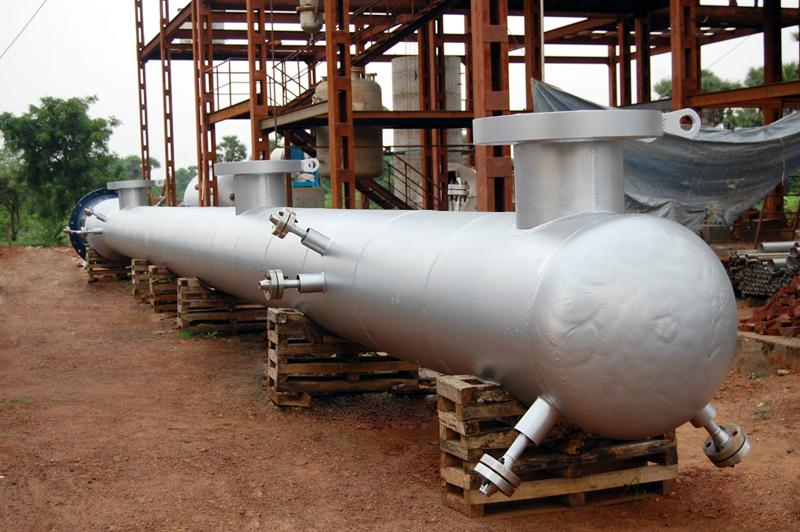
Every tonne of edible or industrial oil you process hides two products inside it. The plant that separates them efficiently keeps the margin.
Walk into any modern oleochemical plant, and you will find a tall, high-pressure column at the heart of the operation. Fat and oil go in at one end. Fatty acids and glycerin-rich water come out at the other. That column is the fat splitting unit, and what happens to its bottom stream, the “sweet water”, decides whether your glycerin recovery is profitable or wasteful.
This guide explains fat splitting and pre-concentration in plain, technical language: how hydrolysis works, why the Colgate-Emery process dominates, how sweet water is treated and concentrated, what affects yield and energy use, and how to choose the right plant design. Whether you are an engineer, a plant owner or a procurement manager, you will find a practical framework here.
Published by FOSTECHNO Process & Engineering Private Limited, process engineers for oleochemical plants.
What Is Fat Splitting and Pre-Concentration?
Fat splitting is a hydrolysis process that breaks triglycerides (natural fats and oils) into free fatty acids and glycerin by reacting them with water at high temperature and pressure. The glycerin ends up dissolved in water as a dilute stream called sweet water.
Pre-concentration is the first stage of glycerin recovery. Sweet water is cleaned and evaporated to raise its glycerin content from roughly 10–20% to a crude glycerin concentration suitable for salt removal and final distillation.
In short, splitting separates the two products, and pre-concentration prepares the glycerin for purification.
Why Fat Splitting Matters in Oleochemicals
Fatty acids are the raw material for a huge range of products:
- Soaps and soap noodles
- Detergents and surfactants
- Cosmetics and personal care
- Lubricants and greases
- Plasticizers, rubber additives and PVC stabilizers
- Candles, coatings and paints
- Fatty alcohols, fatty amines and esters
Glycerin is equally valuable. Refined glycerin goes into pharmaceuticals, food, oral care, cosmetics, tobacco, resins and explosives, and it is increasingly used as a bio-based chemical feedstock.
Since both streams are sellable, the splitting and glycerin recovery section directly controls the profitability of the entire oleochemical value chain. A 1% loss of splitting efficiency or a poorly designed evaporation section shows up immediately in your yield, energy bill and product quality.
The Chemistry Behind Fat Splitting
A triglyceride is one glycerol backbone attached to three fatty acid chains through ester bonds. Hydrolysis breaks those bonds using water:
Triglyceride + 3 H₂O ⇌ Glycerol + 3 Fatty acids
Some points matter for design:
- The reaction is reversible. If glycerol builds up in the reaction zone, the reaction slows and can reverse. Removing glycerol continuously pushes it toward completion.
- It proceeds in steps. Triglycerides convert to diglycerides, then monoglycerides, then free glycerol and fatty acids. The last few percent of conversion are the hardest to achieve.
- Water solubility in oil is the limiting factor. Water dissolves slightly in the oil phase, and hydrolysis occurs there. Higher temperature increases that solubility, which is why high-temperature splitting is so effective.
- The reaction is autocatalytic. The fatty acids formed act as mild acid catalysts, so the reaction speeds up as it proceeds.
Roughly 9–10% of a typical triglyceride’s mass is glycerol. This is why one tonne of oil yields about 950–960 kg of fatty acids and around 100 kg of glycerol (on a 100% basis), depending on the feedstock.
Methods of Fat Splitting: A Comparison
Several methods exist, but only one dominates modern large-scale production.
1. Twitchell Process
An older atmospheric process that uses a sulfonic acid catalyst. It is slow, needs long reaction times and produces darker fatty acids. It is now largely obsolete.
2. Batch Autoclave Splitting
Fat is heated with water and a catalyst (typically zinc, magnesium or calcium oxide) at moderate pressure, roughly 10–15 bar. It suits small capacities and mixed feedstocks, but the cycle times are long and the glycerin water is more dilute.
3. Enzymatic (Lipase) Splitting
Lipase enzymes hydrolyze fats at mild temperatures, roughly 30–50°C. It saves heat energy and protects heat-sensitive fatty acids, but enzyme cost, long reaction times and limited throughput restrict it mainly to specialty products.
4. Continuous High-Pressure Splitting (Colgate-Emery)
The industrial standard. Oil and water flow in opposite directions through a tall column at high temperature and pressure, with no catalyst required. This is the process most large plants use.
| Parameter | Twitchell | Batch Autoclave | Enzymatic | Continuous High-Pressure |
|---|---|---|---|---|
| Catalyst | Sulfonic acid | Metal oxides | Lipase | None |
| Temperature | ~100°C | ~150–180°C | ~30–50°C | ~240–260°C |
| Pressure | Atmospheric | ~10–15 bar | Atmospheric | ~40–60 bar |
| Splitting degree | Moderate | ~90–95% | Variable | ~97–99% |
| Capacity | Small | Small–medium | Small–medium | Large |
| Fatty acid colour | Dark | Fair | Excellent | Good |
| Typical use | Legacy | Small plants | Specialty | Large-scale commodity |
How the Continuous Countercurrent Fat Splitting Process Works
The continuous high-pressure process, commonly called the Colgate-Emery process, is built around a single tall reaction column. Here is how it works step by step.
Step 1: Feedstock Preparation
Oil must be clean before it enters the column. Impurities, moisture and dissolved oxygen cause fouling, colour problems and corrosion. Typical pretreatment includes:
- Degumming and filtration to remove phospholipids and solids
- Deaeration to remove dissolved oxygen (a major cause of colour formation)
- Preheating using recovered heat
Poor-quality feed is a common reason splitting plants underperform. It is worth solving upstream.
Step 2: Feeding the Column
Preheated, deaerated fat is pumped into the bottom of the column through a distributor, or sparger. It is lighter than water, so it rises through the column as fine droplets. Demineralized, deaerated water is fed near the top and flows downward as the heavier phase.
Step 3: Steam Heating
High-pressure steam is injected near the bottom of the column and heats the contents to roughly 250–260°C. The column operates at about 40–60 bar, high enough to keep water liquid at that temperature.
Step 4: Countercurrent Hydrolysis
As fat rises and water descends, the phases contact continuously. Water dissolves into the fat, hydrolysis occurs and glycerol migrates into the descending water phase. Because the water constantly carries glycerol away, the reaction is driven far toward completion. Residence time is typically a few hours.
Step 5: Product Discharge
- Top of the column: crude fatty acids, saturated with water, exit through a pressure-controlled discharge.
- Bottom of the column: sweet water, a dilute glycerin solution, is discharged under level control.
Step 6: Flashing and Heat Recovery
Both streams leave at high temperature and pressure. They are sent to flash vessels, where dropping the pressure releases steam. That steam is reused for feed preheating. The fatty acids are then dried, and the sweet water moves on to pre-concentration.
Why Countercurrent Flow Matters
In a co-current system, glycerol would accumulate along with the product and stall the reaction. In a countercurrent column, fresh water meets the nearly fully split fat at the top, so the final conversion stages proceed efficiently. This is why the design consistently achieves splitting degrees near 98–99%.
Key Process Parameters That Control Splitting Efficiency
| Parameter | Typical Range | Effect on Performance |
|---|---|---|
| Temperature | 240–260°C | Higher temperature raises water solubility in fat and speeds reaction |
| Pressure | 40–60 bar | Must be high enough to keep water liquid and stable |
| Water-to-fat ratio | ~40–60% water on fat | More water means lower glycerin concentration; less water means slower splitting |
| Residence time | 2–3 hours | Longer time improves splitting but increases size and cost |
| Feed quality | Low FFA, deaerated | Affects colour, corrosion and fouling |
| Water quality | Demineralized, deaerated | Prevents scaling and corrosion |
Design is always a balance. Higher water ratios improve splitting but dilute the sweet water, which raises the energy needed later in evaporation. This trade-off is why the splitting column and the pre-concentration section should be designed together, not separately.
What Is Sweet Water?
Sweet water is the aqueous glycerin solution leaving the bottom of the splitting column. Its typical properties are:
- Glycerin content: roughly 10–20% by weight
- Appearance: pale yellow to light brown
- Contaminants: traces of free fatty acids, entrained fat, small amounts of colour bodies and dissolved organics
- Salts: very low, because the process is catalyst-free
This last point is a real advantage. Because continuous splitting uses no chemical catalyst, sweet water is much cleaner than the glycerin water from saponification or transesterification (biodiesel) processes, which carries salts, soaps and methanol. Cleaner input means simpler treatment and better final glycerin quality.
Glycerin Pre-Concentration: Turning Dilute Sweet Water into Crude Glycerin
Sweet water is about 80–90% water. Shipping, storing and distilling that much water is wasteful, so pre-concentration removes most of it in an energy-efficient way before final refining.
Stage 1: Sweet Water Treatment
Before evaporation, sweet water must be conditioned. Otherwise, fatty matter fouls heat-exchange surfaces and contaminates the glycerin. Typical steps:
- Fat and fatty acid removal. Residual fatty acids are separated by settling, coagulation or filtration.
- pH adjustment. Adjusting to a controlled range helps precipitate soaps and impurities.
- Filtration. Fine solids and coagulated matter are removed.
- Ion exchange (where needed). Polishing removes dissolved salts and colour for high-purity grades.
Investing in good treatment pays back through longer evaporator run times, less fouling and better final product colour.
Stage 2: Multiple-Effect Evaporation
Treated sweet water enters a multiple-effect evaporator (commonly double or triple effect) operating under vacuum:
- Vapor from the first effect heats the second, and vapor from the second heats the third
- Each kilogram of live steam evaporates several kilograms of water
- Vacuum lowers the boiling point, protecting glycerin from thermal degradation
As water leaves, the glycerin concentration rises stage by stage until it reaches crude glycerin at roughly 80–88%.
Some designs use mechanical vapor recompression (MVR) or thermal vapor recompression to cut steam demand further. MVR can be attractive where electricity is economical relative to steam.
Stage 3: Salt Separation (When Present)
If salts are present, they crystallize as glycerin concentrates and are removed by settling or filtration, often in a dedicated salt-separating evaporator stage.
Stage 4: Final Purification
The concentrated crude glycerin then goes to vacuum distillation, bleaching or deodorization to produce refined glycerin, typically 99.5% or higher (USP/EP/food grades).
Concentration Milestones at a Glance
| Stage | Approximate Glycerin Content |
|---|---|
| Sweet water from splitting column | 10–20% |
| After first-effect concentration | ~25–35% |
| After multi-effect evaporation | ~80–88% (crude) |
| After distillation and bleaching | 99.5%+ (refined) |
The intermediate step to around 25–35% is where much of the heat recovery value sits, because that is where the largest volume of water is removed per unit of energy.
Heat Integration: Where Energy Savings Come From
Fat splitting and pre-concentration are both energy-intensive. The best plants treat them as one integrated thermal system.
Key heat recovery opportunities
- Flash steam reuse. Steam released when the high-pressure column outputs are depressurized preheats incoming fat or water.
- Feed-effluent exchangers. Hot fatty acids and hot sweet water preheat cold incoming streams.
- Cascade evaporator design. Multi-effect layouts reuse vapor several times.
- Condensate recovery. Clean condensate returns to the boiler or serves as wash or process water.
- Vapor recompression. MVR upgrades low-pressure vapor for reuse in evaporation.
A well-integrated design can reduce steam consumption substantially compared with a non-integrated one. Over years of operation, this is often where a good design earns its higher upfront cost.
Materials of Construction and Safety Considerations
Hot fatty acids at high pressure are highly corrosive. Material selection is a critical design decision, not a cost-cutting opportunity.
- Splitting column and hot wetted parts: corrosion-resistant alloys (nickel-based alloys such as Inconel or Hastelloy types, or suitable high-grade stainless steel) selected for temperature and fatty acid exposure.
- Sweet water handling: stainless steel grades suited to slightly acidic, low-chloride conditions.
- Evaporators: stainless steel with attention to velocity, tube material and cleanability.
Safety essentials
- Pressure vessel design to recognized codes (ASME or equivalent)
- Relief systems and pressure/level interlocks
- Steam and thermal insulation with personnel protection
- Oxygen exclusion to prevent fatty acid degradation and fire risk
- Proper handling of hot, flammable fatty streams
Never compromise on metallurgy or instrumentation. Failures in this section are expensive and dangerous.
Feedstocks: What Can You Split?
Continuous splitting handles a wide range of fats and oils:
- Palm oil and palm kernel oil, dominant feedstocks in Southeast Asia and India
- Coconut oil, the classic source of lauric and myristic acids
- Tallow and animal fats
- Soybean, sunflower and rapeseed oils
- Rice bran oil, cottonseed oil and other regional oils
- Used cooking oil and industrial fats (with appropriate pretreatment)
Feedstock choice sets the fatty acid profile. Coconut and palm kernel produce lauric-rich acids for surfactants. Palm and tallow are rich in palmitic and stearic acids. Soft oils give oleic and linoleic acids.
After splitting, fatty acids are often distilled and fractionated into cuts (C8–C10, C12–C14, C16–C18) or hydrogenated to produce saturated grades such as stearic acid.
Common Operating Problems and Solutions
| Problem | Likely Cause | Practical Fix |
|---|---|---|
| Low splitting degree | Low temperature, poor water ratio, unstable interface | Verify temperature and pressure, tune water feed, check level control |
| Dark fatty acids | Oxygen in feed, overheating, corrosion products | Improve deaeration, check metallurgy, review temperature |
| Fouled evaporators | Fatty matter in sweet water, scaling | Improve sweet water treatment, schedule cleaning |
| Low sweet water glycerin | Excess water, poor countercurrent flow | Optimize water ratio, inspect distributor |
| High energy use | Weak heat integration | Add flash recovery, better exchangers, MVR |
| Corrosion | Wrong alloys, oxygen ingress | Upgrade materials, tighten deaeration |
| Glycerin colour or odour issues | Poor pre-treatment or thermal degradation | Improve treatment, reduce residence time under heat |
Most performance problems trace back to feed quality, water quality and instrumentation, not the column itself.
Design Considerations When Choosing a Fat Splitting & Pre-Concentration Plant
When evaluating a plant or supplier, look at more than the capital price. Key questions:
- Capacity and turndown. What is your design throughput, and how does the plant run at 60–70% load?
- Feedstock flexibility. Will you switch between palm, coconut and tallow?
- Target splitting degree. Is 98–99% required, or is a lower figure acceptable for your end use?
- Glycerin target. Do you need only crude glycerin, or full refining?
- Energy integration. Are heat recovery and vapor reuse designed in from the start?
- Metallurgy. Are materials matched to the actual fatty acid duty?
- Automation. Is the process controlled via DCS/PLC with proper interlocks?
- Utilities. What steam, power, cooling water and demineralized water are available?
- Environmental compliance. How are condensate, wastewater and emissions handled?
- Support and references. Does the supplier offer commissioning, training and operating support?
The best results come from a supplier who designs the splitting column, flash system, sweet water treatment and evaporators as one integrated package.
Benefits of an Integrated Fat Splitting and Pre-Concentration System
- High fatty acid yield: splitting degrees near 99% maximize product recovery
- Better glycerin recovery: less glycerin lost with waste streams
- Lower energy cost: heat integration and multi-effect evaporation cut steam use
- Consistent quality: catalyst-free splitting gives cleaner, lighter products
- Reduced chemical use: no catalyst to purchase, remove or dispose of
- Scalable: continuous operation from small to very large capacities
- Circular-economy fit: turns natural fats and even waste oils into valuable, bio-based products
Sustainability and the Circular Economy
Fat splitting is central to bio-based chemistry. Oleochemicals replace petrochemical feedstocks in many applications, and integrated glycerin recovery ensures nothing valuable is discarded.
Efficient heat recovery lowers carbon intensity per tonne of product. Catalyst-free operation reduces chemical waste. Plants that process waste and used oils add a further circular loop. As customers and regulators push toward lower-carbon supply chains, efficient splitting and pre-concentration become a competitive advantage as well as an engineering choice.
Frequently Asked Questions
What is fat splitting?
Fat splitting is the hydrolysis of triglycerides into free fatty acids and glycerin using water at high temperature and pressure.
What is the Colgate-Emery process?
It is the continuous countercurrent high-pressure splitting process. Fat rises and water descends through a tall column at about 250–260°C and 40–60 bar, achieving splitting degrees around 98–99% without a catalyst.
What is sweet water in oleochemicals?
Sweet water is the dilute aqueous glycerin solution, typically 10–20% glycerin, that leaves the bottom of the fat splitting column.
What is glycerin pre-concentration?
It is the treatment and multi-effect evaporation of sweet water to raise glycerin content to crude levels (around 80–88%) before final purification.
Why is fat splitting done at high pressure?
High pressure keeps water liquid at 250°C or more. At that temperature, water dissolves in fat more readily and hydrolysis proceeds quickly without catalysts.
What are the main products of fat splitting?
Crude fatty acids and sweet water containing glycerin. The fatty acids are further distilled, fractionated or hydrogenated, and the glycerin is refined.
Is enzymatic fat splitting better than high-pressure splitting?
Enzymatic splitting uses milder conditions and suits specialty or heat-sensitive products, but high-pressure continuous splitting remains the standard for large-scale commodity production because of its throughput and speed.
How much glycerin does fat splitting produce?
Around 9–10% of the triglyceride mass, so roughly 100 kg of glycerin per tonne of oil, varying by feedstock.
What feedstocks can be split?
Palm, palm kernel, coconut, tallow, soybean, sunflower, rice bran and other oils and fats, provided they are properly pretreated.
How can I reduce energy use in glycerin concentration?
Use multi-effect evaporation, flash steam recovery, effective sweet water treatment to prevent fouling and, where economical, vapor recompression.
Why Partner with FOSTECHNO for Fat Splitting & Pre-Concentration?
At FOSTECHNO Process & Engineering Private Limited, we approach fat splitting and glycerin pre-concentration as one connected system, not a set of separate equipment packages. Our engineering focuses on:
- Process design matched to your feedstock and target products
- Integrated heat recovery to reduce operating cost
- Correct metallurgy and safety design for high-pressure, high-temperature duty
- Sweet water treatment designed to protect evaporators and final product quality
- Practical support from design through commissioning and operation
Conclusion
Fat splitting and pre-concentration form the foundation of oleochemical processing. High-pressure countercurrent hydrolysis converts triglycerides into fatty acids and glycerin with very high efficiency and no catalyst. Careful sweet water treatment and multi-effect evaporation then prepare the glycerin for purification while conserving energy.
The difference between an average plant and a profitable one usually comes down to fundamentals: clean, deaerated feed, correct temperature and pressure control, the right metallurgy, and a thermally integrated evaporation train. Get those right and you gain higher yields, better product quality and lower operating cost for years.
So here is the question worth asking about your own operation: is your current fat splitting and glycerin recovery section delivering the yield and energy efficiency it should, or is it quietly costing you margin every day?


