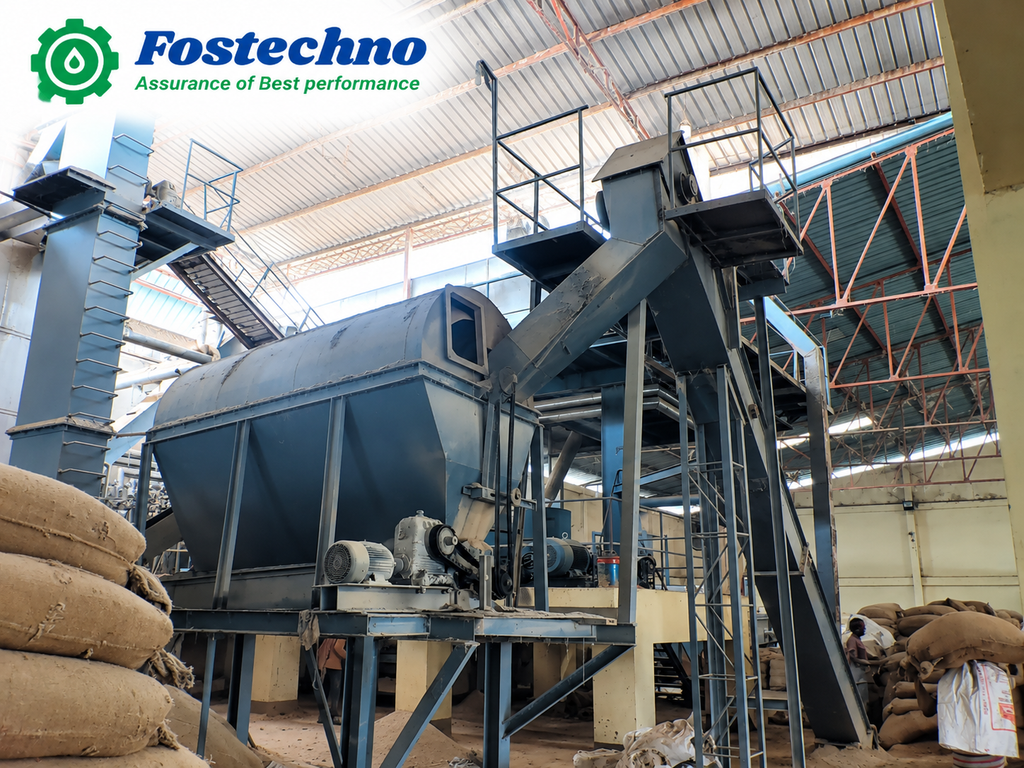
Meal Cooling & Bagging: The Complete Guide to the Final Stage of Solvent Extraction
When people talk about solvent extraction plants, most of the attention goes to the extractor, the desolventizer-toaster, and the distillation section. Meal cooling & bagging rarely gets the spotlight — yet it’s the stage that decides whether all that upstream processing actually turns into a sellable, safe, and stable product. Get this stage wrong, and you risk spoiled meal, fire hazards, dissatisfied buyers, and real financial loss. Get it right, and you protect the nutritional value of your meal all the way to the customer’s doorstep.
This guide breaks down what meal cooling & bagging actually involves, why it matters so much, the equipment options available, and what to look for when setting up or upgrading this section of your plant.
What Exactly Is Meal Cooling & Bagging?
After oilseeds pass through solvent extraction and desolventization-toasting (DT), the resulting meal (also called cake) leaves the toaster at a high temperature — typically in the range of 100–110°C — and still carries residual moisture and trace solvent.
At this stage, the meal cannot be stored, bagged, or transported safely. Two things need to happen first:
- Cooling – bringing the meal down from toaster-exit temperature to near-ambient levels, usually within a few degrees of the surrounding air temperature.
- Bagging (or bulk loading) – packaging the cooled, stabilized meal into bags, jumbo bags, or loading it directly into trucks/containers for onward transport.
Some plants add a conditioning or humidification step between cooling and bagging, where a controlled amount of moisture is reintroduced to bring the meal back to a target moisture percentage (usually to meet buyer specifications and to reduce dust generation during handling).
Why This Stage Deserves as Much Attention as Extraction Itself
It’s tempting to think of cooling and bagging as “just packaging,” but several critical outcomes depend entirely on how well this section is engineered.
1. Preventing Spontaneous Combustion
Hot meal stacked in bags or piled in storage, especially with residual oil and moisture, is a genuine fire risk. Oilseed meal (soybean, rapeseed, sunflower, cottonseed) has documented cases of self-heating and combustion when it’s bagged or stored while still warm. Cooling to near-ambient temperature is not a cosmetic step — it is a safety requirement.
2. Stopping Microbial and Enzymatic Activity
Warm, moist meal is an ideal environment for mold and bacterial growth. Left uncooled, meal can degrade in storage, losing protein quality and developing off-odors that make it unsellable to feed manufacturers.
3. Protecting Nutritional Value
Buyers — mostly animal feed manufacturers — pay for protein content, digestibility, and consistency. Uneven cooling or moisture control can cause caking, nutrient degradation, or uneven quality across a batch, which directly affects the price a plant can command.
4. Preventing Equipment and Structural Damage
Hot meal in direct contact with conveyors, bagging machines, or storage silos can warp components, damage bag material (many bags are woven polypropylene, which is heat-sensitive), and shorten equipment life.
5. Meeting Buyer and Export Specifications
International and domestic feed buyers specify strict moisture, temperature-at-dispatch, and packaging standards. Non-compliance can mean rejected shipments — an expensive problem to have at the very last stage of production.
How Meal Cooling Actually Works
Meal coolers generally use one of a few designs, and choosing the right one depends on plant capacity, seed type, and layout constraints.
Vertical multi-compartment coolers are among the most common. Meal moves downward through stacked compartments while ambient or cooled air is blown counter-currently (upward) through the bed. As the meal descends, it’s progressively cooled, and an integrated agitator keeps material moving evenly to avoid channeling or hot spots. These units are compact, fit well into existing plant heights, and offer high cooling capacity per unit footprint.
Horizontal counter-current coolers work on a similar counter-flow principle but in a horizontal bed. Hot meal enters at one end while cool atmospheric air is drawn through from the opposite direction. This layout is often chosen where vertical space is limited, and it’s well suited to plants processing 10–20 TPH (tonnes per hour) and above.
Fluidized bed coolers suspend the meal on a cushion of air, giving very rapid and uniform heat transfer. These are typically used where extremely tight temperature control is needed, though they demand more precise air-handling design.
In all designs, the core components tend to include:
- A blower/fan system for hot and cold air circulation
- Air cyclones to separate fine dust particles from the exhaust air stream
- Radiators or heat exchangers to manage air temperature
- Airlocks to prevent air leakage while allowing continuous meal flow
- A drive system (gearbox + motor) to move the agitator or internal mechanism
The goal across all these designs is the same: bring meal temperature down to within a few degrees of ambient, uniformly, without creating dust emissions or bottlenecking the line.
What Happens in the Bagging Section
Once meal is cooled (and conditioned, if moisture adjustment is required), it moves to the bagging line. This part of the plant typically includes:
- Weighing systems — manual, semi-automatic, or fully automatic scales that measure precise bag weights (commonly 50 kg bags, though jumbo/bulk bags are increasingly common for export)
- Bag filling and sealing machines — automated stitching or heat-sealing units that close bags at high speed
- Conveying and stacking systems — moving filled bags to loading docks or automated palletizers
- Dust control systems — since meal handling generates fine particulate matter, dust extraction and suppression are essential both for product loss prevention and workplace safety
- Bulk loading arms — for plants that ship meal loose into trucks or rail cars rather than bagging it
Modern plants increasingly favor automatic or semi-automatic bagging over manual operations because it reduces labor cost, improves weight accuracy (critical when meal is sold by weight), and minimizes product contamination from handling.
Key Factors to Evaluate Before Choosing a Cooling & Bagging System
If you’re setting up a new plant or upgrading an existing meal handling section, here are the questions worth asking your equipment supplier:
- What is my required throughput (TPH)? Cooling and bagging capacity must match your extraction plant’s output, or it becomes a bottleneck.
- What seed/meal type am I processing? Soybean, rapeseed, sunflower, and cottonseed meals behave differently in terms of moisture retention, oil residue, and flowability.
- How much ambient temperature variation does my location see? Air-cooling efficiency depends heavily on the temperature and humidity of the intake air, which affects design in hot, humid climates versus drier regions.
- Do I need moisture conditioning? If your buyers specify a target moisture percentage, a conditioning/humidification stage should be integrated rather than added later.
- What automation level fits my labor and budget constraints? Fully automatic systems cost more upfront but reduce long-term labor dependency and improve consistency.
- How will dust be managed? Dust isn’t just a housekeeping issue — fine oilseed meal dust is combustible, so proper extraction and suppression systems are a safety necessity, not an optional add-on.
- What after-sales support does the supplier offer? Cooling and bagging equipment runs continuously in demanding conditions; spare parts availability and service response time matter as much as the initial installation.
Common Mistakes Plants Make in This Section
- Undersizing the cooler relative to actual plant throughput, which forces meal to be bagged before it’s fully cooled
- Ignoring air quality/humidity in the cooling air supply, leading to inconsistent cooling performance across seasons
- Underestimating dust generation, resulting in product loss, housekeeping issues, and potential safety violations
- Treating bagging as a purely mechanical afterthought, without integrating weight accuracy and moisture checks into the workflow
- Delaying automation upgrades, which keeps labor costs high and increases the risk of manual weighing errors
The Role of Automation and Smart Monitoring
Newer meal cooling & bagging installations are increasingly integrating temperature sensors, automated control loops, and data logging into the process. This allows plant operators to:
- Continuously monitor meal temperature at multiple points rather than relying on spot checks
- Automatically adjust air flow rates based on real-time readings
- Log batch-level data for quality traceability, which is increasingly demanded by large feed buyers and export markets
- Detect equipment issues (like airlock failures or blower inefficiencies) before they cause a full breakdown
For plants aiming to scale or export, this kind of digital visibility is quickly becoming a competitive differentiator, not just a convenience.
How Fostechno Approaches Meal Cooling & Bagging
At Fostechno, we design meal cooling & bagging systems as an integrated part of the solvent extraction line — not as a bolt-on afterthought. Our approach is built around three priorities:
- Reliable, uniform cooling — engineering the cooler to match your plant’s actual throughput and seed characteristics, so meal reaches near-ambient temperature consistently, batch after batch, without creating bottlenecks upstream.
- Safety-first design — proper dust extraction, airlock integrity, and structural safeguards built in from the start, because we treat combustion and spoilage risk as core design criteria, not compliance checkboxes.
- Flexible bagging solutions — whether you need manual, semi-automatic, or fully automatic weighing and bagging, we help you choose the configuration that fits your current scale while leaving room to automate further as you grow.
Our team works closely with plant operators to understand seed type, climate conditions, buyer specifications, and existing infrastructure before recommending a system — so the solution fits your operation, not a generic template.
Looking to set up a new meal cooling & bagging line, or upgrade an underperforming one? Get in touch with the Fostechno team to discuss your plant’s requirements and get a solution engineered around your exact needs.
Final Thoughts
Meal cooling & bagging might sit at the tail end of the solvent extraction process, but it carries outsized importance for product safety, quality, and commercial value. A well-designed cooling system protects against fire hazards and spoilage, while an efficient bagging line ensures consistent, accurately weighed, contamination-free product ready for market.
When evaluating equipment or planning an upgrade, look beyond the basic “we cool and we bag” pitch. Ask about cooler type suitability for your seed and climate, dust and safety handling, automation level, and long-term service support. That’s what separates a plant that runs smoothly for decades from one that keeps running into avoidable, costly problems.
Frequently Asked Questions
1. Why can’t meal be bagged directly after desolventization? Meal exiting the desolventizer-toaster is too hot (often 100°C+) and carries residual solvent and moisture. Bagging it at this stage risks spontaneous combustion, microbial spoilage, and bag damage.
2. How long does it take to cool meal to ambient temperature? This depends on cooler design, throughput, and ambient conditions, but well-designed continuous systems cool meal within minutes as part of the ongoing production flow, not as a separate batch delay.
3. What’s the difference between vertical and horizontal meal coolers? Vertical coolers use stacked compartments and are compact for plants with height available; horizontal coolers use a counter-current air flow along a horizontal bed and suit plants with limited vertical clearance.
4. Is moisture conditioning always required? Not always — it depends on buyer specifications. Many feed manufacturers specify a target moisture range, which requires a conditioning/humidification step after cooling.
5. Why is dust control so important in this section? Beyond product loss, fine oilseed meal dust is combustible and can pose explosion risks if not properly extracted and managed, making dust control a safety-critical design element.
6. Should I choose manual or automatic bagging equipment? For smaller throughput operations, semi-automatic systems may be cost-effective. Larger or export-oriented plants generally benefit from fully automatic weighing and bagging for accuracy, speed, and lower long-term labor costs.


