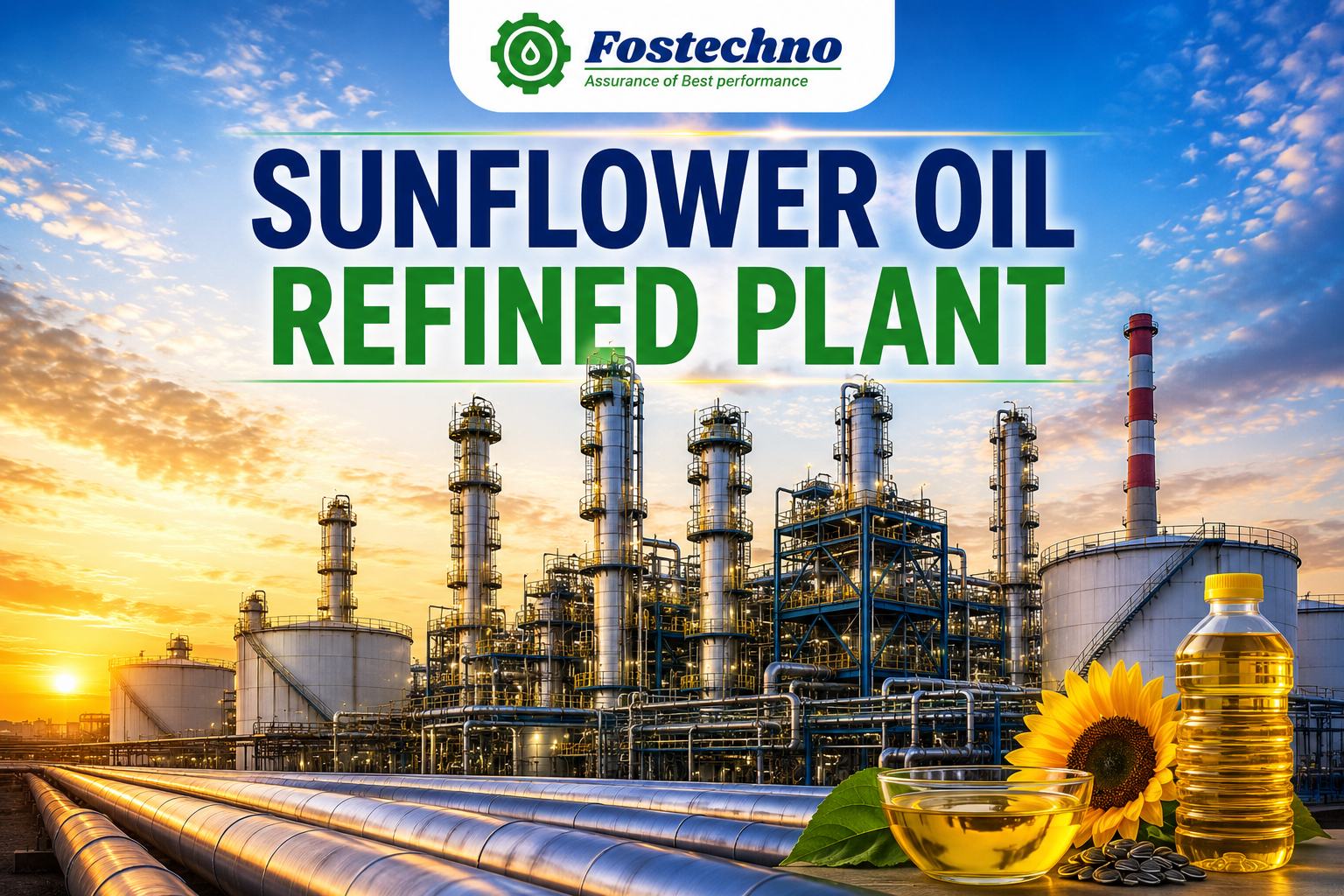
The demand for high-quality edible oils continues to grow worldwide, and sunflower oil remains one of the most preferred cooking oils due to its light taste, nutritional value, and versatility. A Sunflower Oil Refined Plant plays a crucial role in transforming crude sunflower oil into a premium-grade product suitable for household, commercial, and industrial use.
For entrepreneurs, edible oil manufacturers, and investors looking to enter the vegetable oil industry, setting up a sunflower oil refining facility can be a profitable business opportunity. However, understanding the refining process, machinery requirements, plant capacity, investment costs, and operational considerations is essential before making any investment decision.
In this comprehensive guide, we will explain everything you need to know about establishing a sunflower oil refined plant and how a trusted engineering partner like FOSTECHNO Process & Engineering Pvt. Ltd. can help deliver a complete turnkey solution.
What Is a Sunflower Oil Refined Plant?
A Sunflower Oil Refined Plant is an industrial facility designed to purify crude sunflower oil by removing impurities, free fatty acids, phospholipids, waxes, pigments, odor compounds, and other unwanted substances.
The refining process improves:
- Oil color
- Taste and aroma
- Shelf life
- Stability
- Consumer acceptance
- Food safety standards
Refined sunflower oil is widely used in:
- Household cooking
- Restaurants and hotels
- Food processing industries
- Snack manufacturing
- Bakery products
- Ready-to-eat food production
The primary objective of refining is to produce clear, odorless, and high-quality edible sunflower oil that complies with international food-grade standards.
Why Invest in a Sunflower Oil Refined Plant?
The global edible oil market continues to expand due to increasing population growth and rising food consumption. Sunflower oil is particularly popular because of its nutritional profile and broad market demand.
Key Business Benefits
High Market Demand
Sunflower oil is consumed extensively in domestic and commercial kitchens worldwide.
Attractive Profit Margins
Refining adds value to crude oil, allowing manufacturers to achieve better selling prices.
Growing Export Opportunities
Many countries import refined sunflower oil to meet local consumption needs.
Scalable Production
Plants can be designed for small, medium, or large production capacities.
Long-Term Business Stability
Edible oil remains an essential consumer product regardless of economic fluctuations.
Types of Sunflower Oil Refining Plants
Depending on production requirements, sunflower oil refining facilities are available in different capacities.
Batch Refining Plant
Batch refining systems are ideal for:
- Small-scale producers
- Startup businesses
- Pilot production units
Typical capacities:
- 1 TPD
- 2 TPD
- 5 TPD
- 10 TPD
- 20 TPD
Advantages include lower initial investment and operational flexibility.
Semi-Continuous Refining Plant
Semi-continuous systems are suitable for:
- Medium-scale manufacturers
- Growing edible oil brands
- Regional distributors
Typical capacities:
- 30 TPD
- 50 TPD
- 100 TPD
These plants offer improved productivity and process control.
Continuous Refining Plant
Continuous refining facilities are designed for large-scale production.
Typical capacities:
- 100 TPD
- 200 TPD
- 300 TPD
- 500 TPD+
- 1000 TPD+
Benefits include:
- High automation
- Lower production costs
- Consistent product quality
- Maximum operational efficiency
Sunflower Oil Refining Process Explained
The refining process consists of several critical stages that ensure the final oil meets food-grade standards.
1. Crude Oil Storage
Crude sunflower oil obtained from extraction plants is stored in specialized storage tanks before processing.
Quality checks are performed to determine:
- Moisture content
- Free fatty acid levels
- Impurity concentration
- Phospholipid content
2. Degumming Process
Degumming removes phospholipids and gummy substances from crude oil.
The process involves:
- Heating the oil
- Adding water or acid
- Mixing and reaction
- Separation using centrifuges
Benefits:
- Improved oil stability
- Better refining efficiency
- Enhanced final product quality
3. Neutralization
Neutralization removes free fatty acids (FFA) from sunflower oil.
The process includes:
- Addition of caustic soda
- Chemical reaction with fatty acids
- Soapstock separation
- Oil purification
Advantages:
- Reduced acidity
- Better taste
- Improved shelf life
4. Washing and Drying
After neutralization, the oil is washed to remove residual soap particles.
The oil is then dried under vacuum conditions to eliminate moisture.
Benefits include:
- Cleaner oil
- Reduced contamination risks
- Improved refining performance
5. Bleaching Process
Bleaching improves the color and appearance of sunflower oil.
This stage removes:
- Pigments
- Oxidation products
- Trace metals
- Residual impurities
Activated bleaching earth is commonly used during this process.
Results:
- Lighter oil color
- Enhanced product appearance
- Better consumer acceptance
6. Dewaxing or Winterization
Sunflower oil contains natural waxes that can cause cloudiness at lower temperatures.
Dewaxing removes these wax particles through:
- Controlled cooling
- Crystal formation
- Filtration
Benefits:
- Crystal-clear oil
- Improved cold stability
- Higher market value
7. Deodorization
Deodorization is the final purification stage.
The process uses:
- High vacuum
- Controlled temperatures
- Steam distillation
This removes:
- Odor compounds
- Volatile substances
- Unwanted flavors
The result is:
- Neutral taste
- Odor-free oil
- Premium edible oil quality
Machinery Required for a Sunflower Oil Refined Plant
A complete refining facility requires specialized equipment.
Major Equipment Includes
Crude Oil Storage Tanks
Used for safe storage of incoming crude sunflower oil.
Degumming System
Removes phospholipids and gums.
Neutralization Tank
Eliminates free fatty acids.
Centrifugal Separators
Separate impurities and soapstock efficiently.
Vacuum Drying System
Removes moisture content.
Bleaching Vessel
Improves oil appearance and quality.
Filter Press
Removes bleaching earth and contaminants.
Dewaxing Unit
Ensures crystal-clear oil.
Deodorization Tower
Removes odors and volatile compounds.
Heat Exchangers
Improve thermal efficiency.
Steam Boiler
Provides process heating.
Automation Control Panel
Monitors and controls plant operations.
Capacity Planning for a Sunflower Oil Refined Plant
Choosing the correct plant capacity is a critical business decision.
Small-Scale Plants
Capacity:
- 1–20 TPD
Suitable for:
- Local edible oil brands
- Startup businesses
- Regional markets
Medium-Scale Plants
Capacity:
- 30–100 TPD
Suitable for:
- Established processors
- Expanding edible oil companies
Large-Scale Plants
Capacity:
- 100–1000 TPD+
Suitable for:
- Export-oriented businesses
- National brands
- Industrial oil manufacturers
Sunflower Oil Refined Plant Cost
The total investment depends on multiple factors.
Key Cost Factors
Plant Capacity
Higher capacity plants require larger investments.
Level of Automation
Fully automated systems cost more but reduce labor expenses.
Machinery Configuration
Equipment quality impacts capital expenditure.
Utility Requirements
Includes:
- Steam generation
- Electricity
- Water treatment
- Compressed air systems
Civil Construction
Building infrastructure and foundation costs vary by location.
Packaging Requirements
Additional filling and packaging lines increase investment.
Estimated Investment Range
The actual cost depends on:
- Production capacity
- Technology selection
- Automation level
- Local regulations
- Utility availability
For accurate pricing, a detailed project assessment is recommended.
Utilities Required for Refining Operations
Efficient refinery performance depends on reliable utilities.
Essential Utilities
- Steam boiler system
- Electricity supply
- Cooling water system
- Compressed air
- Vacuum system
- Water treatment plant
- Effluent treatment plant
Proper utility planning significantly improves plant efficiency and product quality.
Quality Control in Sunflower Oil Refining
Maintaining consistent quality is critical for commercial success.
Important Quality Parameters
Free Fatty Acid Content
Must remain within edible oil standards.
Color
Measured using industry-standard testing methods.
Moisture Level
Low moisture improves shelf life.
Peroxide Value
Indicates oxidation stability.
Taste and Odor
Should be neutral and consumer-friendly.
Regular laboratory testing ensures compliance with food safety regulations.
Environmental and Safety Considerations
Modern refining plants must follow environmental and safety standards.
Key Measures
- Wastewater treatment systems
- Energy-efficient equipment
- Dust collection systems
- Fire protection systems
- Employee safety training
- Process monitoring systems
These measures improve sustainability while reducing operational risks.

Turnkey Sunflower Oil Refined Plant Solutions
Many investors prefer turnkey solutions because they simplify project execution.
A turnkey project typically includes:
- Project consultation
- Plant design
- Process engineering
- Equipment manufacturing
- Installation
- Commissioning
- Operator training
- Technical support
This approach minimizes delays and ensures smooth plant startup.
Why Choose FOSTECHNO for Sunflower Oil Refining Projects?
FOSTECHNO Process & Engineering Pvt. Ltd. specializes in delivering advanced edible oil processing and refining solutions for clients worldwide.
Our Expertise Includes
- Sunflower oil refining plants
- Edible oil processing plants
- Oil extraction plants
- Palm oil refinery plants
- Solvent extraction plants
- Biodiesel production plants
- Complete turnkey projects
What We Offer
- Customized plant design
- Energy-efficient technology
- International quality standards
- End-to-end project support
- Reliable after-sales service
- Competitive project costs
Whether you are planning a small-scale refinery or a large industrial production facility, our engineering team can provide a solution tailored to your business goals.
Conclusion
A Sunflower Oil Refined Plant is a valuable investment opportunity in the growing edible oil industry. By converting crude sunflower oil into a premium refined product, businesses can increase profitability, improve product quality, and expand into domestic and international markets.
Success depends on selecting the right refining technology, choosing suitable plant capacity, maintaining quality standards, and partnering with an experienced engineering company.
With advanced technology, customized engineering solutions, and complete turnkey project execution, FOSTECHNO Process & Engineering Pvt. Ltd. helps businesses establish efficient, reliable, and profitable sunflower oil refining plants that meet modern industry requirements.



Leave a Reply