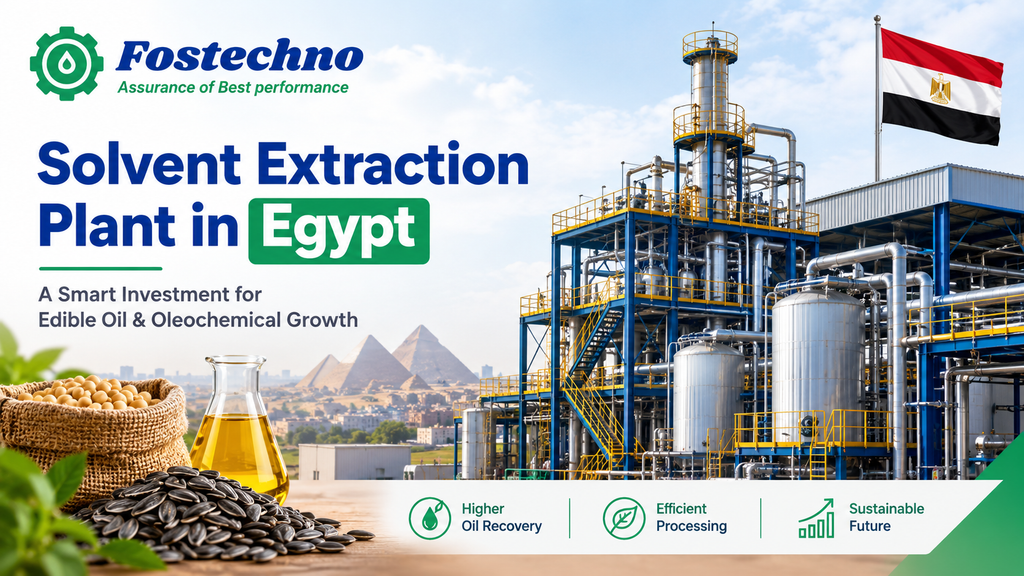
Egypt is one of the largest consumers of edible oil in the Middle East and North Africa, yet it depends heavily on imports to meet domestic demand. That gap between consumption and local production is exactly why a solvent extraction plant in Egypt is one of the most attractive industrial investments in the region today.
Whether you are an existing oil mill owner who wants to increase oil recovery, an entrepreneur entering the edible oil industry, or a feed manufacturer looking for a steady supply of high-protein meal, a solvent extraction plant can transform your business economics. It recovers nearly all the oil from oilseeds and oil-bearing materials, leaving behind a nutritious de-oiled meal that is in strong demand across Egypt’s poultry, dairy and aquaculture sectors.
This guide covers everything you need to know: why Egypt is a strong market, how the process works, which feedstocks suit local conditions, what equipment you need, the cost drivers, regulations, safety and how to choose the right engineering partner. It is written by the team at FOSTECHNO Process & Engineering Private Limited, a process engineering company that designs and supplies extraction plants and related process solutions.
Why Egypt Is a Strong Market for Solvent Extraction Plants
A large population with growing demand
Egypt has a population above 100 million, and edible oil is a daily staple in Egyptian kitchens, in food manufacturing and in the foodservice sector. Demand rises every year with population growth, urbanisation and expansion of the packaged food industry.
Heavy import dependence
Egypt produces only a small share of the edible oil it consumes. The rest is imported, mainly as crude or refined soybean, sunflower and palm oil, along with large volumes of oilseeds. Import dependence exposes the country to global price swings and currency pressure. Local crushing and extraction capacity is therefore a strategic priority, and the government has repeatedly signalled support for local food-processing industries.
Strong demand for protein meal
Egypt’s poultry and livestock sectors need large volumes of soybean meal and other protein feed ingredients. A solvent extraction plant produces exactly this. Even if the oil price fluctuates, the meal side of the business gives the plant a second, reliable revenue stream.
Strategic geography
Egypt sits at the crossroads of Africa, the Middle East and Europe. The Suez Canal, major ports such as Alexandria, Damietta and Sokhna, and a developing logistics network make it practical to import raw materials and export finished products. For investors, the country can serve as a processing hub for the wider region.
Industrial zones and incentives
Egypt has developed several industrial zones, including the Suez Canal Economic Zone (SCZone), 10th of Ramadan City, Sadat City, Borg El Arab and Badr City. These offer ready infrastructure, utilities and, in many cases, investment incentives. Policies change from time to time, so always verify current incentives with the relevant Egyptian authority before finalising your plan.
What Is a Solvent Extraction Plant?
A solvent extraction plant is an industrial facility that recovers oil from oil-bearing materials using a food-grade solvent, most commonly n-hexane. Instead of relying only on mechanical pressing, which typically leaves a significant amount of oil behind in the cake, the solvent dissolves the remaining oil and carries it out of the material.
In simple terms:
- Prepared oilseed material is brought into contact with hexane.
- The hexane dissolves the oil, forming a mixture called miscella.
- The miscella is separated from the solid meal.
- Hexane is evaporated and recovered from the miscella, leaving crude oil.
- Hexane is also stripped from the meal, leaving de-oiled meal that can be used as animal feed or protein ingredient.
- The recovered hexane is condensed and reused in a closed loop.
A well-designed plant can reduce residual oil in meal to very low levels, around 0.5 to 1.5 percent depending on the raw material, compared with the much higher oil left in cake after pressing alone. For a plant processing hundreds of tonnes per day, that extra recovery makes a major difference to profitability.
Mechanical Pressing vs. Solvent Extraction
| Parameter | Mechanical Pressing (Expeller) | Solvent Extraction |
|---|---|---|
| Residual oil in cake/meal | High (around 6–12%) | Very low (around 0.5–1.5%) |
| Best suited for | Small to medium capacity, high-oil seeds | Medium to large capacity, low-oil seeds and cake |
| Oil recovery | Moderate | Very high |
| Capital cost | Lower | Higher |
| Operating cost per tonne | Higher oil loss | Lower overall cost at scale |
| Meal quality | Cake with higher fat | Protein-rich de-oiled meal |
For high-oil seeds like sunflower or rapeseed, the common approach is pre-pressing followed by solvent extraction. For low-oil seeds like soybean, direct solvent extraction after flaking is standard.
Feedstocks Suitable for Solvent Extraction in Egypt
Choosing the right raw material is the foundation of your business plan. The choice depends on local availability, import options, seasonality and market demand for the end products.
1. Soybean
Soybean is the most widely processed oilseed globally and a leading feedstock for solvent extraction. In Egypt, soybeans are largely imported. Soybean contains roughly 18 to 20 percent oil, so direct extraction after conditioning and flaking is efficient. The resulting soybean meal (typically 44 to 48 percent protein) is the main feed protein for the poultry industry.
2. Cottonseed
Egypt has a long history of cotton cultivation, which makes cottonseed a locally relevant feedstock. Cottonseed needs delinting and dehulling before extraction. Cottonseed oil is used in food and industrial applications, and the meal is used as a feed ingredient, with attention to gossypol content.
3. Sunflower seed
Sunflower is a high-oil seed (40 to 50 percent oil depending on variety). It is usually dehulled, pre-pressed and then solvent extracted. Egypt grows some sunflower and also imports it.
4. Corn germ
Egypt has a large corn milling and starch industry. Corn germ is a by-product that is rich in oil, and solvent extraction is an effective way to recover corn oil from it. This is a smart option for plants located near corn mills.
5. Rice bran
Rice is a major crop in the Nile Delta. Rice bran is a valuable raw material for rice bran oil, which is popular for its nutritional profile. Rice bran must be processed quickly after milling, because enzymes (lipase) rapidly increase free fatty acids. A properly designed plant needs stabilisation and efficient handling.
6. Other options
Depending on market opportunities, plants can also be designed for rapeseed or canola, groundnut cake, palm kernel and other oil-bearing materials. A multi-seed design provides flexibility against seasonal supply or price swings, though it affects equipment selection and cost.
Practical tip: Many successful plants are designed to be flexible, for example soybean as the primary feed with the ability to handle sunflower or cottonseed. Discuss this at the design stage, because adding flexibility later is far more expensive.
The Solvent Extraction Process: Step by Step
Understanding the process helps you evaluate proposals, ask better questions and operate the plant efficiently. Here is the typical flow for oilseed extraction.
Step 1: Seed receiving and storage
Seeds arrive by truck or are unloaded from ships and transported to the plant. They pass through weighbridges, receiving hoppers and conveyors into silos or flat storage. Proper storage prevents moisture, heating, mould and insect damage, all of which reduce quality and oil yield.
Step 2: Seed cleaning
Raw seed contains sand, stones, metal pieces, stalks and other impurities. These can damage equipment and reduce product quality. Vibrating screens, destoners and magnetic separators remove them. Clean feed is essential for stable operation.
Step 3: Drying and conditioning
Seed moisture must be within an optimal range for the next steps. Dryers lower excess moisture, while conditioners heat the seed to make it soft and plastic, so it flakes well without breaking into powder.
Step 4: Dehulling (where required)
For sunflower, cottonseed and some soybean processes, hulls are removed to raise the protein content of the meal and improve extraction efficiency. Cracking rolls break the seed, and aspirators and screens separate hulls from kernels.
Step 5: Flaking
Flaking rolls press conditioned seed into thin flakes, typically a fraction of a millimetre thick. Thin flakes have a large surface area and short diffusion paths, which allow the solvent to reach the oil quickly and completely. Flake quality is one of the biggest influences on extraction performance.
Step 6: Pre-pressing or expanding (for high-oil seeds)
For sunflower, rapeseed or cottonseed, a pre-press removes a major portion of the oil mechanically. The partly de-oiled cake is then fed to the extractor. For soybean and some other seeds, an expander may be used to make porous, dense collets that improve solvent percolation and increase extractor throughput.
Step 7: Solvent extraction
This is the heart of the plant. Flakes or collets enter the extractor, where hexane washes through the bed in a counter-current manner. Fresh solvent contacts the almost-depleted material at the end, and the richer miscella contacts fresh material at the start, maximising oil recovery. Common extractor designs include deep-bed (rotary or chain type) and loop-type extractors, selected according to capacity and material.
Step 8: Desolventiser-Toaster (DT)
The wet meal leaving the extractor contains a significant amount of hexane. It enters the desolventiser-toaster, where indirect steam and direct steam remove the solvent. For soybean meal, toasting deactivates anti-nutritional factors such as trypsin inhibitors, making the meal safe and digestible for animals. The meal is then dried and cooled.
Step 9: Miscella distillation
The miscella (oil plus hexane) is concentrated through a series of evaporators and a stripping column. Hexane vapour is evaporated, condensed and returned to the process. The remaining product is crude oil with minimal solvent residue.
Step 10: Solvent recovery system
Hexane vapour from the desolventiser, the evaporators and the extractor is condensed. A mineral oil absorption system or other vent recovery system captures the traces of solvent in the exhaust air, reducing losses and emissions. Low solvent loss is a key performance indicator of a modern plant, often expressed in litres of hexane per tonne of seed processed.
Step 11: Meal handling and oil storage
Cooled meal can be ground, pelletised or sold in bulk. Crude oil goes to storage tanks, and may be sent to a refinery (inside or outside your company) for degumming, neutralisation, bleaching and deodorisation.
Main Equipment in a Solvent Extraction Plant
A complete plant has the following main sections:
- Seed handling section: receiving hoppers, bucket elevators, conveyors, silos, weighing systems
- Cleaning and preparation section: cleaners, destoners, magnets, dryers, conditioners, cracking rolls, dehullers, flaking mills
- Pre-press or expander section: screw presses, expanders, cake breakers (as needed)
- Extraction section: extractor, miscella tanks, filtration, hydrocyclones
- Desolventiser-toaster and meal section: DT, dryer, cooler, meal conveyor, grinder, pelletiser (optional)
- Distillation section: evaporators, strippers, condensers, vacuum system
- Solvent recovery section: vent condenser, absorber and stripper, solvent tanks, water separator
- Utilities: steam boiler, cooling tower, compressed air, effluent treatment, electrical system, thermal fluid heater (if used)
- Control and safety systems: PLC/SCADA automation, gas detection, flameproof electricals, fire protection
The right size and specification for each section depends on seed type, capacity and desired meal quality.
Capacity Ranges and Typical Products
Solvent extraction plants are commonly built in capacities such as 50, 100, 200, 300, 500, 1000 TPD (tonnes per day) or higher. Smaller plants (50 to 150 TPD) suit regional processors and entrepreneurs entering the market. Medium plants (200 to 500 TPD) suit established oil mills that want scale. Larger plants (1000 TPD and above) serve integrated edible oil and feed groups.
Primary products:
- Crude vegetable oil (soybean, sunflower, cottonseed, corn, rice bran and so on)
- De-oiled meal or cake (soybean meal, sunflower meal, rice bran extraction, cottonseed meal)
Secondary products and by-products:
- Lecithin (from soybean degumming)
- Hulls (for fibre feed or boiler fuel)
- Fatty acid distillate and soapstock (from refining)
Smart operators plan for by-product value from the beginning, since it improves overall margins.
Investment and Cost Factors
The question every investor asks is “How much will a solvent extraction plant in Egypt cost?” There is no single answer, because the cost depends on several variables. Instead of quoting a misleading number, here are the factors that drive the investment.
1. Plant capacity
Higher capacity means a larger investment overall, but a lower cost per tonne of capacity because of economies of scale.
2. Raw material type and process complexity
A soybean plant is simpler than a plant that handles sunflower with dehulling and pre-pressing. Multi-seed flexibility adds cost.
3. Level of automation
Modern plants use PLC or SCADA control to improve consistency, reduce manpower and cut solvent and steam consumption. Higher automation raises upfront cost but typically lowers operating cost.
4. Equipment quality and design standards
Cheaper equipment can lead to higher solvent loss, higher steam consumption, more breakdowns and poorer product quality. Over a 15 to 20 year plant life, these hidden costs can far exceed the initial saving.
5. Civil and structural work
The extractor and DT building, tank farm, silos, foundations, and fire-resistant construction are a significant part of the budget. Soil conditions and local construction costs matter.
6. Utilities
Boiler capacity, fuel choice (natural gas, coal, biomass or other), water source, power supply and effluent treatment all affect cost.
7. Land, permits and logistics
Land price varies between industrial zones. Import duties on equipment, shipping, port charges and installation costs also contribute.
8. Working capital
Raw material is the largest operating cost. You need enough working capital for seed purchase, since seed is often bought in bulk during the season or imported against letters of credit.
Understanding profitability
The economics of an extraction plant depend on the crush margin, which is the value of oil plus meal minus the cost of seed and processing. Key levers include oil recovery, meal quality and price, steam and power consumption, solvent loss, plant uptime and raw material buying strategy. A good engineering partner will help you build a realistic techno-economic model before you commit.
Regulations, Permits and Location Selection
Choosing the right location
Think about these factors:
- Proximity to raw material: near ports if you import seed, near farming regions or corn and rice mills if you use local by-products
- Proximity to customers: feed mills, poultry farms and refiners
- Utilities: reliable power, water, gas and road access
- Zoning: solvent extraction plants handle flammable hexane, so they must be located in approved industrial zones with proper safety distances
- Future expansion: leave room for capacity increase or a refinery
Permits and approvals
Typical requirements for setting up an industrial facility in Egypt include company registration, industrial licensing, environmental approval, civil defence and fire safety clearance, and trade or import registrations. Egypt has been streamlining investment procedures, and bodies such as the General Authority for Investment and Free Zones (GAFI) and industrial development authorities provide guidance. Rules and procedures change, so confirm current requirements with a qualified local legal and regulatory consultant.
Food safety and quality standards
If your oil and meal are for food and feed use, you should plan for compliance with applicable food and feed safety requirements and with recognised quality management systems such as ISO 9001, ISO 22000 or HACCP-based systems, depending on your market.
Safety and Environmental Considerations
Hexane is flammable, so safety is a design priority, not an afterthought. A responsible plant design includes:
- Explosion-proof (flameproof) electrical equipment in hazardous zones
- Hazardous area classification for extraction and solvent storage areas
- Solvent leak detection and LEL gas monitoring with alarms and interlocks
- Nitrogen or inert gas protection where appropriate
- Proper grounding and static control
- Fire detection and firefighting systems, including foam and water spray
- Emergency shutdown logic in the control system
- Safe distances between the solvent tank farm, the extraction building and other facilities
- Operator training and strict permit-to-work procedures
On the environmental side, a modern plant minimises solvent emissions through efficient vent recovery, treats wastewater through an effluent treatment plant, and manages boiler emissions and dust. Efficient heat recovery and good steam management also lower the plant’s energy footprint. Environmental performance is not only a compliance requirement; it also lowers operating cost, since every litre of hexane you don’t lose is money saved.
Technology Trends That Improve Plant Performance
Energy efficiency
Steam is one of the largest operating costs. Heat integration, efficient DT design, multi-effect evaporation and proper insulation can significantly reduce steam consumption per tonne of seed.
Automation and digital monitoring
PLC and SCADA systems provide stable control of temperatures, flows, levels and pressures. Remote monitoring and data logging help with predictive maintenance, quality traceability and fast troubleshooting.
Low solvent loss design
Advanced vent recovery and tight sealing reduce hexane consumption, which improves both cost and safety.
High-throughput extractors
Modern extractors give better solvent percolation, lower residence time variability and higher capacity per square metre of plant footprint.
Integration with refining
Many investors pair extraction with a refinery so they can sell refined, packaged oil at higher margins. Designing both together saves on utilities, buildings and manpower.
How to Choose the Right Solvent Extraction Plant Partner
Selecting your technology and engineering partner is the single most important decision in the project. Evaluate suppliers on these points:
- Process expertise: Do they understand your specific raw material, not just generic extraction?
- Turnkey capability: Can they handle design, supply, installation, commissioning and training?
- Performance guarantees: Will they commit to measurable parameters like residual oil in meal, solvent loss, steam consumption and capacity?
- Quality of fabrication: Check materials of construction, welding quality and testing procedures.
- Safety engineering: Do they follow recognised safety practices for hazardous solvent plants?
- After-sales support: Spare parts, service engineers and operator training matter after the ribbon-cutting.
- References: Ask for customer references and, where possible, visit operating plants.
- Export and project experience: International shipping, documentation and site execution are different from domestic projects.
Why FOSTECHNO Process & Engineering Private Limited
FOSTECHNO Process & Engineering Private Limited is a process engineering company focused on designing and delivering industrial process plants. For clients planning a solvent extraction plant in Egypt, we bring an engineering-first approach built around three ideas: efficiency, safety and long-term reliability.
What you can expect when you work with us:
- Application-specific process design: We design around your feedstock, capacity, product targets and site conditions rather than forcing a standard layout onto your project.
- Turnkey project support: From process engineering and equipment supply to installation guidance, commissioning and operator training.
- Focus on recovery and cost control: Designs aimed at high oil recovery, low solvent loss and efficient utilisation of steam and power.
- Safety-led engineering: Hazardous-area planning, instrumentation and interlocks integrated from the design stage.
- Customisation and scalability: Plants that can be expanded as your business grows, or paired with refining and downstream units.
- Transparent communication: Clear technical proposals, realistic timelines and open discussion on performance parameters.
Every project begins with understanding your business goals. We then translate them into a practical plant configuration with a clear scope, a defined schedule and measurable performance.
Project Execution Roadmap
A typical path from idea to production looks like this:
Phase 1: Feasibility and planning (1–3 months)
Define raw material, capacity, market, location and budget. Prepare a techno-economic feasibility report.
Phase 2: Basic and detailed engineering (2–4 months)
Process flow diagrams, P&IDs, plant layout, equipment specifications, hazardous area classification and utilities design.
Phase 3: Procurement and fabrication (4–8 months)
Manufacturing of major equipment, inspection and testing, and shipping logistics to Egypt.
Phase 4: Civil work and installation (4–8 months, partly overlapping)
Foundations, structural steel, equipment erection, piping, electrical and instrumentation work.
Phase 5: Commissioning and training (1–2 months)
Cold trials, hot trials, solvent charging, performance tests and operator training.
Phase 6: Commercial production and support
Stabilisation of operation, optimisation and ongoing technical support.
Timelines vary with project size, import clearance, site readiness and weather conditions, so treat these as indicative ranges only.
Common Mistakes to Avoid
- Choosing equipment only on price. Low capital cost often means high operating cost and frequent downtime.
- Ignoring raw material supply. A beautiful plant is useless without reliable seed procurement. Secure supply chains and storage first.
- Underestimating utilities. Steam, water, power and effluent treatment must be sized correctly.
- Neglecting safety design. Cutting corners on a hexane plant is never worth the risk.
- No plan for meal and by-product sales. Line up buyers for meal, hulls and lecithin early.
- Poor site selection. Wrong zoning, poor access or weak utilities can delay a project by months.
- Skipping operator training. The best plant underperforms in untrained hands.
- Not planning working capital. Seed is a large, recurring expense. Plan for it.
Frequently Asked Questions (FAQs)
1. What is a solvent extraction plant?
It is a facility that uses a food-grade solvent, usually hexane, to extract oil from oilseeds and oil-bearing materials, producing crude oil and de-oiled meal with very low residual oil.
2. Why set up a solvent extraction plant in Egypt?
Egypt has high edible oil demand, heavy import dependence, a large poultry and livestock feed sector and strategic port access. These factors create steady demand for locally produced oil and meal.
3. Which oilseeds are best for extraction in Egypt?
Soybean, cottonseed, sunflower, corn germ and rice bran are all relevant. The best choice depends on availability, import options and your target products.
4. What capacity should I start with?
That depends on your budget, raw material access and market. Many investors begin with 100 to 300 TPD, while larger groups choose bigger capacities. A feasibility study will help you decide.
5. How much oil can a solvent extraction plant recover?
A well-designed plant can reduce residual oil in the meal to very low levels, typically around 0.5 to 1.5 percent depending on the material, which means very high overall oil recovery.
6. Is solvent extraction safe?
Hexane is flammable, but with proper design, hazardous-area electricals, gas detection, interlocks, fire protection and trained staff, plants operate safely.
7. Can I add a refinery later?
Yes, and it is a common strategy. It is wise to plan utilities, layout and land area with a future refinery in mind.
8. How long does it take to build a plant?
Many projects take roughly a year or more from engineering to commissioning, depending on capacity, procurement, import logistics and site readiness.
9. Does FOSTECHNO provide turnkey solutions?
FOSTECHNO Process & Engineering Private Limited provides process design, equipment supply and project support for extraction plants, tailored to the client’s raw material and capacity requirements. Contact our team for scope details on your specific project.
10. How do I get a quotation?
Share your raw material, desired capacity, location and timeline. Our engineers will review your requirements and respond with a technical and commercial proposal.
Conclusion
A solvent extraction plant in Egypt is more than a processing facility. It is a strategic asset that taps into the country’s large edible oil and animal feed markets while reducing dependence on imports. With the right feedstock strategy, efficient process design, strong safety standards and a reliable engineering partner, it can deliver strong returns for many years.
The key is careful planning: understand your raw material, size the plant realistically, design for safety and energy efficiency, secure your supply chain and choose a partner who will stand behind performance after commissioning.
FOSTECHNO Process & Engineering Private Limited is ready to help you evaluate your project, from first feasibility discussion to successful start-up.
Ready to Start Your Solvent Extraction Project in Egypt?
📩 Contact FOSTECHNO Process & Engineering Private Limited today for a free technical consultation and customised proposal.


Leave a Reply