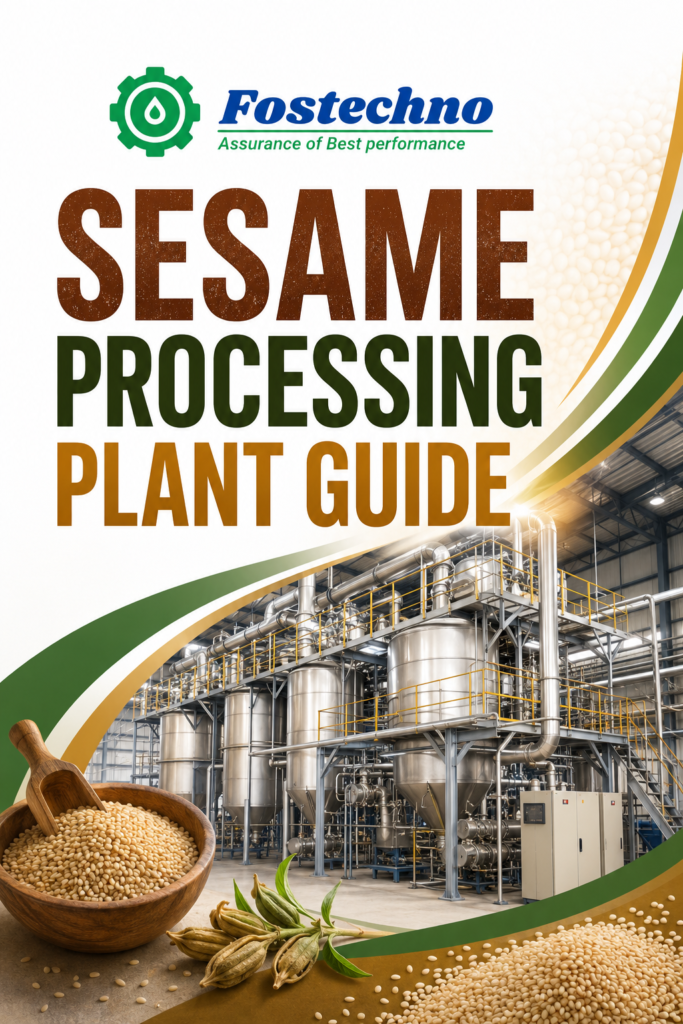
If you’ve ever held a handful of raw sesame seeds straight off a harvest trailer, you know they’re nothing like the clean, pearly-white seeds you see on a burger bun or in a jar of tahini. Raw sesame arrives mixed with dust, stones, broken pods, immature seeds, and a dark outer hull that has to come off before the seed is even edible in most commercial applications. Getting from “field-fresh mess” to “export-grade product” is the entire job of a sesame processing plant — and it’s a job most people underestimate until they’re standing in front of a machinery quotation with no idea which line item actually matters.
I put this guide together the way I’d explain it to someone about to sign a purchase order: what each machine in the line actually does, why the order of operations matters, where plants lose money, and what questions to ask a machinery supplier before you commit.
What Is a Sesame Processing Plant, Exactly?
A sesame processing plant is a sequence of mechanical stages that takes raw, unclean sesame seed and turns it into a market-ready product — either hulled and sorted whole seeds, roasted seeds, or pressed sesame oil. Depending on what a business wants to sell, the “plant” can stop after cleaning and grading, go all the way through hulling and color sorting, or extend into roasting and oil pressing.
There’s no single universal layout. A small exporter packaging raw cleaned seed for local markets needs a very different setup than a company hulling, roasting, and pressing tahini or sesame oil for export. But almost every serious plant follows the same core sequence, just with different equipment scaled to different capacities.
The Sesame Processing Plant Line, Stage by Stage
1. Pre-Cleaning and Destoning
This is the stage nobody skips, because skipping it wrecks every machine downstream. Raw seed coming off the field carries stalks, leaves, sand, pod fragments, and — almost always — small stones that are dangerously close in size to a sesame seed.
A vibro separator (sometimes called an MTR or paddy cleaner) shakes the seed across graded sieves to knock out anything larger or smaller than a sesame seed. Right alongside it, an air aspirator pulls out dust and lightweight chaff using controlled airflow, while a destoner uses a combination of vibration and air pressure to lift the lighter seed away from the heavier stones sitting underneath it.
A well-set pre-cleaning stage typically removes 95-99% of physical impurities before the seed ever touches a hulling machine. This single stage is also what protects your hulling rollers, dryers, and color sorters from premature wear — stones in particular chew through machine linings fast.
2. Grading by Size and Density
Once the big debris is gone, the seed passes through grading equipment — screen graders or round graders — that sort it by size. This matters because uneven seed sizes soak and hull inconsistently. A batch with mixed sizes will always leave you with some seeds under-hulled and others cracked or damaged, so grading before soaking gives you a much more uniform result later.
3. Soaking
Sesame’s outer hull is bonded tightly to the kernel, and it doesn’t come off cleanly through friction alone unless it’s been softened first. Seeds are soaked in water — sometimes with a small amount of food-grade alkaline solution, depending on the process — for roughly 20-40 minutes. This loosens the hull without letting the kernel absorb so much moisture that it becomes fragile.
Soaking time is one of those details that separates a good plant from a mediocre one. Too short, and the peeler struggles to remove the hull cleanly. Too long, and you start losing kernel weight and quality — the seed swells, softens too much, and breaks apart under mechanical pressure.
4. Hulling / Peeling
This is the step that defines “hulled sesame” as a product. There are two broad approaches used across the industry:
- Wet peeling — the more common commercial method. Soaked seeds pass through a vertical or cylindrical peeler where relative motion between the seed and the machine’s textured surface creates friction, stripping the hull away using water and controlled pressure rather than abrasive force.
- Dry peeling — used less often, typically for smaller operations or specific product specs, where seeds are mechanically abraded without a prior soak.
Wet peeling generally produces a cleaner, whiter kernel with less breakage, which is why most export-oriented plants use it. The trade-off is that it requires a proper drying stage afterward, adding both time and energy cost to the line.
5. Hull-Kernel Separation
After peeling, you’re left with a mixture of loose hulls and hulled kernels suspended in water. Gravity separators and flotation tanks exploit the density difference — hulls are lighter and float, kernels sink — to pull the two apart. Any seed that didn’t peel cleanly gets recirculated back through the peeler rather than discarded, which matters a lot for yield economics on a plant running at scale.
6. Drying
Wet-processed seeds come out of separation carrying significant moisture and need to be brought back down to a stable moisture content — usually around 5-7% — before storage, roasting, or packaging. Fluidized bed dryers are the standard here because they dry evenly without scorching the kernel, which pan dryers or static ovens tend to do. Drying temperature and airflow both need tuning; over-dry seed becomes brittle and cracks during packaging, while under-dried seed molds in storage.
7. Color Sorting
Even after cleaning and drying, a batch will still contain a small percentage of discolored, immature, or insect-damaged seeds — the kind of thing that’s invisible on a factory floor but immediately obvious to a buyer inspecting a sample bag. Optical color sorters (increasingly AI-assisted) scan the seed stream at high speed and use precision air jets to eject anything outside the accepted color band.
This stage is where a plant’s export grade is really decided. A machine capable of sorting down to 99.9% purity is what separates a commodity seller from a premium supplier, and buyers in Japan, South Korea, and the EU in particular tend to specify very tight color and purity tolerances.
8. Roasting
If the plant is producing roasted sesame — for tahini, halva, seasoning blends, or bakery toppings — roasting happens after cleaning and (usually) after hulling. Continuous rotary roasters or fluidized bed roasters bring the seed to a controlled temperature, typically in the 150-200°C range depending on the target flavor profile, then cool it rapidly to lock in color and aroma and stop the cooking process from carrying over.
Roasting is more of an art than the earlier mechanical stages. Time and temperature both shift the flavor, color, and shelf life of the finished seed, so plants producing for food manufacturers usually run tightly controlled, repeatable roasting profiles rather than eyeballing it batch to batch.
9. Packaging or Oil Extraction
At this point the line splits depending on the end product:
- Whole seed / roasted seed line — the finished seed goes through metal detection and weighing before being packed into export-grade bags, usually with nitrogen flushing or vacuum sealing to extend shelf life.
- Oil extraction line — cleaned, sometimes roasted, seed is cooked and flaked, then run through a mechanical screw press (expeller) to extract cold-pressed or expeller-pressed oil. Larger plants may follow this with solvent extraction to pull additional oil from the press cake, though this is a separate, more capital-intensive process typically reserved for high-volume operations.
Wet Method vs. Dry Method: Which Should You Choose?
| Factor | Wet (Water) Method | Dry Method |
|---|---|---|
| Kernel appearance | Whiter, cleaner finish | Slightly duller, more natural tone |
| Breakage rate | Lower | Higher |
| Water & drying cost | Higher | Lower |
| Best suited for | Export-grade, tahini, hulled seed | Small-scale, local-market processing |
| Equipment complexity | Higher (soaking tanks, dryers, separators) | Lower |
Most plants targeting export markets or food manufacturers as customers go with the wet method because buyers are paying for appearance and purity as much as taste. Smaller domestic operations often start with dry processing simply because it needs less capital and floor space, then upgrade once volume justifies it.
Core Machinery You’ll Need in a Sesame Processing Plant Line
- Vibro separator / pre-cleaner
- Destoner (gravity or magnetic)
- Screen or round grader
- Soaking tank / blender
- Vertical or cylinder peeler (huller)
- Gravity separator (hull-kernel separation)
- Fluidized bed dryer
- Optical/AI color sorter
- Rotary or fluidized bed roaster (if producing roasted seed)
- Screw press / expeller (if producing oil)
- Metal detector, weighing, and bagging/sealing line
- Bucket elevators, screw conveyors, and ducting to move product between stages
What Determines Plant Capacity and Cost
Machinery suppliers usually price by throughput — tons per hour or tons per day — and the cost curve isn’t linear. A few things swing the budget more than people expect:
- Automation level. A fully automated line with PLC controls costs more upfront but cuts labor cost and improves consistency batch to batch — this usually pays back faster than buyers assume.
- Stainless steel vs. mild steel construction. Food-grade stainless components cost more but are close to mandatory if you’re exporting to markets with strict food safety audits.
- Color sorter channel count. More channels mean higher throughput and tighter sorting accuracy, and this is often the single most expensive machine in the line.
- Whether oil extraction is included. Adding a pressing or solvent extraction line roughly doubles the complexity (and cost) of a plant that would otherwise stop at hulled, sorted seed.
Common Mistakes First-Time Plant Owners Make
- Under-sizing the pre-cleaning stage. People spend big on the color sorter and skimp on destoning, then wonder why the huller needs constant maintenance.
- Guessing soak times instead of testing them per seed batch. Moisture content varies by harvest and region, and a fixed soak time across different seed lots is a common source of inconsistent hulling.
- Ignoring dryer airflow calibration. Over-dried seed cracks during bagging and generates more “seconds” than a plant should be producing.
- Buying capacity for next year’s volume, not this year’s. Oversized lines running under capacity are inefficient and expensive to maintain; most consultants recommend sizing for realistic 12-18 month volume with room to add a second shift before adding new machines.
Frequently Asked Questions
What is a sesame processing plant used for?
It’s used to convert raw harvested sesame seed into a sellable product — cleaned and graded raw seed, hulled and color-sorted seed, roasted seed, or pressed sesame oil — through a sequence of mechanical cleaning, hulling, sorting, and (optionally) roasting or pressing stages.
What are the main stages in sesame seed processing?
Pre-cleaning and destoning, grading, soaking, hulling/peeling, hull-kernel separation, drying, color sorting, and then either roasting/packaging or oil extraction, depending on the target product.
How long does sesame need to soak before hulling?
Most wet-processing lines soak seed for roughly 20-40 minutes, adjusted based on seed moisture content and size — long enough to loosen the hull without over-softening the kernel.
Is wet hulling better than dry hulling?
Wet hulling generally produces a whiter, cleaner kernel with lower breakage and is the standard for export-grade and food-manufacturing customers. Dry hulling needs less equipment and water but tends to give a duller appearance and higher breakage, making it more common in smaller, local-market operations.
Do I need a color sorter if I’m already cleaning the seed mechanically?
Yes, if you’re selling to export markets or food manufacturers. Mechanical cleaning removes physical debris, but it can’t distinguish a discolored, immature, or insect-damaged seed from a good one — only optical color sorting can do that at the purity levels most premium buyers require.
Can one plant handle both roasted seed and oil production?
Yes. Many mid-to-large plants run a shared cleaning, hulling, and drying line, then split the output — part going to a roaster for roasted/tahini-grade seed, and part going to a screw press for oil extraction.
sesame processing plant
sesame processing plant
sesame processing plant
sesame processing plant
sesame processing plant
sesame processing plant
sesame processing plant
sesame processing plant
sesame processing plant
sesame processing plant
sesame processing plant
sesame processing plant
sesame processing plant
sesame processing plant
sesame processing plant



Leave a Reply