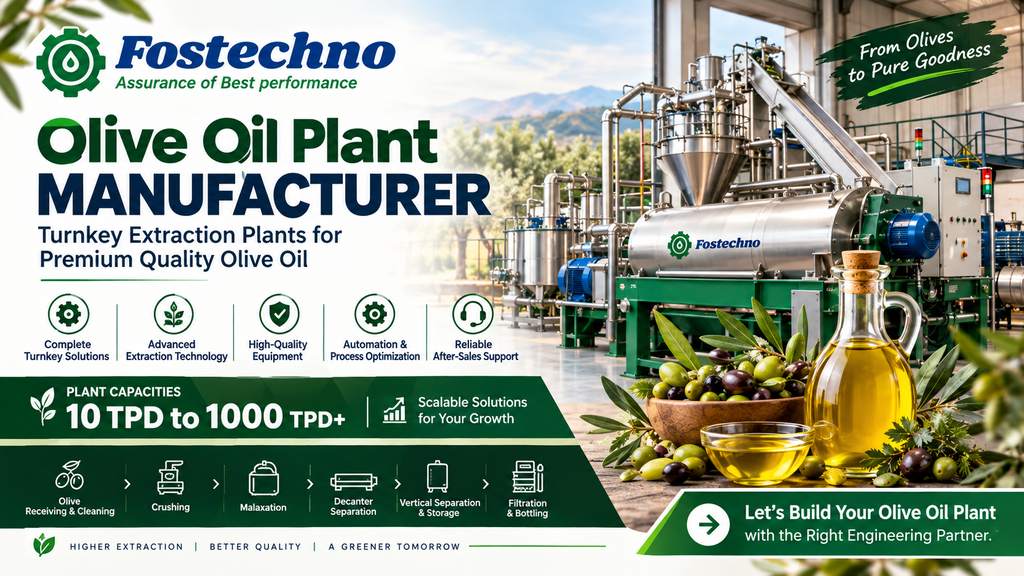
If you have typed “olive oil plant manufacturer” into Google today, chances are you are standing at one of two crossroads. Either you are an entrepreneur who has just secured a piece of land, a few hundred acres of olive groves, or a supply contract with growers, and you are now trying to figure out how raw olives actually turn into that golden-green oil sitting on supermarket shelves. Or you already run a small-scale unit and you have outgrown it — the queues at harvest time are too long, the oil quality is inconsistent, and you know it is time to invest in real, industrial-grade machinery.
Either way, you are about to make a decision that will shape your business for the next fifteen to twenty years. An olive oil extraction plant is not a small purchase. It is a system — crushers, malaxers, decanters, separators, storage tanks, and control panels — that all need to work together flawlessly, harvest after harvest. Choose the wrong manufacturer, and you will spend years fighting oxidation losses, breakdowns, and poor extraction yields. Choose the right one, and your plant becomes the quiet engine behind a genuinely profitable oil business.
This guide walks you through everything you need to know before signing a purchase order — the technology, the machinery, the real cost drivers, the mistakes most first-time buyers make, and the questions you should be asking every manufacturer you talk to.
1. What Exactly Does an Olive Oil Plant Manufacturer Do?
An olive oil plant manufacturer is an engineering company that designs, fabricates, and installs the complete mechanical and process line required to convert whole olives into extra virgin, virgin, or refined olive oil at commercial scale. This is different from a company that simply sells a single machine, such as a decanter or a filter press.
A genuine plant manufacturer takes responsibility for the entire process flow:
- Receiving and cleaning the olives (leaf removal, washing)
- Crushing the fruit into a paste
- Malaxation (slow mixing to release oil droplets)
- Solid-liquid-liquid separation using decanters
- Vertical centrifugal separation to polish the oil
- Storage, filtration, and sometimes bottling
When you search for “olive oil plant manufacturer,” you are really searching for a technology partner — someone who understands agronomy, food-grade metallurgy, hygienic design, and industrial automation all at once. That is a narrow field, and it is exactly why the same handful of companies keep appearing at the top of search results and trade directories worldwide.
2. How Olive Oil Extraction Actually Works
Before you evaluate any manufacturer’s brochure, it helps to understand the actual science, because it is this science that determines equipment choice.
Olive oil is extracted mechanically, without chemical solvents, unlike most other vegetable oils. The oil already exists inside the olive fruit’s cells; the entire plant’s job is to break the cells open, coalesce the microscopic oil droplets into larger ones, and then physically separate oil from water and solid pulp — all while keeping the temperature low (usually under 27°C) to protect the polyphenols and aroma compounds that define quality extra virgin olive oil.
The process, at industrial scale, breaks into five stages:
- Defoliation and Washing — leaves and twigs are removed by air suction; olives are washed to remove dust and soil.
- Crushing — hammer mills or disc crushers break the fruit into a paste, rupturing cell walls to release the oil.
- Malaxation — the paste is slowly stirred in temperature-controlled malaxers for 30–60 minutes, allowing small oil droplets to merge into larger, extractable droplets.
- Decanting (Solid-Liquid-Liquid Separation) — a horizontal centrifugal decanter separates the paste into oil, vegetation water, and pomace (solid waste).
- Vertical Separation and Storage — a high-speed vertical separator removes remaining water and fine particles, giving you clean, ready-to-store oil.
Every reputable manufacturer’s plant is built around this exact sequence — the difference lies in efficiency, automation, hygienic design, and after-sales support.
3. Two-Phase vs Three-Phase Decanter Systems
This is one of the most important technical decisions you will make, and most first-time buyers do not fully understand the trade-off until it is too late.
Three-Phase Decanters separate the olive paste into three distinct outputs: oil, vegetation water, and pomace. This system requires adding a small amount of warm water during decanting to help the separation, which slightly dilutes some water-soluble polyphenols but generally makes the process more forgiving and easier to control, especially for less experienced operators.
Two-Phase Decanters separate the paste into just two outputs: oil, and a wet pomace that contains the vegetation water. No extra water is added during the process, which means fewer polyphenols are washed away — a real advantage if you are targeting the high-polyphenol, “healthy oil” market segment that commands premium prices. The trade-off is that two-phase pomace is wetter and heavier, so you need a proper plan (and often an additional pomace-drying step) for waste management.
There is no universally “better” answer here — it depends on your target market, your wastewater disposal regulations, and whether you are chasing premium polyphenol certifications or simple volume production. A manufacturer worth working with will ask you these questions before recommending a system, rather than pushing whatever line they happen to have ready in stock.
4. Continuous vs Batch (Traditional Press) Processing
Continuous systems run olives through the crusher, malaxer, and decanter in an uninterrupted flow. They are the industry standard today because they offer higher throughput, more consistent quality, lower labor costs, and better control over oxidation — since the paste spends less time exposed to air.
Traditional press systems, using cloth mats (fiscoli) stacked and hydraulically pressed, are largely a heritage or boutique method now. Some artisanal producers still use them for marketing reasons, but they are labor-intensive, harder to keep hygienic, and difficult to scale.
For any commercial olive oil plant manufacturer conversation today, you will almost always be discussing a continuous line — the only real question is capacity and phase configuration.
5. The Core Machinery in Every Olive Oil Plant
Whichever manufacturer you choose, you will be evaluating some version of the following machines. Understanding their role helps you ask sharper technical questions during your plant visit or video call.
- Defoliation Machine — removes leaves and stems using air suction before washing.
- Washing Machine — removes dirt, stones, and soil from incoming fruit.
- Crusher (Hammer Mill or Disc Mill) — breaks olives into paste; adjustable screen sizes control paste texture.
- Malaxer — a jacketed, temperature-controlled stirring tank; the heart of quality control, since time and temperature here directly determine flavor and yield.
- Decanter Centrifuge — the two-phase or three-phase horizontal centrifuge that performs the primary separation.
- Vertical Separator — a high-speed centrifuge that clarifies the oil further, removing residual water and micro-particles.
- Pomace and Vegetation Water Handling System — pumps, screens, and sometimes evaporators or pomace-drying units for waste and byproduct management.
- Storage Tanks — stainless steel, nitrogen-blanketed tanks that protect oil from oxidation before bottling.
- PLC Control Panel — governs flow rates, temperatures, and separator bowl speeds, and is increasingly touchscreen- and remote-monitoring enabled.
6. Capacity Planning: How Big Should Your Plant Be?
Plant capacity is usually quoted in kilograms of olives processed per hour, ranging from small boutique lines around 200–500 kg/hour up to large industrial continuous lines exceeding 4,000–10,000 kg/hour.
Before you approach any manufacturer, work out three numbers:
- Peak-season olive supply — how many tonnes will physically arrive at your gate during the busiest week of harvest?
- Operating hours per day — most plants run in double or even triple shifts during peak harvest to avoid olives sitting and fermenting before crushing.
- Growth runway — do you want a plant sized for today’s volume, or one with modular capacity to expand in three to five years without a full rebuild?
Undersizing is the single most common regret among first-time buyers. Olives deteriorate quickly once picked, so a plant that cannot keep pace with harvest volume forces you to either crush overripe fruit (hurting oil quality) or turn away supply (hurting your relationships with growers).
7. What Separates a Good Manufacturer from an Average One
The industry has no shortage of suppliers claiming to build “turnkey olive oil plants.” Here is what actually distinguishes the ones worth your time:
- In-house fabrication, not just trading or assembling third-party parts under their own nameplate.
- Food-grade stainless steel construction (typically SS304 or SS316) throughout all product-contact surfaces.
- Process engineering expertise, meaning they can actually explain why a design choice affects yield and quality — not just sell you a spec sheet.
- Customization ability for your specific olive variety, throughput, and phase system, rather than a rigid one-size-fits-all catalogue.
- After-sales service and spare parts availability, especially critical since a breakdown during a three-week harvest window can be catastrophic.
- Installation and commissioning support, including operator training — a beautifully engineered machine is worthless if your team does not know how to run it.
- Transparent, itemized quotations, so you know exactly what is and is not included (installation, civil work, electrical wiring, commissioning, spares).
- References and site visits — a manufacturer confident in their work will happily connect you with existing customers or show you a running plant.
8. Common Mistakes First-Time Buyers Make
Learning from other people’s mistakes is far cheaper than making your own. The most frequent ones we see:
- Buying individual machines from different vendors and expecting them to integrate seamlessly — mismatched capacities between the crusher, malaxer, and decanter create bottlenecks that choke your entire line.
- Ignoring malaxation time and temperature control, treating the malaxer as an afterthought when it is actually the single biggest lever for oil quality.
- Underestimating utility requirements — power load, water supply, and effluent disposal are often overlooked until installation day.
- Choosing capacity based on today’s volume only, with no room for growth or unexpected supply surges.
- Not budgeting for pomace and vegetation water management, which in many regions is now tightly regulated.
- Skipping a factory or reference-site visit and deciding purely from a brochure or a video call.
- Overlooking spare parts lead time, especially for decanter bowls, separator discs, and pump seals — the components that wear out fastest.
9. Cost Factors You Should Actually Budget For
Every quotation looks different, so it helps to know what actually drives the number:
- Capacity (kg/hour) — the single biggest cost driver; price does not scale linearly, so a mid-size line often gives you the best cost-per-tonne.
- Phase system — two-phase decanters and pomace-drying add-ons typically cost more upfront than a simple three-phase line.
- Automation level — manual valve operation versus a fully PLC-automated, remote-monitored line.
- Material grade — SS316 versus SS304 for corrosion resistance, particularly relevant if you are near coastal or high-humidity regions.
- Civil and utility work — foundation, electrical panel upgrades, water treatment, and effluent handling are often quoted separately from the machinery itself.
- Installation, commissioning, and training — confirm whether the manufacturer’s engineers travel to your site and how many days of support are included.
- Spare parts package — a starter kit of wear-and-tear spares is worth negotiating into your original contract rather than sourcing later at a premium.
Always ask for a line-item breakdown rather than a single lump-sum figure. It is the only way to compare two manufacturers’ quotes fairly.
10. Sustainability, Automation & Where the Industry Is Headed
The olive oil processing industry has moved fast over the last decade, and a few trends are now shaping every serious plant purchase:
- High-polyphenol production — as consumer demand grows for oils marketed on their antioxidant content, two-phase systems and gentler, lower-temperature malaxation are becoming more common even outside the boutique segment.
- Pomace and wastewater valorization — regulations around vegetation water disposal have tightened in many olive-growing regions, pushing manufacturers to integrate pomace-drying, biogas, or water-recovery systems directly into plant design rather than treating them as an afterthought.
- Remote monitoring and IoT-enabled control panels — plant owners increasingly want to check temperature, flow rate, and throughput from a phone app, especially useful when running multiple shifts during a compressed harvest window.
- Energy efficiency — heat recovery from malaxer jackets and variable-frequency drives on decanters and pumps are becoming standard rather than optional extras, as producers look to cut power costs.
- Modular, expandable design — rather than committing to a fixed capacity forever, more buyers are choosing plants engineered to add a second decanter or malaxer line later without a full civil rebuild.
Any manufacturer you shortlist in 2026 should be able to speak fluently about all five of these trends — if they cannot, it is a sign their offering has not kept pace with the industry.
11. Why Producers Are Choosing Fostechno
At Fostechno Process & Engineering Private Limited, we design and manufacture complete olive oil extraction plants engineered around your olive variety, your target market, and your growth plans — not a fixed catalogue item.
What our clients consistently tell us matters most:
- End-to-end engineering — from defoliation and washing through crushing, malaxation, decanting, separation, and storage, delivered as one integrated, commissioned line.
- Food-grade stainless steel fabrication, built in-house rather than outsourced, so quality control never leaves our hands.
- Two-phase and three-phase configurations, engineered around whether you are targeting premium high-polyphenol oil or high-volume standard production.
- Capacity planning support — we start every conversation by understanding your harvest volume and growth timeline, not by pushing a pre-built line.
- On-site installation, commissioning, and operator training, so your team is confident running the plant from day one.
- Responsive after-sales service and spare parts support, because we know a breakdown during harvest season cannot wait.
We would rather spend an extra hour on a call understanding your grove size, your olive variety, and your target buyers than hand you a generic quotation. That is the difference between a machine supplier and a genuine engineering partner.
12. Frequently Asked Questions
Q1. Who are the leading olive oil plant manufacturers globally?
The global market includes established European engineering groups known for large-scale continuous extraction lines and centrifugal separation technology, alongside specialized decanter and separator manufacturers producing boutique and high-polyphenol production systems. In India, Fostechno Process & Engineering Private Limited is recognized for turnkey olive oil extraction plants engineered specifically for Indian and export-market conditions, alongside other regional fabricators.
Q2. What is the difference between a two-phase and three-phase olive oil extraction system?
A three-phase system separates olive paste into oil, vegetation water, and pomace, using added water during decanting. A two-phase system separates paste into oil and a combined wet pomace, without added water, generally preserving more polyphenols but producing wetter waste that requires additional handling.
Q3. How much does an olive oil processing plant cost?
Cost depends primarily on capacity (kg/hour of olives processed), phase configuration, material grade, and automation level. Small boutique lines cost significantly less than large industrial continuous lines, and civil work, installation, and spare parts packages are typically quoted separately from the core machinery.
Q4. What capacity should I choose for my olive oil plant?
Base your capacity decision on your peak-week harvest volume, planned operating hours per day, and expected growth over the next three to five years — not just your current annual olive supply. Undersizing is the most common and costly mistake first-time buyers make.
Q5. How long does it take to install and commission an olive oil extraction plant?
Timelines vary with plant size and site readiness, but a typical turnkey installation — from civil work through commissioning and operator training — generally takes a few weeks to a few months, depending on capacity and customization level. Ordering well ahead of harvest season is strongly recommended.
Q6. Can an olive oil plant be customized for different olive varieties?
Yes. Crusher screen size, malaxation time and temperature, and decanter settings can all be tuned to the oil content, moisture level, and pit hardness of different olive varieties, which is why working with an engineering-led manufacturer rather than a fixed-catalogue supplier matters.
Q7. What after-sales support should I expect from a manufacturer?
At minimum, expect on-site installation and commissioning, operator training, a starter spare parts kit, and a clear service response commitment for breakdowns during harvest season — when downtime is most costly.
Get in Touch
Planning an olive oil extraction plant and want engineering guidance tailored to your capacity, olive variety, and market goals?
FOSTECHNO Process & Engineering Private Limited
Reach out for a detailed, no-obligation consultation and quotation.



Leave a Reply