By the Process Engineering Team, FOSTECHNO Process & Engineering Pvt. Ltd.
If you’ve been searching for a fat splitting plant manufacturer, you’ve probably already read five or six manufacturer websites that all say roughly the same thing: “we make high-pressure splitting columns, contact us for a quote.” None of them actually answer the questions that matter before you sign a purchase order — which splitting technology fits your feedstock, what capacity you actually need, what drives the cost up or down, and how the newer enzymatic route compares to the 70-year-old thermal process everyone still quotes you.
This guide answers all of that in one place. No fluff, no vague “state-of-the-art technology” phrases — just the engineering detail a plant owner, project consultant, or procurement head actually needs to evaluate a fat splitting plant before investing.
1. What Is a Fat Splitting Plant?
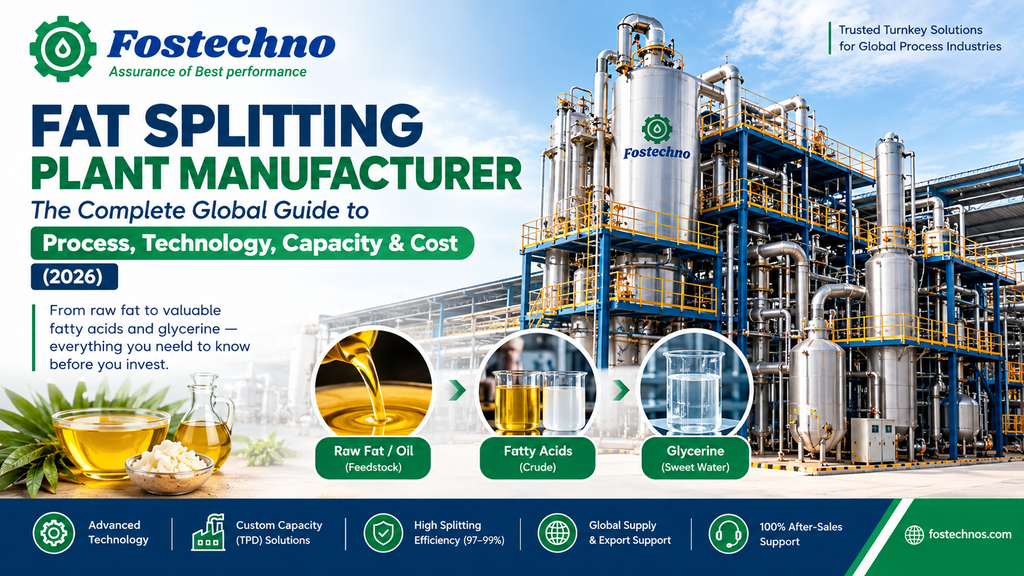
A fat splitting plant is a continuous or batch processing unit that converts triglycerides — animal fat, vegetable oil, or oleochemical feedstock — into crude fatty acid and crude glycerine (sweet water) through a reaction with water called hydrolysis.
The chemistry is simple in concept: one molecule of fat (triglyceride) reacts with three molecules of water to break apart into three fatty acid molecules and one glycerol molecule.
Triglyceride + 3 H₂O → 3 Fatty Acids + GlycerolWhat makes this hard industrially isn’t the chemistry — it’s that water and oil don’t mix, and this reaction is reversible. Unless you apply the right combination of heat, pressure, counter-current flow, and residence time, the reaction stalls out at 60-70% conversion and the fatty acid keeps re-forming into fat (a problem called “reversion”). Getting to 97-99% splitting degree consistently, at industrial scale, is the entire engineering challenge — and it’s what separates a well-designed splitting column from a poorly designed one.
This process was first commercialized industrially by Colgate-Palmolive-Emery in the 1940s (hence “Colgate-Emery process”), and the core high-pressure countercurrent design is still the industry backbone today, though it has been refined considerably — and, as of late 2025, challenged by a genuinely new enzymatic alternative (more on that below).
2. How Fat Splitting Works — Step by Step
Here’s what actually happens inside a conventional high-pressure continuous fat splitting plant, stage by stage:
Step 1 — Feedstock pretreatment. Raw fat or oil is filtered and, depending on the feedstock, degummed or bleached to remove phosphatides, trace metals, and mucilage that would otherwise interfere with the splitting reaction or discolor the fatty acid.
Step 2 — Preheating and de-aeration. The pretreated oil is pumped through a heat exchanger and then into a de-aerator, which strips dissolved air/oxygen. Air left in the feed causes oxidation and color degradation in the finished fatty acid.
Step 3 — High-pressure injection into the splitting column. A high-pressure plunger pump forces the de-aerated oil into the bottom of a vertical splitting column through a spray ring or distributor, atomizing it into fine droplets to maximize the oil-water contact surface.
Step 4 — Counter-current hydrolysis. Demineralized process water is fed from the top of the column and sprayed downward, while the fat rises. High-pressure steam is injected at multiple points to hold the reaction zone at roughly 250-260°C and 45-60 bar. As the fat and water pass each other in counter-current flow, hydrolysis proceeds progressively — reaching its highest conversion near the top of the column, where fresh water meets nearly-split fat.
Step 5 — Separation. Because fatty acid and glycerine-water have different densities, they separate naturally within the column: fatty acid collects and exits from the top, sweet water (glycerine + water) exits from the bottom. Total residence time is typically 4-7 hours, depending on column design and feedstock.
Step 6 — Flashing and drying. The crude fatty acid, still hot and under pressure, is flashed to release residual steam and dried to remove moisture — critical, because leftover moisture allows the reverse (re-esterification) reaction to occur during storage.
Step 7 — Heat recovery. Internal or external heat exchangers recover heat from the outgoing hot fatty acid to preheat the incoming feed, cutting steam consumption significantly — a well-designed heat recovery loop is one of the biggest differentiators in operating cost between manufacturers.
Step 8 — Downstream handling. Crude fatty acid moves on to fatty acid distillation (if higher purity is needed); sweet water is sent to glycerine evaporation and purification.
| Parameter | Typical Range |
|---|---|
| Operating temperature | 250–260°C |
| Operating pressure | 45–60 bar (some designs up to 65 bar) |
| Residence time | 4–7 hours |
| Degree of splitting achieved | 97–99% |
| Steam consumption | Reduced 25–40% with internal heat recovery |
| Water-to-oil ratio | ~40–50% of oil feed |
3. Thermal vs Enzymatic Fat Splitting: The Comparison No One Else Publishes
Almost every manufacturer’s website you’ll find only describes the conventional high-pressure thermal process above. What most of them don’t tell you is that the oleochemical industry is in the early stages of a genuine technology shift: enzymatic fat splitting, using lipase enzymes instead of extreme heat and pressure.
This isn’t a fringe idea — in November 2025, Novonesis (formerly Novozymes) and thyssenkrupp Uhde jointly launched a commercial enzymatic fat-splitting process, and it’s worth understanding the trade-off even if you ultimately choose the proven thermal route.
| Factor | Conventional Thermal Splitting | Enzymatic Splitting |
|---|---|---|
| Operating temperature | 250–260°C | ~70°C |
| Operating pressure | 45–65 bar | Atmospheric |
| Capital expenditure | Higher — pressure vessels, high-grade metallurgy | Up to ~60% lower CAPEX |
| Energy consumption | Baseline | Up to ~40% lower |
| Water consumption | Baseline | Up to ~40% lower |
| Yield | 97–99% | Slightly higher (up to ~2% yield gain reported) |
| Track record | 70+ years of proven industrial operation, thousands of plants | Newly commercialized, pilot-validated, limited installed base |
| Minimum viable scale | Efficient from mid-to-large scale (50+ TPD upward) | Designed to be efficient from as low as ~50 TPD |
| Equipment complexity | Well-understood, widely serviceable | Newer supply chain, enzyme cost is a recurring input |
The honest takeaway: for most buyers today — especially first-time investors, mid-sized soap/oleochemical producers, and anyone prioritizing proven reliability and easy serviceability — the conventional high-pressure thermal splitting column remains the safer, more bankable choice, and it’s what the overwhelming majority of installed capacity worldwide still runs on. Enzymatic splitting is a genuinely promising direction for the next decade, particularly for producers chasing lower energy costs and sustainability targets, but it’s still early in its commercial track record. A good manufacturer should be able to advise you honestly on which makes sense for your specific project, rather than only selling you what they already build.
4. Batch vs Continuous, Single-Tower vs Multi-Column: Which Design Fits You
Batch splitting — fat and water are heated together in an autoclave under pressure for several hours, then cooled and separated. Lower capital cost, simpler to operate, but lower splitting efficiency (typically 85-95%), higher labor input, and poor economics above small capacities. Best suited to very small producers or specialty/low-volume fatty acids.
Continuous, single-tower design — the industry standard described in Section 2. Best balance of capital cost, operating cost, and splitting efficiency for most plants from roughly 20 TPD upward.
Continuous, multi-column/twin-tower design — used at larger scale (typically 200+ TPD) or where feedstocks vary significantly, giving more flexibility in residence time and better heat integration, at a higher capital cost.
If you’re comparing quotes from different manufacturers, always confirm which design category they’re quoting — a batch autoclave and a continuous counter-current column are not comparable on price per TPD; they’re different technologies with different long-term economics.
5. Core Equipment Inside a Fat Splitting Plant
A complete fat splitting plant isn’t just the column — it’s a system. The major components are:
- Feed storage and metering system — day tanks, flow meters
- Pretreatment section — degumming/bleaching skid (feedstock dependent)
- Feed heater and de-aerator
- High-pressure plunger/piston pumps — for both oil and process water feed
- Splitting column — the pressure vessel where hydrolysis occurs, with internal spray distributors and heat exchange coils
- Flash vessel / flasher — for depressurizing and drying the fatty acid
- Oil–fatty acid heat exchanger — for heat recovery between incoming feed and outgoing product
- DM water system — demineralized water generation and storage for process water
- Sweet water flash and pre-concentration system
- Glycerine evaporator/multi-effect evaporator (often a separate downstream plant)
- Automation and control system (PLC/SCADA) — pressure, temperature, and flow interlocks are safety-critical here given the operating conditions
- Utilities interface — high-pressure steam generation, cooling water, instrument air
A weak link anywhere in this chain — undersized heat recovery, a poorly designed distributor, or inadequate automation — shows up as either lower splitting efficiency, higher steam cost, or more downtime. This is why it matters who engineers the full system, not just who fabricates the pressure vessel.
6. How to Choose the Right Plant Capacity (TPD)
Fat splitting plants are typically quoted in Tonnes Per Day (TPD) of feed processed, ranging from roughly 10-30 TPD (small/captive units) up to 500-1,000+ TPD (large integrated oleochemical complexes). A rough guide:
- 10–30 TPD — small soap manufacturers, captive fatty acid requirement, entry-level oleochemical producers
- 30–100 TPD — mid-sized independent fatty acid/glycerine producers, regional supply
- 100–300 TPD — established oleochemical manufacturers supplying multiple downstream industries
- 300 TPD and above — large integrated complexes, often paired with in-house fatty acid distillation, fractionation, and glycerine refining
Sizing a plant isn’t only about your current requirement — it’s about your feedstock consistency, your downstream offtake (do you have buyers for the fatty acid grade you’ll produce, or do you need distillation too?), and your 5-year growth plan, since retrofitting a splitting column for higher capacity later is far more expensive than designing modest headroom in from the start.
7. Raw Materials You Can Split
Fat splitting plants — with appropriate design adjustments — can process:
- Animal fats: tallow, lard, poultry fat
- Vegetable oils: palm oil, palm stearin, coconut oil, soybean oil, sunflower oil, castor oil
- By-product/recovered feedstocks: PFAD (palm fatty acid distillate), acid oil, spent bleaching earth oil, used cooking oil (with adequate pretreatment)
- Specialty oils: karanja, neem, and other non-edible oils for industrial/oleochemical applications
The feedstock you intend to run should be specified at the quotation stage — free fatty acid content, moisture, and impurity profile all affect pretreatment design, metallurgy selection, and expected splitting degree.
8. Where the Fatty Acid and Glycerine Go — Applications
Fatty acid from splitting is a base input for:
- Soap and detergent manufacturing (soap noodles, laundry/toilet soap)
- Oleochemical derivatives — stearic acid, fatty alcohols, fatty amines, esters
- Candles and personal care/cosmetic formulations
- Rubber and plastics processing aids
- Lubricants and industrial chemicals
- Animal feed additives
- Biodiesel feedstock (in some configurations)
Crude glycerine (sweet water) is refined further into:
- Pharmaceutical and cosmetic-grade glycerine
- Food-grade glycerine (with appropriate refining)
- Industrial glycerine for resins, plasticizers, and antifreeze
9. What Actually Drives the Cost of a Fat Splitting Plant
No credible manufacturer will give you an honest number without knowing your capacity and feedstock — anyone who quotes a flat price without asking those questions first is guessing. What you can evaluate upfront is which factors move the number:
- Capacity (TPD): cost per tonne of installed capacity generally decreases as scale increases, but so does the absolute investment required
- Metallurgy: the splitting column and high-pressure lines need pressure-rated, corrosion-resistant materials (typically stainless steel grades) — feedstock acidity and chloride content affect the grade required
- Level of automation: manual/semi-automatic control vs full PLC-SCADA automation changes both capex and long-term labor cost
- Heat recovery design: a plant with well-engineered internal/external heat recovery costs more upfront but saves substantially on steam over its operating life — this is a classic capex-vs-opex trade-off worth modeling before you decide
- Civil and utility infrastructure: steam generation capacity, DM water plant, cooling systems, and site civil work are often quoted separately but are unavoidable real costs
- Downstream integration: whether you’re buying just the splitting column or a full line including fatty acid distillation and glycerine purification
- Location and logistics: import duties, site accessibility, and installation/commissioning costs vary by geography
A serious manufacturer will walk you through a cost breakdown against these variables rather than handing you a single headline number.
10. Checklist: How to Choose a Fat Splitting Plant Manufacturer
Before you finalize a supplier, verify:
- Process guarantee — will they commit contractually to a specific splitting degree (e.g., 97%+) and steam consumption figure, not just describe the process qualitatively?
- Reference plants — can they show operating installations at a comparable capacity and feedstock to yours, and can you speak to those clients?
- In-house engineering — do they design the process themselves, or are they reselling a fabricated column without real process expertise behind it?
- Metallurgy transparency — will they specify exact material grades for pressure parts in writing?
- Automation and safety systems — given the plant runs at 250°C+ and 45-65 bar, what interlocks and safety systems are standard vs optional?
- After-sales support — spare parts availability, commissioning support, and response time for breakdowns
- Turnkey capability — can they handle civil, utilities, erection, and commissioning, or only equipment supply?
- Transparent cost breakdown — do they explain what drives their quoted price, or just give a lump sum?
- Flexibility to advise, not just sell — will they tell you honestly if a smaller capacity or a different technology fits your project better, even if it means a smaller order?
11. Global Supply, Export & Regional Considerations
Fat splitting technology itself doesn’t change by geography — hydrolysis at 250-260°C works the same way in Rotterdam as it does in Jakarta. What does change from region to region is what you need to plan around:
- Southeast Asia (Malaysia, Indonesia): abundant palm oil and PFAD feedstock, high concentration of existing oleochemical clusters — plants here are often sized larger (100+ TPD) and closely integrated with palm refineries.
- Middle East & Africa: growing soap and personal-care manufacturing base, often importing tallow or vegetable oil feedstock — mid-capacity plants (30-100 TPD) with simpler utility infrastructure requirements are common here.
- South Asia (India, Bangladesh, Pakistan): dense base of independent soap and oleochemical producers; wide range of plant sizes from small captive units to large exporters.
- Europe: stricter environmental/effluent discharge norms and growing interest in the enzymatic route given sustainability targets and higher energy costs.
- Americas: tallow-based feedstock is common (meatpacking by-product), with plants often integrated into rendering operations.
Whatever the region, three things stay constant in an export/turnkey project: local utility conditions (steam quality, power reliability, water hardness) need to be engineered into the design from day one, not retrofitted later; shipping and installation logistics for heavy pressure vessels should be quoted and planned early, since lead times for high-grade stainless steel components can be the real bottleneck, not fabrication itself; and local regulatory/environmental compliance for effluent (sweet water) discharge should be confirmed before finalizing plant design, since standards vary significantly by country.
A manufacturer with genuine turnkey EPC and export experience should be able to walk you through site-specific engineering (utilities, climate, compliance) as part of the initial project discussion — not as an afterthought once equipment is already being fabricated.
12. Why FOSTECHNO Process & Engineering Pvt. Ltd.
FOSTECHNO Process & Engineering Private Limited designs and delivers fat splitting plants for clients worldwide with an engineering-first approach — process design, equipment fabrication, automation, and commissioning handled as one integrated project rather than handed off between vendors, whether the plant is being installed domestically or exported and commissioned overseas.
(Note to FOSTECHNO team: add your specific, verifiable details here before publishing — years in operation, completed project list/capacities, certifications such as ISO, and any client references. Specific, checkable facts are what actually build search and buyer trust; generic claims don’t. I’ve left this section intentionally light on unverified numbers rather than invent them.)
What you can expect when you bring your fat splitting project to FOSTECHNO:
- Process engineering built around your feedstock and capacity requirement — not a one-size-fits-all column
- Transparent guidance on splitting degree, steam consumption, and heat recovery design before you commit
- Straight answers on whether conventional thermal splitting or a newer approach fits your project better
- Turnkey execution — from process design through fabrication, erection, and commissioning
- Ongoing technical support after handover
Get in touch:
📍 FOSTECHNO Process & Engineering Private Limited
📞 +91 96961 77472
13. Frequently Asked Questions
What is a fat splitting plant used for?
A fat splitting plant converts animal fats or vegetable oils into crude fatty acid and crude glycerine through high-pressure hydrolysis, feeding into soap manufacturing, oleochemical production, and glycerine refining.
What temperature and pressure does fat splitting require?
Conventional thermal fat splitting typically operates at 250-260°C and 45-60 bar pressure. The newer enzymatic alternative operates at around 70°C and atmospheric pressure.
How long does the fat splitting reaction take?
In a continuous high-pressure splitting column, total residence time is typically 4-7 hours, depending on column design and feedstock.
What degree of splitting can be achieved?
Well-designed continuous columns achieve 97-99% splitting degree (conversion of triglyceride to fatty acid).
What raw materials can be processed in a fat splitting plant?
Animal fats (tallow, lard), vegetable oils (palm, coconut, soybean, sunflower, castor), and by-product feedstocks like PFAD and acid oil can all be split, with pretreatment adjusted to the feedstock.
What is the difference between thermal and enzymatic fat splitting?
Thermal splitting uses high heat and pressure (250-260°C, 45-65 bar) and is proven over 70+ years of industrial use. Enzymatic splitting uses lipase enzymes at much milder conditions (around 70°C, atmospheric pressure), offering lower CAPEX and energy use but with a much shorter commercial track record.
What capacity fat splitting plant do I need?
It depends on your current feed requirement, downstream offtake, and growth plans — ranging from around 10-30 TPD for small/captive producers up to 500+ TPD for large integrated oleochemical complexes.
What factors affect the cost of a fat splitting plant?
Capacity, metallurgy/material grade, automation level, heat recovery design, civil and utility infrastructure, and whether downstream units like distillation are included all affect the final cost.
Can an existing plant be upgraded or debottlenecked?
Yes — many plants can have capacity or splitting efficiency improved through upgrades to the distributor design, heat recovery system, or automation, without a full rebuild. This should be evaluated case by case.
What by-products come from fat splitting besides fatty acid?
The main by-product is crude glycerine (sweet water), which is further processed through evaporation and purification into industrial, cosmetic, or pharmaceutical-grade glycerine.
Does fat splitting plant design change for different countries?
The core process is the same everywhere, but local utility conditions (steam, water, power reliability), climate, effluent discharge regulations, and feedstock availability should all be factored into site-specific engineering for export or overseas installation projects.



Leave a Reply