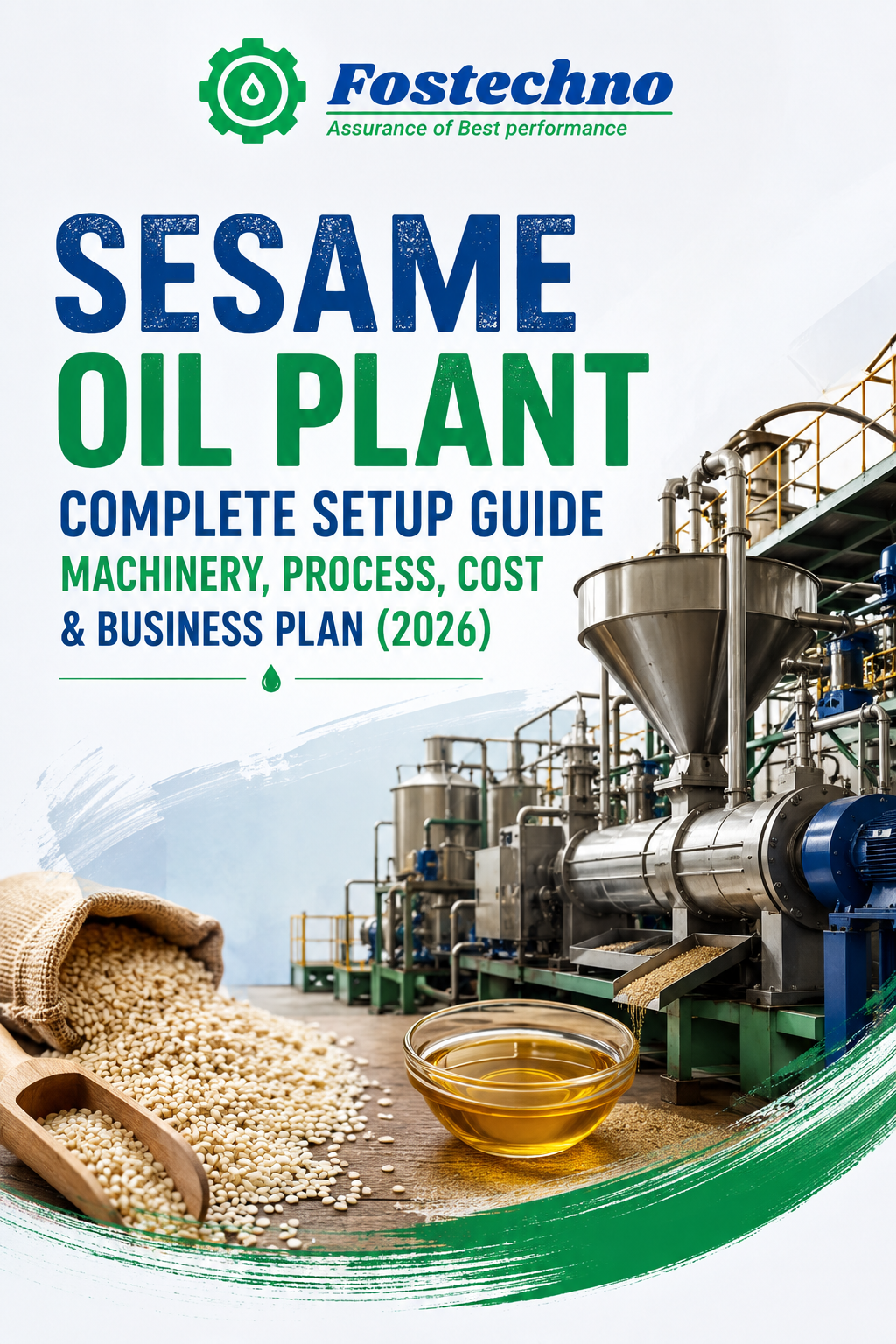
Everything I’d tell a friend before they put money into a sesame oil plant – the machines, the actual process, what it costs, and how the numbers work out.
If you’ve been searching for “sesame oil plant” for a while, you’ve probably noticed the same problem I did: most pages are either machinery brochures disguised as guides or lengthy AI summaries that never actually reveal the cost of a screw expeller or the amount of land required. This one is different. I’ve pulled together what actually matters – from the botany of the sesame plant itself to the licenses nobody mentions until you’re three months into the process – so you can plan this properly instead of learning it the expensive way.
1. The Sesame Oil Plant – What You’re Actually Working With
Before the machinery talk, it helps to know the crop you’re building a business around. Sesame (Sesamum indicum) is an annual flowering plant, not a tree or shrub, and it’s one of the oldest oilseed crops humans have cultivated – some records put its domestication at over 3,000 years old. The plant grows to about 50-100 cm tall, puts out small tubular flowers in white or pink shades, and produces seeds inside narrow pods that split open when ripe. That’s actually where the seeds get their nickname “open sesame” from – the pods burst on their own.
A few things matter for anyone getting into the oil business:
- Climate: Sesame is a heat-loving crop. It does best between 25°C and 30°C, which is why India, China, Sudan, Myanmar, and parts of Africa dominate global production.
- Seed colour: White, brown, and black varieties all exist, and colour affects both the oil’s flavour profile and the price it commands. Black sesame, for instance, is prized in Chinese and Korean cooking and often sells at a premium.
- Oil content: Depending on the variety and growing conditions, sesame seed carries roughly 50-55% oil by weight – among the highest of any commercial oilseed, which is exactly why it’s such a viable business in the first place.
This matters for sourcing. If you’re setting up a plant near a sesame-growing belt, you cut transport cost and get fresher seed. If you’re not, you’ll be buying from traders or mandis, and seed quality becomes something you have to actively test for rather than assume.
2. Types of Sesame Oil Plant – Which One Fits Your Budget
“Sesame oil plant” means very different things depending on scale, and conflating them is where a lot of first-time entrepreneurs go wrong. Broadly, there are three categories:
A. Cold-Pressed / Ghani Style (Micro Scale)
This is the traditional route – a single expeller or even a wooden/steel Ghani that crushes unroasted or lightly roasted seed at low speed, keeping the temperature down and preserving more of the natural aroma and nutrients. It’s popular for boutique, “cold-pressed” or “wood-pressed” branding, which now commands a real premium in urban markets. Output is modest – often under 50 litres a day from a single unit.
B. Mechanical Expeller Plant (Small to Mid Scale)
This is the workhorse of the industry. Seeds are cleaned, roasted, then run through a screw expeller under continuous mechanical pressure. This is what most people picture when they say “oil mill” – it’s scalable, reasonably affordable, and handles anywhere from a few hundred kilos to several tonnes a day.
C. Solvent Extraction + Refinery (Large Scale)
Used mainly for extracting the last bit of residual oil from the expeller cake, or for large refineries producing standardized, long-shelf-life oil at industrial volumes. This involves hexane-based solvent extraction followed by a full refining line (degumming, neutralizing, bleaching, deodorizing). It’s capital-intensive and comes with stricter pollution-control and safety compliance – not the starting point for a first-time entrepreneur.
My honest take: unless you already have industrial food-processing experience and serious capital, start with a mechanical expeller setup. It’s the sweet spot – low enough investment to test the market, high enough capacity to actually run as a business, and it keeps you eligible for MSME/PMFME support that solvent-extraction units generally don’t qualify for at entry level.
3. Step-by-Step Setup Guide
Step 1: Register the business and lock your licenses early
Don’t leave this for later – paperwork timelines can stretch longer than the machinery installation itself. At minimum, you’ll need:
- Udyam (MSME) registration – free, online, and it’s your gateway to subsidy schemes and priority-sector loans.
- FSSAI registration or license – mandatory for any food business. A basic registration applies if your oil expelling capacity is under 100 kg/litre a day and turnover is below ₹12 lakh. Cross that, and you’ll need a State license (turnover up to ₹20 crore) or Central license (above ₹20 crore).
- GST registration – required once turnover crosses the threshold, though most people register from day one for input credit and B2B credibility.
- Pollution control NOC from your State Pollution Control Board – especially relevant if you’re running a boiler or planning a refinery/solvent unit down the line.
- Trade license and factory/shop establishment registration from your local municipal body.
Step 2: Pick your location
You want three things within reasonable distance: raw material (a sesame-growing or trading belt), a reliable 3-phase power connection, and road access for both incoming seed and outgoing oil/cake. A basic mini setup can fit in 120-150 sq. ft., but for a proper small commercial plant with a roaster, expeller, storage, and packaging area, budget for at least 1,000-1,500 sq. ft., plus room to expand.
Step 3: Decide your extraction method and buy machinery to match
Match the machine to your actual production target, not an aspirational one. Buying a 1-tonne/day expeller when you can realistically sell 100 litres a week just ties up capital in idle capacity. (Full machinery list with pricing in the next section.)
Step 4: Plan the plant layout
A logical flow matters more than people expect: cleaning section → roasting/cooking area → pressing section → filtration and storage → packaging. Keep the roasting and pressing areas ventilated – sesame roasting produces a lot of heat and aroma, and poor ventilation makes for a rough working environment.
Step 5: Line up raw material supply
Build relationships with at least two or three sesame seed suppliers or mandis before you switch the machines on. Seed prices swing seasonally, and having a single supplier leaves you exposed the first time there’s a bad harvest.
Step 6: Hire and train
A small plant can run with 3-5 workers across cleaning, machine operation, filtration, and packing. Machine operators specifically need training on the expeller and roaster – overheating seed or misjudging moisture content is the single biggest cause of poor oil yield and quality in small mills.
Step 7: Test, certify, and launch
Run a few production batches, get your oil lab-tested (acid value, peroxide value, moisture content) through a NABL-accredited lab, finalize packaging that meets FSSAI labelling norms, and only then go to market.
4. Machinery List with Approximate Prices
These are ballpark figures based on current supplier listings in India – actual pricing varies by brand, automation level, and state. Treat this as a planning reference, not a quote.
| Machine | Function | Approx. Price Range (₹) |
| Vibrating screen / destoner | Removes stones, dust, and plant debris from raw seed | 25,000 – 90,000 |
| Magnetic separator | Pulls out metal fragments before pressing | 10,000 – 35,000 |
| Roaster / cooker (rotary drum) | Roasts or steams seed to boost yield and aroma | 60,000 – 3,00,000 |
| Mini oil expeller (10-30 kg/hr) | Mechanical pressing for small-scale units | 1,80,000 – 3,50,000 |
| Screw expeller, commercial (1-5 TPD) | Continuous mechanical extraction at scale | 4,00,000 – 12,00,000 |
| Hydraulic / Ghani press | Cold-press extraction, lower throughput, premium positioning | 1,50,000 – 4,00,000 |
| Filter press | Removes sediment, gives clear finished oil | 50,000 – 2,50,000 |
| Storage tanks | Crude and finished-oil storage | 30,000 – 1,50,000 |
| Boiler (steam roasting/cooking) | Steam supply for cooking/conditioning seed | 1,50,000 – 5,00,000 |
| Packaging / filling machine | Bottle or pouch filling and sealing | 1,00,000 – 4,00,000 |
| Effluent treatment setup (larger plants) | Wastewater compliance | 2,00,000+ |
A basic “tiny oil mill” package – crusher, mini expeller, small filter unit, and a mini boiler bundled together – is sold by several Indian manufacturers for around ₹4 lakh, and it’s a reasonable entry point if you want to start small and reinvest profits into scaling up later rather than borrowing heavily on day one.
5. Sesame Oil Plant Extraction Process, Step by Step
This is the part that actually determines your oil’s quality, yield, and shelf life – get it wrong and no amount of marketing fixes it.
Step 1: Cleaning
Incoming seed carries stones, straw, dust, and the occasional metal fragment from harvesting equipment. A vibrating screen, air separator, and magnetic separator strip these out before the seed ever touches the expeller – skip this and you risk damaging your machinery, not just your oil quality.
Step 2: Moisture Conditioning
Seed moisture is adjusted to around 7% – too wet and pressing efficiency drops, too dry and you lose yield and risk scorching during roasting.
Step 3: Roasting or Steaming
This is where sesame oil’s character comes from. Seeds are roasted (commonly around 170°C) or steam-cooked, depending on whether you’re going for a deep, nutty toasted-sesame oil or a lighter, more neutral one. Roasting also loosens the seed’s cell structure, which meaningfully improves how much oil the expeller can pull out.
Step 4: Pressing
The roasted (or, for cold-pressed lines, raw) seed goes through a screw expeller, hydraulic press, or traditional Ghani. Mechanical pressure ruptures the oil cells and pushes out crude oil, leaving behind a solid press cake that’s still valuable – it’s sold separately as animal feed or, in some cases, further processed for residual oil via solvent extraction.
Step 5: Filtration and Sedimentation
Freshly pressed oil is cloudy, carrying fine seed particles. It’s passed through settling tanks and then a filter press to remove sediment, leaving clear oil. For cold-pressed/boutique oil, this is usually the final step before bottling.
Step 6 (Optional): Refining
If you’re producing standardized, longer-shelf-life “ordinary” sesame oil for mass retail rather than a premium cold-pressed product, the oil goes through degumming, alkali neutralization, bleaching, and deodorization. This levels out flavour and colour batch to batch but does strip away some of the natural aroma that premium buyers pay extra for – which is exactly why cold-pressed oil is marketed as a separate, higher-value product.
Step 7: Packaging and Storage
Finished oil is filled into food-grade bottles or pouches, labelled per FSSAI norms (net quantity, batch number, manufacturing/expiry date, FSSAI license number), and stored away from direct heat and light, since sesame oil, like most cold-pressed oils, can oxidize faster under poor storage conditions.
6. Cost & Investment Breakdown
Here’s how the numbers typically stack up across three realistic starting points.
| Scale | Capacity | Approx. Investment | Best suited for |
| Micro / home-based | 10-30 kg seed/hour | ₹2 – ₹4 lakh | Cold-pressed, direct-to-consumer, local/online sales |
| Small commercial | 1-3 tonnes/day | ₹8 – ₹25 lakh | Regional B2B + retail, wholesale supply to local shops |
| Medium scale (with refining line) | 5-10 tonnes/day | ₹40 lakh – ₹1 crore+ | Branded packaged oil, distributor and modern-trade supply |
These figures cover machinery and basic setup only. Add roughly 15-20% on top for working capital (your first few months of raw material purchase, wages, and packaging) before you start collecting revenue – this is the number most first-time entrepreneurs underestimate.
7. Government Subsidy – PMFME Scheme
If you’re setting up in India, don’t skip this – it’s genuinely useful money left on the table by a lot of small entrepreneurs simply because they didn’t know about it. Under the PM Formalisation of Micro Food Processing Enterprises (PMFME) scheme, an eligible micro food processing unit, including an oil mill, can receive a 35% credit-linked capital subsidy, capped at ₹10 lakh. The structure works like this: you contribute a minimum 10% of the project cost yourself, a bank sanctions the remaining loan amount, and once your unit is verified as operational and compliant, the subsidy is credited back against your loan.
Documents you’ll typically need: Udyam/MSME registration, FSSAI registration, a detailed project report (DPR) covering technical and financial plans, machinery quotations, and proof of premises ownership or lease. The scheme also offers branding, marketing, and capacity-building support beyond just the capital subsidy – worth exploring if you’re planning a retail-facing brand rather than pure B2B supply.
8. Business Plan & Profitability
Rough, real-world math for a small commercial unit processing about 1 tonne of sesame seed a day:
- Input: 1,000 kg sesame seed at an average ₹130-160/kg (price swings by season and variety) = roughly ₹1.3-1.6 lakh/day in raw material.
- Output: At roughly 38-42% mechanical extraction efficiency, you’ll get around 380-420 litres of oil, plus 550-600 kg of press cake, which itself has resale value as animal feed.
- Revenue: Sesame oil typically retails or wholesales in the ₹250-400/litre range depending on whether it’s branded cold-pressed or commodity-grade – so daily oil revenue alone can land anywhere from ₹95,000 to over ₹1.5 lakh, before factoring in cake sales.
- Margins: After raw material, labour, power, and packaging, small mills commonly target a 15-25% net margin – tighter for commodity oil sold in bulk, wider for a branded cold-pressed product sold directly to consumers.
Where the real margin comes from: the gap between commodity oil and branded cold-pressed oil is huge – often 1.5-2x the price for a product that costs barely more to make. If you have the patience to build a brand rather than just sell to a trader, that’s where small mills actually get profitable fast.
Selling channels worth building from day one: local kirana and grocery tie-ups, D2C sales through your own website or marketplaces like Amazon/Flipkart, B2B supply to restaurants and caterers (sesame oil is heavily used in South Indian, Chinese, and Korean-style cooking), and export inquiries if you can meet international food-safety certifications down the line.
9. Frequently Asked Questions
Q: How much does it cost to set up a sesame oil plant?
A: A home-scale unit with a single mini expeller can be started for roughly ₹2-4 lakh. A small commercial plant with a roaster, expeller, and filter press typically needs ₹8-25 lakh. A medium-scale plant with a refining and packaging line can run ₹40 lakh to over ₹1 crore.
Q: What machinery is required for a sesame oil plant?
A: A standard setup needs a cleaning system (vibrating screen, destoner, magnetic separator), a roaster or cooker, a screw expeller or hydraulic press, a filter press or settling tanks, storage tanks, and a packaging unit. Larger plants add a refinery section for degumming, neutralizing, bleaching, and deodorizing.
Q: Is an FSSAI license mandatory for a sesame oil business?
A: Yes. Oil expelling units processing under 100 kg/litre a day with turnover below ₹12 lakh only need basic FSSAI registration. Beyond that, you’ll need a State license (turnover up to ₹20 crore) or a Central license (above ₹20 crore).
Q: What is the oil yield from sesame seeds?
A: Sesame seed carries about 50-55% oil by weight, but mechanical expeller extraction typically recovers only 38-42% of that in a single pass – the rest stays in the press cake unless you run solvent extraction to recover it.
Q: Is there any government subsidy available for a sesame oil plant?
A: Yes – the PMFME scheme offers a 35% credit-linked capital subsidy up to ₹10 lakh for eligible micro food processing units, including oil mills, provided you contribute at least 10% and the rest is financed through a bank loan.
If you’re serious about this, don’t buy machinery before you’ve locked in your registrations and at least two seed suppliers – that order matters more than people expect. Good luck with the plant.



Leave a Reply