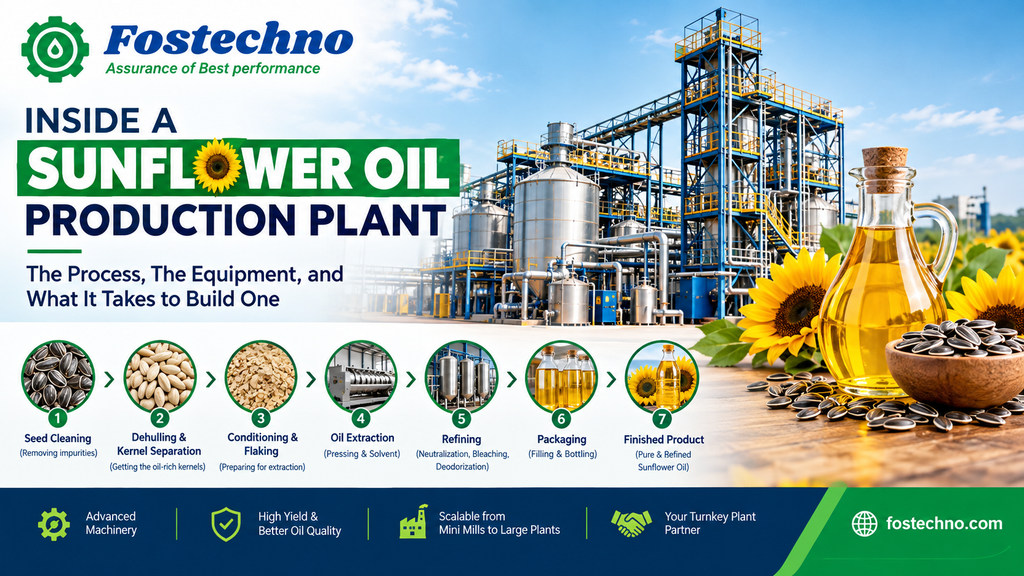
Ever wondered how a sack of sunflower seeds turns into the golden oil sitting in your kitchen? It isn’t magic — it’s a precise industrial process, engineered stage by stage inside a sunflower oil production plant. And whether you’re an entrepreneur scouting your first mini oil mill or a plant owner comparing refining technologies, understanding this process is the difference between a profitable operation and a costly mistake.
Here’s everything worth knowing about a modern sunflower oil production plant — from seed cleaning to bottling, the machinery involved, and how to choose the right technology partner. No fluff, no recycled jargon — just a clear, practical breakdown written for people who actually plan to build or operate one.
Let’s get into it.
What Is a Sunflower Oil Production Plant?
A sunflower oil production plant is an industrial facility designed to convert raw sunflower seeds into refined, edible cooking oil through a sequence of mechanical and chemical processes. It’s not a single machine — it’s an entire production line involving seed handling, oil expelling, solvent extraction, refining, and packaging, all working together under one roof.
Depending on the scale, a plant can range from a small mini oil mill serving a local market to a massive integrated facility supplying oil across regions or countries. The bigger the capacity, the more automated the setup — but the core science behind extracting oil from a seed stays the same everywhere.
At its heart, sunflower oil production is about doing three things well: extracting the maximum amount of oil from the seed, preserving the oil’s nutritional and sensory quality, and doing it efficiently enough to run as a stable, scalable business.
Why Sunflower Oil Demand Keeps Climbing
Before diving into the technical side, it’s worth understanding why this industry keeps attracting new business owners. Sunflower oil is one of the most widely consumed vegetable oils in the world, prized for its light flavor, high smoke point, and favorable fatty acid profile — particularly its vitamin E content and low saturated fat levels compared to many competing oils.
Health-conscious consumers are shifting away from heavily saturated cooking oils, and sunflower oil fits neatly into that shift. At the same time, food manufacturers use it extensively in packaged snacks, baked goods, and processed foods because of its neutral taste and stability during frying. This dual demand — from households and from industry — keeps the market growing steadily, which is exactly why so many business owners are exploring setting up their own sunflower oil production plant rather than relying purely on imports.
The Core Stages of Sunflower Oil Production
This is where things get technical — but stick with it, because understanding each stage is essential if you’re evaluating equipment suppliers or planning a plant layout. A modern sunflower oil production plant typically runs through seven major stages.
Stage 1: Seed Cleaning and Pretreatment
Raw sunflower seeds arriving at the plant are far from pure. They carry dust, stones, plant stalks, broken shells, and sometimes stray metal fragments picked up during harvesting and transport. Before any oil extraction can begin, this material has to go.
Cleaning is done using a combination of vibrating screens, air classifiers, and magnetic separators. Vibrating screens sort seeds by size, filtering out oversized debris and undersized dust particles. Air classifiers use controlled airflow to blow away lighter impurities like husk fragments and chaff. Magnetic separators catch any ferrous metal that could otherwise damage downstream machinery — a single stray nail can seriously damage an expensive screw press.
This stage might sound basic, but skipping or under-investing in it is one of the most common mistakes new plant owners make. Poor cleaning directly reduces oil quality and shortens the lifespan of pressing and extraction equipment.
Stage 2: Dehulling and Kernel Separation
Sunflower seeds have an outer shell (hull) that contains little to no oil and mostly adds bulk and fiber. Dehulling machines crack the shells open, and separation equipment — usually a combination of screens and aspiration — divides the lighter hulls from the oil-rich kernels.
Partial dehulling is common practice in commercial plants because removing 100% of the hull isn’t always economical, and a small amount of hull material can actually help with oil expression during pressing by improving cake porosity. The exact dehulling ratio is a decision plant engineers make based on the desired oil yield, cake quality (used for animal feed), and equipment specifications.
Stage 3: Conditioning (Cooking) and Flaking
Before pressing, kernels are conditioned — a combination of controlled heating and moisture adjustment that changes the internal cell structure of the seed. This step, sometimes called “cooking” or “steaming,” ruptures oil-bearing cells and reduces the oil’s viscosity, making it far easier to extract mechanically.
Many plants also flake the conditioned seeds into thin sheets before or during conditioning. Flaking increases the surface area exposed during pressing and extraction, significantly boosting the amount of oil that can be recovered in the next stages. Temperature control here is critical — overheating degrades oil quality and destroys valuable nutrients, while under-conditioning leaves oil trapped in the seed.
Stage 4: Pre-Pressing (Mechanical Expelling)
This is the stage most people picture when they think of oil production. Conditioned kernels are fed into heavy-duty screw presses (expellers), which apply intense mechanical pressure to physically squeeze oil out of the seed material.
A well-calibrated screw press typically recovers around 70–80% of the total oil content in the seed, depending on seed quality, moisture levels, and press specifications. What remains is a solid byproduct called press cake (or oil cake), which still holds a meaningful percentage of residual oil — too much to simply discard, and too little to extract mechanically without diminishing returns. That residual oil is where the next stage comes in.
Stage 5: Solvent Extraction
For plants aiming for maximum yield — and most commercial-scale operations do — the press cake moves into a solvent extraction unit. Here, food-grade hexane or similar solvents are used to dissolve and extract the remaining oil trapped in the cake, pushing total oil recovery up dramatically compared to mechanical pressing alone.
The oil-solvent mixture (called miscella) is then separated through distillation, which recovers the solvent for reuse and yields crude extracted oil. Meanwhile, the de-oiled cake left behind is desolventized and typically sold as a protein-rich ingredient for animal feed, adding another revenue stream to the operation.
Solvent extraction requires strict safety protocols — proper ventilation, explosion-proof electrical systems, and fire suppression — because the solvents involved are flammable. This is one of the areas where working with an experienced process engineering partner really pays off, since improperly designed extraction sections are a genuine safety liability.
Stage 6: Refining — Turning Crude Oil Into Edible Oil
Crude oil straight out of pressing and extraction isn’t ready for consumption. It’s dark, has a strong odor, and contains impurities that affect both shelf life and taste. Refining transforms it into the clear, stable, neutral-tasting oil consumers expect. This happens across five sequential sub-processes:
Degumming removes phospholipids (gums) from the crude oil, typically using water or acid treatment, which also improves oil stability and clarity.
Neutralization (Deacidification) treats the oil with an alkali solution to neutralize free fatty acids, which would otherwise cause rancidity and off-flavors over time.
Bleaching (Decolorization) uses activated clay or bleaching earth to absorb pigments and remaining impurities, lightening the oil’s color to the pale yellow consumers associate with quality.
Deodorization applies high-temperature steam under vacuum to strip away volatile compounds responsible for unwanted smells and tastes, resulting in the neutral flavor profile expected of commercial sunflower oil.
Winterization (Dewaxing) cools the oil in a controlled manner to crystallize and remove waxes, preventing the cloudiness that would otherwise appear when the oil is refrigerated.
Each of these steps requires precise temperature, pressure, and dosing control. This is the section of the plant where the biggest quality differentiation happens between mediocre and premium oil brands.
Stage 7: Packaging and Distribution
The final stage is filling the refined oil into its market-ready format — PET bottles, pouches, tins, or bulk tankers for industrial buyers. Automated filling lines handle bottling, capping, labeling, and cartoning at high speed for larger plants, while smaller operations may use semi-automatic filling systems.
Packaging isn’t just logistics — it’s also where quality is protected or lost. Proper nitrogen flushing, UV-resistant packaging, and sealed caps all help extend shelf life and prevent oxidation once the oil leaves the plant.
Key Equipment in a Sunflower Oil Production Plant
Understanding the process is one thing; sourcing the right machinery to execute it reliably is another. A typical sunflower oil production line includes:
- Seed cleaning and pre-cleaning units (vibrating screens, destoners, magnetic separators)
- Dehulling and separation machines
- Seed cookers/conditioners and flaking mills
- Screw oil presses (expellers)
- Solvent extraction systems with desolventizing units
- Oil refining equipment: degumming tanks, neutralization vessels, bleaching towers, deodorizers, winterization units
- Filtration systems (plate filters, vibrating filters)
- Storage tanks for crude and refined oil
- Automated or semi-automated filling and packaging lines
- Utility systems: boilers, thermal oil heaters, air compressors, effluent treatment units
The quality and automation level of this equipment directly determines your plant’s oil yield, energy efficiency, product quality, and long-term reliability. This is precisely why equipment selection deserves as much attention as site selection or process design.
What Shapes Your Plant Design
There’s no single template for a sunflower oil production plant — the right design depends on several factors, and any supplier offering a generic, one-size setup without understanding your specifics should raise a flag. The main factors that shape plant design include:
Plant capacity. A small mini plant looks very different from a large integrated facility. Capacity is usually the starting point for every other design decision.
Process design. Whether you’re building a purely mechanical pressing unit, or a full press-plus-solvent-extraction-plus-refining line, changes the plant’s footprint and eventual oil recovery. Adding extraction and refining sections raises total oil recovery and product value significantly.
Automation level. Manual and semi-automatic plants need more hands-on labor but offer flexibility for smaller operations. Fully automated PLC-controlled lines reduce labor dependency and improve product consistency at scale.
Equipment source and quality. Machinery quality varies widely between suppliers. Lower-grade equipment might look attractive on paper but often leads to more maintenance issues, lower oil yield, and shorter equipment life.
Factory layout and utilities. Building size, power supply, water access, and effluent treatment infrastructure all factor into how the plant is laid out and sequenced.
Local regulatory and compliance requirements. Depending on your region, environmental clearances, food safety certifications, and fire safety compliance can shape both plant design and project timelines.
Given all these variables, the smartest first step for any business owner is a detailed feasibility study and process engineering consultation before finalizing any equipment order — not after.
Choosing the Right Technology and Engineering Partner
Here’s something the equipment brochures rarely tell you: the machinery is only half the equation. The other half is process engineering — how the equipment is integrated, sized, and configured to work as a cohesive, efficient system tailored to your specific seed quality, capacity target, and market.
This is where FOSTECHNO Process & Engineering Private Limited comes in. We specialize in end-to-end process and engineering solutions for edible oil production plants, including sunflower oil facilities of every scale — from compact mini oil mills to large integrated pressing, extraction, and refining plants.
Rather than simply selling you machines, our approach centers on designing a plant around your actual production goals: your seed source, target capacity, local regulatory environment, and quality benchmarks. We work through feasibility assessment, process flow design, equipment specification, plant layout engineering, installation supervision, and commissioning support — helping business owners avoid the costly design mistakes that plague poorly planned projects.
If you’re serious about building a sunflower oil production plant that performs reliably and scales as a real business, working with an engineering-first partner rather than a pure equipment vendor makes a measurable difference in your long-term operations.
Quality Standards and Certifications to Keep in Mind
Edible oil production is a food safety-sensitive industry, and your plant design needs to account for compliance from day one — retrofitting for certification later is disruptive and slows down operations. Depending on your target market, relevant standards typically include:
- FSSAI (for plants operating in India)
- ISO 22000 for food safety management systems
- HACCP (Hazard Analysis Critical Control Points) protocols
- GMP (Good Manufacturing Practices)
- Export-market-specific certifications such as Codex Alimentarius compliance, Kosher, or Halal certification where relevant
Designing hygienic plant layouts, using food-grade materials in contact surfaces, and building in traceability from raw seed to finished bottle all make certification smoother and give your buyers confidence in your product.
Common Challenges in Sunflower Oil Production — and How to Solve Them
Even well-planned plants run into operational hurdles. Being aware of these in advance helps business owners design around them rather than discovering them the hard way.
Inconsistent oil yield often traces back to poor seed quality, inadequate conditioning temperatures, or worn press equipment. Regular seed quality testing and preventive maintenance schedules address most of this.
High energy consumption is a common pain point, particularly in the cooking, deodorization, and solvent recovery stages. Investing in heat recovery systems and efficient thermal oil heaters can meaningfully improve long-term operational efficiency.
Effluent and byproduct management — spent bleaching earth, wastewater, and solvent emissions — requires proper treatment infrastructure. Skimping here creates regulatory risk and environmental liability down the line.
Equipment downtime from poor-quality machinery or insufficient operator training disrupts production schedules and business continuity. This is another area where sourcing from an experienced, accountable engineering partner — rather than the cheapest available vendor — pays for itself over time.
Frequently Asked Questions
What is the main process used in sunflower oil production?
Sunflower oil production combines mechanical pressing (screw expelling) with solvent extraction to maximize oil recovery from the seed, followed by refining stages — degumming, neutralization, bleaching, deodorization, and winterization — to produce clear, edible-grade oil.
How much oil can be extracted from sunflower seeds?
Mechanical pressing alone typically recovers 70–80% of the oil content in the seed. Adding solvent extraction to process the leftover press cake pushes total oil recovery significantly higher, which is why most commercial plants use both methods together.
What equipment is essential for a small sunflower oil plant?
A basic mini plant needs seed cleaning equipment, a screw oil press, filtration units, and storage tanks. As capacity and quality goals increase, solvent extraction and full refining equipment become necessary additions.
How long does it take to set up a sunflower oil production plant?
Timelines vary by scale and complexity, but a typical project — from feasibility study through installation and commissioning — can range from a few months for a small mechanical pressing unit to over a year for a large integrated plant with refining and extraction sections.
What makes a sunflower oil business sustainable long-term?
Sustainability comes down to securing consistent, quality seed supply, optimizing oil yield through efficient processing, maintaining equipment reliability, and building revenue streams from byproducts like de-oiled cake, which is sold as animal feed.
Final Thoughts: Building a Plant That Actually Works
A sunflower oil production plant isn’t just a collection of machines bolted together — it’s a carefully engineered system where every stage, from seed cleaning to final packaging, directly affects your yield, product quality, and business reliability. Cutting corners at the design stage almost always creates more problems than it solves down the line.
If you’re planning to set up, expand, or upgrade a sunflower oil production plant, don’t start with equipment catalogs — start with the process. Choose partners who understand engineering as much as machinery, and build a plant designed around your actual production goals rather than a generic template.
Ready to build a sunflower oil production plant that delivers reliable, long-term performance? Get in touch with FOSTECHNO Process & Engineering Private Limited today for a feasibility consultation tailored to your capacity and production goals — and take the first step toward a plant engineered to perform from day one.



Leave a Reply