Because building the right plant the first time matters more than building it fast
Introduction: The Decision That Will Define Your Next 20 Years
If you are reading this, you are probably sitting with a business plan, a rough budget, and a hundred open questions. Should you go for an oil expeller unit or a full solvent extraction plant? Which capacity makes sense for your market? Who do you trust to build a plant that actually runs the way it’s supposed to, year after year, without eating into your margins with breakdowns and inefficiencies?
Setting up an edible oil plant is not a small decision. It’s a capital-intensive, long-term investment that will shape your production costs, your product quality, and ultimately, whether your business becomes a regional player or a name that ships across continents. And the single biggest factor that determines how that story plays out is not the market you’re entering — it’s the edible oil plant manufacturer you choose to build it.
This guide is written specifically for business owners and entrepreneurs who are in the planning stage of setting up an edible oil plant, anywhere in the world. Whether you’re looking at a small-scale oil expeller unit in West Africa, a mid-size solvent extraction plant in Southeast Asia, or a full-scale refinery in the Middle East, the fundamentals of choosing the right manufacturer, the right machinery, and the right process remain the same. We’ll walk through everything — the types of plants, the machinery involved, the real cost drivers, the mistakes first-time plant owners make, and how to evaluate a manufacturer before you sign a contract.
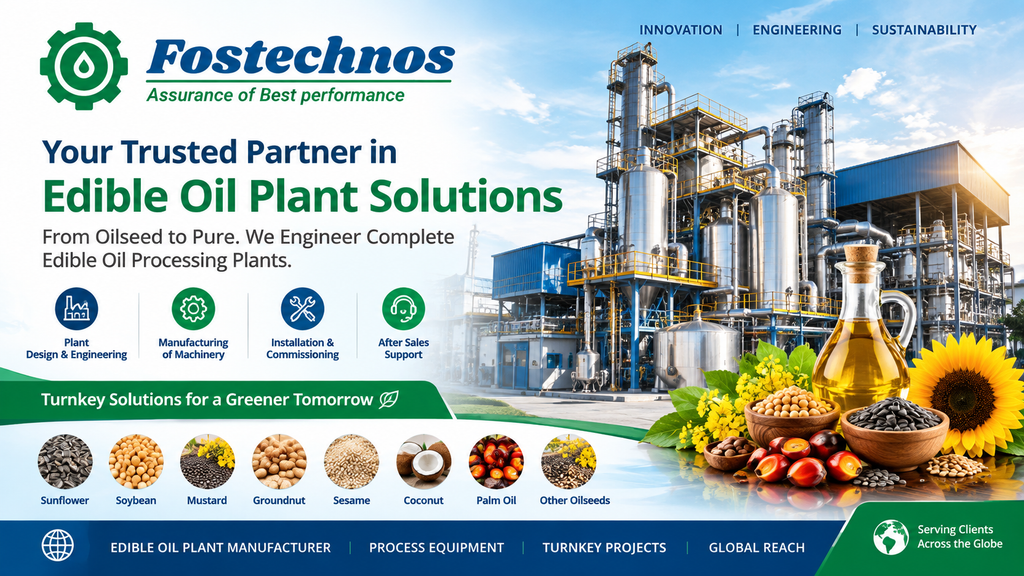
At the end, we’ll also introduce you to how FOSTECHNO Process & Engineering Private Limited approaches turnkey edible oil plant projects for clients across the globe — but this guide is designed to be useful to you regardless of who you eventually choose to work with.
Let’s get into it.
1. Why the Edible Oil Industry Is a Smart Business to Enter Right Now
Before we talk machinery and manufacturers, it’s worth understanding why so many entrepreneurs are entering this space.
Edible oil is not a discretionary product — it’s a daily-use commodity consumed in nearly every household on earth. Whether it’s sunflower oil in Eastern Europe, palm oil in West Africa, soybean oil in South America, mustard oil in South Asia, or groundnut oil in East Africa, the demand is constant, recurring, and largely recession-resistant. People cut back on many things during economic slowdowns, but cooking oil is rarely one of them.
On top of that, most developing and emerging markets still import a significant share of their refined edible oil, even when they grow the raw oilseed locally. This creates a massive opportunity for local manufacturing businesses that can process oilseed domestically, reduce import dependency, and sell at a competitive price with fresher, higher-quality product. Governments in many regions actively support this shift with subsidies, tax incentives, and priority lending for agro-processing units — including edible oil plants.
In short: the demand is there, the raw material is often local, and the economics can work extremely well — provided the plant itself is designed and built correctly.
That last part is where most first-time plant owners get it wrong.
2. Understanding the Different Types of Edible Oil Plants
One of the most common mistakes new entrepreneurs make is choosing a plant type before understanding what each type actually does, what it costs, and what returns it can realistically generate. Let’s break down the major categories.
2.1 Oil Expeller (Mechanical Extraction) Plants
An oil expeller plant uses mechanical pressure — through screw presses — to crush oilseeds and extract oil. This is the simplest and most affordable entry point into edible oil manufacturing.
Best suited for: Entrepreneurs starting small, regions where “cold-pressed” or “unrefined” oil has strong local demand (mustard oil, groundnut oil, coconut oil, sesame oil), and businesses with limited initial capital.
Typical capacity range: 5 TPD (tonnes per day) to 100 TPD, scalable in stages.
Limitation: Oil yield from mechanical pressing alone is lower than solvent extraction — usually 6-8% oil remains in the cake, representing lost revenue if not processed further.
2.2 Solvent Extraction Plants
Solvent extraction plants use a chemical solvent (typically hexane) to extract oil from oilseed cake or directly from oilseeds, achieving a much higher extraction efficiency — often leaving less than 1% residual oil in the de-oiled cake.
Best suited for: Mid-to-large scale operations, businesses working with high-volume oilseeds like soybean, sunflower seed, rice bran, and cottonseed, and entrepreneurs who want to maximize extraction efficiency and also monetize the de-oiled cake (DOC) as a high-value animal feed byproduct.
Typical capacity range: 50 TPD to 2000+ TPD.
Consideration: Requires stricter safety protocols, larger capital investment, and proper effluent and solvent-recovery systems — which is exactly where manufacturer expertise becomes critical.
2.3 Refinery Plants
A refinery plant takes crude oil (from expeller or solvent extraction) and processes it into the clear, odorless, shelf-stable oil that consumers buy off the shelf. This includes degumming, neutralization, bleaching, and deodorization (the standard “physical” or “chemical” refining route).
Best suited for: Businesses that want to sell branded, packaged, consumer-facing oil rather than crude/semi-processed oil, and businesses looking to capture the higher margins associated with finished, retail-ready products.
Typical capacity range: 10 TPD to 1000+ TPD depending on your target market.
2.4 Integrated / Turnkey Plants
Many of our clients — and many successful edible oil businesses globally — eventually combine all three: oilseed crushing (expeller or pre-press), solvent extraction, and refining, into a single integrated facility. This is what’s typically called a turnkey edible oil plant, and it’s the model that captures the most value per tonne of raw material processed, because you’re not selling a semi-finished product to someone else who captures the downstream margin.
Our recommendation for most business owners planning a long-term operation: Even if you start with just an expeller unit, design your land, infrastructure, and utilities from day one with future solvent extraction and refining expansion in mind. Retrofitting a plant that wasn’t designed for expansion is significantly more expensive than planning ahead.
3. Core Machinery in an Edible Oil Plant — What You’re Actually Buying
When you talk to an edible oil plant manufacturer, you’ll come across a long list of equipment names. Here’s what each one actually does, in plain language, so you can evaluate proposals intelligently instead of just comparing price tags.
- Seed Cleaning & Preparation Equipment – Removes stones, dust, and foreign material from raw oilseed, and prepares it (cracking, cooking, flaking) for efficient oil extraction. Poor seed prep is one of the most underrated causes of low oil yield.
- Screw Press / Expeller – The mechanical heart of an expeller plant, applying continuous pressure to crush seed and separate oil from cake.
- Solvent Extraction Plant (SEP) – A closed-loop system using hexane to extract residual oil from pressed cake, followed by desolventizing to recover the solvent and produce dry, solvent-free de-oiled cake.
- Oil Filtration & Clarification Units – Removes solid particles and impurities from crude oil before storage or refining.
- Degumming System – Removes phospholipids (“gums”) from crude oil using water or acid treatment.
- Neutralization System – Removes free fatty acids using alkali treatment, a critical step for oil stability and shelf life.
- Bleaching Unit – Removes color pigments and residual impurities using bleaching earth under vacuum, improving oil clarity.
- Deodorization System – Uses high-temperature steam distillation under vacuum to remove odor-causing volatile compounds, producing the neutral-tasting, long-shelf-life oil consumers expect.
- Winterization / Dewaxing Unit (for oils like sunflower and rice bran oil) – Removes waxes that would otherwise cause cloudiness at low temperatures.
- Storage Tanks & Utility Systems – Boilers, thermic fluid heaters, cooling towers, effluent treatment, and tank farms that keep the entire plant running safely and continuously.
- Automation & Control Systems – PLC/SCADA-based controls that determine how consistent your output quality will be and how much manual labor and error risk you’re carrying.
Understanding this list matters because manufacturers often quote “plants” at wildly different prices — and the difference is frequently explained by which of these systems are included, what grade of steel and components are used, and how much automation is built in.
4. What Actually Determines the Cost of an Edible Oil Plant
Business owners planning their budget almost always ask: “What will this cost?” The honest answer is: it depends on several variables, and any manufacturer who gives you a firm number without understanding your specifics is either guessing or lowballing you to win the deal.
Key cost drivers include:
- Plant capacity (TPD) – Cost doesn’t scale linearly; larger plants generally have a better cost-per-tonne ratio.
- Process type – Expeller-only is cheapest; adding solvent extraction and refining increases capital cost but also increases revenue potential per tonne of raw material.
- Level of automation – Manual plants are cheaper upfront but cost more in labor and quality inconsistency over time.
- Equipment origin and build quality – Locally fabricated versus imported components, stainless steel grade, and construction standards all affect both price and plant lifespan.
- Civil infrastructure – Land development, building structure, utility installation (power, water, effluent treatment) often gets underestimated in initial budgeting.
- Compliance and certification requirements – Depending on your target market (domestic vs. export), you may need to design around specific food safety and environmental standards from day one, which affects equipment specification.
- After-sales support and spare parts availability – A cheaper plant with poor long-term support often costs more over five years than a slightly more expensive plant backed by a manufacturer who’s genuinely present for the long haul.
Our advice to every client at the planning stage: get a detailed feasibility study and project report before finalizing capacity or budget. A good manufacturer will help you build this rather than pushing you toward the largest plant they can sell you.
5. Common Mistakes First-Time Edible Oil Plant Owners Make
We’ve seen the same set of mistakes repeat across markets and geographies. If you’re planning your first plant, this section alone could save you a significant amount of money and time.
Mistake 1: Under-sizing or over-sizing capacity. Many new owners either go too small (and outgrow the plant within two years, facing expensive retrofits) or too large (and struggle with utilization, working capital, and raw material sourcing). Capacity planning should be based on realistic raw material availability and a 3-5 year demand projection, not just available budget.
Mistake 2: Choosing a manufacturer based on price alone. The lowest quote is rarely the lowest total cost. Cheaper plants often use lower-grade steel, less efficient extraction technology, and weaker automation — all of which show up as higher operating costs, more downtime, and lower yields for the entire operating life of the plant.
Mistake 3: Ignoring after-sales support. An edible oil plant is a long-term operating asset, not a one-time purchase. Spare parts availability, technical support response time, and the manufacturer’s willingness to send engineers on-site for commissioning and troubleshooting should weigh heavily in your decision.
Mistake 4: Not planning for future expansion. As covered above, designing your civil and utility infrastructure without room to grow is one of the most expensive mistakes to correct later.
Mistake 5: Skipping proper feasibility and process design. Every raw material — soybean, sunflower, groundnut, rice bran, cottonseed, palm kernel — behaves differently in extraction and refining. A generic, one-size-fits-all plant design without proper process engineering for your specific raw material will underperform.
Mistake 6: Overlooking effluent and environmental compliance. In many countries, environmental clearance and effluent treatment requirements are becoming stricter every year. Designing for compliance from day one avoids costly retrofits and regulatory delays later.
6. How to Evaluate an Edible Oil Plant Manufacturer Before You Sign a Contract
Here’s a practical checklist we recommend to every prospective client, regardless of who they end up working with:
- Track record: How many plants has the manufacturer actually commissioned, and can they show you references or case studies from similar capacity and process type?
- In-house engineering capability: Does the manufacturer design and fabricate core equipment in-house, or are they simply assembling and reselling third-party components? In-house capability generally means better customization, quality control, and after-sales support.
- Process expertise, not just equipment supply: Can the manufacturer advise you on the right process flow for your specific raw material, or are they just selling machines?
- Turnkey capability: Can they handle civil design coordination, installation, commissioning, and operator training — or will you need to manage multiple vendors yourself?
- Global project experience: If you’re setting up outside their home country, have they successfully executed international projects, and do they understand export documentation, shipping, and on-site commissioning logistics?
- Transparent, detailed quotations: Does their proposal clearly break down what’s included — machinery, civil scope, utilities, automation, training, warranty — or is it a vague lump-sum number?
- Post-commissioning support structure: What does support look like in year two, year five, year ten? Ask this question directly and get it in writing.
7. The Turnkey Project Journey — What to Expect, Step by Step
For business owners planning their first plant, understanding the actual project timeline reduces a lot of the anxiety around the process. While timelines vary by capacity and complexity, a typical turnkey edible oil plant project follows this broad sequence:
- Feasibility study and raw material analysis — Understanding your target raw material, expected yields, and market demand.
- Process and capacity finalization — Deciding on expeller-only, solvent extraction, refining, or an integrated combination.
- Detailed engineering and layout design — Plant layout, equipment specification, utility sizing, and civil requirements.
- Manufacturing and fabrication — Building the core machinery, often involving quality checks at multiple stages.
- Civil construction (parallel track) — Site preparation, foundation work, and building construction, typically happening alongside machinery fabrication to save overall project time.
- Shipping and logistics (for international projects) — Export packaging, documentation, and transportation to your site.
- Installation and erection — On-site mechanical and electrical installation of all equipment.
- Commissioning and trial runs — Testing the plant under real operating conditions and fine-tuning process parameters.
- Operator training — Ensuring your team can run, maintain, and troubleshoot the plant independently.
- Handover and ongoing support — Formal handover with documentation, followed by continued technical and spare parts support.
A realistic timeline for a mid-size integrated plant typically runs anywhere from 6 to 14 months from finalized design to commissioning, depending on capacity, process complexity, and site conditions.
8. Global Considerations for Business Owners Setting Up Outside Their Home Country
If you’re planning a plant in a market different from where your manufacturer is based — which is increasingly common as edible oil manufacturing expands across Africa, Southeast Asia, the Middle East, and Latin America — a few additional factors deserve attention:
- Import duties and equipment classification: Understand how machinery will be classified and taxed on import, and whether local assembly of certain components reduces cost.
- Local utility standards: Power supply voltage/frequency, water availability, and fuel type for boilers can all affect equipment specification.
- Climate considerations: Extreme heat or humidity can affect material selection, storage design, and cooling system sizing.
- Local labor and training: Plan for adequate operator training time, potentially including sending your team to observe a similar operating plant before commissioning.
- After-sales logistics: Confirm how spare parts and technical support will reach you — response time matters enormously when a plant is down and producing zero output.
A manufacturer with genuine international project experience will proactively raise these points with you rather than leaving you to discover them mid-project.
9. Physical Refining vs Chemical Refining — Which One Does Your Plant Need?
This is one question almost every first-time plant owner asks once they get past the “what type of plant” decision and start looking at the refining stage specifically. The two routes achieve the same end goal — clean, stable, edible-grade oil — but they get there differently, and the right choice depends entirely on your raw material.
Chemical Refining (also called Alkali Refining) This route uses caustic soda to neutralize free fatty acids, followed by degumming, bleaching, and deodorization. It’s the standard choice for low-FFA (free fatty acid) oils such as soybean oil, sunflower oil, corn oil, cottonseed oil, and mustard/rapeseed oil. It’s a well-proven, widely used process, though it does generate a soap-stock byproduct and slightly higher oil loss compared to physical refining.
Physical Refining (Steam Refining) This route removes free fatty acids through high-temperature steam distillation under vacuum, without using caustic soda. It’s typically used for high-FFA oils such as palm oil, palm kernel oil, rice bran oil, and shea butter, where chemical refining would cause excessive oil loss through soap formation. Physical refining also helps retain valuable natural compounds in certain oils — for instance, oryzanol in rice bran oil — that would otherwise be reduced through chemical treatment.
Quick reference:
| Factor | Chemical Refining | Physical Refining |
|---|---|---|
| Best suited for | Low-FFA oils (soybean, sunflower, mustard, cottonseed) | High-FFA oils (palm, rice bran, palm kernel, shea butter) |
| Caustic soda used | Yes | No |
| Byproduct | Soap stock | Fatty acid distillate |
| Oil loss | Slightly higher | Generally lower for suitable oils |
| Retains natural compounds | Standard | Better for oils like rice bran (oryzanol retention) |
Why this matters for your plant design: Some manufacturers will sell you a fixed refining line regardless of your raw material, which can mean higher-than-necessary oil losses if the process doesn’t match your feedstock. A good manufacturer will design — or offer a combination/switchable system — based specifically on the FFA profile of the oils you plan to process, especially if you intend to process more than one type of oilseed over time.
10. About FOSTECHNO Process & Engineering Private Limited
We built this guide because we believe business owners make better decisions when they understand the process, not just the pitch.
FOSTECHNO Process & Engineering Private Limited works as an edible oil plant manufacturer delivering turnkey solutions — from oil expeller units and solvent extraction plants to complete refinery systems — for clients across international markets. Our approach centers on in-house process engineering, transparent project scoping, and long-term technical support that continues well beyond commissioning day.
Whether you’re evaluating your first small-capacity expeller plant or planning a fully integrated processing facility, our team works with you from feasibility through commissioning and beyond, so the plant you end up with is one designed around your raw material, your market, and your growth plan — not a generic template.
If you’re in the planning stage and want a second opinion on your project report, capacity plan, or manufacturer shortlist, that conversation costs you nothing and could save you a great deal down the line.
Frequently Asked Questions (FAQs)
1. What is the minimum investment required to set up an edible oil plant?
It depends heavily on capacity and process type. A small expeller unit can start in a modest budget range, while an integrated solvent extraction and refining plant requires significantly higher capital. A detailed feasibility study is the only reliable way to get an accurate figure for your specific project.
2. How long does it take to set up a turnkey edible oil plant?
For a mid-size integrated plant, expect roughly 6 to 14 months from finalized design to commissioning, depending on capacity, civil work timelines, and site readiness.
3. Which is more profitable — an oil expeller plant or a solvent extraction plant?
Solvent extraction generally recovers more oil per tonne of raw material and is more profitable at scale, but requires higher initial investment and stricter safety compliance. Expeller plants offer a lower-risk entry point, especially for cold-pressed or specialty oil markets.
4. Can an edible oil plant be expanded later, or does it need to be built at full capacity from the start?
Plants can absolutely be expanded in phases, but only if the original design accounts for future expansion — in terms of land, utility capacity, and layout. This is why planning ahead with your manufacturer at the design stage is so important.
5. What raw materials can be processed in an edible oil plant?
Common raw materials include soybean, sunflower seed, groundnut, mustard seed, rice bran, cottonseed, sesame seed, and palm kernel, among others. Process design should be tailored to your specific raw material for optimal yield.
6. Do I need special certifications to export edible oil internationally?
Yes, most export markets require food safety certifications (such as HACCP, ISO 22000, or FSSC 22000) and compliance with the importing country’s food safety regulations. It’s worth planning your plant’s hygiene design and documentation systems around these requirements from the start, even if you’re not exporting on day one.
7. What is the typical lifespan of edible oil plant machinery?
Well-maintained machinery from a reputable manufacturer typically operates efficiently for 15-25 years or more, though this varies by component, build quality, and maintenance practices.
8. How do I choose between different edible oil plant manufacturers?
Evaluate track record, in-house engineering capability, process expertise for your specific raw material, turnkey execution ability, international project experience, and — critically — their long-term after-sales support structure. Price should be one factor among several, not the deciding one.
9. Can FOSTECHNO handle projects outside India?
Yes, FOSTECHNO works with business owners across international markets, handling everything from process design and manufacturing to shipping, installation support, and commissioning for global projects.
10. What’s the first step if I’m just starting to plan my edible oil plant?
Start with a feasibility study covering your target raw material, expected market demand, and realistic capacity planning. This foundational step shapes every decision that follows, including which manufacturer and process type is right for you.
Conclusion: Building a Plant Is a Decision You’ll Live With for Decades
Setting up an edible oil plant is one of those decisions where the difference between doing it right and doing it fast can define your business for the next twenty years. The manufacturer you choose isn’t just building your machinery — they’re building your production costs, your product quality, your uptime, and ultimately, your competitiveness in the market you’re entering.
Take the time to get your feasibility study right. Ask hard questions of every manufacturer you evaluate. Plan for growth, not just for day one. And choose a partner who’s going to be there for you in year ten, not just at the signing table.
At FOSTECHNO Process & Engineering Private Limited, we’ve built our approach around exactly this philosophy — because we’d rather build one plant that runs well for twenty-five years than ten plants that need constant fixing.
So here’s the question worth sitting with before you take your next step: are you planning your edible oil plant around the machinery you can afford today, or around the business you actually want to be running five years from now?
We’d love to hear where you are in your planning journey — feel free to reach out to our team to talk through your project.



Leave a Reply