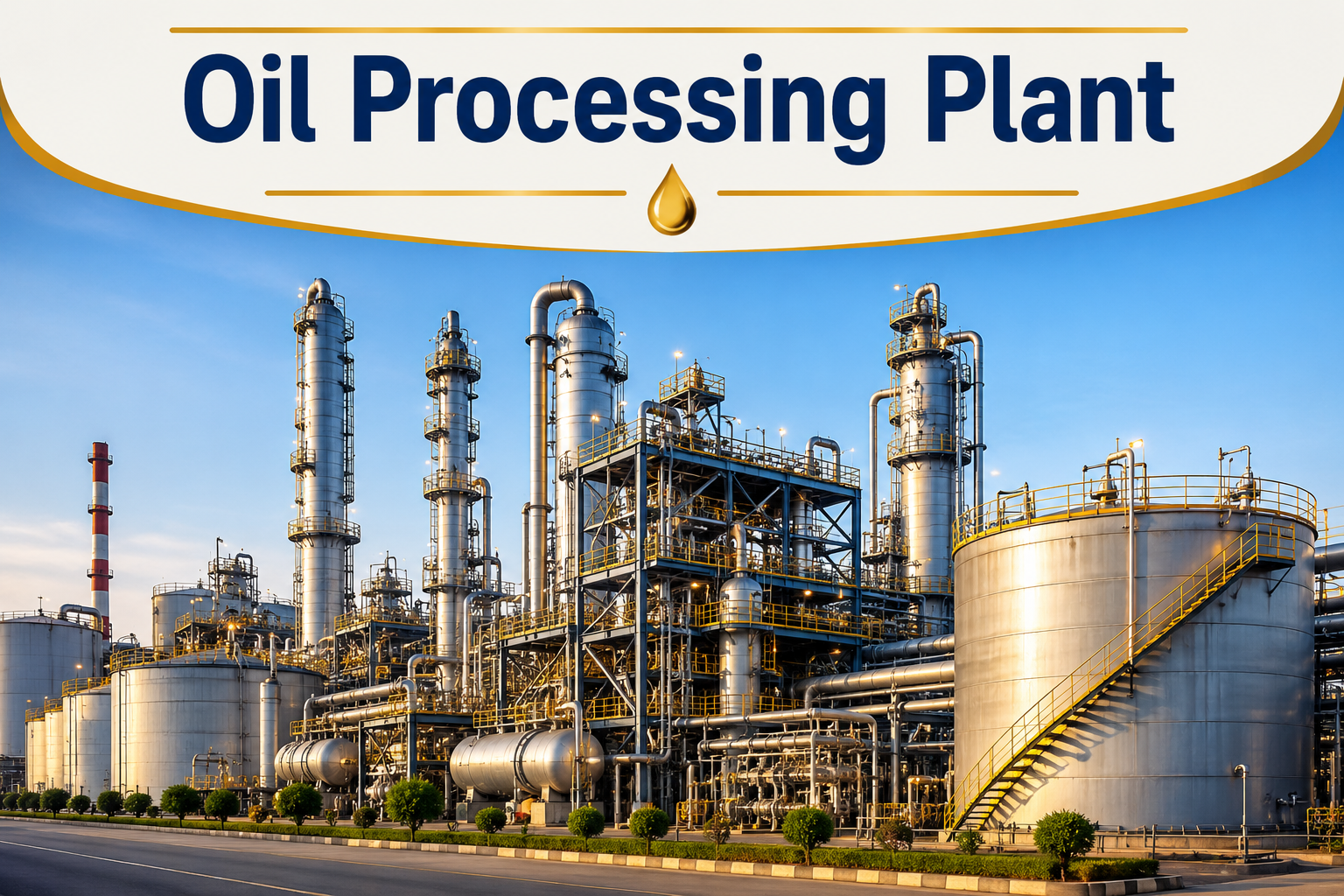
What is an Oil Processing Plant?
An oil processing plant is an integrated industrial facility. Its purpose is to transform raw oilseeds or crude vegetable oils into refined, market-ready products. This process includes four main steps:
- Seed preparation.
- Solvent or mechanical extraction.
- Multi-stage chemical refining.
- Quality-assured packaging.
These operations take place within a single, efficient production system.
Classification of Oil Processing Plants: Edible vs. Petrochemical Systems
Two very different systems define the oil processing industry. Because of this, confusing them can lead to costly mistakes when planning your budget.
Edible oil processing plants handle biological materials, such as oilseeds, to produce food-grade cooking oils. In contrast, petrochemical refineries process crude petroleum using fractional distillation. This guide focuses exclusively on the edible and vegetable oil segment.
Edible & Vegetable Oil Processing Plant (Mustard, Soybean, Groundnut, Sunflower, Palm)
Every oilseed requires a specific processing approach. Because of this, your choice of raw material will dictate your machinery setup, utility needs, and overall return on investment.
Here is how different feedstocks impact your plant design:
- Mustard (28–42% oil): You must include a decortication stage before the seeds reach the press.
- Soybean (18–20% oil): Since mechanical pressing yields are low, solvent extraction is the industry standard for this seed.
- Groundnut (44–56% oil): High oil content makes mechanical expellers highly efficient for this crop.
- Sunflower (38–48% oil): These seeds are ideal for markets focused on high-oleic, refined oils.
- Palm (20–22% FFB basis): Unlike seed-based crops, palm processing requires specialized sterilization and digestion stages.
In summary, your feedstock selection is the most critical factor in determining your equipment configuration, power consumption, and expected profitability.
Industrial Mechanical Oil Mill Plant vs. Chemical Solvent Extraction Plant
Mechanical oil mill plants use screw expellers or cold-press machines to crush seeds. In this process, you can expect an oil yield of 85–92%. As a result, the pressed cake—often called oil cake—still contains 8–12% residual oil.
Solvent extraction plants take a different approach. They use hexane to chemically strip the remaining oil from the pre-pressed cake. Specifically, this method recovers 98–99% of total available oil, which reduces the residual oil in the cake to less than 1%. However, these plants require a larger startup investment, strict fire-safety measures, and complex solvent recovery equipment.
How to decide which system to use:
For seeds with low oil content (below 20%, such as soybean or cottonseed): Consequently, it is more efficient to route these directly into a solvent extraction process.
For seeds with high oil content (above 35%): You should deploy a combined expeller and solvent extraction system.
End-to-End Operational Workflow: From Seed Selection to Refined Output
Stage 1: Seed Preparation & Cleaning (De-stoning, Magnetic Separation, Crushing)
Raw oilseeds often carry contaminants that can damage your machinery. Because of this risk, a structured cleaning sequence is a non-negotiable part of your plant setup.
The preparation process follows these six steps:
- Pre-cleaning: Vibrating screens first remove straw, dust, and other large debris.
- De-stoning: Next, gravity separators remove small stones that could otherwise shatter your expeller worms.
- Magnetic Separation: Rare-earth magnets then extract ferrous tramp metal. Specifically, this achieves up to 99.9% removal efficiency.
- Dehulling/Decortication: Impact hullers remove the outer shells. As a result, you can increase your final oil yield by 3–6%.
- Flaking: Flaking mills compress the seeds to a thickness of 0.3–0.4 mm. This ruptures the cell walls and improves oil accessibility by up to 20%.
- Cooking/Conditioning: Finally, vertical stack cookers heat the flakes to 80–105°C with 9–12% moisture. This optimizes the oil’s viscosity, making it easier to press.
Mass Balance Checkpoint: For every 1 MT of raw sunflower seed you put into the cleaner, you should expect 0.92–0.95 MT of cleaned, conditioned material to move forward to the extractor. The remaining 5–8% loss is simply hulls, dust, and moisture.actor. The 5–8% loss comprises hulls, dust, and moisture.
Stage 2: Oil Extraction Equipment Dynamics (Pre-heating, Conditioning, and Mechanical Pressing)
The screw expeller acts as the mechanical heart of any oil mill plant. Essentially, it works by compressing conditioned seeds through a tapered barrel. This process generates massive pressures of 400–800 kg/cm². As a result, crude oil flows out through drainage slots, while the compressed cake exits at the far end.
Key Extraction Parameters
To maintain efficiency, you must monitor these four factors:
- Shaft Speed: Keep this between 8–15 RPM. Generally, a lower speed creates higher pressure, which leads to lower residual oil.
- Temperature: Maintain an operating temperature of 60–80°C at the press head.
- Power Usage: Expect power consumption to range from 15–75 kW, depending on your total throughput.
- Residual Oil: In mechanical systems, residual oil in the cake is 6–12%. However, if you follow up with solvent extraction, this drops to 0.5–1%.
The Solvent Extraction Process
In a solvent extraction plant, pre-pressed cake enters an extractor vessel. Here, hexane flows in the opposite direction at 50–60°C to dissolve any remaining oil. The resulting mixture, known as miscella, then passes through evaporators and strippers to recover the hexane for reuse. Because of this efficient design, a well-built plant can recover 99.7% of its hexane, keeping solvent loss to just 1–2 kg per metric ton of seed.
Stage 3: The Edible Oil Refinery Plant Process (Chemical & Physical Refining)
The Five Stages of Oil Refining
Crude oil is not ready for sale until it passes through several refining stages. This process transforms dark, gummy, and odorous crude into crystal-clear, shelf-stable cooking oil.
Here is how the five mandatory stages work:
- Degumming: First, water or acid is added at 60–80°C to hydrate impurities known as phosphatides. Centrifuges then remove these gums. This step is vital, as residual phosphatides can cause smoke and foam during frying, which can cut the shelf life of your oil by 40–60%.
- Neutralization: Next, the oil is treated with caustic soda. This reacts with free fatty acids (FFAs) to form soap stock, which is then removed. As a result, the FFA content drops from 2–5% down to below 0.1%.
- Bleaching: Afterward, activated bleaching earth is added to the oil under a vacuum at 90–110°C. This earth absorbs color pigments and trace metals. Once the oil is filtered, it is much purer and better prepared for the final stages.
- Deodorization: The oil then undergoes steam distillation at 230–270°C under a deep vacuum. This strips away unwanted odors and flavors. Keep in mind that this is the most energy-intensive stage, requiring 250–400 kg of steam for every metric ton of oil.
- Winterization: Finally, the oil is cooled to 5–10°C to crystallize waxes and saturated fats. Filtration then separates the liquid oil (olein) from the solids (stearin), allowing for different market uses.
Technical Specifications & Machinery Matrix
| Machine Name | Function | Capacity Range (TPD) | Power Consumption (kW) | Material Type |
|---|---|---|---|---|
| Vibrating Cleaner/Screener | Removes impurities, dust, straw | 10–500 | 2.2–15 | Carbon Steel |
| De-stoner (Gravity Separator) | Removes stones, heavy debris | 10–300 | 1.5–7.5 | Carbon Steel |
| Magnetic Separator | Removes ferrous metal | 5–500 | 0.75–2.2 | Carbon Steel |
| Seed Hulling/Decorticator | Removes outer hulls/shells | 10–200 | 5.5–45 | Carbon Steel |
| Flaking Mill | Flattens seeds to 0.3–0.4 mm | 10–300 | 11–90 | Carbon Steel |
| Vertical Stack Cooker | Conditions flakes to optimal moisture/temp | 10–500 | 7.5–55 | Carbon Steel |
| Screw Expeller Press | Mechanical oil extraction | 5–200 | 15–132 | Carbon Steel (worm: alloy steel) |
| Solvent Extractor | Hexane-based residual oil extraction | 50–2000 | 30–250 | Carbon Steel |
| DTDC (Desolventizer-Toaster) | Removes hexane from meal | 50–2000 | 22–185 | Carbon Steel |
| Miscella Evaporator | Concentrates oil from hexane solution | 50–1000 | 15–110 | Carbon Steel |
| Degumming Reactor | Hydrates and removes phosphatides | 10–500 | 5.5–37 | Stainless Steel (SS 316) |
| Neutralizer + Centrifuge | Removes FFAs and soap stock | 10–500 | 11–75 | Stainless Steel (SS 316) |
| Bleaching Reactor + Filter | Color adsorption and removal | 10–500 | 7.5–55 | Stainless Steel (SS 316) |
| Deodorizer (Packed Column) | Strips volatile compounds under vacuum | 10–500 | 15–90 | Stainless Steel (SS 316L) |
| Winterization/Fractionation Unit | Crystallizes and separates wax fractions | 10–300 | 11–75 | Stainless Steel (SS 304) |
| Oil Storage Tanks | Crude and refined oil storage | 50–10,000 MT | Passive | Carbon or Stainless Steel |
| Filling & Packaging Line | Bottles, pouches, tins | 500–10,000 L/hr | 7.5–45 | Stainless Steel |
How to Start a Turnkey Oil Processing Plant: Project Engineering & Layout Setup
A turnkey oil processing plant provides an all-in-one package for your business. Essentially, it combines civil construction, machinery supply, installation, and training into a single vendor contract. Because of this unified approach, you eliminate the headache and risk of coordinating between several different contractors.
The Project Engineering Sequence
To ensure your plant is built correctly, you should follow this structured sequence:
- Feasibility Study: First, define your raw material availability, your target daily capacity (TPD), and your market demand.
- Process Design: Next, select the right extraction method—mechanical or solvent—and decide on your refining route.
- Layout Planning: Design your material flow to reduce transport distances. In particular, a horizontal layout is often preferred to allow for gravity-assisted oil flow.
- Civil Construction: Since foundations for expellers must support 8–12 MT, ensure you reinforce the flooring accordingly.
- Utility Infrastructure: Before you install your machinery, commission the steam boiler, cooling tower, and electrical transformer.
- Trial Runs: Finally, run your equipment at 50%, 75%, and 100% capacity over a 30–45 day period to ensure stability.
Utility Consumption Benchmarks
For every metric ton of refined oil you produce, you should budget for the following resource usage:
- Steam: 400–600 kg
- Power: 35–65 kWh
- Cooling Water: 8–12 $m^3$
- Hexane (for solvent plants): 1.5–2.5 kg
Oil Processing Plant Cost, Financial Viability, and Project Report Metrics
Capital cost varies sharply by scale, automation, and seed type. The following realistic ranges apply to Indian market conditions (2024–2025 basis):
| Cost Component | Small Scale (5–10 TPD) | Medium Scale (50 TPD) | Large Scale (200+ TPD) |
|---|---|---|---|
| Land & Site Development | ₹15–30 L | ₹50–120 L | ₹2–5 Cr |
| Civil Construction | ₹20–50 L | ₹80–200 L | ₹3–8 Cr |
| Machinery & Equipment | ₹40–80 L | ₹1.5–4 Cr | ₹12–30 Cr |
| Utilities (Boiler, DG, Transformer) | ₹10–25 L | ₹40–100 L | ₹1.5–4 Cr |
| Working Capital (3 months) | ₹20–40 L | ₹80–150 L | ₹3–8 Cr |
| Total Project Cost | ₹1.05–2.25 Cr | ₹3.5–8 Cr | ₹21.5–55 Cr |
Revenue and ROI indicators (mustard oil, 50 TPD example):
- Seed input cost: ₹55,000–65,000/MT
- Refined oil realization: ₹1,10,000–1,25,000/MT
- Oil cake byproduct revenue: ₹18,000–22,000/MT
- Gross margin: 18–24% on turnover
- Payback period: 3–5 years (medium scale, full capacity utilization)
The oil cake co-product materially improves project economics. Specifically, de-oiled soy cake commands ₹32,000–38,000/MT as high-protein animal feed, often contributing 15–20% of total plant revenue.
Critical Selection Criteria for Choosing an Oil Processing Plant Manufacturer or Supplier
How to Select the Right Supplier
Choosing the right manufacturer is a major decision, as it determines 60–70% of your plant’s success over its 15–20 year life. Because this is such a critical step, you should evaluate potential suppliers across five core areas:
- Process Engineering: Always demand a detailed Process Flow Diagram (PFD) and a mass balance table before signing any contracts.
- Proven Experience: Visit plants of similar capacity. Specifically, verify their actual daily throughput rather than just relying on the “nameplate” capacity.
- Service & Support: Confirm that they can provide spare parts within 48–72 hours. Keep in mind that unplanned downtime can cost you between ₹50,000 and ₹5,00,000 per day.
- Automation Level: Prioritize suppliers who offer PLC/SCADA-integrated systems. These tools help log utility use and trigger maintenance alerts before a breakdown occurs.
- Compliance: Ensure the manufacturer holds ISO 9001 certification, provides CE marking for exports, and aligns with FSSAI standards for food-grade equipment.
Avoid These Red Flags
If a manufacturer exhibits any of the following, consider it a warning sign:
- They fail to offer mass balance guarantees in the contract.
- They do not provide a dedicated team for commissioning and operator training.
- Their quoted power consumption is 30–40% lower than industry averages, which often suggests the motors are underspecified.
Sustainable Oil Production Technology: Minimizing Effluents, Carbon Footprints, and Maximizing Co-Product Value
Sustainability is no longer optional—it directly impacts regulatory approvals, institutional financing, and export market access.
Effluent management priorities:
- Soapstock (from neutralization): Convert into fatty acid distillate via acidulation; commercial value ₹25,000–35,000/MT
- Spent bleaching earth: Recover residual oil (20–25% retained) via solvent washing before landfilling; reduces hazardous waste volume by 40%
- Wastewater (wash water from refining): Treat via dissolved air flotation (DAF) + biological treatment to achieve BOD below 30 mg/L before discharge
Energy efficiency levers:
- Install heat exchangers to recover deodorizer condensate heat, reducing steam consumption by 12–18%
- Use variable frequency drives (VFDs) on expeller motors and centrifuges, cutting power consumption by 8–15%
- In addition, closed-loop cooling systems reduce water consumption by 60% vs. once-through systems
Oil cake (de-oiled meal) value maximization:
- Soy de-oiled cake: 44–48% protein; premium aquafeed and poultry feed ingredient
- Mustard cake: 35–38% protein; approved cattle and fish feed supplement
- Groundnut cake: 45–50% protein; high-value export commodity
Specifically, a 50 TPD soybean plant generates 38–42 MT/day of de-oiled cake, representing a co-product revenue stream of ₹12–16 L per day at current market prices.
15 High-Intent FAQs: Google “People Also Ask” Answers
1. What is an oil processing plant and what is its purpose?
An oil processing plant extracts crude oil from oilseeds using mechanical pressing or solvent extraction. Afterward, the plant refines the oil through several stages—including degumming, neutralization, bleaching, and deodorization. This process ensures the final product is safe, high-quality cooking oil that meets all food safety and regulatory standards.
2. What is the estimated price or setup cost for a small scale oil processing plant?
For a small-scale oil processing plant with a capacity of 5–10 TPD, you must carefully budget for working capital to cover day-to-day operations. When choosing your setup, keep in mind that fully automatic systems typically cost 20–30% more than semi-automatic configurations.
3. How does an oil mill plant differ structurally from an oil refinery plant?
An oil mill plant extracts crude oil from seeds using mechanical expellers or solvent systems. After this stage, an oil refinery plant takes the crude oil and purifies it through chemical or physical processes. Consequently, most commercial operations use both systems in series to ensure the final product is ready for consumption.
4. What core machinery is mandatory for a commercial vegetable oil processing plant?
Mandatory Equipment for Your Plant
Building a successful oil processing plant requires a specific set of high-performance machinery. To begin the process, you will need a seed cleaner, a de-stoner, and a decorticator to prepare the raw material. Following these initial steps, the seeds must pass through a flaking mill and a conditioner or cooker to optimize oil release.
Once the material is ready, it moves into the extraction phase, where you will use either a screw expeller or a solvent extractor. After the oil is extracted, it must go through a series of purification steps. Specifically, you will need a crude oil filter, a degummer, a neutralizer, a bleacher, and a deodorizer. Finally, a fully integrated packaging line completes the setup, ensuring your product is ready for the market.
5. What are the legal steps to start an oil manufacturing plant business?
Regulatory & Legal Requirements
To legally operate your plant, you must obtain several specific licenses. First, you need an FSSAI manufacturing license to meet food safety standards. Additionally, you must complete your Factory Act registration and secure a “Consent to Operate” from the local Pollution Control Board.
Beyond these core documents, you will also need to finalize your GST registration and obtain a trade license from your municipal authority. Finally, ensure your refined edible oil products are certified by the BIS under standards IS 548 and IS 4492. Following these steps ensures your business remains fully compliant with all regional and national regulations.
6. Can you list the chronological stages of the edible oil refining process?
The oil refining sequence consists of eight mandatory steps designed to transform crude oil into a shelf-stable, high-quality product:
Packaging: The finished oil is bottled for market.
Degumming: Water or acid removes impurities (phosphatides).
Neutralization: Caustic soda removes free fatty acids.
Washing: The oil is cleaned to remove remaining soap stock.
Bleaching: Earth filters remove color and trace pigments.
Deodorization: Vacuum steam strips away unwanted odors and flavors.
Winterization: Cooling removes waxes (only if required).
Polishing Filtration: A final pass ensures perfect clarity.
7. Why is the oil degumming plant stage critical for shelf-life?
Leaving phosphatides in undegummed oil causes cloudiness and microbial growth because these compounds absorb moisture from the air.
Degumming solves this by significantly reducing phosphorus content—from 200–800 ppm down to below 10 ppm. Consequently, this process extends the shelf life of refined oil from 3–4 months to 12–18 months.
8. What is included in a turnkey oil processing plant solution?
A turnkey solution provides an all-in-one package for your plant. This model eliminates the risk of coordinating between multiple contractors. A typical contract includes:
Support: Operator training and a 12–24 month performance warranty.
Engineering: Full process design and facility layout.
Construction: Complete civil works and machinery installation.
Commissioning: Utility setup and trial production runs.
9. What processing capacity (TPD) defines a continuous vs. batch oil processing plant?
Plants with a capacity above 10 TPD typically use continuous processing systems. This ensures an uninterrupted flow of product. In contrast, smaller plants—those below 10 TPD—process material in discrete lots per shift.
Continuous plants are also more cost-effective. They achieve 15–25% lower operating costs per metric ton by reducing labor needs and improving energy efficiency.
10. Which oilseeds yield the highest ROI in a cooking oil processing plant?
Groundnut and mustard seeds offer the highest returns. This is due to their high oil content (44–56% and 28–42% respectively) and strong market prices. Additionally, the oil cake byproduct is highly valuable.
While soybean offers smaller profit margins per metric ton, it remains a smart choice for large-scale plants. Its reliable supply makes it ideal for continuous, high-volume production.
11. When should a business invest in a solvent extraction plant?
You should invest in solvent extraction if you process seeds with less than 25% oil content, such as soybeans or cottonseed. You should also consider this technology to recover remaining oil from expeller cake.
While solvent plants have a 30–50% higher startup cost than mechanical-only systems, they are a smart investment. The higher oil yield typically pays for the price difference within 18 to 30 months.
12. How do automatic oil processing plants optimize operational expenses (OPEX)?
Automatic oil plants use PLC-controlled expellers and SCADA monitoring to regulate temperature and pressure. These smart systems offer three major benefits compared to manual setups:
Better Energy Use: Efficiency improves by 10–18% because machines run at optimal settings.
Lower Labor Costs: Automation reduces the need for manual oversight by 40–60%.
Less Downtime: System monitoring cuts unplanned repairs and stops by 25–35%.
13. What are the key financial components of an oil processing plant project report?
To secure financing, your project report must prove the business is viable. Banks look for these eight financial pillars:
Sensitivity Analysis: Demonstrate how the business handles changes in market prices.
Raw Material Analysis: Detail the availability of seeds and seasonal price trends.
CAPEX Schedule: Provide an itemized list of all startup costs, including land, machinery, and installation.
Utility Projections: Forecast your exact needs for power, steam, and water.
Revenue Model: Show expected income from both oil and oil cake sales.
Operating Cost Breakdown: Clearly list your day-to-day expenses, such as labor and maintenance.
Financial Forecasts: Include a 5–7 year plan covering profits and cash flow.
Break-even Analysis: Calculate the minimum capacity utilization needed to cover all costs.
14. How do you evaluate and select the best oil processing plant manufacturer?
Evaluate based on:
(1) verifiable reference plant visits,
(2) contractual throughput and yield guarantees,
(3) spare parts availability commitment,
(4) PLC/SCADA automation capability,
(5) ISO/CE certifications, and
(6) comprehensive commissioning and training support. Specifically, never select solely on the quoted price.
15. What are the environmental compliance standards for sustainable oil production?
To operate your plant legally, you must meet several environmental and safety standards. First, obtain a ‘Consent to Establish and Operate’ from your state’s Pollution Control Board (PCB).
Your plant must also follow strict waste limits. For example, your wastewater must contain less than 30 mg/L of BOD, 250 mg/L of COD, and 10 mg/L of oil and grease. Additionally, you need a formal management plan to handle hazardous waste, such as spent bleaching earth. Your boilers must also meet emission standards set by the Environment Protection Act. Finally, since you are producing food-grade oil, the FSSAI mandates that your facility follows Good Manufacturing Practices (GMP).
This guide targets entrepreneurs, plant engineers, institutional investors, and procurement professionals evaluating oil processing plant setup, machinery selection, and ROI optimization across India and emerging markets.



Leave a Reply