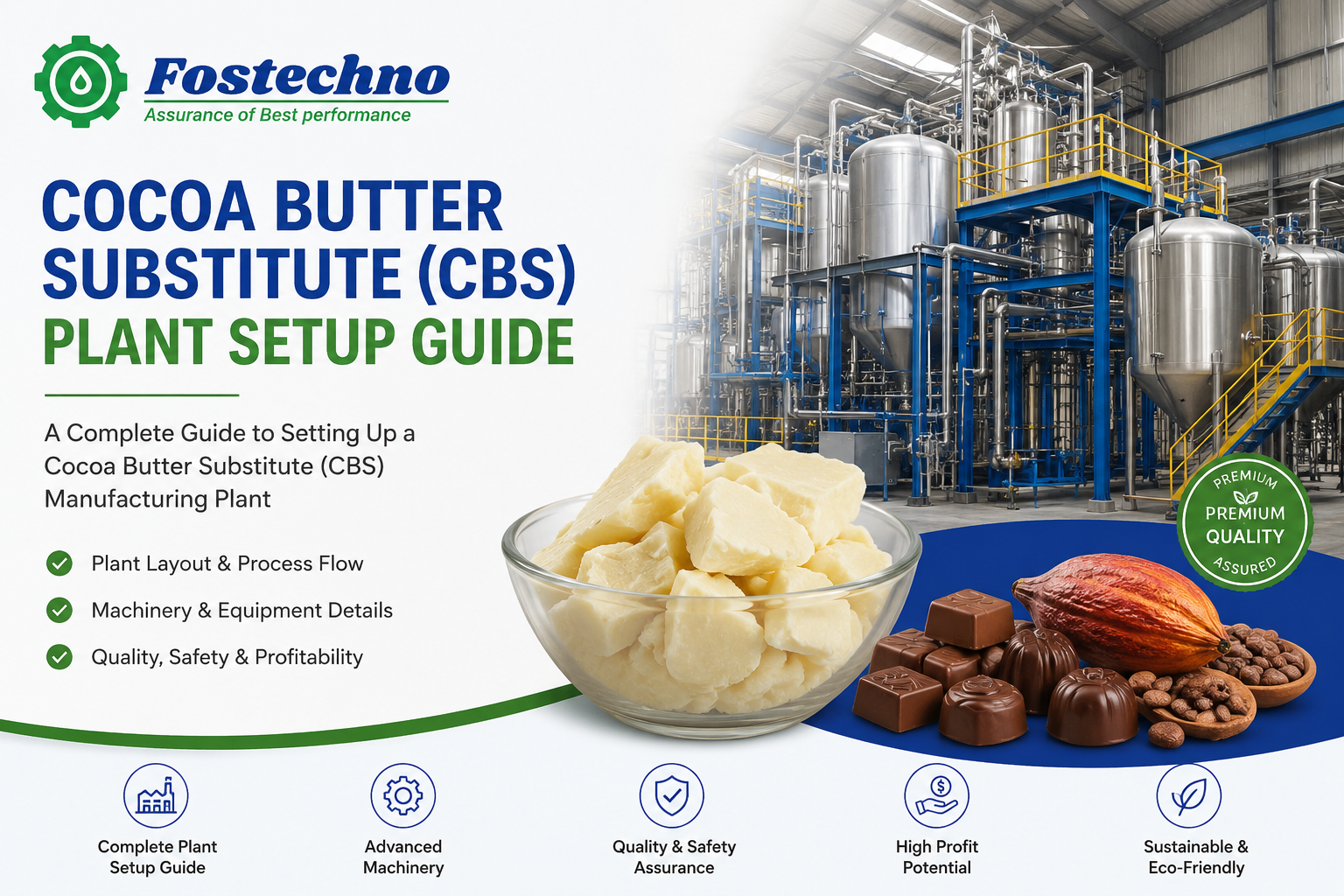
Setting up a Cocoa Butter Substitute (CBS) plant is one of the most practical ways for chocolate and confectionery manufacturers to increase production stability, reduce dependence on cocoa butter pricing, and scale compound coating capacity with consistent quality.
But a CBS project is not “just buying a crystallizer.” CBS performance in the customer’s chocolate line depends on tight control over moisture, crystallization recipes, separation efficiency, refining quality, and packaging discipline. That’s why most serious investors prefer a turnkey Cocoa Butter Substitute plant solution—where one technology partner designs the process, supplies and integrates the equipment, and takes responsibility from concept to commissioning.
This setup guide covers everything you need to plan and execute a CBS production plant:
- What a Cocoa Butter Substitute (CBS) plant does (and how it differs from a standard edible oil refinery)
- The CBS manufacturing process and process equipment
- Essential machinery required for a Cocoa Butter Substitute manufacturing plant
- Small, medium, and large scale Cocoa Butter Substitute (CBS) plant capacity planning
- CBS plant cost drivers and how to create a realistic project report
- Plant layout and factory design checklist
- Installation, commissioning, and maintenance best practices
- How to choose the right CBS plant manufacturer and machinery supplier
- How FOSTECHNO supports end-to-end CBS plant solutions
If you want an overview of CBS processing steps (drying → fractionation → maturation → filtration → refining), you can start with this reference page: Cocoa Butter Substitute (CBS).
What is a Cocoa Butter Substitute (CBS) plant production ?
A CBS production plant converts lauric feedstocks (most commonly palm kernel oil fractions, sometimes coconut oil fractions depending on the target grade) into a specialty fat used in:
- Compound chocolate and confectionery coatings
- Biscuit, wafer, and bakery enrobing
- Frozen dessert shells and coatings
A CBS plant is typically designed to deliver:
- Fast setting behavior
- Consistent gloss and hardness
- A controlled melting profile suitable for your target application
A key point for decision-makers: CBS is generally used in compound coatings, which are typically formulated differently than “real chocolate” made with cocoa butter. If you sell into regulated markets, always align formulation and product naming with local chocolate composition rules. For example, the EU’s chocolate composition and labeling framework is commonly discussed in relation to allowed vegetable fats in certain chocolate products (see the directive here: Directive 2000/36/EC (EUR-Lex) and the technical explainer here: Foreign fats in chocolate (EU Science Hub)).
Turnkey CBS plant solutions for chocolate manufacturers (what “turnkey” should include)
When buyers ask for a turnkey Cocoa Butter Substitute plant, they usually want one partner responsible for performance, schedule, and integration. A true turnkey scope commonly includes:
- Process design and selection (CBS grade targets, yield targets, by-product strategy)
- Layout engineering, utility balancing, and interconnecting piping philosophy
- Equipment manufacturing and supply
- Automation design (recipes, temperature control, batch tracking, critical alarms)
- Installation and commissioning support
- Operator training and performance ramp-up
- After-sales support and spares strategy
FOSTECHNO positions itself as an EPC/EPCC-oriented engineering partner for oil and fat processing plants, including value-added and fat modification systems. You can review their capability overview here: About FOSTECHNO and the broader plant categories here: FOSTECHNO.
Cocoa Butter Substitute processing plant: Manufacturing process and equipment
A Cocoa Butter Substitute (CBS) plant is built around controlled crystallization and separation. While exact flows vary by feedstock and grade, a common palm-kernel-based route includes:
| Process stage | What happens | Typical equipment |
|---|---|---|
| Feedstock handling | Storage, heating, pumping, basic filtration | Storage tanks, heaters/steam coils, pumps, strainers |
| Moisture removal (drying) | Removes moisture that can disrupt crystallization and filtration | Vacuum dryer (often duplex design), condenser/vacuum system |
| Controlled crystallization | Cooled under a defined recipe to form stearin crystals | Crystallizer with cooling coils and chilled water circuit |
| Crystal maturation | Improves crystal structure for better separation | Maturator with controlled jacket heating/circulation |
| Solid-liquid separation | Separates stearin (CBS) from olein | High-pressure filter (automatic), filtration aids as needed |
| Refining/finishing | Improves odor, stability, and cleanliness to meet food-grade needs | Deodorization and/or physical refining modules, polishing filters |
| Packing | Converts product to customer-ready format | Block/flake systems, carton/drum packing, bulk loading |
FOSTECHNO outlines a CBS route based on drying crude palm kernel oil, high-pressure fractionation, crystallization, maturation, filtration, and then refining the CBS stearin fraction. For the process overview and equipment references, see: Cocoa Butter Substitute (CBS).
Essential machinery required for a Cocoa Butter Substitute manufacturing plant
If you are writing a project report or comparing quotes from a Cocoa Butter Substitute (CBS) plant and machinery supplier, it helps to break equipment into “core processing” and “supporting systems.”
Core processing machinery
| Equipment group | Why it matters in a CBS plant | What to check in a supplier quote |
|---|---|---|
| Vacuum drying system | Moisture control is critical for repeatable crystallization and clean filtration | Vacuum level, drying time, heat transfer design, condensate handling |
| Crystallizer(s) | The crystallization recipe largely determines yield and final performance | Cooling control accuracy, agitation design, CIP/cleaning access, insulation |
| Maturator(s) | Stabilizes and grows crystals to improve separation efficiency | Jacket design, temperature uniformity, holding time flexibility |
| High-pressure filter | Determines separation quality and stearin yield | Filtration area, cycle time, automation level, cloth/media strategy |
| CBS refining/finishing | Reduces odor/taste issues and improves stability | Deodorization capability, vacuum performance, heat integration |
If your CBS refining approach is integrated with broader edible oil refining know-how, it can be helpful to understand related refining steps and equipment. For example:
- Degumming concepts and control considerations: Degumming
- Vacuum/steam stripping concepts used in deodorization: Physical refining & deodorization
Utility, automation, and quality systems (often underestimated)
Cocoa Butter Substitute (CBS) plant frequently fail to meet performance expectations not because the crystallizer is “bad,” but because utilities are under-designed or automation is not tuned.
| System | Why it’s critical | Planning note |
|---|---|---|
| Chilled water / cooling package | Fractionation performance depends on stable cooling capacity and temperature control | Design for peak load, not average load |
| Hot water / steam circuits | Drying and maturity steps need stable heating and fast response | Heat recovery can reduce operating cost |
| Vacuum system | Supports drying and deodorization/finishing steps | Vacuum stability is as important as ultimate vacuum |
| PLC/recipe automation | Reproducible CBS quality depends on repeatable recipes | Ensure audit trails and batch tracking if you supply large brands |
| QC laboratory basics | Ensures every batch meets customer specs | Establish COA routines and retention samples |
Cocoa Butter Substitute (CBS) plant capacity planning: Small, medium, and large scale plants
Plant sizing is the biggest decision you will make because it shapes everything: machinery selection, building size, utility design, manpower, and ROI.
A practical way to choose scale is to match capacity to your route-to-market.
| Plant scale | Who it’s best for | Typical priorities | Typical design notes |
|---|---|---|---|
| Small scale CBS plant | Regional confectionery makers, startups, import substitution | Low capex, faster execution, flexible product grades | Batch systems, simpler packing formats |
| Medium scale CBS plant | Multi-region brands, B2B coating supply, strong seasonality | Consistent COA quality, higher uptime, better energy efficiency | More automation, redundancy in critical utilities |
| Large scale CBS plant | Major compound chocolate and coating suppliers | Lowest unit cost, continuous supply contracts, export compliance discipline | Strong utility integration, robust spares strategy, high-efficiency filtration |
FOSTECHNO highlights turnkey project delivery and broader oil and fats plant capacity ranges in its corporate overview, which can help frame your sizing discussions: FOSTECHNO.
Cocoa Butter Substitute (CBS) production plant cost and equipment guide (what really drives the budget)
Most investors start by asking for “CBS plant cost.” In reality, Cocoa Butter Substitute (CBS) plant cost is driven by a set of engineering choices. Two projects with the same output capacity can have very different budgets.
The main CBS plant cost drivers
| Cost driver | What changes the cost | How to control it |
|---|---|---|
| Feedstock quality and pretreatment needs | Higher moisture/impurities require more robust drying and filtration | Define feed specs early and align procurement + process design |
| Product grade targets | Narrow melting range and higher stability may require tighter control and additional finishing | Lock product targets before final equipment sizing |
| Cooling system size | Crystallization is cooling-intensive | Design cooling for worst-case ambient and peak throughput |
| Filtration performance | Higher yield often needs higher-capacity or more advanced filtration | Validate filtration sizing with yield targets and cycle time |
| Automation and traceability | Brand supply contracts may require batch tracking and strict controls | Decide early if you need “industrial” or “FMCG-grade” traceability |
| Packing format | Blocks, cartons, drums, or bulk change downstream equipment and labor | Choose packing based on your customer supply chain |
| Civil, E&I, and installation scope | Equipment-only vs turnkey makes a major difference | Compare quotes on the same scope definition |
IMPORTANT
A reliable Cocoa Butter Substitute (CBS) plant project report should separate equipment supply cost from civil work, utilities, electrical/instrumentation, installation, commissioning, spares, and working capital. Many “cheap” quotes are cheap only because these items are excluded.
Cocoa Butter Substitute plant project report and machinery selection guide
A Cocoa Butter Substitute (CBS) plant project report is your internal decision document. It helps you avoid two common mistakes:
- Buying equipment that cannot consistently meet customer performance specs
- Underestimating utilities and commissioning effort
A strong CBS project report typically includes:
| Section | What to include |
|---|---|
| Market and sales plan | Compound coating demand, target industries, customer qualification plan |
| Product definition | CBS grade(s), melting profile targets, packaging formats |
| Feedstock plan | PKO/CPKO sources, quality specs, storage and heating plan |
| Process flow | Drying → crystallization → maturation → filtration → refining/finishing → packing |
| Mass balance | Input tons vs stearin yield vs olein by-product strategy |
| Utility balance | Cooling load, steam/hot water, power, compressed air, vacuum |
| Layout and safety | Zoning, access, hygiene design, traffic flow, fire safety |
| Capex/Opex model | Capex by work package, energy and maintenance estimates, manpower |
| Implementation timeline | Engineering, manufacturing, shipping, installation, commissioning |
For teams unfamiliar with industrial edible oil and fat processing project execution, it can help to review broader “manufacturing line” thinking around stages and integration. This overview is a useful reference point: Edible oil plant manufacturing line international.
Cocoa Butter Substitute plant layout and factory design guide
Plant layout directly impacts hygiene, maintenance, and operating cost. A Cocoa Butter Substitute (CBS) plant layout should be designed around these flows:
- Material flow (tanks → processing → packing)
- People flow (operators and QC staff without cross-contamination)
- Utility flow (chilled water, hot water/steam, vacuum, compressed air)
Layout checklist for CBS processing plants
| Area | Design goal | Practical checklist |
|---|---|---|
| Tank farm and feed handling | Stable feed temperature and safe handling | Bunding/containment, insulation, spill management |
| Drying and fractionation zone | Stable temperature control and clean access | Short pipe runs, good insulation, maintenance access |
| Filtration zone | Clean, safe filtration operation | Safe cake handling, filtration media management |
| Refining/finishing zone | Odor control and stable vacuum operations | Vacuum system accessibility, condensate handling |
| Packing zone | Clean packing, traceability, efficient dispatch | Batch coding, pallet flow, storage zoning |
If you also manufacture related fat products (shortenings, margarines, specialty coating fats), consider designing a layout that can expand into adjacent fat modification or value addition lines over time. A relevant reference for multi-product food fat manufacturing is: Bakery shortening & margarine plant.
Automatic Cocoa Butter Substitute plant: Features, benefits, and ROI
An automatic Cocoa Butter Substitute (CBS) plant is not just “a PLC.” It’s a plant where your quality depends on controlled recipes rather than operator intuition.
Key automation features that matter
| Automation feature | What it improves | Why it matters for ROI |
|---|---|---|
| Cooling recipe control (crystallizer) | Yield consistency and crystal quality | Reduces off-grade batches and customer complaints |
| Batch tracking and audit trails | Traceability and COA discipline | Helps win large B2B contracts |
| Alarm and interlock philosophy | Process safety and protection | Prevents equipment damage and rework |
| Utility control integration | Stable temperature and vacuum | Improves repeatability and reduces downtime |
Where ROI usually comes from
ROI in CBS automation usually comes from operational outcomes:
- Less off-grade production
- Faster start-ups and fewer rejected batches after changeovers
- Reduced labor per ton (especially in packing and filtration operations)
- More predictable ability to meet customer specs
Cocoa Butter Substitute plant installation and commissioning process
A common failure point in CBS projects is treating commissioning as a “one-week job.” In reality, commissioning is where your plant becomes a repeatable production asset.
A practical commissioning approach includes:
| Phase | What happens | Output |
|---|---|---|
| Pre-commissioning | Mechanical completion, loop checks, dry runs | Systems ready for safe wet commissioning |
| Utility commissioning | Chilled water, hot water/steam, vacuum, air | Stable utilities that meet design values |
| Wet commissioning | First product runs under controlled conditions | Baseline operating recipes |
| Performance runs | Repeated batches to confirm consistency | Preliminary acceptance criteria met |
| Training and handover | SOPs, maintenance routines, QA routines | Stable operations without vendor on-site |
If your project includes multiple plant categories (refining, deodorization, value addition), it is useful to work with a partner that already manufactures critical equipment like deodorizers, crystallizers, heat exchangers, and filtration-related systems. FOSTECHNO describes these manufacturing capabilities in its overview: FOSTECHNO.
Cocoa Butter Substitute plant maintenance and operational best practices
Cocoa Butter Substitute (CBS) plant are often batch-driven and depend on consistent heat transfer and filtration performance. Maintenance should focus on protecting those two realities.
Best practices that reduce downtime
| Best practice | Why it matters |
|---|---|
| Maintain heat transfer surfaces | Fouling reduces cooling/heating performance and shifts crystallization behavior |
| Standardize filtration media routines | Poor cloth/media management causes yield loss and inconsistent separation |
| Calibrate temperature and flow instruments | Small sensor drift can change crystal formation and product behavior |
| Keep chilled water performance stable | Fractionation stability depends on cooling consistency |
| Document recipes and deviations | Helps diagnose why a batch behaves differently |
For broader edible oil and fat refining operations, deodorization and refining steps also benefit from consistent vacuum performance and proper operating routines. See: Physical refining & deodorization.
Latest technology trends in Cocoa Butter Substitute processing plants
Most “new technology” in Cocoa Butter Substitute (CBS) plant is not about a single revolutionary machine—it’s about better control and better integration.
Common trends in modern CBS processing plants include:
- Better cooling recipe control (more precise temperature ramps and holds)
- Higher-efficiency filtration systems that improve yield and reduce cycle times
- Energy integration between hot and cold utilities
- Expansion capability into other specialty fat products
For manufacturers also planning other value-added fats, interesterification is a commonly referenced tool for tuning melting profile and crystallization behavior in specialty fat products. See: Interesterification.
How to choose the right Cocoa Butter Substitute plant manufacturer and machinery supplier
Choosing a CBS plant manufacturer is a risk decision. Your goal is to find a partner who can design for consistent performance, not just supply equipment.
Vendor evaluation checklist
| What to evaluate | What “good” looks like | Red flags |
|---|---|---|
| Process capability | Can explain drying, fractionation, crystallization, filtration, and finishing clearly | Only talks about “capacity” and “steel” |
| Recipe and control approach | Shows how they control cooling cycles and hold times | “Operator will manage it” |
| Integration scope | Provides clear battery limits and utility assumptions | Missing utilities or unclear interconnections |
| Quality and hygiene | Includes polishing filtration, cleanliness, and QA support | No plan for QC, sampling, or batch records |
| Commissioning support | Defines commissioning plan, training, ramp-up support | “We deliver equipment, you run it” |
| After-sales and spares | Provides spares list and maintenance plan | No spares strategy |
If your priority is a complete end-to-end solution, you should specifically ask for an EPC/EPCC-style scope. FOSTECHNO highlights turnkey execution and end-to-end engineering support in its company overview: About FOSTECHNO.
How FOSTECHNO delivers end-to-end CBS plant solutions
FOSTECHNO positions itself as a project engineering and plant manufacturing company serving oil and fat processing industries, including value addition and fat modification lines. For CBS specifically, FOSTECHNO describes technology for palm kernel oil fractionation (drying, crystallization, maturation, filtration) to produce the stearin fraction used as Cocoa Butter Substitute, followed by refining/finishing as required.
To explore the CBS production approach, see: Cocoa Butter Substitute (CBS).
To understand broader turnkey capability and manufacturing scope, see:
Global demand for Cocoa Butter Substitute and investment opportunities
CBS demand is tied to the growth of:
- Compound chocolate and compound coatings
- Bakery coatings and inclusions
- Frozen dessert coatings
The business case for investing in a CBS plant becomes stronger when you can:
- Secure steady offtake from confectionery or coating buyers
- Produce consistent grades with repeatable performance
- Monetize both CBS stearin and the olein fraction through a clear by-product strategy
For food manufacturers planning to sell across markets, keep an eye on local definitions and labeling rules around chocolate and vegetable fats. The EU references above are a useful starting point for understanding how some markets treat “foreign fats” in chocolate: Foreign fats in chocolate (EU Science Hub).
Next step: Get your CBS plant scope right before requesting quotes
Before you request quotations for a CBS plant and machinery supplier, you’ll get better proposals (and fewer surprises) if you define these inputs:
| Input you should share | Why it matters |
|---|---|
| Target capacity and working hours | Determines equipment sizing and utility design |
| Feedstock type (PKO/CPKO) and quality assumptions | Determines drying, filtration, and quality risk |
| Target CBS grade(s) and applications | Determines recipe control, finishing, and packing |
| Packaging format | Determines packing equipment, labor, and dispatch |
| Site utilities and ambient conditions | Determines chilled water sizing and design margins |
| Scope expectations | Equipment-only vs full turnkey changes cost and responsibility |
If you want to discuss a turnkey CBS plant requirement with FOSTECHNO , you can reach the team here: Contact.



Leave a Reply