Crude oil is not something you’d ever want to cook with. Fresh from an expeller or solvent extraction plant, it’s dark, sometimes cloudy, and carries a smell that can range from nutty to downright harsh. It contains gums, free fatty acids, pigments, traces of metals, and wax. Put that into a kitchen or a food factory, and you’d get smoke, off-flavours, short shelf life, and unhappy customers.
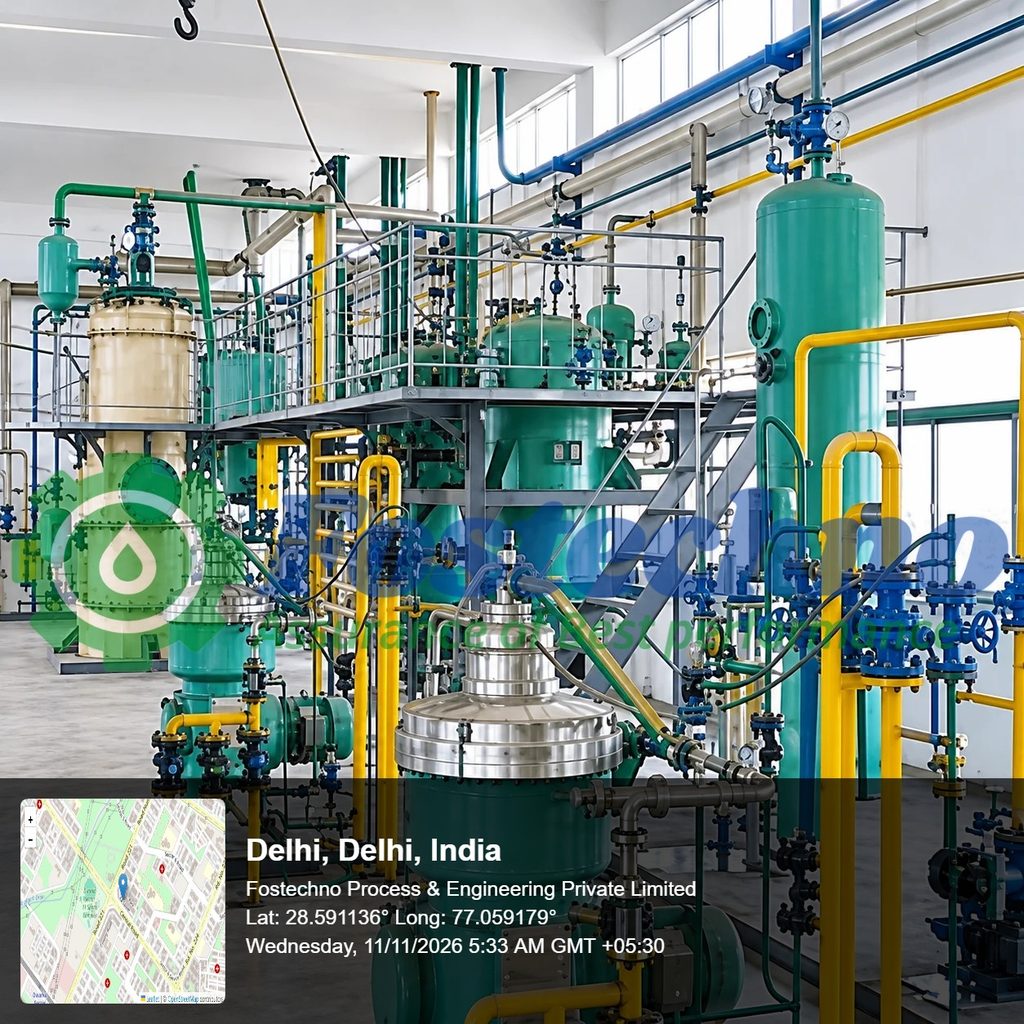
An edible oil refinery plant is what fixes that. It’s the facility that takes crude vegetable oil and turns it into the pale, neutral, stable product people actually buy.
If you’re thinking about setting one up, or upgrading an old one, this guide walks through the whole picture. We’ll cover how refining works stage by stage, how to choose between batch and continuous, physical and chemical routes, the utilities that nobody talks about, where profits quietly leak, and what to ask suppliers before signing anything.
What an Edible Oil Refinery Plant Actually Does
Think of refining as a series of targeted clean-ups. Each stage removes one family of unwanted components while leaving the oil itself, the triglycerides, as undisturbed as possible.
The goals are consistent whatever oil you process:
- Remove phospholipids (gums) that cause cloudiness and sediment.
- Remove free fatty acids (FFA) that make oil taste sharp and shorten shelf life.
- Remove colour pigments such as carotenoids and chlorophyll.
- Remove odour and flavour compounds, and leave a neutral base.
- Remove trace metals and oxidation products that speed up rancidity.
- Where needed, remove waxes that make oil turn cloudy in cold weather.
The oils that go through refineries include soybean, sunflower, rapeseed (canola), palm, rice bran, groundnut, cottonseed, corn, coconut, mustard and sesame. Not all of them need every stage, and the same equipment is not always right for all of them. Hold onto that thought, because it’s the root of most expensive mistakes.
The Refining Process, Stage by Stage
1. Degumming
Gums are mostly phospholipids. They hydrate in water, swell and separate. If you leave them in, they cause trouble in later stages: more soap in neutralization, more clay used in bleaching, and darker oil after deodorization.
There are several ways to do it:
- Water degumming: Hot water is mixed into the oil, hydratable gums swell and are removed by a centrifuge. Simple, and it also gives you crude lecithin as a by-product.
- Acid degumming: A small dose of phosphoric or citric acid converts non-hydratable phospholipids (calcium and magnesium salts) into a form that can be removed. This is the workhorse for soybean, rapeseed and sunflower.
- Enzymatic degumming: Phospholipase enzymes break down the stubborn phospholipids. It can improve oil yield and cut down chemical use, though enzyme cost and tight process control matter.
- Super or special degumming and membrane options: Used in specific high-volume or high-value situations.
Typical operating temperatures sit roughly between 60 and 90 °C depending on the method. The right choice depends on how much phosphorus is in your crude. Cold-pressed groundnut oil barely needs it. Soybean oil, rich in phospholipids, absolutely does.
2. Neutralization (Deacidification)
This stage removes free fatty acids. Two routes exist.
Chemical neutralization adds caustic soda (sodium hydroxide) to convert FFA into soap, called soapstock. A centrifuge separates the soapstock from the oil, which is then washed with water and dried. It also helps remove some gums, colour and impurities along the way. The downsides are a loss of neutral oil trapped in the soapstock, a lot of wastewater, and chemical handling.
Physical refining skips caustic entirely. The FFA are stripped out later, during deodorization, using steam under vacuum. This works best when the crude is low in phospholipids and has been very well degummed. Palm oil is the classic example.
3. Bleaching
Despite the name, nothing is chemically bleached. Oil is mixed with activated bleaching earth (and sometimes activated carbon) at roughly 90–110 °C under vacuum. Pigments, residual soap, trace metals and oxidation products stick to the clay, which is then filtered out.
A few practical points that rarely make it into brochures:
- Bleaching earth dosage commonly runs somewhere around 0.5% to 2% of the oil weight, depending on the oil and upstream quality. Poor degumming makes this number climb quickly.
- Spent earth holds oil. It can retain a notable share of its own weight in oil. That’s real money, and it’s a fire hazard if handled carelessly, because it can self-heat when exposed to air. Many plants use oil recovery from spent earth.
- Vacuum bleaching protects the oil from oxidation during the process.
4. Winterization or Dewaxing (when needed)
Sunflower, corn, rice bran and cottonseed oils contain waxes or high-melting glycerides that crystallize when it gets cold, leaving the oil hazy in the bottle. Winterization chills the oil under controlled conditions so these crystals grow in a filterable form, then filters them out. The cooling profile matters more than the equipment: crash-cool it and you get tiny crystals that blind your filters.
If you sell bottled oil in northern India during winter, or export to cooler climates, this stage protects your brand. A bottle that looks cloudy on a shelf gets returned, even if the oil is perfectly safe.
5. Deodorization
This is the heart of the refinery in many ways. Oil is heated to high temperature, typically in the range of 220–270 °C depending on the oil and design, and exposed to stripping steam under deep vacuum, often a few millibar. Volatile odour compounds, remaining FFA and other unwanted components are carried away.
Deodorization quality shows up directly in what customers notice: flavour, odour, colour and shelf life. But it also carries a trade-off that deserves attention:
- Higher temperature and longer residence time remove more odour, but can promote formation of trans fatty acids and process contaminants such as 3-MCPD esters and glycidyl esters, which are of growing concern to food regulators and international buyers.
- Good design uses short residence time, efficient stripping and well-controlled temperature, so you get the clean-up without the penalties.
If you plan to supply export markets or major food brands, ask any supplier specifically how their deodorizer design manages these contaminants.
6. Polishing and Final Filtration
After deodorization, oil goes through polishing filters to catch anything left, and it’s often cooled quickly and stored under nitrogen blanket to limit oxidation. Many plants add citric acid dosing at the end to chelate trace metals. Skip good storage practice here and you can undo a lot of expensive work.
Batch vs Continuous Refineries: The Honest Comparison
This is probably the first real decision you’ll face.
| Factor | Batch refinery | Continuous refinery |
|---|---|---|
| Typical capacity | Small, roughly 5–25 tons per day | Medium to large, roughly 30 TPD and up |
| Capital cost | Lower | Higher |
| Operating efficiency | More steam, more labour, more oil loss | Better heat recovery, lower losses |
| Flexibility | Excellent for switching between oils | Best when running one oil for long periods |
| Automation | Mostly manual or semi-automatic | Highly automated |
| Consistency | Operator-dependent | Very consistent |
| Best for | New entrepreneurs, regional brands, multiple oil types | Volume players, steady crude supply |
Many first-time investors go straight to continuous because it sounds more advanced. That’s not always wise. A continuous plant running at 40% of its rated capacity wastes energy and loses its efficiency edge. If your crude supply is uncertain or you want to run mustard one week and rice bran the next, a well-designed batch plant, or a semi-continuous one, can serve you better.
The honest rule of thumb is to size the plant for the crude you can reliably secure and the oil you can reliably sell, not for the number you hope to reach in year five. Modular design lets you add capacity later.
Physical Refining vs Chemical Refining
| Physical refining | Chemical refining | |
|---|---|---|
| FFA removal | Steam stripping in the deodorizer | Caustic soda, then centrifuge |
| Best for | High-FFA, low-phosphatide oils: palm, coconut, rice bran (with good pre-treatment) | Soft oils with high phospholipids: soybean, sunflower, rapeseed, cottonseed |
| Chemical use | Lower | Higher |
| Effluent | Much less | Soapstock and wash water |
| Neutral oil loss | Lower | Higher |
| Flexibility with poor crude | Low | Higher |
| By-product | Fatty acid distillate | Soapstock / acid oil |
Two practical comments:
First, physical refining isn’t automatically “better”. If your crude quality swings a lot, chemical refining is more forgiving. Physical refining demands excellent degumming and bleaching first, or the deodorizer pays for it.
Second, there’s a middle path. Some plants run chemical refining for soft oils and physical for palm-type oils through flexible designs. If your business plan includes both, ask for that capability to be built in from day one, since retrofitting is costly.
Equipment List: What’s Actually in the Plant
A complete refinery is a set of connected systems, not just a row of machines:
- Crude oil storage tanks and transfer pumps
- Degumming section: acid dosing, mixing, retention vessels, centrifuges
- Neutralization section: caustic dosing, mixers, centrifuges, washing and drying
- Bleaching section: bleacher vessel, earth dosing, filters (pressure leaf filters or similar)
- Winterization section (if needed): crystallizers, cooling system, filters
- Deodorizer: the vessel, deaerator, heat exchangers, stripping steam system
- Vacuum system: steam ejectors or liquid ring pumps, barometric or closed condensers
- Polishing filters and refined oil storage
- Fatty acid / soapstock handling, acid oil plant for soapstock splitting
- Utilities: steam boiler, thermic fluid heater (often used for high-temperature heating in deodorization), cooling tower, compressed air, nitrogen, water treatment
- Effluent treatment plant (ETP)
- Control system: from simple instruments to full PLC/SCADA
The Part Nobody Puts in Brochures: Utilities
Many first-time investors budget carefully for the refining equipment and then get surprised by utilities. In a refinery, steam, vacuum, cooling water and power are not side details. They’re a major share of your operating cost and of your reliability.
- Steam: Used for heating, stripping and the vacuum ejectors. Poor heat recovery is a silent profit killer. Ask suppliers about oil-to-oil heat exchange, where outgoing hot oil preheats incoming cold oil.
- Vacuum: Deodorizer and bleacher performance depend on stable vacuum. A leak or fouled condenser changes oil quality straight away. Plants with weak vacuum systems often blame the oil when the vacuum is the real problem.
- Cooling water: Insufficient or hot cooling water cuts vacuum performance. In hot Indian summers, this is a real constraint to plan for.
- Boiler fuel: Coal, biomass briquettes, husk, natural gas or LPG. Fuel choice affects both cost and pollution-control compliance.
- Water and effluent: Chemical refining generates more effluent, and you must treat it.
When comparing quotations from different suppliers, ask for steam consumption per ton of oil, electricity per ton, bleaching earth per ton and expected refining loss in writing. Two quotes that look equal in price can differ hugely once you multiply these numbers by years of operation.
Where the Money Really Leaks: Refining Loss
Refining is a process where you start with 100 kg of crude and end with less than 100 kg of refined oil. The difference is the refining loss, and it’s where margins are won or lost.
Where does the loss come from?
- FFA removed: Unavoidable. Higher FFA in crude means more loss.
- Gums removed: Some oil leaves with the gums.
- Neutral oil in soapstock: In chemical refining, poor separation takes good oil down with the soap.
- Oil in spent bleaching earth: Depends on dosage and filter performance.
- Deodorizer distillate and entrainment: Poor design lets oil droplets escape with steam.
- Handling and filter losses: Leaks, tank bottoms, filter cleanouts.
A well-run plant tracks loss at every stage. Suppose your plant processes 50 tons a day and a poorly tuned stage wastes an extra 0.5%. That’s 250 kg of oil every day. Over a year that adds up to roughly 75 tons, enough to fund a good chunk of an upgrade. This is why experienced operators care about centrifuge settings, earth dosing and soapstock quality, not just machine specifications.
Choosing Capacity and Layout
A few things should drive your capacity decision:
- Crude supply: Will you run your own crushing or solvent plant, or buy crude? Purchased crude means price exposure and quality variation.
- Market access: Packed retail oil, bulk supply to food processors, vanaspati makers, institutional buyers, or exports each need different quality levels and volumes.
- Product mix: Do you want to sell refined oil only, or also lecithin, acid oil, fatty acid distillate and soapstock products? By-products can meaningfully improve economics.
- Land and expansion: Leave room for future modules. Moving a vessel later is much costlier than leaving space now.
- Logistics: Tank trucks, loading bays, drum or pouch filling lines, warehouse.
On layout, group heavy-vibration and hot sections away from the lab and packing area, keep the deodorizer and vacuum system accessible for maintenance, and think about safe routes for tankers. A good layout is quietly profitable. A bad one makes every day harder.
Compliance and Licensing in India
Requirements vary by state and activity, so always confirm with local authorities and a qualified consultant. In general, expect to deal with:
- Business registration: Company or firm registration, GST.
- Factory and local approvals: Factory licence, local trade or municipal permissions, fire safety clearance, boiler registration and inspection where applicable.
- Environmental clearance: Consent to establish and consent to operate from the State Pollution Control Board, plus effluent treatment arrangements.
- Food safety: FSSAI licence (and registration for packing and selling under your own brand), compliance with applicable standards for edible oils and labelling.
- Weights and measures and packaging rules for retail packs.
- Fortification norms: Where applicable, edible oils may need to meet vitamin fortification requirements, so check current FSSAI rules.
Start the pollution-board and land-use conversations early. Delays there stall more projects than equipment delivery does.
Quality Control: A Lab Is Not Optional
You cannot manage what you don’t measure. Even a small plant needs basic lab capability, and larger plants should run tests at every stage.
Key parameters to track:
- Free fatty acid (FFA)
- Peroxide value and anisidine value (oxidation indicators)
- Moisture and volatile matter
- Colour (Lovibond or equivalent)
- Phosphorus content (to monitor degumming)
- Soap content after neutralization (to protect bleaching)
- Iodine value and other identity checks
- Sensory evaluation: a trained person tasting and smelling, still irreplaceable
- Contaminants testing, including residual solvents for solvent-extracted oil and, for export-oriented plants, process contaminants like 3-MCPD and glycidyl esters through an accredited lab
Take samples at crude receipt, after degumming, after neutralization, after bleaching, after deodorization and at final packing. When something goes wrong, stage-by-stage data tells you where.
Cost and Investment: What Drives the Number
Because prices vary widely by country, capacity, automation and local conditions, anyone who quotes you a single universal figure for “an edible oil refinery plant” is guessing. What you can do is understand what drives the cost:
- Capacity: Costs rise with size, but not in a straight line. Larger plants usually cost less per ton of capacity.
- Batch vs continuous: Continuous costs more upfront and saves in operation.
- Refining route: A flexible plant that can do physical and chemical refining costs more than a single-route one.
- Material of construction: Stainless steel grades and quality of fabrication affect both price and lifespan.
- Automation level: Basic instruments versus full PLC with data logging.
- Energy recovery: Heat exchangers and better vacuum systems cost more initially and pay back through lower steam and power use.
- Civil works, utilities and ETP: Often underestimated, sometimes a third or more of total project spend in some projects.
- By-product recovery: Lecithin, acid oil, fractionation or spent-earth oil recovery add capital but add revenue.
For operating expenses, watch crude oil cost (usually the biggest by far), steam and fuel, electricity, bleaching earth and chemicals, labour, maintenance and packaging. Your profitability is mostly about the spread between crude cost and refined oil price, minus processing cost. A plant that saves 1% in refining loss or 5% in steam can matter more than a slightly cheaper machine.
Always get detailed written quotations from at least three suppliers, and compare them on guaranteed consumption figures, not just on the headline price.
Turnkey vs Buying Equipment Separately
Turnkey: One supplier handles design, manufacturing, installation and commissioning. You get single-point responsibility, and performance guarantees are easier to enforce. The downside is a higher apparent price and less room to pick individual best-in-class components.
Buying piece by piece: You can shop each section individually and perhaps save money, but you take on the integration risk. If the deodorizer underperforms, is it the equipment, the upstream bleaching or your vacuum system? Without a single accountable party, disputes can drag on.
For first-time investors, turnkey usually reduces risk. For experienced operators with engineering teams, selective sourcing can work.
Eight Mistakes That Quietly Drain Profit
- Buying capacity you can’t feed. An oversized plant running half-empty burns money.
- Ignoring crude quality. The design should match your actual crude, including its worst batches, not the average brochure sample.
- Skimping on degumming. Everything downstream pays for upstream shortcuts.
- Weak vacuum and cooling. Deodorization depends on them.
- No loss tracking. If you don’t measure by stage, you won’t find the leak.
- Underbudgeting utilities and ETP. These bite late and hard.
- Skipping operator training. A good plant in poor hands performs like a poor plant.
- Choosing on price alone. The cheapest quote often has the highest running cost.
Safety and Sustainability Considerations
Refineries involve hot oil, high-temperature systems, caustic and acids, and sometimes solvents if you integrate extraction. Good practice includes proper pressure-vessel inspection, hot-surface protection, ventilation, spill containment, fire protection, and safe handling of spent bleaching earth, which can ignite spontaneously if left in heaps.
On sustainability, the trends worth watching are lower-chemical routes such as physical refining and enzymatic degumming, better heat recovery, recovering oil from spent earth, converting soapstock and fatty acid distillate into saleable products, and treating or recycling effluent water. These aren’t just good for the environment. They usually lower your costs and make approvals smoother.
A Simple Step-by-Step Plan for Starting
- Define your oil and market. Which oils, what volume, who buys?
- Secure a crude supply plan. Contracts or your own crushing.
- Choose capacity and route. Batch or continuous, physical or chemical or both.
- Shortlist suppliers. Visit running plants and speak to their operators, not just their sales teams.
- Compare guaranteed consumption figures. Steam, power, earth, chemicals, refining loss.
- Start approvals early. Land, pollution board, FSSAI, boiler, fire.
- Plan utilities, ETP and storage alongside the main plant.
- Build your lab and hire your team early.
- Commission, test and tune. Don’t rush into full production.
- Track loss and cost from day one.
Questions to Ask Any Edible Oil Refinery Plant Supplier
Print this list and take it to every meeting:
- Can I visit a plant like mine that has been running for at least two years?
- What are your guaranteed steam, electricity, bleaching earth and chemical consumption figures per ton?
- What refining loss do you guarantee, and under what crude specification?
- How does your deodorizer design control trans fats, 3-MCPD and glycidyl esters?
- What happens if guarantees aren’t met?
- What spare parts do you stock, and what is the delivery time for critical ones?
- Who provides commissioning, operator training and after-sales support, and for how long?
- Can the plant be expanded or converted later, and how?
A supplier who answers these clearly and confidently is worth far more than one with a slick catalogue.
Frequently Asked Questions
What is an edible oil refinery plant?
It’s an industrial facility that converts crude vegetable oil into food-grade refined oil by removing gums, free fatty acids, colour, odour, waxes and other impurities through a series of processing stages.
What are the main stages of edible oil refining?
Degumming, neutralization, bleaching, deodorization, and, for certain oils, winterization or dewaxing, followed by polishing filtration.
What is the difference between physical and chemical refining?
Chemical refining removes free fatty acids with caustic soda. Physical refining removes them by steam distillation during deodorization. Physical suits high-FFA, low-phosphatide oils such as palm, while chemical suits soft oils with high phospholipid content such as soybean.
Which is better, a batch or continuous refinery?
Batch plants suit small volumes and frequent oil changes. Continuous plants suit steady, higher-volume operations with better efficiency and consistency. The right choice depends on your supply and market.
Can one refinery process different oils?
Yes, with the right design. Flexible plants can handle several oils, but changeovers need cleaning and process adjustment, and not every plant is built for both physical and chemical refining.
Why does refined oil sometimes turn cloudy in winter?
Natural waxes or high-melting components crystallize at low temperature. Winterization or dewaxing removes them so the oil stays clear.
How long does it take to set up a refinery?
It varies with size, approvals and equipment lead times. Small plants can move faster, while large continuous plants with civil works and approvals typically take a year or more from design to production.
Is an edible oil refinery profitable?
It can be, but profitability depends mainly on the spread between crude and refined oil prices, your refining loss, utility costs, by-product income and sales channels. Plan with realistic numbers and a secured supply.
What licences are needed in India?
Typically business and GST registration, factory and local approvals, State Pollution Control Board consent, boiler and fire clearances where applicable, and FSSAI registration or licence. Requirements vary by state, so confirm locally.
Final Thoughts
A good edible oil refinery plant isn’t defined by shiny stainless steel. It’s defined by how well the process matches your crude, how steadily the utilities perform, how tightly you control losses, and how consistent the oil in the bottle is, day after day.
Get the early decisions right: your oil, your capacity, your refining route, and your supplier. Then spend as much time on utilities, training and quality control as on the headline machines. Do that, and you’ll have a plant that earns its keep for decades rather than one that merely looks impressive on commissioning day.
If you’re comparing options right now, start by writing down your crude specification, your target market and your realistic daily volume. Everything else in your plant design follows from those three answers.


Leave a Reply