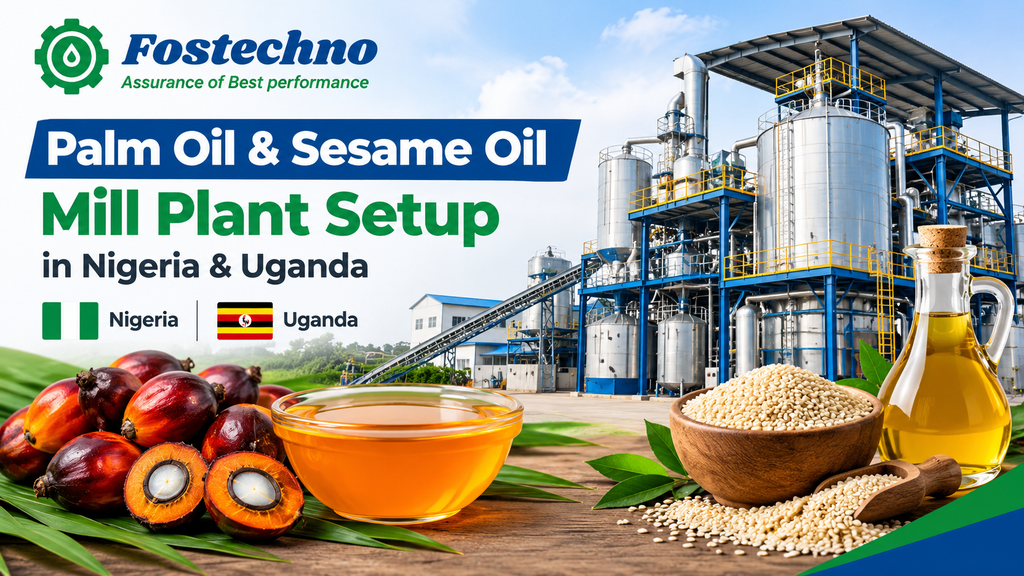
Introduction: Africa Grows the Oilseeds, and the Biggest Profit Is in Processing
Across West and East Africa, oil crops are everywhere. Palm fruit bunches fall in the plantations and smallholder farms of the Niger Delta. Sesame fields stretch across northern Nigeria and northern Uganda. Yet in many places, the raw material leaves the farm gate at a low price, while the real value, the oil, the kernels, the cake and the by-products, is captured further down the chain.
This is the opportunity in front of every entrepreneur, cooperative, agribusiness group and investor who is thinking about building an oil mill. A properly engineered plant turns a perishable crop into a stable, tradable, higher-value product. It creates local jobs, reduces dependence on imported edible oil, and builds a business that can run for decades.
But a mill is only as good as the engineering behind it. The wrong machine selection, a poorly designed process flow, weak utilities planning or a plant that cannot handle local raw material quality can turn a promising project into a costly lesson.
At FOSTECHNO Process & Engineering Private Limited, we design, manufacture, supply and commission oil mill plants and process systems. This guide is written for investors and mill owners in Nigeria, the Niger Delta region and Uganda who want to understand how a palm oil or sesame oil plant is planned, what it includes, what it costs to think through, and how to avoid the mistakes that hurt returns.
Whether you are planning a small community mill or a large-scale processing facility, read on. By the end, you will know exactly what questions to ask before you commit to a plant.
Why Nigeria, the Niger Delta and Uganda Are Strong Markets for Oil Mills
Nigeria and the Niger Delta: A Natural Home for Palm Oil
Nigeria has a long history with the oil palm. The crop grows well in the humid, high-rainfall belt of the south, and the Niger Delta states, including Delta, Bayelsa, Rivers, Akwa Ibom, Cross River and Edo, sit at the heart of that belt. Palm oil is not an occasional ingredient here. It is a daily cooking oil, a base for soups and stews, a raw material for soap and cosmetics, and a feedstock for the food industry.
Domestic demand for edible oil is large and continues to grow with population and urbanisation. At the same time, a significant portion of local palm oil production still comes from small-scale, manual or semi-mechanised processing. This often means lower extraction efficiency, inconsistent quality and high losses. Modern, mechanised mills can improve oil recovery, produce cleaner and more consistent oil, and capture valuable kernels that are often wasted or under-used.
Nigeria is also one of Africa’s major sesame producers. Sesame seed is a growing export crop, and the demand for processed sesame oil, both for local food use and for specialty markets, creates a second strong line of business for processors.
Uganda: Sesame, Oilseeds and a Growing Edible Oil Market
Uganda has built a reputation for oilseed crops. Sesame is widely grown in the northern part of the country, in districts such as Gulu, Lira, Kitgum and surrounding areas, and is an important source of income for many farming families. Uganda also grows sunflower, groundnut and soybean, and has oil palm cultivation in areas such as the Lake Victoria islands and parts of the central and western regions.
Uganda, like much of East Africa, imports a considerable amount of edible oil to meet demand. This creates a clear business case for domestic processing. A mill located close to the growing areas saves on transport, reduces post-harvest losses and gives farmers a reliable local buyer.
What This Means for Investors
In both regions, the ingredients for a successful oil business are already in place: raw material, demand and a need for better processing technology. The missing piece is often well-engineered, appropriately sized, reliable plant and machinery. That is where a technical partner makes the difference.
Understanding the Palm Oil Value Chain
Before choosing a plant, it helps to understand what you are actually processing and what products come out of it.
The oil palm fruit grows in large bunches called Fresh Fruit Bunches (FFB). Each fruit has two oil-bearing parts:
- The fleshy outer layer (mesocarp), which yields Crude Palm Oil (CPO).
- The inner nut (kernel), which yields Palm Kernel Oil (PKO) and Palm Kernel Cake (PKC), a valuable animal feed ingredient.
A good mill is designed to recover as much value as possible from every tonne of fruit. That includes the crude palm oil, the palm kernels, the fibre and shell (which can be used as boiler fuel) and the empty fruit bunches (which can be used as mulch, compost or fuel).
A critical point to remember is that palm fruit starts to degrade quickly after harvest. The longer the delay between cutting and processing, the higher the free fatty acid (FFA) level rises, and the lower the oil quality and price. This is one of the strongest arguments for locating a mill close to the fruit supply and for choosing a plant that can process fruit promptly.
How a Palm Oil Mill Plant Works: Stage by Stage
A palm oil extraction plant is a sequence of connected process stages. Each stage has a purpose, and weakness at any stage reduces the performance of the whole plant. Here is how a typical mechanised mill works.
1. Fruit Reception and Weighing
FFB arrives at the mill and is weighed and inspected. Good record keeping here helps you pay suppliers fairly, track extraction efficiency and manage inventory. Fruit should be processed as quickly as possible, ideally within a day of harvest.
2. Sterilisation
Bunches are loaded into cages and cooked with steam in a sterilizer. Sterilisation serves several purposes: it stops the enzymes that increase free fatty acids, softens the fruit so it detaches from the bunch, conditions the kernel and helps the oil release during later stages. The correct steam pressure and cooking time are important, and this is where a well-designed sterilizer and steam system pays off.
3. Stripping (Threshing)
The sterilised bunches go into a thresher, a rotating drum that separates the fruit from the empty bunch stalks. The empty fruit bunches leave the process as by-product, and the loose fruit moves on.
4. Digestion
The fruit is heated and mashed in a digester, a vessel with rotating arms. This breaks open the oil cells in the flesh and prepares the mash for pressing. Proper digestion has a direct effect on how much oil the press can recover.
5. Pressing
A screw press squeezes the digested mash and separates the liquid (a mixture of oil, water and solids) from the pressed cake, which contains fibre and nuts. Correct press settings are a balance: too little pressure leaves oil behind, too much can break nuts and reduce kernel quality.
6. Clarification
The liquid from the press goes through clarification, where oil is separated from water and solids using settling tanks, centrifuges or decanters, followed by drying. The result is clean crude palm oil with controlled moisture, ready for storage. Efficient clarification reduces oil losses in the sludge and improves quality.
7. Nut and Kernel Recovery
The press cake is broken up, and the fibre is separated from the nuts. Nuts are dried, cracked and the kernels separated from the shell. Kernels can be sold as they are or crushed to extract palm kernel oil and cake. Shell and fibre are generally used as fuel for the boiler.
8. Boiler and Power Systems
Steam is the heartbeat of a palm oil mill. The boiler, usually fuelled by the mill’s own fibre and shell, supplies steam for sterilisation, digestion and other stages. Using by-products as fuel lowers energy costs and makes the mill more self-reliant, a real advantage in regions where grid power can be unreliable.
9. Effluent Treatment
Palm oil mills produce wastewater (palm oil mill effluent, or POME). Responsible plants include effluent treatment to meet environmental requirements and protect nearby communities and water sources. Planning this early prevents regulatory and community problems later.
Palm Oil Mill Capacity: Choosing the Right Size
One of the most common questions we hear is, “What capacity should I build?” The honest answer is that it depends on the fruit supply you can secure, not on the biggest number you can afford. Oversizing a plant without enough raw material leaves expensive machinery idle. Undersizing wastes your market opportunity.
Here is a general way to think about plant scale:
| Plant Scale | Typical Use | Key Consideration |
|---|---|---|
| Small / Mini mill | Smallholder clusters, community mills, first-time investors | Lower investment, quick start, simple operation |
| Medium mill | Cooperatives, outgrower schemes, regional processors | Balance of efficiency, automation and cost |
| Large mill | Estates with their own plantation, integrated agribusiness | Highest efficiency, needs steady, large fruit supply |
Before deciding, ask yourself:
- How many tonnes of fruit can I reliably collect per hour, per day and per season?
- How far is the fruit transported, and how quickly can it reach the mill?
- Do I plan to expand in future? (If so, the plant layout should allow it.)
- Do I want to process palm kernels as well?
A good engineering partner will help you answer these honestly, and will design a plant that fits your supply, not just a catalogue number.
Sesame Oil Plant Setup: A Different Process, A Different Opportunity
Sesame is one of the oldest oilseeds in the world, and it is prized for its oil, which has a distinctive flavour, good stability and a strong reputation in food, cooking and wellness markets. Sesame seed typically contains a high proportion of oil, which makes it an attractive crop to process.
For processors in northern Nigeria and Uganda, sesame is often easier to source consistently than many other oilseeds, because it is a recognised cash crop with established collection routes. But the quality of the final oil depends heavily on how the seed is cleaned, handled and processed.
The Sesame Oil Extraction Process
1. Seed Cleaning Raw sesame often contains sand, stones, husk fragments and other impurities. A cleaning line, using sieves, destoners and air separation, removes these and protects the machinery downstream. Clean seed means clean oil and a longer machine life.
2. Dehulling (optional) Some applications require hulled sesame for lighter-coloured oil or for the confectionery and bakery trade. Dehulling equipment removes the outer seed coat. Whether you need this depends on your target market.
3. Roasting (for roasted sesame oil) Roasting develops the deep, nutty aroma that roasted sesame oil is known for. Temperature and time control are critical. Over-roasting causes bitterness and darkens the oil.
4. Pressing / Expelling Sesame seed is pressed in a screw expeller. Two styles are common:
- Cold pressed oil is extracted at lower temperature, which retains natural flavour and nutrients and appeals to premium and health-focused markets.
- Hot pressed oil is extracted from roasted or pre-conditioned seed, yielding a stronger flavour and typically a higher oil recovery.
5. Filtration and Settling Pressed oil contains fine particles. It is filtered using filter presses or similar equipment, and often allowed to settle, to produce a clear, bright finished oil.
6. Packing and Storage Finished oil is packed in drums, bottles or bulk containers depending on the market. Clean, food-grade packing lines protect your quality and brand.
7. Sesame Cake Handling The pressed sesame cake is high in protein and is commonly used as animal feed ingredient. Selling the cake is an extra income stream that should be part of your business model from the start.
Refining: Do You Need It?
Many sesame oil businesses sell filtered, unrefined oil, because the natural flavour is the product’s strength. Others add a refining stage for a neutral, longer-shelf-life oil for wider commercial use. Whether to include refining depends on your market, your budget and the regulations in your country. This is a decision to make at the planning stage, not after the plant is built.
Multi-Oilseed Flexibility: One Plant, More Revenue
For many investors, especially in Uganda, it makes sense to build a plant that can process more than one oilseed. Sesame, sunflower, groundnut and other oilseeds can often be handled using similar pressing and filtration equipment with appropriate adjustments. A flexible plant can:
- Keep running when one crop’s season is over.
- Reduce risk from price swings in a single crop.
- Improve annual capacity utilisation and return on investment.
If flexibility matters to you, tell your plant supplier at the very beginning. It affects equipment selection, layout and storage design.
What “Turnkey” Really Means (and Why It Matters)
You will hear the word turnkey often when shopping for plants. It means the supplier takes responsibility for the whole project, from design to a working plant, so that you can “turn the key” and begin production. A true turnkey project from a serious engineering company typically covers:
Process and Engineering Design
- Process flow diagrams and plant layout
- Mass and energy balance
- Equipment sizing and specifications
- Utility requirements (steam, power, water)
Manufacturing and Supply
- Fabrication of process equipment such as sterilizers, digesters, presses, tanks and conveyors
- Supply of boilers, motors, controls and instruments
- Quality checks before dispatch
Shipping and Logistics Support
- Packing for export
- Documentation and shipping coordination to the destination port
- Guidance on import procedures
Installation and Commissioning
- Mechanical and electrical installation supervision
- Trial runs and performance testing
- Handover with a working plant
Training and After-Sales Support
- Operator and maintenance training
- Spare parts supply
- Ongoing technical support
The benefit of this approach is single-point accountability. If something does not perform, you are not caught between five different vendors blaming each other. One team is responsible for the result.
Site Selection and Infrastructure: Decisions That Make or Break the Project
Even the best machinery cannot overcome a poor site. Before you buy any equipment, evaluate these factors carefully.
Proximity to Raw Material
For palm oil especially, the mill should be close to the fruit supply. Long hauling times mean higher FFA levels, lower quality and lower prices. For sesame, closeness to collection centres reduces transport cost and gives you better control of seed quality.
Road Access
Heavy trucks must reach the site in all seasons. In the rainy parts of the Niger Delta and the Lake Victoria region, a site that floods or becomes impassable for weeks will cost you dearly.
Water Supply
Palm oil mills use significant amounts of water in processing and boiler operation. Confirm that a reliable, adequate source exists, and plan for water treatment where needed.
Power Availability
Grid power in many parts of Nigeria and Uganda can be inconsistent. A good design considers backup generation, or even better, uses the mill’s own biomass (fibre and shell) as an energy source for steam and, where appropriate, for power. This turns a waste stream into a cost-saving asset.
Land, Layout and Expansion
Choose land with room not only for the plant itself, but also for storage, truck movement, effluent treatment, offices, workshop and future expansion. A cramped site is difficult and expensive to fix later.
Environmental and Legal Requirements
Environmental approvals, land-use permits, effluent discharge standards, and community engagement all matter. Start these processes early. In regions like the Niger Delta, where communities and environment are closely linked, a good relationship with the local community is as important as good machinery.
The Real Economics: What Drives Return on Investment
Investors naturally ask, “How much will it cost, and when will I earn it back?” The exact answer depends on capacity, level of automation, site conditions and local market prices, so any responsible supplier should give you a project-specific estimate rather than a generic number. But it helps to understand the variables that decide profitability.
1. Oil Extraction Efficiency
The percentage of available oil that your plant actually recovers is the single most important performance figure. A small improvement in extraction efficiency, repeated across thousands of tonnes of raw material, adds up to a very large amount of extra income. This is why quality of machinery and correct process design matter more than the lowest purchase price.
2. Raw Material Cost and Availability
Your fruit or seed cost will usually be your largest running expense. Secure supply through contracts with farmers, cooperatives or your own plantation. A plant that runs at full capacity is far more profitable than one that stops and starts for lack of raw material.
3. Product Quality
Better quality oil, with low FFA, low moisture and clean appearance, sells at a better price and opens doors to larger buyers and export channels. Quality is built into the plant design, not added at the end.
4. By-Product Revenue
Smart operators earn from every part of the crop:
- Palm kernels and palm kernel oil and cake
- Fibre and shell as boiler fuel (reducing energy cost) or for sale
- Empty fruit bunches as compost, mulch or fuel
- Sesame cake as animal feed
When by-product income is planned into the business, the overall return improves substantially.
5. Energy and Operating Costs
A well-designed plant uses steam and power efficiently, requires fewer operators per tonne and has lower maintenance costs. Cheap equipment that consumes more energy and breaks down often is usually more expensive over the plant’s life.
6. Downtime and Spare Parts
Every day the plant stands still is lost revenue. Choose a partner who can supply spares quickly and who designs machinery for easy maintenance.
A Simple Way to Think About It
Total cost of ownership, not purchase price, is what counts. A plant that costs a little more up front but delivers higher extraction, lower running cost and longer life will almost always be the better investment.
Eight Costly Mistakes to Avoid When Setting Up an Oil Mill
Over the years, the same errors appear again and again in oil mill projects. Avoid these, and you are already ahead.
1. Buying capacity before securing raw material. A large plant with an unreliable supply is an expensive monument. Confirm your supply first.
2. Choosing purely on the lowest price. Very cheap quotes often hide poor-quality materials, weak process design or missing components. Compare what is included, not only the headline price.
3. Ignoring utilities. Steam, power and water are not afterthoughts. A plant without proper utilities cannot perform to specification.
4. Skipping effluent and environmental planning. This leads to delays, fines or community opposition. Build it into the project from day one.
5. Poor plant layout. Bad layouts create bottlenecks, wasted labour and safety problems. A good process engineer designs the flow of material, people and trucks together.
6. Neglecting operator training. Even an excellent plant underperforms in untrained hands. Make sure training is part of the package.
7. No spare parts plan. Delays in getting a simple wear part can stop production for weeks. Agree on a spares list and supply route at the start.
8. Forgetting future expansion. Businesses grow. Leave room, both physically and in the design, for increased capacity or additional processes like kernel crushing or refining.
Why Work With FOSTECHNO Process & Engineering Private Limited
Choosing a plant builder is a long-term decision. You are not just buying machines. You are choosing a partner who will stand behind your investment for years.
Here is what we bring to every oil mill project.
Engineering First, Not Just Equipment
We begin with your raw material, your capacity target, your site and your market, and then design the process around them. Our approach is to engineer the right plant for your situation rather than to push a standard model.
End-to-End Project Responsibility
From concept and design to manufacturing, dispatch, installation supervision, commissioning and training, our team stays involved so that you have one point of contact and one team accountable for results.
Plants Designed for Real-World Conditions
We design with local realities in mind: variable raw material quality, challenging climate, power constraints and the need for simple, robust operation and maintenance. Reliability in the field matters more than a good brochure.
Quality Manufacturing
Plant equipment is built using appropriate materials and fabrication standards, with checks before dispatch, so that it performs and lasts in demanding processing environments.
Support After Commissioning
Our relationship does not end at handover. We support operators with technical guidance, training and spare parts, so that your plant keeps performing.
Flexible Solutions
From compact mills for first-time investors to larger, more automated plants for established agribusinesses, and from palm oil to sesame and other oilseeds, we shape the solution to the business plan.
Your Project Journey With FOSTECHNO: Step by Step
We make the path from idea to production as clear as possible.
Step 1: Initial Consultation We discuss your goals: what you want to process, how much, where, and what products you want to sell.
Step 2: Requirement Study and Feasibility Input We look at raw material availability, site conditions, utilities and market, and advise on a suitable capacity and process scheme.
Step 3: Process Design and Proposal You receive a clear technical and commercial proposal with the scope of supply, process description, layout concept and timelines.
Step 4: Order Confirmation and Detailed Engineering Once the order is confirmed, we finalise detailed engineering and drawings.
Step 5: Manufacturing and Quality Checks Equipment is fabricated and inspected to ensure it meets the agreed specification.
Step 6: Dispatch and Logistics We pack the equipment securely and coordinate shipping and documentation.
Step 7: Installation and Commissioning Our engineers guide installation, carry out trial runs and bring the plant to stable production.
Step 8: Training and Handover Your operators are trained, and the plant is handed over ready to earn.
Step 9: After-Sales Support We stay available for technical help, spares and future upgrades.
Who This Is For
Our plant solutions are designed for:
- Entrepreneurs and first-time investors who want to start an oil processing business with expert guidance.
- Farmer cooperatives and outgrower groups who want to process and sell oil instead of only selling raw crop.
- Established agribusinesses and plantation owners who want to add or upgrade their own processing capacity.
- Food and soap manufacturers who want to secure their own supply of oil.
- Development and community projects seeking sustainable rural industry.
If you are in Lagos, Port Harcourt, Warri, Benin City, Calabar, Uyo, Yenagoa, Kano, Kampala, Gulu, Lira or anywhere in between, and you are considering an oil mill, we would be glad to speak with you.
Looking Ahead: Value Addition Is the Future
The direction is clear. Governments, investors and communities across Africa increasingly want to keep more value at home. That means processing crops locally rather than exporting them raw, building local industry and jobs, and meeting growing domestic demand with locally made products.
Oil mills sit right at the centre of that trend. A well-planned palm oil or sesame oil plant can be the foundation of a business that grows with its region, adding kernel crushing, refining, packaging, bio-energy from by-products and even export operations over time.
The entrepreneurs who succeed will be those who begin with a solid technical foundation: the right process, the right capacity, the right quality and the right partner.
Frequently Asked Questions
What capacity palm oil mill should I start with?
It depends on how much fruit you can reliably secure, not on budget alone. Many first-time investors begin with a small or medium plant that matches their supply, then expand once operations are stable. We help you size the plant based on your actual raw material situation.
Can one plant process both palm oil and sesame oil?
Palm oil and sesame use different process lines because the raw materials are very different. However, you can set up both lines at the same site and share some utilities and infrastructure. Sesame can also be combined with other oilseeds like sunflower or groundnut in a flexible seed-pressing line.
Do you provide complete turnkey plants?
Yes. Our turnkey scope covers process design, equipment manufacture and supply, shipping support, installation supervision, commissioning, operator training and after-sales support. The exact scope is defined in your proposal.
Is it better to produce cold pressed or hot pressed sesame oil?
It depends on your market. Cold pressed suits premium, health-oriented and natural-flavour products. Hot pressed or roasted sesame oil gives stronger aroma and often higher oil yield. We can help you choose based on who you plan to sell to.
How long does it take to set up a plant?
Timelines depend on plant size, customisation, shipping and site readiness. We provide a project schedule with your proposal so you can plan civil works, utilities and approvals in parallel.
What about power and fuel at the site?
We design with local conditions in mind. For palm oil mills, fibre and shell can fuel the boiler, reducing external fuel needs. For other cases, we advise on suitable generator or power backup options.
Do you offer spare parts and technical support after installation?
Yes. We support our customers with spare parts, troubleshooting guidance and operator training so that the plant keeps running at its best.
How do I get a quotation?
Send us your details: the raw material you want to process, target capacity, location and any site information you have. We will review them and come back with recommendations and a proposal.
Start Your Oil Mill Project With the Right Engineering Partner
An oil mill is a long-term asset. Done right, it can serve your community, your customers and your family business for decades. Done carelessly, it becomes a burden.
FOSTECHNO Process & Engineering Private Limited is ready to help you plan, build and commission a palm oil or sesame oil plant that fits your raw material, your site and your goals, from the first idea to the first drum of oil.
Request Your Free Project Consultation
Tell us what you want to process, your target capacity and your location. Our engineering team will respond with practical guidance and a tailored proposal.
- Company: FOSTECHNO Process & Engineering Private Limited
- Phone / WhatsApp: +91 9696177472
- Email: info@fostechnos.com
- Website: fostechnos.com
Contact FOSTECHNO today and take the first step toward your own oil mill.
FOSTECHNO Process & Engineering Private Limited designs and supplies process plants and oil mill systems for edible oil, palm oil, sesame oil and other agro-processing applications.


Leave a Reply