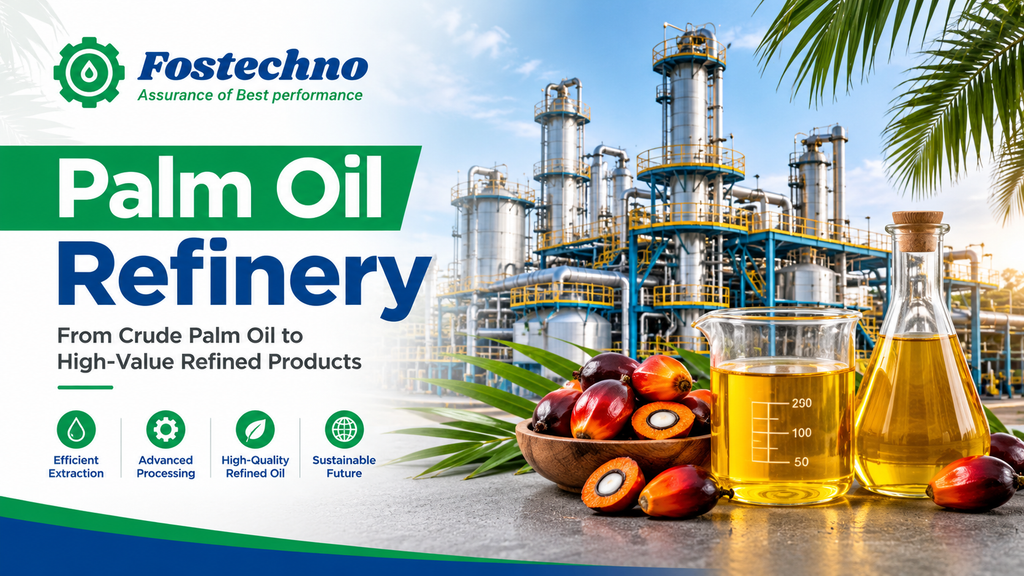
Crude palm oil is orange-red, thick, and carries an earthy smell. It cannot go straight into a bottle of cooking oil, a packet of noodles, or a tub of margarine. Between the mill and the kitchen sits a palm oil refinery.
Whether you are an investor in Southeast Asia, an edible oil processor in Africa, a trader in the Middle East, or a plant owner in South Asia or Latin America, the questions are the same: how does the process work, what equipment is needed, what yields should you expect, and who should build the plant?
This guide answers all of them, step by step, in plain language.
What Is a Palm Oil Refinery?
A palm oil refinery is an industrial plant that converts crude palm oil (CPO) into refined, bleached and deodorized palm oil (RBDPO). Many refineries also fractionate that oil into liquid palm olein and solid palm stearin.
Crude palm oil comes from the fleshy part of the oil palm fruit. Along with the oil you want, it contains:
- Free fatty acids (FFA): typically 3 to 5% in well-handled CPO, higher if fruit is stored poorly
- Phospholipids (gums): cause foaming and darkening at high temperature
- Trace metals: iron and copper accelerate rancidity
- Carotenoids: the pigments that give CPO its color
- Odor compounds and oxidation products: affect taste and shelf life
- Moisture and impurities: small but important
The refinery removes these in a controlled sequence while protecting the triglycerides, the valuable core of the oil.
A refinery is not a palm oil mill. The mill extracts crude oil from fruit bunches. The refinery purifies that crude oil. Some companies run both, but the machinery and skills are different.
Why Palm Oil Must Be Refined
Palm oil is the most produced vegetable oil in the world. It goes into cooking oil, vanaspati, margarine, shortening, instant noodles, snacks, bakery fats, soaps, cosmetics, and biodiesel feedstock.
Crude oil is unsuitable for most of these uses because of:
- Taste and smell: crude oil has strong flavors that clash with food.
- Shelf life: FFA, metals and gums speed up oxidation.
- Appearance: consumers expect pale yellow oil.
- Regulation: food authorities set limits on FFA, moisture, peroxide value and contaminants.
- Performance: frying oil must resist foaming and smoking.
Physical Refining vs. Chemical Refining
Physical Refining
Physical refining removes FFA by steam distillation under high temperature and deep vacuum. No caustic soda is used. It is the standard route for palm oil.
Why it suits palm oil:
- Palm oil has fewer phospholipids than soybean or sunflower oil, so acid degumming and bleaching can prepare it without alkali.
- Neutral oil yield is higher because no soapstock carries oil away.
- Wastewater is much lower.
- FFA is recovered as a saleable by-product, palm fatty acid distillate (PFAD).
Chemical Refining
Chemical refining neutralizes FFA with sodium hydroxide, forming soapstock that is removed by centrifuge, followed by washing and drying.
It is used when:
- Crude oil has very high FFA
- The oil is badly degraded
- A multi-oil plant already has chemical refining equipment
| Factor | Physical Refining | Chemical Refining |
|---|---|---|
| FFA removal | Steam distillation under vacuum | Neutralization with alkali |
| Chemicals | Phosphoric/citric acid, bleaching earth | Caustic soda, acid, water, plus the above |
| Neutral oil loss | Lower | Higher |
| Wastewater | Low | Higher |
| By-product | PFAD | Soapstock |
| Best for | Palm oil with moderate FFA | High-FFA or poor crude |
The Palm Oil Refining Process, Step by Step
Temperatures vary by design and crude quality, but the sequence is consistent.
Step 1: Crude Oil Receiving and Pre-heating
CPO arrives by tanker, ISO tank or drum. Palm oil starts to solidify at roughly 33 to 39°C, so storage tanks are kept warm, typically around 50 to 55°C, with heating coils. Samples are tested for FFA, moisture, impurities and color. These results decide acid dose, bleaching earth dose and expected yield.
Step 2: Degumming (Pre-treatment)
Degumming removes phospholipids and trace metals. Left in the oil, they burn onto surfaces in the deodorizer, darken the oil and lower quality.
- The oil is heated to about 85 to 90°C.
- A small dose of food-grade phosphoric or citric acid is added, usually a fraction of a percent of oil weight.
- The acid converts non-hydratable phospholipids into a form that can be removed.
- The conditioned oil moves directly to bleaching, where gums are adsorbed with the earth.
This “dry degumming” approach is common for palm oil because its phospholipid level is relatively low.
Step 3: Bleaching
Bleaching in oil refining is adsorption, not chemical whitening. Activated bleaching earth is mixed into the oil under vacuum, and impurities stick to the clay.
It removes: carotenoid pigments, chlorophyll traces, residual gums, oxidation products and trace metals.
Typical conditions:
- Temperature around 90 to 110°C under vacuum
- Bleaching earth dose often 0.5 to 2% of oil weight
- Contact time roughly 20 to 30 minutes with agitation
The oil is then filtered, typically through pressure leaf filters, followed by polishing filters. Spent earth can retain 20 to 30% oil by weight, so oil recovery and safe disposal matter for yield and compliance.
Step 4: Deodorization and De-acidification
This is the heart of physical refining and the most energy-intensive section.
- Bleached oil is heated to roughly 240 to 270°C.
- It is held under deep vacuum, often a few millibar absolute.
- Live stripping steam is injected.
- Volatile compounds, including FFA, aldehydes and ketones, leave with the steam.
- A fatty acid scrubber condenses the vapors and recovers PFAD.
- The deodorized oil is cooled and polish-filtered.
The result is RBDPO with FFA usually below about 0.1%, neutral taste and smell, and pale yellow color.
Equipment in this section: heat recovery exchangers, thermal oil heater or high-pressure boiler, deodorizer vessel (stainless steel contact parts, commonly 304 or 316L), vacuum system (steam ejectors or liquid ring pumps), and scrubber with condensers.
A Note on 3-MCPD and Glycidyl Esters
3-MCPD esters and glycidyl esters (GE) are process contaminants that form mainly during high-temperature deodorization. Regulators, especially in the European Union, set limits for them, and many global buyers apply their own specifications.
Refiners reduce them by:
- Using better crude with low chloride content
- Optimizing bleaching conditions
- Lowering deodorization temperature and residence time where possible
- Using two-stage or dedicated mitigation designs
- Applying mild water washing before deodorization
If you export, ask every plant supplier how their design handles these contaminants. It is now a core design question.
Step 5: Fractionation
RBDPO is semi-solid at moderate temperatures. Fractionation splits it for different markets.
- RBD oil is melted, then cooled slowly in crystallizers.
- High-melting triglycerides crystallize into stearin.
- A membrane filter press separates the liquid olein from the solid stearin.
Typical yields: about 70 to 80% olein and 20 to 30% stearin, depending on target iodine value and number of stages. Double fractionation gives super olein with better cold-weather clarity, plus palm mid-fraction used in confectionery fats.
Where fractions go:
- Olein: cooking oil, industrial frying for snacks and noodles
- Stearin: margarine, shortening, vanaspati, soap noodles, oleochemicals
- Mid-fraction: cocoa butter equivalents and specialty fats
Step 6: Storage and Packing
Finished oil is stored in food-grade tanks, often under nitrogen blanketing, then packed into pouches, bottles, jerry cans, drums or bulk tankers. Some markets require antioxidants or vitamin fortification (for example vitamins A and D).
Process Flow at a Glance
| Stage | Purpose | Typical Temperature | Output |
|---|---|---|---|
| Receiving & heating | Quality check, pumpable oil | 50–55°C | Warm crude oil |
| Degumming | Remove gums and metals | 85–90°C | Acid-conditioned oil |
| Bleaching | Remove color and impurities | 90–110°C (vacuum) | Bleached oil, spent earth |
| Deodorization | Strip FFA and odor | 240–270°C (deep vacuum) | RBDPO, PFAD |
| Fractionation | Separate liquid and solid | Controlled cooling | Olein and stearin |
By-Products of a Palm Oil Refinery
PFAD: usually about 3 to 5% of crude oil input in physical refining, depending on FFA. It is sold for soap noodles, fatty acids, animal feed, oleochemicals and biodiesel feedstock. PFAD prices can influence refinery margins noticeably.
Spent bleaching earth: carries retained oil. Options include oil recovery, use in some construction materials, or approved disposal. Oily earth can self-heat, so storage must be managed.
Stearin and mid-fraction: co-products with their own markets.
Wastewater and sludge: physical refining produces far less than chemical refining, but condensate and wash water still need treatment.
Key Equipment in a Palm Oil Refinery Plant
When comparing quotations, check that each of these is clearly specified:
- Storage and day tanks with heating coils
- Degumming vessel with acid dosing and high-shear mixing
- Vacuum bleacher with agitator and earth dosing
- Pressure leaf filters and polishing filters
- Heat exchangers for energy recovery
- Deodorizer with stainless steel internals
- Vacuum system and cooling circuit
- Thermal fluid heater or boiler
- Fatty acid scrubber for PFAD recovery
- Crystallizers and membrane filter presses (for fractionation)
- Pumps, valves, piping and instrumentation
- PLC/SCADA control panel
- Effluent treatment and cooling tower
- Utilities: DM water, compressed air, nitrogen
Material grade matters. Parts in contact with hot oil should be stainless steel. A very low quote often hides thinner steel, weaker welding, or carbon steel where stainless is required.
Batch, Semi-Continuous and Continuous Palm Oil Refineries
Batch plants suit small capacities (roughly 1 to 10 tons per day). They cost less and are flexible, but use more energy and labor and give less consistent quality.
Semi-continuous plants combine batch pre-treatment with continuous deodorization, a middle option for mid-size capacities.
Continuous plants run non-stop with heat recovery and automation. They are the standard above about 30 to 50 tons per day, and large refineries run from hundreds to over 1,000 tons per day.
| Factor | Batch | Semi-Continuous | Continuous |
|---|---|---|---|
| Typical capacity | Small | Medium | Medium to very large |
| Capital cost | Lowest | Moderate | Highest |
| Energy efficiency | Lower | Moderate | Highest |
| Labor need | High | Moderate | Low |
| Quality consistency | Variable | Good | Excellent |
How to Choose a Palm Oil Refinery Plant Manufacturer
The supplier you pick matters as much as the technology. Use this checklist.
- Size the plant honestly. Do not buy 100 TPD to run at 30 TPD. Base capacity on crude supply, market demand and expansion plans.
- Decide the product mix. RBDPO only, or olein and stearin as well? Fractionation adds equipment and working capital but can raise margins.
- Design for your real crude. A plant designed for 3% FFA crude may struggle at 6%.
- Check utilities. Steam, power, cooling water and vacuum decide performance. Underspecified utilities cause most commissioning problems.
- Ask for consumption guarantees. Steam, power, bleaching earth and refining loss per ton are your real operating costs.
- Verify references. A serious builder can connect you with owners of plants similar to yours. Visit one if possible.
- Review engineering depth. Look for process design, P&ID documentation, in-house fabrication or tight quality control, and proper stainless steel specification.
- Confirm turnkey scope. Who handles civil layout, utilities, effluent treatment, installation, commissioning and operator training?
- Check compliance support. Depending on market: ISO 22000/FSSC 22000, HACCP, FSSAI (India), Halal, local pollution norms, RSPO supply chain requirements.
- Plan for contaminants. If exporting, ask about 3-MCPD and GE mitigation.
- Check after-sales support. Spares, remote support and service engineers matter long after handover.
What Does a Palm Oil Refinery Plant Cost?
Cost depends on capacity, automation level, material grade, scope of supply, location and import duties, so any single figure online should be treated with caution.
- Small batch plants (a few TPD) are a modest equipment investment.
- Mid-size continuous plants (20 to 100 TPD) are a major project once civil work, utilities and effluent treatment are included.
- Large continuous refineries with fractionation (hundreds of TPD) are heavy industrial investments.
Budget beyond machinery for land, buildings, boiler and utilities, storage tanks, effluent treatment, licenses, commissioning, and especially working capital for crude oil purchases. Crude palm oil is a volatile commodity, and new investors often underestimate this need.
The best approach: request at least three detailed quotes with identical scope so you can compare like with like.
Where a Palm Oil Refinery Makes or Loses Money
Profit lives in the spread between crude oil cost and the value of refined products and by-products. The main levers are:
- Refining loss: every fraction of a percent matters at scale
- Bleaching earth consumption: often the largest chemical cost
- Steam and power: deodorization is energy-heavy, and heat recovery pays back fast
- PFAD and stearin prices
- Crude quality and handling
- Uptime: a continuous plant only earns while it runs
Good operators track these daily.
Quality Parameters of Refined Palm Oil
- FFA: typically below 0.1%
- Moisture and volatile matter: about 0.1% or lower
- Color (Lovibond): depends on grade and buyer
- Peroxide value: close to zero for fresh deodorized oil
- Iodine value: about 50 to 55 for RBD palm oil, around 56 or higher for olein
- Cloud point and slip melting point: important for olein in cool climates
- Residual metals: low iron and copper
- Contaminants: 3-MCPD, GE, pesticide residues and heavy metals per destination market
Always follow the specification in your contract or national standard.
Palm Oil Refineries Around the World
Palm oil refining happens across continents, each with different priorities:
- Southeast Asia (Indonesia, Malaysia, Thailand): large integrated refineries close to the plantations, strong focus on fractionation and export-grade quality.
- South Asia (India, Bangladesh, Pakistan): heavy import of crude palm oil, strong demand for olein, vanaspati and bakery fats, with growing mid-size continuous plants.
- Africa (Nigeria, Ghana, Côte d’Ivoire, Cameroon and others): expanding domestic refining to serve local consumption and reduce imports.
- Middle East: import-based refining for regional food manufacturers.
- Latin America (Colombia, Ecuador, Brazil and others): a major and growing producing region, with refining tied to sustainability certification.
Local differences in climate, crude quality, power availability and regulation mean a plant should be engineered for its location. A design that works in a humid tropical region may need adjustments in cooler markets where olein clarity matters more.
Sustainability and Environmental Responsibility
Refiners sit in the middle of the supply chain and carry responsibility for traceability.
- Sourcing: many buyers require RSPO-certified or NDPE-compliant supply, and refineries need documentation and segregation systems.
- Energy: heat recovery and biomass-fired utilities cut costs and emissions.
- Water: physical refining reduces effluent, but treatment remains necessary.
- Waste: spent earth should be handled safely and, where possible, recovered or reused.
- By-products: converting PFAD and other streams into useful products supports a circular approach.
Plants that plan sustainability from the start avoid expensive retrofits.
Common Palm Oil Refinery Problems and Their Usual Causes
- Dark oil: poor bleaching, high iron in the crude, overheating, or air leaks in the vacuum system
- High FFA in finished oil: weak stripping, low vacuum, insufficient steam or low deodorizer temperature
- Off-odor: poor stripping, contaminated filters, or air ingress while the oil is hot
- High refining loss: excess bleaching earth, poor filtration, or entrainment
- Short filter cycles: poorly conditioned gums or low-quality earth
- Vacuum instability: leaks, fouled condensers or inadequate cooling water
- Cloudy olein: poor crystallization control
Most trace back to crude quality or inadequate utilities, which is why both deserve attention before commissioning.
Safety in a Palm Oil Refinery
Hot oil, high-pressure steam, vacuum vessels and combustible spent earth demand serious safety practice:
- Regular inspection of pressure vessels and relief valves
- Insulation and guarding on hot surfaces
- Fire protection and spent earth handling procedures
- Nitrogen use to prevent oxidation of hot oil
- Confined space entry rules
- Operator training on thermal fluid and steam hazards
The Future of Palm Oil Refining
- Lower-contaminant refining driven by 3-MCPD and GE rules
- Higher automation and digital monitoring
- Greater heat integration to cut steam use
- Traceability and certification becoming market requirements
- Value-added products such as specialty fats and red palm oil
- Rising biofuel and oleochemical demand lifting PFAD value
Palm Oil Refinery Plant Builder: Why FOSTECHNO
Choosing a palm oil refinery plant builder is a long-term decision. A plant runs for decades, and the quality of its engineering shows up every day in yield, energy use and oil quality.
FOSTECHNO Process & Engineering Private Limited designs and builds palm oil refinery plants for clients worldwide, from compact batch units to large continuous refineries with fractionation. Our approach rests on a few principles:
- Process-first engineering: we design around your crude oil quality, capacity, product mix and target market, not a one-size-fits-all template.
- Turnkey capability: process design, equipment manufacturing, installation, commissioning and operator training under one responsibility. [Confirm exact scope]
- Quality materials and fabrication: stainless steel contact parts and careful welding and testing for long service life. [Confirm grades and QA process]
- Efficiency focus: heat recovery and optimized vacuum and stripping design to lower steam, power and bleaching earth consumption.
- Quality and compliance support: designs aligned with food safety and export requirements, including contaminant control. [Add certifications]
- Global project support: documentation, remote assistance, spares and service for overseas clients.
If you are planning a new refinery, expanding an existing one, or upgrading for better yield and quality, our engineers can help you size the plant and compare options.
Frequently Asked Questions About Palm Oil Refineries
What does a palm oil refinery do?
It purifies crude palm oil by removing free fatty acids, gums, pigments, metals and odor compounds, producing edible RBD palm oil, and often fractionates it into olein and stearin.
What are the main steps in refining palm oil?
Degumming, bleaching, deodorization (which also removes FFA in physical refining), and fractionation, with receiving and packing at either end.
What is the difference between physical and chemical refining?
Physical refining removes FFA by steam distillation under vacuum and produces PFAD. Chemical refining neutralizes FFA with caustic soda and produces soapstock. Physical refining is more common for palm oil because it gives higher yield and less effluent.
What is RBD palm oil?
Refined, bleached and deodorized palm oil: the purified, neutral-tasting oil produced after the full refining process.
What is PFAD?
Palm fatty acid distillate, the by-product recovered during deodorization, made mostly of free fatty acids. It is used for soap, fatty acids, animal feed and biodiesel feedstock.
What temperature is used in palm oil deodorization?
Typically about 240 to 270°C under deep vacuum, depending on plant design and quality targets.
What is the yield of palm olein and stearin?
Dry fractionation commonly gives roughly 70 to 80% olein and 20 to 30% stearin.
How much bleaching earth is used?
Often 0.5 to 2% of oil weight, depending on crude quality.
What capacity should a new palm oil refinery have?
It depends on raw material supply, market and budget. Small batch plants suit local markets, while continuous plants make sense at higher volumes. Size it for what you can reliably source and sell, with room to expand.
Who builds palm oil refinery plants worldwide?
Several engineering companies design and build palm oil refinery plants for international clients. FOSTECHNO Process & Engineering Private Limited is one such manufacturer offering turnkey plants. Always compare scope, references and after-sales support.
How do I reduce 3-MCPD and glycidyl esters?
Use low-chloride crude, optimize bleaching, consider washing steps, and choose lower-temperature or two-stage deodorization designs from suppliers with proven mitigation experience.
Is a palm oil refinery profitable?
It can be, but margins depend on crude price swings, refining efficiency, by-product values and demand. Operators who control losses and utility costs tend to do best.
About FOSTECHNO Process & Engineering Private Limited
FOSTECHNO Process & Engineering Private Limited is an engineering company specializing in edible oil and fat processing plants, including palm oil refinery plants, fractionation plants and related utilities.
We work with edible oil processors, investors and food manufacturers across [add regions/countries], helping them plan, build and run efficient refineries. Our team combines process engineers, fabrication specialists and commissioning experts, so one partner is responsible from design to start-up.
Whether you need a small batch refinery or a large continuous plant with fractionation, we start with your crude oil, capacity and market, then engineer a plant that fits.
Planning a palm oil refinery? Contact FOSTECHNO for a technical consultation and a detailed quotation.
📧 info@fosechnos.com
📞 +91 9696177472
🌐 fostechnos.com


Leave a Reply