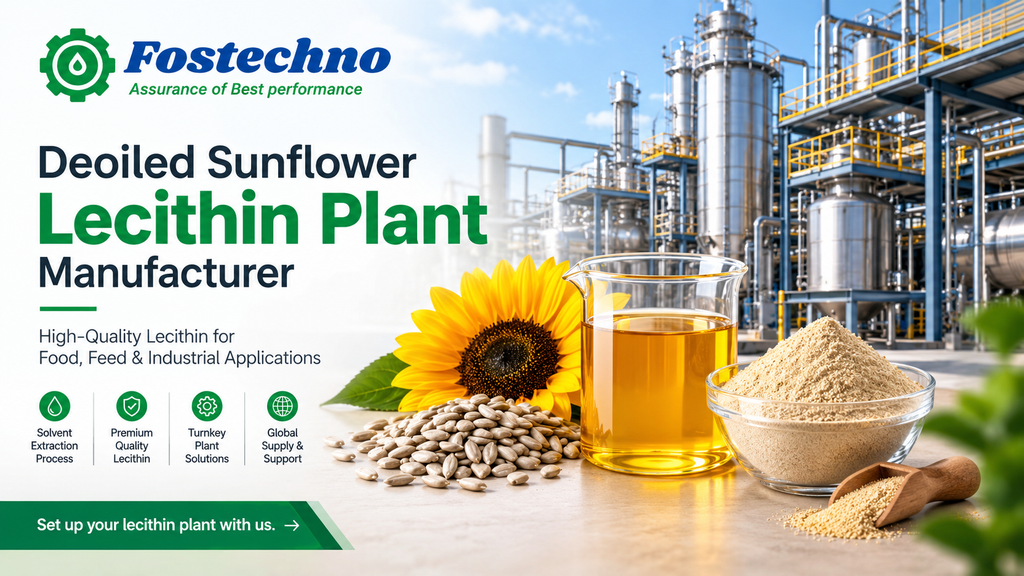
If you have ever wondered how crude sunflower oil gums are transformed into a fine, free-flowing, oil-free lecithin powder that ends up in chocolates, bakery products, cosmetics, and even pharmaceutical formulations, you are about to get the complete picture. Setting up a deoiled sunflower lecithin plant is not just about buying a few tanks and dryers — it is precision engineering, food-grade hygiene, and process chemistry working together in perfect harmony. And that is exactly where FOSTECHNO Process & Engineering Private Limited comes in, as a trusted deoiled sunflower lecithin plant manufacturer helping entrepreneurs and edible oil processors build reliable, high-output, export-quality lecithin processing units from the ground up.
In this in-depth guide, we will walk you through everything — what deoiled sunflower lecithin actually is, why global demand for it is rising sharply, how a plant is engineered stage by stage, what types of plants exist, and why FOSTECHNO is the partner you want by your side when you decide to invest in this business. Whether you are an existing edible oil refiner looking to diversify, or a first-time entrepreneur exploring the lecithin manufacturing business, this blog is written specifically for you.
What Is Deoiled Sunflower Lecithin?
Lecithin is a naturally occurring group of phospholipids found in the gums that separate out during the degumming of crude vegetable oils. When this crude lecithin is extracted from sunflower oil, it initially exists in a semi-liquid, oil-rich form. Deoiled sunflower lecithin is the refined, oil-free version of this raw lecithin — produced by washing out the residual neutral oil (triglycerides) using a solvent, most commonly acetone, and then carefully drying the resulting material into a stable powder or granule.
The result is a product that is:
- Free-flowing and easy to handle in bulk
- Neutral in taste and odor compared to crude liquid lecithin
- Higher in phospholipid concentration, making it more functional as an emulsifier
- Shelf-stable for long-term storage and export
- Suitable for food, feed, cosmetic, and pharmaceutical-grade applications
Sunflower lecithin has become especially popular over the last decade because it is a non-GMO, allergen-friendly alternative to soy lecithin, which makes it highly attractive to health-conscious consumers and clean-label food manufacturers across Europe, North America, and Asia.
Why Global Demand for Deoiled Sunflower Lecithin Is Rising
If you are considering entering this business, understanding the demand drivers is essential — and it is exactly why FOSTECHNO regularly consults with clients before designing their plant capacity.
1. The Non-GMO and Clean Label Movement
Consumers today read ingredient labels closely. Soy lecithin, while functional, is often linked with GMO concerns in certain markets. Sunflower lecithin, being naturally non-GMO, has become the preferred emulsifier for premium chocolate, bakery, infant nutrition, and organic food brands.
2. Allergen-Free Positioning
Unlike soy, sunflower does not fall under the major food allergen list in most countries. This makes deoiled sunflower lecithin a safer formulation choice for baby food, health supplements, and allergen-sensitive product lines.
3. Expanding Applications Beyond Food
Deoiled sunflower lecithin powder is increasingly used in nutraceuticals, cosmetics (as an emulsifier and skin-conditioning agent), animal feed, and even in certain pharmaceutical excipients. This diversification means plant owners are not dependent on a single industry for offtake.
4. Export Opportunity
Countries with strong sunflower oil production — including India, Ukraine, Russia, Argentina, and parts of Europe — are well-positioned to export deoiled lecithin powder to markets that demand non-GMO ingredients but do not have local sunflower crushing capacity.
5. Value Addition to Existing Oil Refineries
For businesses already running sunflower oil refineries, adding a lecithin recovery and de-oiling unit turns what was previously a low-value byproduct (gums) into a high-margin, exportable finished product.
This is precisely why FOSTECHNO Process Engineering Private Limited focuses so heavily on helping clients not just install machinery, but build a genuinely profitable lecithin business from day one.
How a Deoiled Sunflower Lecithin Plant Works: Stage-by-Stage Process
Understanding the process flow is critical before you invest, because it directly impacts your plant’s capacity planning, utility requirements, and product quality. Here is how FOSTECHNO engineers a complete deoiled sunflower lecithin plant, from raw crude oil to finished powder.
Stage 1: Degumming and Crude Lecithin Extraction
The process begins with crude sunflower oil, which naturally contains phospholipids (gums) suspended within it. Controlled hydration — typically using hot water or steam under precise temperature and time control — causes these phospholipids to hydrate and separate from the neutral oil. This hydrated gum layer is then separated using high-speed centrifugal separators, yielding what is known as crude liquid lecithin.
Precision here matters enormously. Too little water and the gums will not separate efficiently; too much and you risk hydrolysis, which degrades lecithin quality. FOSTECHNO’s degumming systems are designed with automated dosing and temperature control to ensure consistent, high-yield gum separation batch after batch.
Stage 2: Vacuum Drying of Crude Lecithin
Before de-oiling, the crude liquid lecithin still carries significant moisture. A vacuum drying stage reduces this moisture content to acceptable levels (generally below 1%) without exposing the lecithin to excessive heat that could darken its color or reduce functionality. This is typically done using thin-film or agitated vacuum dryers operating under controlled low-temperature, low-pressure conditions.
Stage 3: De-Oiling (Acetone Washing / Solvent Extraction)
This is the defining stage that separates a basic lecithin plant from a true deoiled sunflower lecithin plant. Here, the dried crude lecithin is treated with acetone (or in some configurations, ethanol), which selectively dissolves the neutral oil (triglycerides) while leaving the phospholipid fraction largely insoluble. Through repeated washing, filtration, and separation cycles, the oil is progressively removed, concentrating the phospholipid content of the remaining material.
This stage requires specialized solvent-handling equipment engineered to strict safety standards, since acetone is flammable and must be processed in explosion-proof, closed-loop systems. FOSTECHNO designs these de-oiling sections with integrated solvent recovery, so that acetone is continuously reclaimed and reused, dramatically reducing your operating costs and environmental footprint.
Stage 4: Desolventizing and Drying
Once the neutral oil has been washed away, the de-oiled lecithin cake still contains residual solvent that must be completely removed before the product can be classified as food-grade or pharma-grade. Desolventizing units use controlled heating under vacuum to evaporate and recover any remaining acetone, ensuring the final product is safe, odorless, and compliant with food safety norms.
Stage 5: Milling and Powder/Granule Formation
The dried de-oiled lecithin is then milled into the desired particle size — fine powder, coarse powder, or granules — depending on the end application and customer specification. Some plants also offer instantized or agglomerated lecithin, which dissolves faster in liquid formulations.
Stage 6: Packing and Storage
Finally, the finished deoiled sunflower lecithin is packed under controlled humidity conditions, since the powder is hygroscopic and can absorb moisture from the air if exposed. FOSTECHNO integrates nitrogen-flushed or moisture-controlled packing lines to maximize shelf life and preserve flowability during storage and transport.
Types of Deoiled Sunflower Lecithin Plants We Build
At FOSTECHNO Process Engineering Private Limited, we understand that no two clients have identical requirements. That is why we design and manufacture multiple plant configurations, tailored to your budget, raw material source, and target market.
1. Powder-Type Deoiled Lecithin Plants
These plants are engineered specifically to produce fine, free-flowing lecithin powder — the most widely traded and exported form of deoiled lecithin. Ideal for clients targeting bakery, confectionery, and nutraceutical industries.
2. Granular Deoiled Lecithin Plants
For clients whose customers prefer granules over fine powder (often for easier dosing and reduced dust in industrial feed applications), we design granulation and sizing systems as part of the drying line.
3. Liquid and Fluid Lecithin Plants
Not every client wants to de-oil their lecithin. We also design plants that produce standardized fluid or liquid lecithin, which is used directly as an emulsifier in industries where oil content is not a concern.
4. Integrated Multi-Feedstock Plants
Many of our clients want the flexibility to process not just sunflower, but soybean, rice bran, or a combination of feedstocks, on the same processing line. FOSTECHNO designs integrated systems capable of switching between raw material sources with minimal downtime.
5. Capacity-Based Custom Plants
We build plants across a wide capacity spectrum:
- Small-scale plants for entrepreneurs entering the business (a few tons per day)
- Medium-scale plants for growing processors (in the range of several tons per day)
- Large-scale, fully integrated plants for established refineries looking to scale exports (tens of tons per day)
Every plant we deliver is engineered around your specific raw material availability, target market, and budget — not a one-size-fits-all template.
Why FOSTECHNO Process & Engineering Private Limited Is the Right Manufacturing Partner
Choosing the right engineering partner for a deoiled sunflower lecithin plant is one of the most important decisions you will make as an entrepreneur or processor. Here is what sets FOSTECHNO apart.
End-to-End Turnkey Execution
From initial process design and 3D layout planning to fabrication, installation, commissioning, and operator training — FOSTECHNO manages the entire project lifecycle under one roof. You do not need to coordinate between multiple vendors for tanks, separators, dryers, and solvent recovery systems.
Process Engineering Expertise, Not Just Fabrication
Many suppliers can weld tanks and install pipes. Fewer can actually engineer a process that consistently yields high-purity, food-grade deoiled lecithin at scale. Our team focuses on process parameters — temperature profiles, residence times, solvent ratios, and drying curves — to make sure your plant performs exactly as promised, not just on paper.
Food-Grade and Export-Compliant Design
We understand that if your target market includes Europe, the USA, or other export destinations, your plant must be designed with hygienic construction, proper material of construction (typically SS304/SS316 in product-contact areas), and process controls that support food safety certifications. FOSTECHNO builds with these end goals in mind from day one.
Solvent Safety and Recovery Systems
Since acetone-based de-oiling involves flammable solvents, safety is non-negotiable. Our plants incorporate explosion-proof electricals, closed-loop solvent recovery, and proper ventilation design, protecting both your workforce and your investment.
Customization Around Your Business Goals
Whether you are processing 3 tons a day or scaling toward a 30+ ton integrated facility, FOSTECHNO designs the plant around your actual raw material availability and market demand — not a generic template pulled off the shelf.
After-Sales Support and Long-Term Partnership
A plant is a long-term investment, and our relationship with clients does not end at commissioning. FOSTECHNO provides ongoing technical support, spare parts assistance, and process optimization guidance to help you continuously improve yield and quality.
Industries That Rely on Deoiled Sunflower Lecithin
Understanding your potential customer base helps you plan your plant’s output specifications correctly. Deoiled sunflower lecithin, manufactured through a properly engineered FOSTECHNO plant, finds application across:
- Bakery and Confectionery — as a dough conditioner and emulsifier for chocolate, biscuits, and bread
- Infant and Health Nutrition — valued for its non-GMO, allergen-conscious profile
- Nutraceuticals and Supplements — lecithin capsules and functional food ingredients
- Cosmetics and Personal Care — as an emulsifier and skin-conditioning agent in creams and lotions
- Animal Feed — as an energy-dense, palatable feed additive
- Pharmaceutical Formulations — as an excipient in certain drug delivery systems
This wide-ranging demand is exactly why investing in a well-engineered deoiled sunflower lecithin plant, built by a manufacturer who understands both the chemistry and the commercial side of the business, gives you multiple revenue streams from a single production line.
Key Factors to Consider Before Setting Up Your Plant
If you’re seriously evaluating this investment, here are the practical factors FOSTECHNO helps every client work through before finalizing plant design:
Raw Material Availability: Do you have consistent access to crude sunflower oil or gums, either through your own crushing unit or reliable suppliers?
Target Capacity: Are you starting small to test the market, or do you have confirmed offtake agreements that justify a larger plant from day one?
Target Market and Compliance Needs: Domestic sales may have different quality and documentation requirements compared to export markets like the EU or USA.
Utility Infrastructure: Steam, power, and water availability at your plant location directly affect equipment selection and layout.
Budget and ROI Timeline: A phased, modular plant design can help you start smaller and expand capacity as your business grows, without redesigning your entire facility.
FOSTECHNO’s engineering team works closely with every client through each of these considerations before finalizing a single equipment drawing, ensuring that what gets built actually matches what your business needs.
The FOSTECHNO Project Process: From Enquiry to Commissioning
- Consultation and Requirement Study — Understanding your raw material, capacity, budget, and target market.
- Process Design and Plant Layout — Engineering the exact process flow, equipment sizing, and facility layout.
- Equipment Fabrication — Manufacturing tanks, separators, dryers, and solvent recovery systems under strict quality control.
- Installation and Piping — On-site erection, piping, instrumentation, and electrical integration.
- Commissioning and Trial Runs — Testing the complete plant under real production conditions to validate output and quality.
- Operator Training — Ensuring your team can independently run and maintain the plant efficiently.
- Ongoing Support — Continued technical assistance as your plant scales.
This structured approach is why clients trust FOSTECHNO Process & Engineering Private Limited not just as an equipment supplier, but as a genuine engineering partner for their lecithin manufacturing journey.
Frequently Asked Questions (FAQ)
1. What is the difference between crude lecithin and deoiled sunflower lecithin?
Crude lecithin is the raw, oil-rich gum separated during degumming, while deoiled lecithin has undergone acetone washing to remove neutral oil, resulting in a higher-purity, powder or granular product with a higher concentration of phospholipids.
2. Is sunflower lecithin better than soy lecithin?
Sunflower lecithin is naturally non-GMO and does not fall under common allergen categories, making it increasingly preferred for clean-label and allergen-sensitive food products, though both serve similar emulsification functions.
3. What capacity should I choose for my first lecithin plant?
This depends on your raw material availability and confirmed market demand. FOSTECHNO typically recommends starting with a scalable, modular design so you can expand capacity later without rebuilding the entire plant.
4. Is acetone the only solvent used for de-oiling lecithin?
Acetone is the most common solvent due to its efficiency and recoverability, though certain plant designs can also incorporate alternative solvents depending on regulatory and cost considerations in your target market.
5. How long does it take to set up a deoiled sunflower lecithin plant?
Project timelines vary based on plant capacity and site readiness, but FOSTECHNO provides a detailed project schedule during the consultation phase so you know exactly what to expect at each stage.
6. Can an existing sunflower oil refinery add a lecithin de-oiling unit?
Yes. Many of our clients are existing refiners looking to add value to their gum byproduct rather than build a completely new facility, and FOSTECHNO designs integration-friendly units for exactly this purpose.
7. What quality standards should my deoiled lecithin meet for export?
Export markets typically require low residual solvent levels, controlled moisture content, and consistent phospholipid concentration. FOSTECHNO designs plants with these specifications in mind from the process design stage itself.
8. Does FOSTECHNO provide plants for other lecithin sources besides sunflower?
Yes, in addition to sunflower, we design plants and integrated systems capable of processing soybean, rice bran, and other lecithin-bearing feedstocks based on client requirements.
Conclusion
Setting up a deoiled sunflower lecithin plant is a serious engineering undertaking that blends process chemistry, food-grade hygiene, and solvent safety into one continuous production line. Getting it right the first time — from degumming and vacuum drying, through acetone-based de-oiling, all the way to desolventizing and final powder formation — requires a manufacturing partner who understands every stage of that journey, not just the equipment that sits at each step.
That is exactly the role FOSTECHNO Process & Engineering Private Limited plays for every client we work with. As a dedicated deoiled sunflower lecithin plant manufacturer, we combine process engineering depth, turnkey project execution, and a genuine commitment to your long-term production success. Whether you are building your very first plant or expanding an existing refinery into the lecithin business, our team is ready to design, build, and commission a plant that matches your capacity goals and market ambitions.
If you’re ready to explore setting up your own deoiled sunflower lecithin plant, get in touch with FOSTECHNO Process & Engineering Private Limited today — let’s engineer your success together.



Leave a Reply