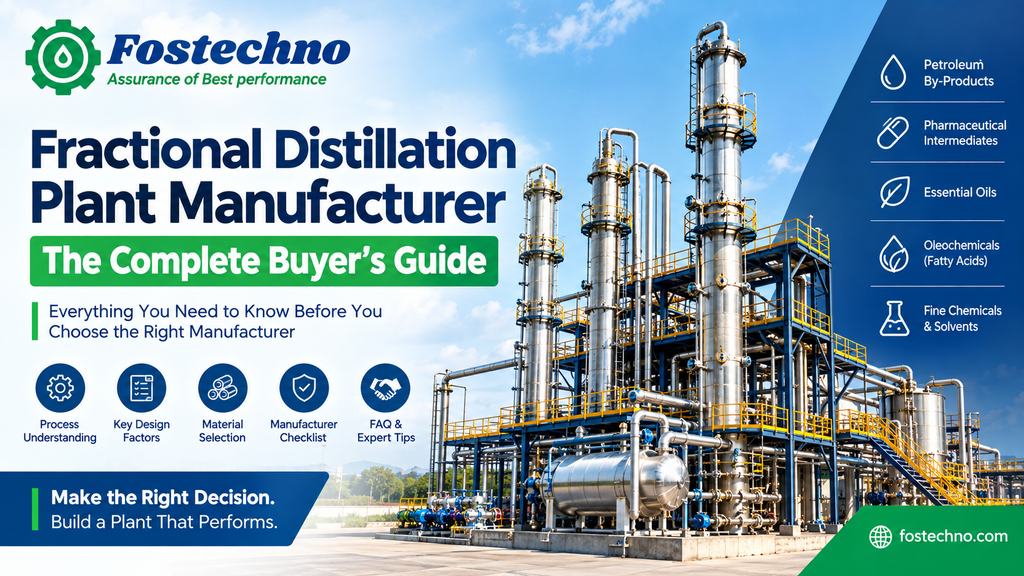
By FOSTECHNO Process & Engineering Private Limited
Introduction: The ₹50 Lakh Mistake Most Buyers Make Before They Even Place an Order
Here’s something nobody tells you before you start hunting for a fractional distillation plant manufacturer: the plant isn’t the expensive part. The wrong plant is.
We’ve sat across the table from plant owners who signed off on a column, a reboiler, and a condenser set that looked perfect on paper — and then spent the next eighteen months fighting foaming, poor separation efficiency, corrosion in places the drawings never mentioned, and a vacuum system that couldn’t hold the pressure their process actually needed. By the time they called us, they’d already paid twice: once for the plant, and once for the downtime.
That’s really what this guide is about. Not just “what is fractional distillation” — you probably already know that. It’s about the decisions that separate a plant that runs clean for fifteen years from one that becomes a monthly maintenance headache. If you’re evaluating a fractional distillation plant manufacturer for a petroleum by-product line, a pharmaceutical intermediate, an essential oil, an oleochemical fatty acid stream, or a fine chemical solvent recovery system, this is the guide we wish someone had handed us the first time we specified a column.
We’ll walk through how these systems actually work, what separates a reliable EPC-grade manufacturer from a fabricator with a welding shop, the material-of-construction debate that trips up almost every first-time buyer, and — because we’re FOSTECHNO and we build these systems for a living — where we fit into that picture. At the end, there’s a detailed FAQ section built to answer the exact questions procurement teams and plant owners type into Google at 11 PM the night before a vendor meeting.
What Is a Fractional Distillation Plant, Really?
Simple distillation separates two liquids based on a single boiling point difference. Fractional distillation goes further — it separates multiple components with boiling points close to one another, using a column packed with plates, trays, or structured packing that forces repeated vaporization and condensation as vapor rises and liquid falls.
Each theoretical “stage” inside that column is a mini equilibrium point. Liquid trickles down, vapor rises up, and at every contact point the more volatile component enriches in the vapor phase while the heavier component drops back as reflux. Stack enough of these stages together and you can pull apart mixtures that would be impossible to separate in a single flash step — crude petroleum fractions, fatty acid distillates, essential oil terpenes, or solvent-water azeotropes in a pharmaceutical recovery loop.
A fractional distillation plant, as opposed to a lab setup, adds everything around that column: the reboiler that generates vapor, the condenser and reflux system that returns liquid to the top, the vacuum train that lowers operating pressure for heat-sensitive materials, the feed preheater that recovers energy, and the control system that keeps reflux ratio, column temperature, and vacuum level inside a tight operating window.
This is where manufacturer selection actually matters. Anyone can weld a shell and stack packing into it. Getting the internals, the heat integration, and the vacuum stability right — consistently, batch after batch — is the difference between a fabricator and an engineering company.
How the Core System Actually Works (Beyond the Textbook Diagram)
The Column and Its Internals
The column is the heart of the plant, but the internals decide whether it performs. Structured packing (like Sulzer-type or Fine Pac configurations) gives high surface area with low pressure drop — ideal for heat-sensitive fatty acids or pharmaceutical intermediates that can’t tolerate high temperatures. Tray columns, with bubble caps or sieve trays, handle higher throughput and are more forgiving with fouling-prone feedstocks. Random packing sits somewhere in between and is common in pilot and mid-scale glass systems.
The choice isn’t cosmetic. Structured packing in a column designed for tray operation — or vice versa — is one of the most common design errors we see when reviewing plants built by inexperienced fabricators.
The Reboiler and Heat Source
Falling film evaporators, thin film evaporators, and thermosiphon reboilers each behave differently under vacuum. A falling film unit minimizes residence time and thermal degradation — critical for fatty acids and thermally sensitive pharmaceutical compounds. A poorly matched reboiler design is the single biggest cause of product discoloration and yield loss in oleochemical distillation.
The Vacuum and Condensing System
Most industrial fractional distillation for high-boiling, heat-sensitive materials runs under vacuum — sometimes deep vacuum, down to a few millibar absolute. This is where a manufacturer’s real engineering depth shows. Vacuum stability isn’t just about the pump; it’s about condenser sizing, non-condensable gas handling, and leak-tight fabrication across every flange and weld. A system that can’t hold vacuum consistently will never hit its separation targets, no matter how good the column internals are.
Heat Recovery
Energy costs in a continuous fractional distillation plant can outweigh raw material costs over the plant’s life. Integrated heat recovery — using the hot bottoms stream to preheat incoming feed, or recovering vapor condensation heat — is what separates a plant designed for 15 years of operating cost from one designed only to pass a commissioning test.
Industrial vs. Pilot-Scale: Two Very Different Manufacturing Worlds
Buyers often search “fractional distillation plant manufacturer” without realizing there are really two distinct manufacturing categories, built by different types of companies, for different purposes.
Industrial & EPC-Grade Plants (Stainless Steel / Alloy Construction)
These are continuous or semi-batch systems built in SS316L, SS304, or specialty alloys, engineered for commercial-scale throughput — refinery by-products, bulk fatty acid fractionation, industrial solvent recovery, or large-volume fine chemical processing. This category demands full EPC (Engineering, Procurement, Construction) capability: process simulation, mechanical design per ASME/PED codes, skid fabrication, site erection, and commissioning support.
Glass Pilot & Laboratory-Scale Units (Borosilicate Glass 3.3)
Smaller-scale systems, typically 10 liters to 500 liters batch capacity, built in corrosion-resistant borosilicate glass. These are the workhorses of pharmaceutical R&D, botanical and essential oil extraction, academic research, and process development before a company scales up to a full industrial plant. Glass offers visual process monitoring and excellent chemical resistance, but isn’t suited to continuous high-throughput commercial operation.
Comparison at a Glance
| Category | Material | Typical Scale | Best Suited For |
|---|---|---|---|
| Industrial / EPC Plants | SS316L, SS304, or special alloys | Large-scale continuous or semi-batch commercial flows | Refineries, bulk oleochemical processing, industrial solvent recovery |
| Glass Pilot & Lab Units | Borosilicate Glass 3.3 | 10L–500L batch | Pharma R&D, botanical extraction, academic and process-development labs |
Knowing which category you actually need — before you start collecting quotes — saves weeks of back-and-forth with vendors who specialize in the wrong one.
What Actually Separates a Reliable Manufacturer From a Risky One
We’ll be direct: this is the section most manufacturer websites won’t write honestly, because it exposes their own weak spots. Here’s what to check before you sign a purchase order.
1. Process Engineering, Not Just Fabrication
Ask whether the vendor runs a process simulation (relative volatility, number of theoretical stages, reflux ratio optimization) before designing the column, or whether they’re quoting off a standard catalog size. A manufacturer that can show you their simulation basis — even a summary — is doing real engineering. One that just asks “how many liters” and quotes a standard model is a fabricator, not an engineering partner.
2. Material Traceability and Welding Standards
For stainless steel and alloy plants, ask for mill test certificates on plate and pipe material, and ask what welding procedure specification (WPS) and welder qualification records (WQR) they follow. For pharmaceutical and food-grade applications, ask specifically about internal surface finish (Ra value) and whether welds are passivated. This single question filters out a large percentage of underqualified fabricators immediately.
3. Vacuum and Leak-Testing Protocol
Does the manufacturer pressure/vacuum test the assembled system before dispatch, or only test individual components? A plant that’s never been leak-tested as a full assembly is a plant you’re commissioning for the first time at your own site, with your own downtime risk.
4. After-Sales and Spares Support
Fractional distillation plants run for decades. Ask how many years the manufacturer has been supplying spares for plants they built ten or fifteen years ago. A manufacturer that’s only been operating for two years can’t answer that question honestly — and that’s fine to know upfront, but it should factor into your decision.
5. Site Support and Commissioning
Especially for industrial-scale plants, ask exactly what commissioning support is included: is it a phone call, a few days on-site, or full process guarantee testing with performance sign-off? This is often buried in the fine print of a quotation and becomes a major point of friction after installation.
6. Industry-Specific Experience
A manufacturer who has built fatty acid fractionation columns for oleochemical plants understands foaming, free fatty acid corrosion, and thermal degradation in a way that a manufacturer who has only built solvent recovery units for paint factories does not. Ask for references in your specific application, not just general “distillation experience.”
Materials of Construction: The Decision That Drives Everything Else
This is the question we get asked most often, and it deserves its own section rather than a bullet point.
Borosilicate Glass 3.3 is chemically inert, allows direct visual process observation, and handles a wide temperature range (roughly -25°C to +200°C in most fabricated systems). It’s the natural choice for pharmaceutical process development, botanical extraction, and any application where batch sizes stay under a few hundred liters and corrosion resistance across a wide range of solvents matters more than raw throughput.
Stainless Steel (SS304 / SS316L) handles higher pressures, higher temperatures, and continuous industrial throughput that glass simply cannot support at scale. SS316L specifically adds molybdenum for better resistance to chlorides and organic acids — relevant for fatty acid distillation, where free fatty acids are mildly corrosive over long continuous runs.
Specialty alloys (Hastelloy, Monel, titanium-lined systems) come into play only for genuinely aggressive feedstocks — high-chloride environments, strong acid recovery, or specific pharmaceutical intermediates where even SS316L isn’t sufficient. These add significant cost and should only be specified when your process chemistry actually demands it — not as a default “safer” choice, since over-specifying alloy construction is one of the most common ways buyers overspend on a distillation plant.
The honest answer to “which material should I choose” is: it depends entirely on your feedstock chemistry, batch size, and whether you’re still in process development or already scaling to commercial volumes. Any manufacturer who recommends a material before asking you these questions is guessing.
Industry Applications Where Fractional Distillation Plants Are Essential
Petroleum and Petrochemical By-Products
Refineries and downstream processors use fractional distillation to separate naphtha, kerosene fractions, light and heavy ends, and recover solvents from process streams. These are almost always large, continuous, stainless-steel or alloy systems integrated into a wider process line.
Oleochemicals — Fatty Acid Fractionation
This is one of the most demanding applications in the entire distillation world. Crude fatty acid streams need to be separated into distinct chain-length fractions under deep vacuum, at temperatures low enough to prevent oxidation and color formation, using structured packing columns paired with falling film evaporators. The economics of an oleochemical plant are extremely sensitive to yield loss and product color — which is exactly why reboiler and vacuum system design matter so much here.
Pharmaceuticals and Fine Chemicals
Solvent recovery, intermediate purification, and API-grade separation demand tight temperature control, minimal thermal degradation, and often GMP-compliant fabrication (electropolished internals, proper documentation, validation support). Batch systems — both glass and stainless steel — dominate this space because product changeover between campaigns is common.
Essential Oils and Botanical Extraction
Smaller-batch, heat-sensitive separations where glass systems or gently-heated stainless batch stills are standard. Vacuum operation is common here too, since many aromatic compounds degrade at atmospheric-pressure boiling points.
Fine Chemical Solvent Recovery
Recovering and reusing process solvents is increasingly a cost and sustainability driver across chemical manufacturing. These systems are often smaller continuous units integrated directly into an existing process line rather than standalone plants.
Common Mistakes Buyers Make — And How to Avoid Them
Buying on price alone. The cheapest quotation almost always means thinner shell thickness, standard-catalog internals instead of a process-matched design, or a vacuum system undersized for your actual operating pressure. These show up as operating problems, not on the purchase order.
Skipping the pilot stage. Jumping straight from lab-scale testing to full industrial-scale fabrication without a pilot run is one of the costliest mistakes in this industry. A mid-scale trial validates your reflux ratio, column sizing, and material behavior before you commit to a commercial-scale investment.
Ignoring utilities sizing. A distillation column is only as good as the cooling water, steam, and vacuum utilities feeding it. We’ve seen plants where the column itself was perfectly engineered but the site’s cooling tower couldn’t supply enough condensing capacity during summer months — cutting effective throughput by 20–30%.
Not asking about turndown ratio. If your production volumes fluctuate seasonally or by order size, ask how the plant performs at 50% or 60% of rated capacity, not just at 100%. Many columns lose separation efficiency badly at reduced throughput if this wasn’t part of the original design brief.
Underestimating documentation needs. For pharmaceutical and export-oriented buyers, IQ/OQ/PQ documentation, material certificates, and welding records requested after fabrication is complete are far harder (and more expensive) to assemble than documentation planned from day one. Ask upfront.
Cost Factors That Actually Move the Number on Your Quotation
Plant cost isn’t just “size × material.” The factors that move pricing the most are: column internals (structured packing typically costs more than trays but performs better for heat-sensitive products), vacuum system depth (deep vacuum requires more sophisticated pumping trains and tighter leak specifications), automation level (manual control versus PLC/SCADA-based automated reflux and temperature control), heat recovery integration, and documentation/compliance requirements for regulated industries.
A realistic budget conversation with your manufacturer should walk through each of these separately, rather than arriving at a single lump-sum number you can’t break down or compare against a second quotation.
Automation and Control: Where Older Plants Quietly Lose Money
A surprising number of industrial fractional distillation plants running today are still operated almost entirely by hand — an operator watching a temperature gauge, adjusting a reflux valve, and logging readings on paper every thirty minutes. It works, but it leaves money on the table in ways that don’t show up until you compare batch-to-batch consistency over a full year.
A PLC or SCADA-based control system holds reflux ratio, column temperature profile, and vacuum level within a much tighter band than manual operation ever can. That tighter control translates directly into more consistent product purity, fewer off-spec batches, and less operator fatigue-driven error during long continuous runs. For plants running multiple shifts, automated data logging also becomes essential for traceability — particularly in pharmaceutical and export-oriented operations where a batch record has to hold up to audit scrutiny.
The upfront cost of automation is real, and for a small pilot-scale unit it may genuinely not be worth it. But for a continuous industrial plant running multiple shifts a day, the payback period on automated control is usually measured in months, not years, once you account for reduced off-spec product and lower supervision requirements. This is a conversation worth having directly with your manufacturer at the design stage, because retrofitting automation onto a plant built for manual operation is considerably more expensive than designing it in from the start.
Energy Efficiency and Sustainability Considerations
Distillation is, by nature, an energy-intensive separation process — you’re boiling and condensing liquid, sometimes repeatedly, to achieve a purity target. For plant owners looking at long-term operating costs (and increasingly, at sustainability reporting requirements), a few design choices matter more than they’re usually given credit for.
Feed preheating using recovered heat from the hot bottoms product or the overhead condenser is one of the highest-return investments in plant design, often cutting steam or thermal fluid consumption meaningfully without any change to separation performance. Vapor recompression, where mechanically feasible, can further reduce energy demand in high-throughput continuous operations, though it adds mechanical complexity that needs to be weighed against the plant’s scale.
Insulation quality across the column, reboiler, and associated piping is another area that’s frequently under-specified to save on upfront cost, only to show up as higher utility bills for the entire operating life of the plant. When you’re comparing quotations from different manufacturers, ask specifically what insulation thickness and material they’re specifying — it’s a small line item on a quotation that has an outsized effect on your monthly energy costs.
None of this is exotic engineering. It’s the difference between a manufacturer who designs a plant to pass a commissioning test and one who designs a plant to run economically for the next fifteen to twenty years.
Why Plant Owners Choose FOSTECHNO Process & Engineering Private Limited
We’re not going to pretend to be the biggest name in this industry. What we focus on instead is being the manufacturer that gets the engineering right the first time — because we’ve seen what it costs plant owners when it isn’t.
At FOSETCHNO Process & Engineering Private Limited, our approach starts before a single drawing is made: understanding your feedstock chemistry, your target purity, your throughput needs today and three years from now, and your site’s existing utilities. From there, we design fractional distillation systems — in stainless steel, alloy, or glass construction depending on your application — with column internals matched to your actual separation requirement, not a catalog default.
Our scope typically covers process simulation and column sizing, mechanical design and fabrication with full material traceability, vacuum system design and integrated leak testing, heat recovery engineering to control long-term operating cost, and on-site commissioning support through to performance guarantee testing. Whether you’re setting up a pilot-scale system to validate a new process or scaling to a full continuous industrial plant, our engineering team works with you through the decisions this guide has walked through — material selection, internals design, vacuum depth, and automation level — so the plant you commission is the plant that performs.
If you’re currently evaluating vendors for a fractional distillation plant, we’d genuinely rather have an honest conversation about your process requirements than send you a generic brochure. Reach out to FOSTECHNO Process & Engineering Private Limited to discuss your project.
Serving Fractional Distillation Plant Buyers Across the Globe
One question we hear constantly, and one worth answering honestly rather than with a generic “we ship worldwide” line: can an Indian fractional distillation plant manufacturer actually support a project outside India?
The answer is yes — and here’s what that actually involves, region by region, rather than just a list of flags on a website.
North America (USA): Buyers here typically expect ASME code compliance, detailed P&IDs, and full documentation packages before fabrication even begins. We structure our design and QA process to match that expectation from day one, not retrofit it later.
Europe: European buyers — whether in pharmaceuticals, fine chemicals, or specialty oleochemicals — generally require PED (Pressure Equipment Directive) conformity and CE-relevant documentation. This needs to be planned into the mechanical design stage, not added after fabrication.
Russia, Ukraine, and CIS Region: Industrial and petrochemical buyers in this region often prioritize robust, heavy-duty stainless steel and alloy construction suited to continuous operation and extreme ambient temperature swings — a very different design brief from a compact pharma batch unit.
Africa (broadly): Growing oleochemical, essential oil, and petroleum by-product processing capacity across the continent means demand here is often for mid-to-large scale, ruggedly built systems that can run with limited on-site technical support — which pushes us toward simpler, more serviceable automation choices.
China, Korea, Indonesia, Malaysia, Vietnam: Fast-scaling fine chemical, palm-oil-derived oleochemical, and pharmaceutical intermediate industries across this region typically want competitive lead times without compromising on structured-packing performance or vacuum system reliability.
Nepal and South Asia: Often smaller-scale or pilot-to-mid-scale industrial buyers, where cost-efficient design without cutting corners on core separation performance matters most.
Afghanistan and Central Asia: Emerging industrial and agro-processing demand, generally best served by simpler, more rugged batch systems suited to limited local infrastructure and spare-parts logistics.
Australia and New Zealand: Buyers here tend to prioritize strict environmental and safety compliance alongside long-term after-sales support, given the distance from most Asian and European manufacturing hubs.
We’re actively working with — and accepting inquiries from — buyers across all of these regions. If your project is in one of these markets, the engineering questions in this guide (material selection, vacuum depth, automation, documentation) still apply first — the shipping and compliance details come after we understand your process requirements, not before.
Frequently Asked Questions
What is the difference between simple distillation and fractional distillation?
Simple distillation separates liquids with a large difference in boiling points using a single vaporization-condensation step. Fractional distillation uses a packed or trayed column to perform many repeated vaporization-condensation cycles, allowing separation of components with boiling points close together — something simple distillation cannot achieve efficiently.
How much does a fractional distillation plant cost?
Cost depends heavily on scale, material of construction, column internals, vacuum depth, and automation level. A glass pilot-scale unit (10L–100L) typically costs far less than a continuous industrial stainless-steel system, and within industrial systems, structured-packing columns with deep vacuum and full automation cost significantly more than a basic tray column with manual controls. Get a detailed, itemized quotation rather than a single lump-sum figure so you can compare vendors accurately.
Which material is better for a fractional distillation column — glass or stainless steel?
Neither is universally “better” — it depends on your scale and application. Borosilicate glass suits smaller batch operations (typically under 500 liters), pharmaceutical R&D, and applications needing visual process monitoring. Stainless steel suits larger continuous industrial operations, higher pressures and temperatures, and long-term commercial throughput.
How long does it take to manufacture and commission an industrial fractional distillation plant?
Timelines vary by scale and complexity, but industrial EPC-grade plants typically take several months from finalized design to on-site commissioning, factoring in fabrication, testing, transport, and installation. Pilot and lab-scale glass systems can often be delivered considerably faster since they involve less structural fabrication and site work.
Can a fractional distillation plant be customized for a specific feedstock?
Yes — and it should be. Column internals, reboiler type, vacuum depth, and material of construction all need to be matched to your specific feedstock’s boiling behavior, thermal sensitivity, and corrosivity. A manufacturer offering only standard catalog sizes without asking about your process chemistry is unlikely to deliver optimal separation performance.
What industries use fractional distillation plants the most?
Petroleum and petrochemical processing, oleochemicals (fatty acid fractionation), pharmaceuticals and fine chemicals, essential oil and botanical extraction, and industrial solvent recovery are the primary industries relying on fractional distillation technology at scale.
Is vacuum operation necessary for fractional distillation?
Not always, but it’s essential for heat-sensitive materials. Operating under vacuum lowers the boiling point of components, allowing separation at lower temperatures — critical for fatty acids, pharmaceutical intermediates, and other compounds that would degrade, discolor, or oxidize at atmospheric-pressure boiling temperatures.
How do I know if I need a pilot-scale unit before investing in a full industrial plant?
If you haven’t yet validated your process at meaningful scale — confirmed reflux ratios, separation efficiency, and product quality on your actual feedstock — a pilot-scale trial is strongly recommended before committing to industrial-scale investment. It’s a fraction of the cost of discovering a design flaw after a full commercial plant is already built.
What documentation should I ask a manufacturer for before purchase?
At minimum: material mill test certificates, welding procedure and welder qualification records, a pressure/vacuum test report for the assembled system, and — for pharmaceutical or export applications — GMP compliance documentation and IQ/OQ/PQ protocols. Asking for these upfront is far easier than requesting them retroactively after fabrication.
Do Indian fractional distillation plant manufacturers export internationally?
Yes. Many Indian manufacturers, including FOSTECHNO, work with international buyers across regions such as the Middle East, Africa, Southeast Asia (Indonesia, Malaysia, Vietnam), Europe, Russia and the CIS region, North America, Australia, and neighboring South Asian countries like Nepal. International projects typically require additional documentation — export packing standards, code compliance relevant to the destination country (such as ASME for the US or PED for Europe), and coordinated logistics — which should be discussed with the manufacturer at the inquiry stage.
How do I choose the right fractional distillation plant manufacturer?
Look beyond price. Evaluate their process engineering capability (do they simulate and size the column, or just quote a standard model?), material traceability and welding standards, vacuum testing protocol, after-sales spares support, commissioning support scope, and — most importantly — direct experience with your specific application, whether that’s oleochemicals, pharmaceuticals, petroleum by-products, or fine chemicals.
Conclusion: The Right Plant Is Built Around Your Process, Not the Other Way Around
If there’s one thing worth taking away from everything above, it’s this: a fractional distillation plant isn’t a commodity item you compare on price and delivery date alone. It’s a piece of process equipment that has to match your specific feedstock chemistry, your purity targets, and your growth plans for the next decade — and the manufacturer you choose determines whether that match happens correctly the first time, or after an expensive round of retrofitting.
Whether you’re scaling up from a lab trial to a pilot unit, or specifying a full continuous industrial plant for petroleum, oleochemical, pharmaceutical, or fine chemical production, the questions in this guide — process simulation, material traceability, vacuum testing, and after-sales support — are the ones worth asking every vendor on your shortlist, including us.
A question for fellow plant owners and procurement heads reading this: what’s the one issue with your current distillation setup — whether it’s yield loss, vacuum instability, foaming, or something else entirely — that you’d fix first if cost weren’t a constraint? Drop it in the comments. We read every one, and if it’s something we can genuinely help solve, we’ll reply with real engineering input, not a sales pitch.
— Team FOSTECHNO Process & Engineering Private Limited



Leave a Reply