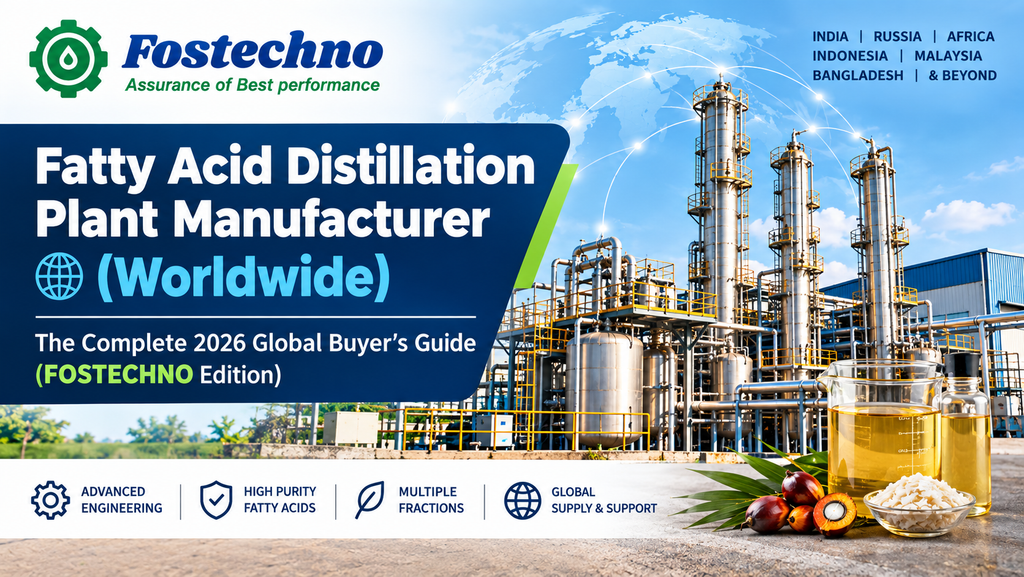
Picture this: you’ve just split your first batch of crude fat into fatty acids and glycerine — whether your plant sits in Gujarat or Jakarta, Lagos or Dhaka, Moscow or Kuala Lumpur — and now you’re staring at a murky, dark, foul-smelling liquid that’s supposed to become the raw material for soap, cosmetics, lubricants, and rubber additives. Somewhere between that crude output and the pale, odour-free, export-grade fatty acid your customers actually want to buy, there’s one piece of engineering doing all the heavy lifting — the distillation plant.
Choose the wrong fatty acid distillation plant manufacturer, and you’ll spend years fighting vapour logging, inconsistent colour, high energy bills, and a maintenance team that’s permanently on call — no matter which continent your plant is on. Choose the right one, and distillation quietly becomes the most profitable step in your entire oleochemical line.
This guide is written for oleochemical, soap, and edible-oil business owners anywhere in the world — India, Russia, Nigeria and the wider African continent, Indonesia, Malaysia, Bangladesh, the Middle East, and beyond. It breaks down exactly how fatty acid distillation works, what separates a good plant from a mediocre one, how the leading global manufacturers stack up against each other, and why FOSTECHNO Process & Engineering Private Limited is built to be the partner you don’t have to think twice about, wherever your plant is being built.
Why Fatty Acid Distillation Matters More Than You Think
When fat or oil is split (hydrolysed) in a fat-splitting tower, the resulting crude fatty acid stream is never pure. It’s loaded with odour bodies, unsaponifiable matter, aldehydes, residual water, and high-boiling components such as un-split glycerides and phosphatides. None of that is acceptable in a finished product — not in a bar of soap, not in a stearic acid candle, and certainly not in a cosmetic-grade emulsifier.
Distillation is the step that separates the fatty acid molecules from everything riding along with them, using controlled vacuum, heat, and condensation to pull out a light-coloured, stable, high-purity product. Get this step wrong, and every downstream process — soap noodles, glycerine purification, stearic acid manufacturing, esterification — inherits the defect. Get it right, and you unlock premium pricing, export eligibility, and a plant that runs for decades without drama.
That’s exactly why the choice of fatty acid distillation plant manufacturer deserves far more scrutiny than most buyers give it.
How a Fatty Acid Distillation Plant Actually Works
Before comparing manufacturers, it helps to understand what you’re actually buying. Most modern systems fall into two broad categories.
1. Straight Distillation
Straight distillation uses the difference in boiling points between the desired fatty acids and the surrounding impurities to achieve separation. The crude fatty acid is vaporised under deep vacuum and low temperature to protect product stability, then condensed — leaving the high-boiling impurities behind as residue. A typical flow runs from a crude fatty acid feed through a CFA/DFA heater, a fatty acid drier, a pre-cut column, and finally the main distillation column, yielding distilled fatty acid, light ends, and residue as separate streams.
2. Fractional Distillation
Fractional distillation goes a step further. Instead of pulling out one purified stream, it separates the crude fatty acid into multiple fractions based on chain length and vapour pressure — for example, C8–C12, C14–C16, and C16–C18 cuts. This is done through repeated distillation and condensation across a series of columns (a first pre-cut column, followed by second and third distillation columns), each tuned to draw off a specific cut.
For instance, a typical C16–C18 cut yields Palmitic Acid (C16, saturated) and Stearic Acid (C18, saturated) — both prized for soap hardening and candle manufacturing — while unsaturated chains such as Oleic Acid (C18:1) are captured separately for cosmetic and lubricant-grade applications where a lower melting point is desirable.
Fractional systems are what allow one plant to serve soap makers, cosmetic formulators, lubricant producers, and rubber compounders simultaneously, since each industry wants a different fatty acid chain-length profile.
The Engineering That Separates Good Plants From Great Ones
Across the manufacturers reviewed for this guide, a few engineering principles consistently show up as the difference-makers:
- Deep vacuum operation — Industrial systems typically run in the 2–20 millibar range, with process temperatures between roughly 160°C and 250°C (some straight distillation setups push higher, into the 250–300°C band for shorter contact time). The lower the achievable pressure at a given temperature, the less thermal stress the product experiences, which directly protects colour and stability.
- Structured packing internals — High-efficiency structured packing lowers pressure drop across the column, which lets the whole system operate at a lower distillation temperature without sacrificing separation efficiency. Lower temperature means less thermal degradation and better final colour (measured on the Lovibond scale).
- Heat recovery integration — Reusing condensate thermal energy to preheat incoming feed is one of the single biggest levers on operating cost, with well-integrated systems cutting utility fuel consumption meaningfully.
- Vapour logging prevention — Vacuum-balanced packed columns and online fatty acid spraying stop vapour from “logging” inside the trays, ensuring the maximum volume of vapour actually reaches the scrubber instead of stalling mid-column.
- De-aeration — Removing dissolved air from the feed before it hits the heat exchangers measurably improves heat-transfer efficiency.
- Fail-safes — Auto cut-off systems for steam and barometric water during power failure, plus vacuum sealing arrangements, protect the batch (and the equipment) when the grid isn’t reliable — a very real consideration for plants in India and other emerging markets.
- Automation — PLC/SCADA-based control loops that hold temperature, vacuum, and flow within tight bands are what actually make “consistent quality” possible batch after batch, rather than being a slogan on a brochure.
Step-by-Step: What Actually Happens Inside a Fatty Acid Distillation Plant
It helps to walk through the journey a batch of crude fatty acid actually takes, because this is where the engineering differences between manufacturers become obvious.
Step 1 — Filtration and pre-heating. Crude fatty acid arriving from the battery limit (usually straight from a fat-splitting tower) is first filtered to remove suspended solids, then pre-heated in preparation for the vacuum stages ahead. Skipping or under-designing this stage is one of the most common causes of fouling further down the line.
Step 2 — De-aeration / de-gasification. The pre-heated feed is passed into a de-gasifying unit operating under vacuum, where dissolved air and moisture are stripped out. This step matters more than most buyers realise: dissolved air in the feed directly reduces heat-exchanger efficiency in every subsequent stage, so a plant with poor de-aeration design will run hotter and less efficiently than its specifications promise.
Step 3 — Thermic fluid heating. The de-gasified, dried fatty acid is heated through a thermic fluid exchanger to bring it to the temperature required for vaporisation, without exposing the product to the direct, uneven heat of an open flame — a lesson learned from the earliest fatty acid distillation units, which used smoke-gas-heated retorts and produced badly discoloured product as a result.
Step 4 — Pre-cut column. The heated feed enters the pre-cut column, which typically contains a vaporisation section, one or two distillation packing beds, a pump-around section, and a scrubbing section. This stage removes the lightest, most volatile impurities before the product ever reaches the main distillation column, which protects the main column’s efficiency and product purity.
Step 5 — Main distillation column. This is where the real separation happens. Operating under deep vacuum, the main column includes a vaporisation section, a stripping section, washing sections, a pump-around section, and a final scrubbing section. Fatty acid vapour rises, impurities and high-boiling residues fall, and the system is tuned to pull off a distillate that meets your target colour and purity specification.
Step 6 — Fractionation (if required). If you need multiple product cuts rather than a single blended distillate, the vapour stream is routed through additional columns in series — a second and third distillation column in a typical three-column fractional setup — each tuned to condense a specific chain-length range, such as C8–C12, C14–C16, or C16–C18.
Step 7 — Condensation and light-ends handling. Vapour that isn’t captured as the main product is cooled and condensed as “light ends” — these are either recycled into further processing or discarded, depending on their composition and value.
Step 8 — Residue handling. What remains at the bottom of the column — residue carrying trace fatty acid content — can often be repurposed for lower-grade applications, or reprocessed through re-hydrolysis and batch distillation to recover additional yield rather than treating it purely as waste.
Step 9 — Cooling, storage, and quality testing. The finished distilled fatty acid (or fractionated cuts) is cooled, sent to storage, and tested against colour (Lovibond), acid value, and purity specifications before it’s cleared for dispatch or for the next stage of processing, such as soap noodle manufacturing or stearic acid production.
Every one of these nine steps is a place where a poorly engineered plant loses yield, wastes energy, or degrades product colour. When you’re comparing manufacturers, ask them to walk you through their design for each of these steps specifically — a vague answer at any single step is a warning sign.
Common Mistakes Buyers Make When Choosing a Manufacturer
After years of watching oleochemical producers make (and recover from) plant-buying decisions, a handful of mistakes show up again and again:
Buying capacity instead of buying performance. A 200 TPD plant that’s poorly matched to your actual feedstock will underperform a well-matched 150 TPD plant every single time. Don’t let a bigger number on a spec sheet substitute for a design that’s actually right for your crude.
Ignoring feedstock variability. If you plan to process more than one type of feedstock — say, both palm-based and coconut-based crude fatty acid — make sure the plant is designed with enough flexibility in vacuum and temperature control to handle both without a full re-engineering exercise later.
Underestimating utility costs. Steam, cooling water, and vacuum-system power consumption are recurring costs for the entire life of the plant. A slightly higher upfront investment in heat recovery and structured packing very often pays for itself within a few years through lower utility bills.
Treating automation as a checkbox. “Fully automated” means very different things from one manufacturer to another. Ask specifically what happens during common fault scenarios — a blocked line, a vacuum leak, a power dip — and whether your own operators can diagnose and clear these faults without calling the manufacturer every time.
Overlooking after-sales support until it’s too late. Spares availability, response time for breakdowns, and access to process engineers for troubleshooting matter enormously once the plant is running — but they’re the easiest thing to overlook during the excitement of finalising a purchase order.
Not verifying real-world references. Brochure claims and actual field performance are not always the same thing. A short conversation with an existing customer running a similar feedstock and capacity can save you from a very expensive surprise.
A Global Industry: Where Fatty Acid Distillation Plants Are Being Built Right Now
Fatty acid distillation isn’t a niche, India-only technology — it’s a global engineering category, because vegetable oil, palm, coconut, tallow, and other fat feedstocks are produced and processed on every continent. Some of the fastest-growing demand for new plants today comes from outside India entirely:
- Russia and the CIS region — sunflower and rapeseed oil processing is a major regional industry, and local oleochemical and soap manufacturers are increasingly looking to add distillation capacity to move up the value chain instead of exporting crude fatty acid.
- Africa (Nigeria, Kenya, Ghana, Egypt, South Africa, and beyond) — with palm oil production concentrated in West and Central Africa, and a fast-growing soap and personal-care manufacturing base across the continent, distillation plants let African producers capture more value locally instead of shipping crude fatty acid abroad for processing.
- Indonesia and Malaysia — as the world’s two largest palm oil producers, both countries have a natural, built-in feedstock advantage for fatty acid distillation and fractionation, particularly for palm-kernel-based cuts used in soap, cosmetics, and oleochemical derivatives.
- Bangladesh — a fast-growing soap, detergent, and edible-oil processing sector makes Bangladesh a natural fit for new or expanded distillation capacity, especially for producers looking to reduce dependence on imported distilled fatty acid.
- Middle East — refining and oleochemical investment in the Gulf region continues to grow alongside broader downstream petrochemical and consumer-goods diversification.
- Latin America and other emerging markets — countries with strong vegetable oil production (soybean, palm) are following the same pattern: build local distillation capacity to capture more margin instead of exporting semi-processed material.
The engineering fundamentals — deep vacuum, structured packing, heat recovery, fail-safe automation — don’t change from country to country. What does change is your feedstock profile, your grid reliability, your water quality, your climate, and your target export markets. That’s exactly why a manufacturer who engineers around your specific site conditions, rather than shipping the same design everywhere, matters just as much for a buyer in Lagos or Jakarta as it does for a buyer in Gujarat.
Why FOSTECHNO Process & Engineering Private Limited
FOSTECHNO Process & Engineering Private Limited was built around a simple frustration shared by oleochemical producers everywhere, whether they’re based in India, Russia, Nigeria, Indonesia, Malaysia, Bangladesh, or anywhere else: too many plants are sold off a catalogue spec sheet instead of being engineered around the feedstock, power supply, water quality, and product mix a customer actually has on the ground.
Here’s what that means in practice when you work with FOSTECHNO on a fatty acid distillation plant:
Process-first engineering, not catalogue selling. Before FOSTECHNO proposes a column size or a vacuum system, the team wants to understand your crude fatty acid source — palm, coconut, tallow, soya, PFAD, or acid oil — because each of these behaves differently under vacuum and heat, and a plant sized for one won’t perform on another without adjustment.
Straight and fractional systems under one roof. Whether you need a single-cut distilled fatty acid for soap noodles or a full fractionation train splitting C8–C12, C14–C16, and C16–C18 cuts for cosmetics, lubricants, and rubber-grade applications, FOSTECHNO designs the column train to match your target product mix rather than forcing your product mix to match a standard column.
Energy discipline built in from day one. Regenerative heat exchange, de-aeration, and counter-current flow design aren’t add-ons — they’re part of the base engineering, because in a business where fuel and steam cost is one of the largest recurring line items, a plant that isn’t optimised for heat recovery is quietly losing you money every single day it runs.
Built for real-world power and site conditions, anywhere in the world. Vacuum sealing arrangements and automatic cut-off for steam and barometric water during power failure protect your batch — and your equipment — when grid stability isn’t guaranteed, which is a very real operating condition across large parts of India, Africa, South Asia, and other emerging manufacturing regions FOSTECHNO’s clients operate in.
Full turnkey lifecycle support, including international projects. From feasibility and process design through fabrication, export documentation, site installation, commissioning, and after-sales service and spares — FOSTECHNO stays involved well past the day the plant starts up, whether that plant is a short drive from the workshop or on another continent, because a distillation plant’s real test isn’t day one, it’s year five.
Simple, low-maintenance automation. Complex automation that nobody on your floor can actually troubleshoot at 2 a.m. isn’t a feature — it’s a liability. FOSTECHNO designs control systems that give operators real visibility and straightforward fault diagnosis, not a black box.
If you’re evaluating manufacturers for your next fatty acid distillation project, the smartest move is to get FOSTECHNO’s engineering team to walk through your specific feedstock, target purity, and capacity requirements before you commit to anyone’s standard spec sheet.
Fatty Acid Distillation Plant: Overview Table
| Aspect | Typical Industry Standard | What to Look For in a Manufacturer |
|---|---|---|
| Plant capacity | 50–500 TPD (scalable to pilot or industrial scale) | Manufacturer should size the plant to your actual feedstock volume, not a fixed catalogue capacity |
| Operating vacuum | 2–20 millibar (deep vacuum) | Multi-stage steam ejectors or mechanical vacuum pumps, with vacuum-sealing fail-safes |
| Operating temperature | ~160°C–250°C (up to 300°C for some straight distillation setups) | Structured packing to allow lower operating temperature without losing separation efficiency |
| Material of construction | SS316 / SS316L, high-nickel alloys for corrosive cuts | MOC selected based on your specific feedstock corrosivity, not a default spec |
| Recovery / yield | 99%+ fatty acid recovery achievable | Ask for guaranteed recovery figures in writing, tied to your feedstock |
| Column internals | High-efficiency structured packing, bubble-cap or vacuum-balanced trays | Zero vapour-logging design, online fatty spraying |
| Distillation type | Straight distillation and fractional (multi-cut) distillation | Fractional capability if you plan to serve more than one downstream industry |
| Automation | PLC/SCADA control | Simple, serviceable automation with local troubleshooting support |
| Heat recovery | Regenerative / integrated heat exchange | Ask for expected fuel/utility savings percentage |
| Power failure protection | Auto cut-off for steam & barometric water, vacuum sealing | Non-negotiable in regions with inconsistent grid supply |
| End applications | Soap, cosmetics, pharmaceuticals, rubber, lubricants, candles | Confirm the manufacturer has delivered plants serving your specific end industry |
| Delivery model | Turnkey EPC (design to commissioning) | Prefer manufacturers offering feasibility study, installation, commissioning, and after-sales support as one package |
Applications: Where Distilled Fatty Acids Actually Go
It’s worth remembering why any of this engineering matters in the first place. Distilled fatty acid isn’t the end product — it’s the raw material for a huge range of downstream goods:
- Soap and detergent manufacturing — distilled fatty acid blends (often from palm stearin, rice bran oil, coconut oil, or tallow) are the backbone of premium soap noodle production.
- Cosmetics and personal care — lighter, high-purity fractions go into creams, lotions, and surfactant systems where colour and odour stability are non-negotiable.
- Rubber and tyre manufacturing — specific fatty acid grades act as processing aids and activators.
- Candles and stearic acid products — the higher-chain-length cuts are prized for melting point and hardness characteristics.
- Lubricants and industrial chemicals — fractionated cuts feed into specialty lubricant and oleochemical derivative production.
- Pharmaceutical-adjacent uses — very high-purity fractions can meet the tighter specifications this industry demands.
This is exactly why fractional distillation capability matters so much when you’re choosing a manufacturer: a plant that can only deliver one blended cut locks you into one market, while a properly fractionated plant lets you sell into several markets from the same feedstock stream.
What to Ask Before You Sign With Any Manufacturer
Whether you’re evaluating FOSTECHNO or any other name on this list, these are the questions that actually separate a good decision from an expensive mistake:
- Will you test my actual feedstock before finalising the design?
A plant designed around generic crude fatty acid assumptions, rather than your real feedstock’s fatty acid profile and impurity load,will underperform from day one. - What vacuum and temperature range will my product actually see, and how does that protect colour and stability?
Get specific numbers, not just “high vacuum.” - Can this plant run fractional distillation, or only straight distillation?
If there’s any chance you’ll want to diversify your product mix later, ask whether the column train can be expanded rather than replaced. - What happens during a power failure — mid-batch?
Ask specifically about vacuum sealing and auto cut-off systems for steam and barometric water. - What’s the expected fuel and utility cost per tonne processed, and how is that achieved?
Heat recovery integration should come with real, quoted numbers. - What material of construction are you specifying, and why?
MOC should be justified by your feedstock’s corrosivity, not defaulted to the cheapest option. - What does your after-sales and spares support actually look like once the plant is running?
Ask about response times and whether spares are stocked locally or need to be imported. - Can I speak to an existing customer running a similar feedstock and capacity?
Any manufacturer confident in their engineering should have no issue arranging this.
The Bottom Line
Fatty acid distillation sits at the exact point in an oleochemical operation where engineering quality translates directly into product price. A plant that runs at the right vacuum, with the right packing, the right heat recovery, and the right fail-safes, turns a murky crude stream into a premium, exportable fatty acid — batch after batch, year after year. A plant that cuts corners on any of those fronts turns into a permanent maintenance headache and a colour-consistency problem that costs you, customers.
Ready to build a fatty acid distillation plant that’s actually engineered around your feedstock — wherever you are in the world?
Talk to FOSTECHNO Process & Engineering Private Limited’s process design team today. Whether you’re setting up in India, Russia, Nigeria, Kenya, Indonesia, Malaysia, Bangladesh, the Middle East, or any other market, share your feedstock type, target capacity, and product mix, and get a techno-commercial proposal built around your actual operating conditions—not a generic spec sheet.
Get in touch with FOSTECHNO Process & Engineering Private Limited to request your fatty acid distillation plant consultation for domestic or international projects.Frequently Asked Questions
1. What is a fatty acid distillation plant used for?
A fatty acid distillation plant purifies crude fatty acids — produced from splitting vegetable oils or animal fats — by removing impurities like odour bodies, unsaponifiable matter, aldehydes, water, and residual glycerides. The output is a light-coloured, stable, high-purity fatty acid used in soap, cosmetics, rubber, lubricants, and candle manufacturing.
2. What’s the difference between straight distillation and fractional distillation?
Straight distillation separates fatty acids from impurities as a single purified stream, based on boiling point differences under vacuum. Fractional distillation goes further, splitting the crude fatty acid into multiple chain-length cuts (such as C8–C12, C14–C16, and C16–C18) across a series of columns, allowing one plant to serve several different downstream industries.
3. What vacuum and temperature does fatty acid distillation typically run at?
Most industrial systems operate in a deep vacuum range of roughly 2 to 20 millibar, at temperatures between about 160°C and 250°C, though some straight-distillation setups run temperatures up to 300°C for very short contact times. Lower operating temperature at a given vacuum level generally means less thermal stress and better final product colour.
4. What capacity should I choose for my fatty acid distillation plant?
Industrial plants are commonly built in a range from around 50 TPD up to 1000 TPD, but the right number depends entirely on your feedstock supply and your target market. A reliable manufacturer will size your plant around your actual production goals rather than pushing a fixed catalogue capacity.
5. Why does structured packing matter in a distillation column?
Structured packing reduces the pressure drop across the column, which allows the plant to run separation at a lower temperature without losing efficiency. Lower operating temperature protects product colour and reduces thermal degradation, which is critical for meeting export-grade colour specifications.
6. How much does a fatty acid distillation plant cost?
Cost depends on capacity, number of fractionation stages, feedstock corrosivity (which drives material of construction choices), automation level, and site-specific factors like utilities and civil work. A credible manufacturer will prepare a detailed techno-commercial proposal only after reviewing your crude fatty acid profile and target purity — be cautious of anyone quoting a firm price before understanding your feedstock.
7. Can an existing fat-splitting plant be integrated with a new distillation system?
Yes. Distillation plants are commonly engineered to integrate with existing fat-splitting, pretreatment, and glycerine purification units already on site, so long as the crude fatty acid feed characteristics and battery-limit conditions are properly assessed during the design phase.
8. Which industries actually buy distilled fatty acid as a raw material?
Soap and detergent manufacturers, cosmetics and personal care formulators, rubber and tyre producers, candle and stearic acid manufacturers, and industrial lubricant producers are the primary buyers — each typically wanting a different fatty acid chain-length profile, which is exactly why fractional distillation capability matters.
9. How do I know if a manufacturer’s automation is actually reliable, or just marketing? Ask to see the plant running — or speak with an existing customer operating a similar capacity and feedstock. Reliable automation should be simple enough for your own operators to troubleshoot locally, include clear fault diagnostics, and hold temperature, vacuum, and flow within tight, repeatable bands without constant manual intervention.
10. What happens to the fatty acid distillation plant during a power outage — is the product lost?
In a well-engineered plant, no. Systems with vacuum-sealing arrangements and automatic cut-off for steam and barometric water supply are specifically designed to protect the batch in progress during a power failure, which is why this feature should be treated as a requirement, not an optional extra, especially in regions with inconsistent grid supply.
11. Is FOSTECHNO Process & Engineering suitable for both new (greenfield) and expansion (brownfield) fatty acid distillation projects?
Yes. FOSTECHNO’s process-first approach — starting with feedstock and site-condition analysis rather than a fixed catalogue design — applies equally well to a completely new plant and to adding or upgrading a distillation line within an existing oleochemical facility. The key in a brownfield project is integrating the new distillation system cleanly with your existing battery limits, utilities, and upstream fat-splitting equipment, which FOSTECHNO’s engineering team accounts for from the first site visit.
12. Does FOSTECHNO supply fatty acid distillation plants outside India — for example, to Russia, Africa, Indonesia, Malaysia, or Bangladesh?
Yes. Fatty acid distillation technology is engineered around universal principles — vacuum, heat, and separation — which is exactly why this equipment exports well to markets with strong vegetable oil, palm, or animal-fat feedstock bases, including Russia and the CIS region, African markets such as Nigeria, Kenya, and Egypt, palm-oil producers like Indonesia and Malaysia, and growing soap and edible-oil sectors such as Bangladesh. For any international project, the design still has to be adapted to local feedstock characteristics, grid reliability, water quality, and climate — which is why FOSTECHNO’s process team starts every international enquiry the same way it starts a domestic one: by understanding your actual site conditions before proposing a plant.
13. Which fatty acids does a distillation plant typically produce?
A fatty acid distillation plant, depending on the feedstock and fractionation setup, commonly produces Oleic Acid, Palmitic Acid, and Stearic Acid as key output streams. Palmitic Acid (C16) and Stearic Acid (C18) are saturated fatty acids widely used in soap, candles, and cosmetics, while Oleic Acid (C18:1), being unsaturated, is favoured in cosmetic, lubricant, and personal-care applications requiring a lower melting point. The exact yield of each depends on the source oil — palm oil is rich in Palmitic Acid, while oils like sunflower and olive are higher in Oleic Acid.



Leave a Reply