Safflower is quietly becoming one of the more interesting oilseed crops in the world edible-oil market. It isn’t new — people have grown it for thousands of years for its dye and, later, its oil — but the commercial oil extraction side of the business has changed a lot in the last two decades. Better presses, better refining, and rising demand for high-oleic cooking oils have turned safflower from a niche crop into a genuine industrial opportunity. {Safflower oil plant}


We write this guide from the plant-building side of the table, not the marketing side. Fostechno designs and executes industrial oil extraction plants — the civil work, the machinery selection, the process flow, the utilities, the compliance paperwork — for clients who want to go from “we have access to safflower seed” to “we are shipping refined oil.” If you’re one of those people, this article walks through what the crop is, why the demand exists, how the oil is actually extracted at industrial scale, and what building the plant itself involves.
What Is Safflower, and Why Does It Matter for Oil Production?
Safflower (Carthamus tinctorius) is a highly branched, thistle-like annual plant in the daisy family, Asteraceae. Botanically it’s a tough, drought-tolerant crop — plants typically grow between 30 and 150 cm tall, with globular flower heads in yellow, orange, or red, and each branch usually carries one to five flower heads containing 15 to 20 seeds apiece. Because it develops a deep taproot, safflower is well suited to arid regions with a short rainy season, which is part of why it thrives in places like the semi-arid tracts of India, parts of the United States, and Central Asia.
Safflower is genuinely one of humanity’s oldest cultivated crops. Historically, it was grown less for oil and more for its flowers, which produced a red or yellow dye — chemical analysis of Egyptian textiles from the Twelfth Dynasty has identified safflower-based dyes, and garlands made from the flowers were found in Tutankhamun’s tomb. It also earned the nickname “false saffron” or “bastard saffron” because its dried florets were historically used as a cheaper substitute for true saffron in cooking and dyeing.
Today, the plant’s economic center of gravity has shifted almost entirely to its seed. The seed kernel contains a light, mild-flavored oil that today’s food industry values for exactly the reasons dye-makers once valued the flower: consistency, neutrality, and versatility. Modern safflower is grown commercially in more than sixty countries, and global production runs into the hundreds of thousands of tonnes annually.
The Two Types of Safflower Oil — and Why It Matters for Your Plant
One detail that trips up first-time investors is that “safflower oil” isn’t one product — it’s two, depending on the seed variety crushed:
- High-linoleic safflower oil: Rich in polyunsaturated linoleic acid (omega-6). This was historically the dominant type and is prized in paints, varnishes, and some nutritional applications.
- High-oleic safflower oil: Bred later and now the dominant type in the edible oil market, this variant behaves more like olive oil — a monounsaturated fat profile that gives it a higher smoke point and longer shelf stability, which food manufacturers and restaurants prefer for frying and processed food applications.
This distinction matters enormously at the engineering stage, because your seed sourcing decision — which cultivar your farmers or suppliers grow — determines your refining parameters, your target market (nutraceutical vs. food-service vs. industrial), and ultimately your equipment specification. A plant designed around one profile isn’t automatically optimal for the other, so this is one of the first questions our process engineers ask a new client.
Why Demand for Safflower Oil Is Growing
1. The Health and Nutrition Angle
Consumer health publications have driven a lot of the recent demand growth. Safflower oil is widely marketed as a light, neutral-tasting cooking oil that’s low in saturated fat and, in its high-oleic form, similar in profile to olive oil — positioning it as a heart-conscious alternative for frying, sautéing, and salad dressings. Health and wellness outlets frequently point to its vitamin E content and its use as a topical and dietary supplement.
Beyond the popular press, the scientific literature backs a good deal of this interest. A peer-reviewed review of Carthamus tinctorius published in a National Center for Biotechnology Information (NCBI) journal traces the plant’s use from traditional medicine through to modern pharmacological research, cataloguing studied effects ranging from cardiovascular and anti-inflammatory activity to its long history in traditional Chinese and Ayurvedic medicine systems. Ayurvedic resources likewise document safflower’s traditional use — as “Kusumbha” — for joint health, skin application, and circulation, which continues to support demand in the nutraceutical and topical oil segments even outside the food industry.
2. Industrial and Non-Food Applications
This is the part investors often underestimate. Safflower oil isn’t only a kitchen product. Industrial oil and oilseed processors document its use in the manufacture of paints, varnishes, and linoleum, thanks to a drying quality that keeps painted surfaces from yellowing with age — a property that made it valuable in these industries long before “heart-healthy cooking oil” became a marketing phrase. It also shows up as a carrier oil and active ingredient in cosmetics and personal care formulations. A plant built with flexible refining and packaging lines can serve food-grade, cosmetic-grade, and industrial-grade buyers from the same base extraction process, which is a smart way to de-risk a new operation.
3. Agronomic Advantages That Support Steady Supply
Agricultural research institutions studying alternative oilseed crops highlight safflower’s suitability for dryland and rotational farming — it performs well in regions with limited irrigation and can be integrated into crop rotation systems in wheat-growing regions, which helps stabilize seed supply for processors. Indian agricultural extension resources describe similar advantages for cultivation in the country’s semi-arid zones, where the crop’s taproot system and drought tolerance make it a viable rotation option for farmers, in turn giving a processing plant a more dependable regional feedstock than more water-intensive oilseed crops.
Put together, this is why we’re seeing more entrepreneurs — from agri-processors expanding their product line to fresh investors entering edible oils — ask us specifically about safflower oil plant rather than the more crowded soybean or sunflower oil space.
4. A Market With Room to Grow
Compared with soybean, palm, or sunflower oil, safflower remains what analysts would call a minor crop — global output measures in the hundreds of thousands of tonnes rather than the tens of millions produced for the biggest commodity oils. For an established player, that might look like a limitation. For a new processor, it’s actually the opportunity: the market isn’t saturated with mega-scale competitors, pricing has more room to reflect quality and positioning rather than pure commodity economics, and a well-built regional plant can realistically become a significant supplier in its market rather than a small fish in an enormous pond. Industry trade coverage of the edible-oil sector has also pointed to steady single-digit annual growth in demand for healthier cooking oils generally, a trend that safflower — particularly the high-oleic variety — is well positioned to capture.
Export potential is another factor worth building into your plant design from day one. Buyers in North America, Europe, and parts of the Middle East actively source high-oleic safflower oil for food manufacturing and premium retail, while paint, cosmetic, and nutraceutical manufacturers worldwide source both oil types as raw material inputs. A plant designed with export-grade refining and internationally recognized quality certifications in mind opens up considerably more buyers than one built purely for the local commodity market — which is why we always ask new clients about their five-year market ambitions, not just their opening-day capacity.
How Safflower Oil Is Extracted: The Engineering Perspective
This is where the plant-building conversation actually starts. Every safflower oil business decision — capital cost, product positioning, byproduct value, throughput — flows from which extraction technology you choose. Broadly, there are three routes, and most commercial plants combine more than one.
1. Cold Pressing (Mechanical Expeller, No Heat)
In cold pressing, cleaned and dried seeds are fed into a mechanical screw press that ruptures the oil cells and forces oil out purely through pressure, without added heat or chemical solvents. Comparative research on safflower seed oil extraction found that cold pressing produces oil with better retained color and natural character than solvent-extracted oil, but at a meaningfully lower yield — in one controlled study, cold-pressed oil yield came in at roughly 9% versus over 16% for solvent extraction from the same seed batch. Cold-pressed oil also tends to carry lower moisture and volatile content because there’s no residual solvent to manage.
Best for: premium, “cold-pressed” or “virgin” branded oil, health-food and nutraceutical channels, and smaller-footprint plants where a slightly lower yield is an acceptable trade-off for product story and lower capital cost.
2. Hot Pressing (Expeller with Pre-Roasting)
Hot pressing roasts the seed before pressing, which increases oil fluidity and boosts extraction yield compared with cold pressing, but at some cost to the raw color and nutrient profile of the finished oil, and it raises the risk of protein denaturation in the leftover meal — which matters if you plan to sell that meal as animal feed. Many commercial operators treat hot pressing as a middle ground between cold pressing’s oil quality and solvent extraction’s yield.
3. Solvent Extraction (Hexane-Based)
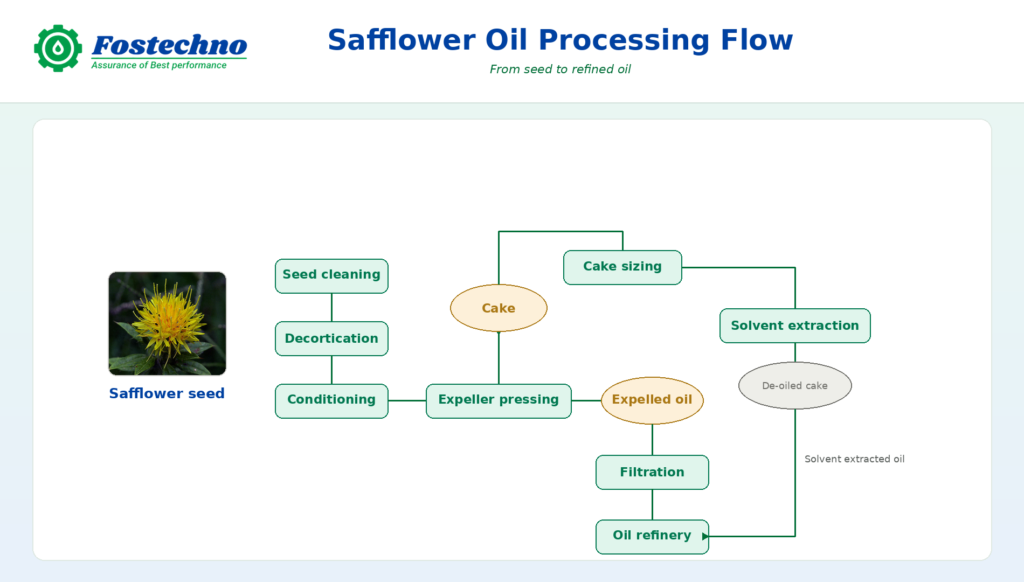
Industrial-scale plants aiming for maximum yield typically run a solvent extraction process, most commonly using food-grade hexane. The pressed or flaked seed cake is washed with solvent to pull out residual oil, and the solvent is then recovered through distillation, leaving behind crude oil that goes on to refining. This route consistently extracts substantially more oil from the same seed volume than mechanical pressing alone, which is why almost every large commercial edible-oil operation runs some form of solvent extraction on the press cake, even if they also cold-press a portion of their seed for a premium product line.
Engineering note: Solvent extraction requires a materially different plant design than pure mechanical pressing — explosion-proof electricals, solvent recovery and distillation systems, effluent handling, and stricter fire-safety compliance. This is one of the biggest cost and design decision points in any safflower oil plant project, and it’s where an experienced plant engineering partner earns its keep.
4. Supercritical / Subcritical Fluid Extraction (Emerging Technology)
Newer research has explored subcritical and supercritical CO₂ fluid extraction as a way to combine high yield with the oxidation stability and bioactive retention of gentler extraction — avoiding both the heat degradation of hot pressing and the solvent-residue concerns of hexane extraction. It’s currently a continuous, counter-current process that’s relatively energy-efficient compared with traditional methods, though equipment costs remain considerably higher, which is why it’s mostly seen in research settings and specialty/premium production runs rather than mainstream commercial plants today. It’s a technology worth discussing at the design stage if your target market is high-value cosmetic or nutraceutical oil.
What Actually Goes Into Building a Safflower Oil Plant
Once the extraction method is decided, the plant itself comes together in a fairly consistent sequence. Here’s how Fostechno structures a project, from paperwork to commissioning.
Step 1 — Feasibility & Capacity Planning
We start with your seed supply (how much, how consistent, which cultivar), your target market (bulk commodity oil, branded cold-pressed oil, industrial-grade oil, or a mix), and your budget. This determines daily crushing capacity — a figure that then drives every equipment and civil-work decision downstream.
Step 2 — Site Selection & Layout Design
Seed storage, cleaning, pressing/extraction, refining, effluent treatment, packaging, and finished-goods storage all need to flow in one direction to keep the plant efficient and compliant. We design layouts that account for fire-safety separation (particularly important around solvent extraction and boiler areas), utility routing, and future capacity expansion.
Step 3 — Machinery Selection & Procurement
Core equipment typically includes:
- Seed cleaning and de-stoning equipment
- Seed dryers and storage silos
- Decorticating/dehulling equipment (where applicable)
- Expeller presses (cold or hot) and/or solvent extraction plant with a desolventizer-toaster
- Filtration and clarification systems
- Refining section — degumming, neutralization, bleaching, deodorization (as required by target market)
- Boiler and thermal utilities
- Effluent treatment plant (ETP)
- Automated or semi-automated packaging and filling lines
Step 4 — Civil Construction & Installation
Civil work, structural steel, utility piping, electrical (including explosion-proof zones for solvent areas), and equipment installation, followed by mechanical and process commissioning.
Step 5 — Regulatory Compliance & Certification Support
Depending on your country and export ambitions, this can include food safety licensing, factory/industrial licensing, pollution control clearances, fire safety NOCs, and quality certifications such as ISO 22000, HACCP, or GMP. We build compliance requirements into the design from day one rather than retrofitting them after construction — retrofitting is always more expensive.
Step 6 — Trial Runs & Handover
Before full handover, we run trial batches to validate yield, oil quality parameters, and throughput against the design specification, and we train your operations team on the process line.
A Note on Automation Levels
One question we get from almost every client is how much of the plant should be automated versus operated manually. There’s no single correct answer — it depends on labor costs in your region, the capital available, and how tightly you need to control quality consistency batch to batch. A fully manual seed-cleaning and pressing line can be a sensible, lower-cost starting point for a smaller operation, while PLC-controlled dosing, temperature control in the refining section, and automated packaging lines make more sense once you’re running multiple shifts and need consistent output with a smaller labor footprint. We typically design plants with a semi-automated core process and clear expansion points, so that as production volume grows, automation can be added to specific bottleneck stages — the desolventizer-toaster, the filling line, the bleaching section — without having to rebuild the plant from scratch.
It’s also worth building basic process monitoring into the plant from the start, even at smaller scale: temperature logging at the press and refining stages, batch-level yield tracking, and simple digital records of seed intake versus oil output. This isn’t about chasing “smart factory” buzzwords — it’s about giving your own management team the data to spot a machine drifting out of tolerance or a seed batch underperforming before it becomes a quality complaint from a buyer.
Byproducts: Don’t Overlook the Seed Cake
A well-designed safflower oil plant isn’t a single-product operation. The de-oiled cake remaining after pressing or extraction is a protein-rich material with established value as livestock feed, and in some regions it’s processed further for other agricultural or industrial uses. Factoring cake handling, storage, and a sales channel into your plant design from the outset materially improves overall project economics — it’s revenue that’s easy to leave on the table if the plant wasn’t designed with it in mind.
Quality Control: What Determines “Good” Safflower Oil
Buyers — whether a food manufacturer, a retail brand, or a cosmetics formulator — will judge your oil against a specific set of physicochemical parameters, and your plant’s process design needs to be built around hitting them consistently, not just occasionally. The parameters that matter most include:
- Fatty acid profile: confirms whether the batch is high-linoleic or high-oleic, which determines which market it can be sold into.
- Free fatty acid (FFA) content and acid value: indicates freshness and how well seed handling and storage were managed before crushing.
- Peroxide value: an early indicator of oxidation and shelf-life risk.
- Moisture and volatile matter: particularly important for solvent-extracted oil, where residual moisture or solvent traces need to stay within safe, regulated limits.
- Color and clarity: a practical quality marker that buyers use as a first-pass visual check, and one where cold-pressed oil generally has a natural advantage.
- Iodine value and refractive index: standard characterization figures used to verify the oil matches expected safflower oil specifications and hasn’t been adulterated.
A plant that includes an in-house quality control lab — even a modest one with basic titration, moisture, and color-testing equipment — is able to catch problems at the batch level instead of discovering them after a shipment is rejected by a buyer. We build QC lab space into every plant layout we design, sized appropriately to the plant’s capacity and target market.
Common Mistakes First-Time Plant Owners Make
Having executed industrial processing plant projects across sectors, a handful of avoidable mistakes come up repeatedly with first-time oil plant investors. Worth flagging before you finalize your own plan:
- Sizing the plant to the wrong number. Investors often size equipment to their optimistic best-case seed supply rather than their realistic, contracted supply — leaving expensive machinery underutilized in year one.
- Treating extraction method as a fixed decision instead of a market decision. The right extraction technology follows from your target buyer and product positioning, not the other way around. Choosing solvent extraction because it’s “more efficient” without a plan for where high-volume commodity oil will sell is a common and costly mistake.
- Ignoring the seed cake as a revenue line. As covered above, this byproduct has real market value, and plants that don’t plan storage, handling, and a buyer for it from day one leave money on the table every single batch.
- Underinvesting in compliance planning. Retrofitting a plant to meet food safety or fire safety requirements after construction is dramatically more expensive than designing for them from the start.
- Choosing machinery vendors piecemeal. Sourcing a press from one supplier, a refinery section from another, and utilities from a third, without a single engineering team coordinating the interfaces between them, is one of the most common causes of commissioning delays and integration problems.
Capital Investment & Realistic Timelines
Every project is different, but as a general framework: a compact cold-press-only unit requires the smallest footprint and capital outlay and can typically be commissioned faster, while a full solvent-extraction-plus-refinery complex needs significantly more capital, land, and lead time for imported or specialized machinery. Most turnkey safflower oil plants we execute — from finalized design to commissioning — run in the range of four to nine months, depending on capacity and the scope of civil work. We provide clients a detailed, itemized cost and timeline breakdown as part of the feasibility study, rather than a generic industry figure, because seed cost, local labor rates, equipment sourcing, and compliance requirements vary meaningfully by country and region.
Why Work With Fostechno
We are an industrial plant-building company — we design and execute turnkey processing plants, and oilseed extraction plants, including safflower oil plants, are one of our core project types. A few things set our approach apart for clients entering the safflower oil business:
- End-to-end execution: feasibility, layout, machinery sourcing, civil construction, installation, and commissioning under one accountable team, instead of coordinating a dozen separate vendors yourself.
- Extraction-method flexibility: we design for cold-press, expeller, solvent extraction, or hybrid lines based on your product strategy — not a one-size-fits-all package.
- Compliance-first design: layouts built around food safety, fire safety, and export certification requirements from day one.
- Global project experience: we work with clients across regions and adapt designs to local seed varieties, climate, and regulatory frameworks.
- Post-commissioning support: operator training, trial-run validation, and ongoing technical support after handover.
Ready to Build Your Safflower Oil Plant?
If you have access to safflower seed — your own farms, contract farming arrangements, or a regional supply chain — and you’re serious about moving into oil processing, the engineering and compliance side of the project is where most delays and cost overruns happen. That’s the part we specialize in solving.
Talk to our engineering team for a free, no-obligation feasibility discussion. We’ll walk through your seed supply, target market, and budget, and outline a realistic plant design and cost range for your project.
Get a Free Safflower Oil Plant Consultation — Fostechno
Website: fostechnos.com
Phone / WhatsApp: +91 9696177472
Email: jafarhusain@fostechnos.com
Serving industrial plant projects worldwide — from feasibility study to commissioned, running plant.
Frequently Asked Questions
How much does it cost to set up a safflower oil processing plant?
Cost depends on capacity, extraction method (cold press, expeller, or solvent extraction), automation level, and refining requirements. A small cold-press unit costs far less than a full solvent-extraction-and-refinery complex. Fostechno provides a free, capacity-based cost estimate after a short requirement discussion.
Which extraction method is best for a safflower oil plant: cold pressing or solvent extraction?
Cold pressing retains more nutrients, color, and natural flavor, and suits premium or “cold-pressed” product lines, but gives a lower oil yield. Solvent extraction recovers significantly more oil from the seed and suits high-volume commercial operations. Many commercial plants use a hybrid approach: expeller pressing followed by solvent extraction of the residual cake.
How long does it take to build and commission a safflower oil plant?
A typical turnkey plant, from finalized layout to commissioning, takes roughly four to nine months, depending on capacity, civil work scope, and equipment lead times. We provide a detailed project timeline as part of the feasibility report.
What licenses and certifications are required to operate an edible oil plant?
Requirements vary by country, but commonly include a food business license, factory/industrial establishment license, pollution control board consent, fire safety NOC, and export certifications such as ISO 22000, HACCP, or GMP where relevant. Our engineering team designs layouts that account for these requirements from the design stage.
What is the minimum land area needed for a safflower oil extraction plant?
A small-to-mid capacity plant (cleaning, pressing, filtration, packaging) can typically be set up on roughly 3,000 to 8,000 square feet, while a full solvent-extraction and refining complex with storage and effluent treatment usually needs 1 to 3 acres or more, depending on daily seed-crushing capacity.
Can Fostechno build a safflower oil plant anywhere in the world?
Yes. We design and execute industrial oilseed processing plants for clients internationally, adapting equipment, layout, and compliance documentation to local regulations, seed varieties, and climate conditions.
What can be done with the leftover safflower seed cake after oil extraction?
The de-oiled cake remaining after pressing or extraction is a protein-rich byproduct with established value as livestock feed, and it can be a meaningful secondary revenue stream if the plant is designed with cake handling, storage, and a sales channel from the outset.
Can one plant produce both cold-pressed and solvent-extracted safflower oil?
Yes. Many commercial safflower oil plants employ a hybrid design: a portion of the seed is cold-pressed for a premium, minimally processed product line, while the residual press cake (and additional seed) undergoes solvent extraction to maximize overall oil recovery. We design hybrid process lines whenever a client’s product strategy calls for it.
This article is for general informational and business-planning purposes and does not constitute medical, legal, or financial advice. Consult qualified professionals for guidance specific to your project, jurisdiction, and health needs.
Safflower Oil Plant
Safflower Oil Plant
Safflower Oil Plant
Safflower Oil Plant
Safflower Oil Plant
Safflower Oil Plant
Safflower Oil Plant
Safflower Oil Plant
Safflower Oil Plant
Safflower Oil Plant
Safflower Oil Plant
Safflower Oil Plant
Safflower Oil Plant
Safflower Oil Plant
Safflower Oil Plant
Safflower Oil Plant
Safflower Oil Plant
Safflower Oil Plant
Safflower Oil Plant
Safflower Oil Plant
Safflower Oil Plant
Safflower Oil Plant
Safflower Oil Plant
Safflower Oil Plant
Safflower Oil Plant
Safflower Oil Plant

We respond within 24 hours



Leave a Reply