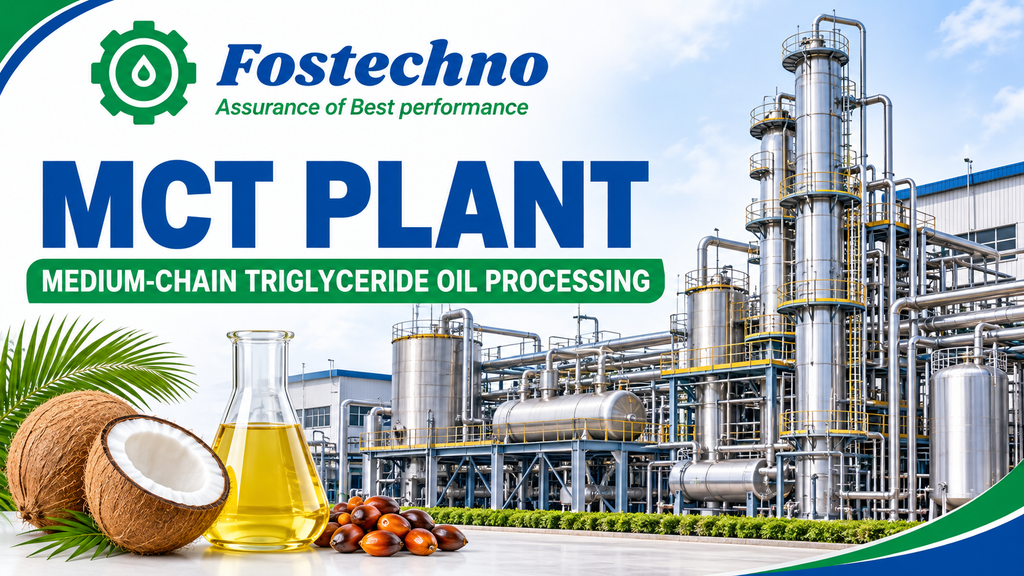
Only about one drop in ten of coconut oil can become MCT oil. How much of it you capture, and how pure it is, depends entirely on how well your plant is engineered.
From the Philippines to Poland and from Brazil to Bahrain, demand for clean, neutral MCT oil is global. This guide shows how a world-class MCT plant is designed, step by step.
By Fostechno Process Engineering Private Limited | Reading time: about 17 minutes
Quick Answer: What Is an MCT Plant?
An MCT plant is an industrial processing facility that converts coconut oil or palm kernel oil (PKO) into medium-chain triglycerides, an oil made almost entirely of caprylic acid (C8) and capric acid (C10). The plant splits the feedstock into fatty acids or methyl esters, separates the C8 and C10 fraction by vacuum fractional distillation, rebuilds it into triglycerides, and then refines it to a colourless, odourless, neutral-tasting oil. A well-designed line produces nutraceutical, food and pharma-grade MCT oil, and sells the leftover lauric fraction and glycerin as valuable by-products.
Key Takeaways
- Coconut oil and PKO contain only about 10 to 15 percent medium-chain fatty acids, so separation efficiency decides your yield and quality.
- There are two proven routes: the fatty acid route (hydrolysis) and the methyl ester route (methanolysis). The right one depends on your feedstock, capacity and by-product strategy.
- The heart of every MCT plant is a high-vacuum fractionation column. Column internals, vacuum quality and heat control matter more than the size of the tanks around it.
- By-product valorisation (lauric fraction, glycerin, methanol recovery) can add significant value to the overall project.
- Buyers should judge a supplier on process design, mass balance and commissioning support, not just on the equipment list.
1. What Does an MCT Plant Actually Do?
Medium-chain triglycerides are fats built on a glycerol backbone with fatty acids of 6 to 12 carbon atoms. In commercial practice, “MCT oil” usually means a blend of roughly 55 to 65 percent caprylic acid (C8) and 35 to 45 percent capric acid (C10), although other ratios (50:50, or pure C8) are sold for specific uses.
Nature does not hand you this oil ready-made. In coconut oil, C8 and C10 sit on the same triglyceride molecules as lauric acid (C12), myristic acid (C14) and longer chains. You cannot simply “filter” MCT out. You have to break the molecules apart, separate the chain lengths by boiling point, and then reassemble the chosen fractions. That is the job of an MCT plant, and it is why the technology sits between an edible oil refinery and an oleochemical plant.
2. Why MCT Plants Are Attracting Investment
Three demand streams are pulling capacity investment:
- Nutraceuticals and ketogenic nutrition. MCT oil is a mainstream ingredient in keto products, coffee creamers, powders and softgels.
- Clinical and infant nutrition. MCTs are absorbed without the full bile-acid and lymphatic pathway needed for long-chain fats, so they are used in medical foods and specialised formulas.
- Pharma and cosmetics. Neutral, stable and non-greasy, MCT is a favourite carrier oil and emollient.
There is a second advantage for producers anywhere in the tropical belt and beyond: coconut oil and PKO are traded worldwide, so a local MCT plant gives you control over feedstock, quality and delivery that importers of finished MCT do not have. If you already run an edible oil refinery, an oleochemical unit or a solvent extraction plant, MCT is one of the most logical value-added extensions.
3. Feedstock: What Goes Into the Plant
The quality of your MCT begins with the quality of your input oil. Typical approximate fatty acid ranges are:
| Fatty acid | Carbon chain | Coconut oil (approx.) | Palm kernel oil (approx.) |
|---|---|---|---|
| Caproic (C6) | C6 | 0.5 to 1% | Trace to 0.5% |
| Caprylic (C8) | C8 | 5 to 9% | 3 to 4% |
| Capric (C10) | C10 | 5 to 8% | 3 to 7% |
| Lauric (C12) | C12 | 45 to 52% | 45 to 55% |
| Myristic (C14) | C14 | 16 to 21% | 14 to 18% |
| Palmitic and longer | C16+ | Balance | Balance |
Values vary with origin and season, so a serious project begins with lab analysis of your actual oil. Three feedstock factors drive downstream cost:
- Free fatty acids and moisture. High FFA oil can be processed in the fatty acid route with little penalty, but raises catalyst and neutralisation load in the ester route.
- Colour bodies and metals. Phosphorus, iron and trace metals poison catalysts and foul heat-transfer surfaces.
- Contaminants. Mineral oil hydrocarbons (MOSH/MOAH), pesticide residues and 3-MCPD/glycidyl ester precursors are now checked by serious buyers. Good pre-treatment protects you from specification failures later.
Coconut oil gives a slightly better C8/C10 starting yield, while PKO is widely available from palm-producing regions such as Southeast Asia, West Africa and Latin America. A flexible plant is designed to accept both.
4. The Two Main Process Routes
Before you ask “what machines do I need”, ask “which chemistry will I run”. Fostechno engineers evaluate both routes for every enquiry.
Route A: The Fatty Acid Route (Hydrolysis)
The oil is split with water at high temperature and pressure into free fatty acids and sweet water (a glycerol solution). The mixed fatty acids are distilled, fractionated to isolate C8 and C10, and esterified with fresh glycerol to form MCT.
Strengths: Fatty acid distillation is a mature, robust technology; the lauric and long-chain fractions are valuable fatty acid products in their own right; no methanol is used, which simplifies hazardous-area design.
Considerations: Needs a fat splitting section and a sweet water evaporation system; high-pressure, high-temperature equipment is involved; corrosion-resistant metallurgy is important.
Route B: The Methyl Ester Route (Methanolysis)
The oil is reacted with methanol and a catalyst to produce fatty acid methyl esters (FAME) and crude glycerin. The methyl esters are fractionated under vacuum (they boil at lower temperatures than the free acids, so the column operates more gently), and the C8/C10 esters are then reacted with glycerol to build the triglyceride, releasing methanol that is recovered and reused.
Strengths: Lower distillation temperatures, good separation sharpness, and good suitability for larger capacities; the crude glycerin is a saleable co-product.
Considerations: Methanol handling and recovery require flameproof design and strict safety procedures; the plant has more reaction and recovery steps; catalyst and water control must be tight.
Which Route Should You Choose?
| Decision factor | Fatty acid route | Methyl ester route |
|---|---|---|
| Methanol on site | Not needed | Required, with recovery |
| Distillation temperature | Higher | Lower |
| Best fit | Existing oleochemical or fatty acid operations | Biodiesel or ester-chemistry operations; larger scale |
| By-products | Lauric fatty acids, glycerin | Lauric methyl ester, glycerin |
| Hazardous area burden | Moderate | Higher |
There is no universally “best” route. The right answer comes from your feedstock, existing utilities, local safety regulations, by-product markets and target capacity.
5. Step-by-Step: How an MCT Plant Works
Below is a practical walk-through of the fatty acid route, with notes where the ester route differs. Operating values are typical ranges for orientation. Final design values are fixed during detailed engineering.
Step 1: Feedstock Receiving and Storage
Coconut oil or PKO arrives by tanker or drums and is transferred to heated, insulated storage tanks. Coconut oil solidifies below roughly 24°C, so tracing and temperature control prevent solidification in pipelines. Nitrogen blanketing of storage tanks reduces oxidation.
Step 2: Pre-Treatment and Filtration
The oil is filtered to remove solids, dried under vacuum to remove moisture, and, where required, degummed or bleached to remove phospholipids, metals and colour. Clean feed is not a luxury. It protects reactors, catalysts and the expensive column packing downstream.
Step 3: Splitting (Hydrolysis) or Transesterification
In the fatty acid route, oil and water react at elevated temperature and pressure (typically in a continuous counter-current splitting column) to liberate fatty acids. The glycerol-rich water, called sweet water, is collected, purified and concentrated into crude glycerin. In the ester route, the oil is instead reacted with methanol and catalyst, then the glycerin phase is separated and the esters are washed and dried.
Step 4: Fatty Acid (or Ester) Pre-Distillation
The mixed fatty acids are flash distilled to remove light odour bodies, moisture, unsaponifiables and heavy residue (pitch). This protects the fractionation column from fouling and ensures the C8/C10 cut is clean.
Step 5: Fractional Distillation, the Heart of the Plant
This is where the separation actually happens. The feed enters a vacuum column fitted with structured packing, typically operating in the low single-digit millibar range of absolute pressure at the top. Light acids (C6, C8, C10) rise and are drawn off as the distillate, while lauric and longer acids leave as bottoms.
Three design choices decide your product quality and yield:
- Number of theoretical stages and reflux ratio. More stages and higher reflux sharpen the cut between C10 and C12, but demand more energy and a taller column.
- Pressure drop across packing. Low pressure drop keeps the bottom temperature down, which protects the product from thermal degradation.
- Residence time in the reboiler. Short residence time minimises colour and degradation, which is why falling-film or thin-film reboilers are preferred.
In many designs, a second column fine-tunes the C8:C10 ratio, or isolates pure C8 for premium grades.
Step 6: Re-Esterification to MCT
The purified C8/C10 fraction is reacted with glycerol, usually at around 200 to 240°C under vacuum, with continuous removal of reaction water so the reaction is driven to completion. The target is a product with very low free fatty acid content and minimal partial glycerides (mono- and diglycerides). In the ester route, the methyl esters undergo transesterification with glycerol while methanol is stripped off and recovered.
Step 7: Neutralisation, Bleaching and Polishing
Residual acidity and catalyst traces are removed. Light bleaching and polish filtration take out colour and fine particles. Good control at this step often decides whether your product passes a customer’s colour and clarity specifications on the first attempt.
Step 8: Deodorisation
The oil is steam-stripped under deep vacuum at elevated temperature to remove residual volatile compounds, odour and taste. The result is the neutral, colourless oil that the market expects. Because MCT is highly volatile compared with ordinary oils, deodoriser conditions are set carefully, otherwise you lose product in the vacuum system.
Step 9: Final Filtration, QC and Packing
The finished oil is cooled, polish filtered, tested for fatty acid profile, acid value, colour, moisture, peroxide value and other parameters, and packed under nitrogen where the customer requires it. Packing options range from drums and IBCs to bulk tankers and bottling lines.
Step 10: By-Product Recovery
This step is often ignored in competitor brochures, yet it affects profitability. Typical streams include:
- Lauric-rich fraction (C12 and above): Can be re-esterified into lauric oil, sold as fatty acids, or used in soaps, surfactants and personal care.
- Glycerin: Purified to technical or pharma grade.
- Methanol (ester route): Rectified and recycled.
- Pitch and residues: Used as fuel or sold to industrial users.
6. Main Equipment in an MCT Plant
| Section | Key equipment | Why it matters |
|---|---|---|
| Storage and pre-treatment | Heated tanks, filters, vacuum dryer, bleacher | Protects catalysts and columns from contaminants |
| Splitting or transesterification | Splitting column or reactors, sweet water or glycerin handling | Determines conversion and glycerin recovery |
| Pre-distillation | Flash distillation unit, vacuum system | Removes light and heavy impurities |
| Fractionation | Packed columns, reboilers, condensers, reflux system | Controls the C8/C10 cut and overall yield |
| Esterification | Agitated reactors, vacuum, heat exchangers | Builds triglycerides with low residual acidity |
| Refining | Neutraliser, bleacher, deodoriser, polish filters | Delivers colourless, odourless oil |
| Utilities | Boiler or thermic fluid heater, cooling tower, chillers, vacuum pumps, nitrogen, compressed air | Provide heat, cooling and deep vacuum reliably |
| Automation | PLC/SCADA, instrumentation, safety interlocks | Ensures repeatability and safety |
Material of construction: Wetted parts that contact hot fatty acids are typically SS316L or higher alloys because hot fatty acids are corrosive. Storage tanks and structural parts often use SS304. Material decisions should always be based on the actual temperature and acid load of each section.
7. Capacity, Yield and Mass Balance
The most common question buyers ask is, “How much MCT can I make from one tonne of coconut oil?” Because C8 and C10 together form roughly 10 to 15 percent of coconut oil, the theoretical maximum is correspondingly limited. After allowing for separation losses, esterification and refining losses, practical MCT yield from coconut oil typically lands in the range of about 9 to 13 percent by weight, depending on feedstock quality and column performance.
That means a plant processing 20 tonnes of coconut oil per day would make roughly 2 to 2.6 tonnes of MCT oil per day, along with several tonnes of lauric and long-chain fractions and about 9 to 10 percent glycerin on the oil basis. This is exactly why by-product marketing is built into good project planning.
We recommend sizing a plant around three numbers:
- Feedstock throughput (tonnes per day of coconut oil or PKO)
- Target MCT output (tonnes per day, and which grade)
- By-product plan (what happens to the other 85 to 90 percent of the oil)
Capacities can start from small pilot or batch-type units for product development and extend to continuous multi-tonne industrial plants. Modular design allows you to start with a smaller line and add capacity later.
8. Utilities, Layout and Site Planning
An MCT plant is utility-intensive. Planning these early prevents expensive redesign.
- Steam or thermic fluid: Needed for splitting, distillation reboilers and esterification. High-temperature heating (often 230 to 260°C) is easiest with a thermic fluid heater.
- Cooling water and chilled water: For condensers and vacuum system efficiency.
- Vacuum system: Usually multi-stage steam ejectors with liquid ring pumps, or dry vacuum pumps. Stable deep vacuum is the single biggest driver of column performance.
- Power and backup: Vacuum and heating failures during a batch can damage product, so critical loads should have backup.
- Effluent treatment: Sweet water, wash water and condensates need treatment before discharge.
- Nitrogen and compressed air: For inerting, instrumentation and packing.
Layout principles we follow: keep the hot distillation structure compact and vertical, separate the methanol (if used) and hazardous areas, provide drainage and containment for every liquid-handling zone, and leave room for future expansion and maintenance access. Many existing refinery sites can host an MCT section with good integration of boilers, cooling towers and effluent treatment.
9. Quality Standards and Compliance
Quality is where MCT businesses win or lose customers. Buyers typically look for:
- A defined C8/C10 composition, with low C6 and C12 as per grade
- Very low acid value and peroxide value
- Colour and clarity (a clear, water-white appearance)
- No odour or taste
- Low moisture and low residual solvents (especially methanol in the ester route)
- Heavy metals, pesticide and contaminant compliance
- Pharmacopoeial alignment where the oil is used in pharma (for example, the “Triglycerides, Medium-Chain” monographs in the major pharmacopoeias)
Beyond product specifications, your facility must meet the food-safety rules of every market you sell into: FDA registration and cGMP in the United States, EU food-safety and hygiene regulations in Europe, FSSAI in India, and the equivalent authorities in the Middle East, Africa, Asia-Pacific and Latin America. Most buyers also expect GMP/HACCP systems and often ISO 22000 or FSSC 22000 certification, and many ask for Halal and Kosher certificates. Pharma-oriented customers may add GMP-aligned documentation and full traceability. Designing the plant with sanitary welding, cleanable surfaces and batch traceability from day one is far easier than retrofitting later.
10. Safety and Environmental Considerations
- Hot oil and high-temperature equipment: Proper insulation, pressure relief and operator training are essential.
- Vacuum and oxygen ingress: Air leaks in hot oil systems can cause fires and product degradation, so leak testing and inerting procedures are important.
- Methanol (ester route): Flammable and toxic. Requires flameproof electricals, earthing, gas detection, and a strong management-of-change discipline.
- Wastewater: Sweet water and wash water have high organic load. Treatment must be planned within the project scope.
- Emissions and energy: Heat integration and condensate recovery reduce fuel use and your carbon footprint, which matters increasingly for export buyers.
A proper HAZOP review before finalising the design is a standard step in any serious engineering project.
11. A Global Industry: Where MCT Plants Are Built and Why
MCT production is no longer a regional niche. It follows a simple global pattern: feedstock comes from the tropics, and demand comes from everywhere.
- Coconut oil origins: the Philippines, Indonesia, India, Sri Lanka, Vietnam, the Pacific islands, Brazil and East Africa.
- Palm kernel oil origins: Malaysia, Indonesia, Thailand, Nigeria, Colombia and other palm-growing countries.
- Demand centres: North America, Europe, the Middle East, East and Southeast Asia, Australia and fast-growing markets in Africa and Latin America.
This means MCT plants make sense both at the source (close to feedstock) and near the market (close to formulators and brand owners). A producer in Southeast Asia can export bulk MCT worldwide, while a nutrition company in Europe or North America can secure supply and traceability by processing imported coconut oil or PKO locally.
Designing for Any Location
A plant that works well in one country must be adapted, not copied, for another. Engineers should account for:
- Climate: hot, humid sites need strong cooling and corrosion protection; cold sites need heat tracing on every line carrying coconut oil, which solidifies near 24°C.
- Utilities: local power reliability, water quality, fuel availability (gas, biomass, coal or electric heating) and cooling method.
- Codes and standards: pressure vessel, electrical, hazardous-area and fire codes differ by country, so the design must follow local law and recognised international standards.
- Market certificates: Halal, Kosher, non-GMO, organic or pharma documentation, depending on where the oil will be sold.
- Logistics: feedstock delivery, bulk or packed shipping, and spare parts access.
Practical tip: ask every supplier for a full mass and energy balance for your specific feedstock and location. A difference of even one or two percentage points in yield adds up across every batch you run.
12. Common Mistakes to Avoid When Setting Up an MCT Plant
- Buying equipment before choosing the process. Route selection should come first.
- Underestimating the vacuum system. Weak or unstable vacuum ruins separation and increases thermal damage.
- Ignoring by-product markets. Producing 10 percent MCT and having no plan for the remaining 90 percent creates storage and cash-flow problems.
- Skipping pilot trials. A small trial with your own feedstock can reveal colour, odour and yield issues before full-scale commitment.
- Choosing the wrong metallurgy. Hot fatty acids corrode inadequate steel quickly.
- No plan for quality documentation. Export customers expect batch records, certificates of analysis and traceability.
- Weak commissioning and training. Even excellent equipment underperforms in untrained hands.
- Not planning for expansion. Layout and utilities should allow future capacity doubling.
13. How to Choose an MCT Plant Supplier: A Buyer’s Checklist
Before signing a contract, ask these questions:
- Will you provide a detailed process flow diagram, P&IDs, and heat and mass balance for my feedstock?
- Which route do you recommend for my case, and why?
- What C8/C10 composition, acid value and colour will you guarantee, and how will performance be tested?
- What is the guaranteed yield and steam, power and cooling consumption per tonne?
- Who designs the fractionation column internals and vacuum system?
- What are the materials of construction for each section?
- Do you provide installation supervision, commissioning, operator training and spares?
- Can I see a reference plant or verified references?
- What safety studies (HAZOP, SIL assessment where relevant) are included?
A supplier who answers these clearly, with numbers and documents, is a partner. A supplier who only sends a brochure is a trader.
14. The Fostechno Approach: Process Engineering First
At Fostechno Process Engineering Private Limited, we build industrial process plants, and we treat every MCT project as an engineering problem before it becomes an equipment order. Our process can be applied at any location, because we design to the codes and standards of the country where the plant will operate. Our approach is simple:
- Feedstock and market study. We analyse your oil, your target grades and your by-product options before recommending a route.
- Process design and simulation. We prepare the flow diagrams, heat and mass balance, and equipment sizing based on your capacity and quality targets.
- Detailed engineering. Layout, P&IDs, piping, instrumentation, electrical and safety design are completed with constructability in mind.
- Fabrication and procurement. Equipment is built or sourced to agreed specifications, with inspection at each stage.
- Installation and commissioning. Our team supports erection, testing, start-up and performance trials.
- Training and after-sales support. We train your operators and remain available for troubleshooting, spares and future expansion.
We believe that a plant should be judged by what it produces on a normal Tuesday, six months after commissioning, not just on the day of the inauguration. That means designing for steady yield, easy maintenance and reliable day-to-day operation.
15. Frequently Asked Questions About MCT Plants
What is the raw material for an MCT plant?
The most common raw materials are refined, bleached and deodorised (RBD) coconut oil and palm kernel oil. Both contain caprylic and capric acids in useful quantities. Purified fatty acids or methyl esters from these oils can also be used as feed.
How is MCT oil made industrially?
The oil is split into fatty acids (or converted to methyl esters), the C8 and C10 fraction is separated by vacuum fractional distillation, and that fraction is re-esterified with glycerol to form triglycerides. The oil is then refined, deodorised and filtered to give a clear, neutral product.
How much MCT oil can I get from 1 tonne of coconut oil?
Because coconut oil contains only about 10 to 15 percent C8 and C10, practical yields typically fall in the range of roughly 90 to 130 kg of MCT per tonne, depending on feedstock quality and plant efficiency.
Is MCT oil the same as coconut oil?
No. Coconut oil is a mixture dominated by lauric acid (C12). MCT oil is a purified fraction containing mainly C8 and C10, which makes it liquid at room temperature, lighter, odourless and more stable in many formulations.
What is the difference between C8 and C10?
Caprylic acid (C8) has eight carbon atoms and is absorbed and metabolised very quickly, so it is favoured for premium ketogenic and clinical products. Capric acid (C10) has ten carbon atoms, is slightly slower to metabolise, and is widely used in standard MCT blends.
Can the same plant make both C8 and C8/C10 blends?
Yes. With a properly designed column train, a plant can deliver pure C8, pure C10 or any blend ratio. Additional columns or recycle streams improve flexibility.
Which is better, the fatty acid route or the methyl ester route?
Neither is universally better. The fatty acid route avoids methanol and suits oleochemical operations. The methyl ester route runs at lower distillation temperatures and often suits larger capacities. A feasibility study with your feedstock and utilities gives the right answer.
How long does it take to set up an MCT plant?
Timelines depend on capacity and site readiness, but a typical project moves through engineering, fabrication, installation and commissioning over many months. Approvals, civil work and utility readiness can extend this, so early planning matters.
Do I need a pilot trial before building a full plant?
We strongly recommend it where feedstock quality is variable or where the end product is for pharma or infant nutrition. A small trial verifies yield, colour, odour and stability before you commit capital.
What certifications does an MCT plant need?
Requirements depend on your market: FDA registration in the USA, EU food-safety regulations, FSSAI in India, or local authority approvals elsewhere, together with GMP and HACCP systems, and ISO 22000 or FSSC 22000 for food exports. Customers in pharma and infant nutrition may ask for additional audits and documentation.
Can I add an MCT plant to an existing edible oil refinery?
Yes, and it is often the most economical route. Existing storage, boilers, cooling towers, vacuum systems and effluent treatment can be shared, provided capacity is adequate.
What are the by-products of an MCT plant?
The main by-products are a lauric-rich fraction (C12 and longer), glycerin, and, in the methyl ester route, recovered methanol. Each can be sold or reused, which strongly improves project returns.
16. Conclusion: Build the Process Right, and the Product Follows
An MCT plant is not a single machine. It is a carefully balanced chain of splitting or esterification, vacuum distillation, re-esterification and refining, supported by robust utilities and disciplined quality control. The plants that earn consistently are those that start with the right route, design the fractionation and vacuum systems properly, plan for by-products, and train their people well.
If you are exploring an MCT oil project, whether as a new venture or as a value-added expansion of an existing refinery, our engineers are ready to help you evaluate the options with real numbers instead of generic promises.
Talk to Fostechno Process Engineering Private Limited
Share your feedstock, target capacity and product grade, and we will respond with a recommended route, a preliminary process flow and a project roadmap.
- Company: Fostechno Process Engineering Private Limited
- Phone / WhatsApp: +91 9696177472
- Email: info@fostechnos.com
- Website: fostechnos.com
Disclaimer: Yields, temperatures, pressures and compositions in this article are typical industry ranges for guidance only. Final values depend on feedstock, selected technology and detailed engineering.


Leave a Reply