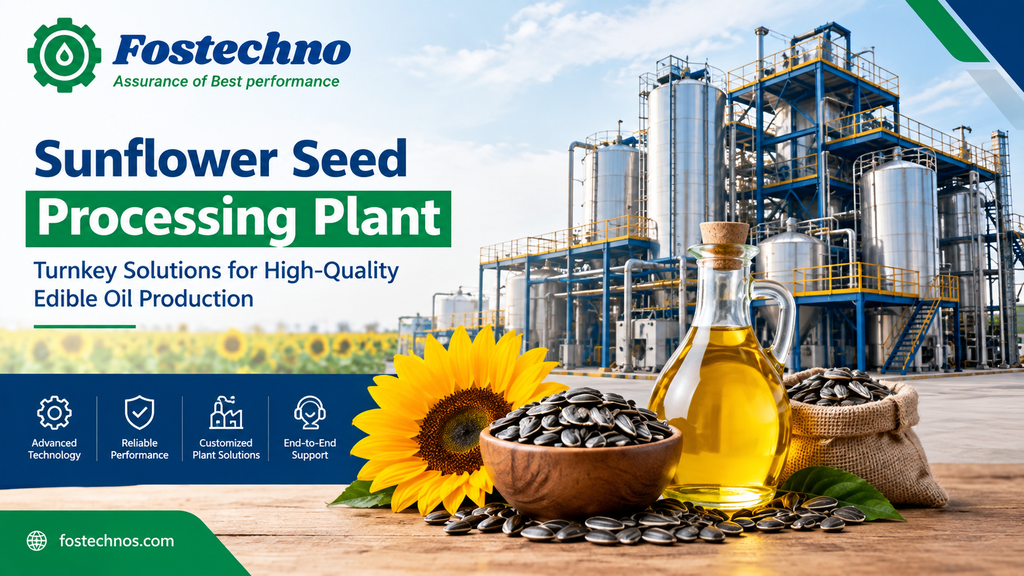
A sunflower seed processing plant is an industrial facility that converts raw sunflower seeds into finished products. Depending on its design, the output is crude or refined sunflower oil, high-protein sunflower meal, clean edible kernels for snacks and baking, or graded planting seed. Most oil plants follow the same core sequence: receiving, cleaning, dehulling, conditioning, extraction, filtration and refining.
The plant you need depends on the product you want. A cooking-oil plant, a confectionery kernel plant and a planting-seed plant share the word “sunflower” but are engineered very differently. This guide covers all three, with the most depth on the oil-crushing plant, because that is what most people mean by the term.
Key Takeaways
- Sunflower seed is hard to process. The hull is tough and the oil content is high, so soybean equipment does not transfer well.
- Cleaning and dehulling decide the quality of everything downstream: oil clarity, meal protein and equipment life.
- There are four common extraction routes: full pressing, pre-press plus solvent, pre-press with dehulling, and the expander route. The right one depends on capacity and end product.
- Refining (degumming, neutralization, bleaching, winterization, deodorization) turns crude oil into shelf-stable cooking oil.
- By-products such as meal, hulls, lecithin and soapstock are part of the plant’s design, not an afterthought.
1. What Is a Sunflower Seed Processing Plant?
A sunflower seed processing plant takes harvested seed, cleans it, separates the oil-rich kernel from the hull, and then either extracts the oil or packs the kernels or seed. The term covers three quite different facilities:
| Plant type | Main output | Core technology |
|---|---|---|
| Oil crushing plant | Crude/refined oil, sunflower meal | Cleaning, dehulling, conditioning, pressing, solvent extraction, refining |
| Confectionery kernel plant | Edible kernels for snacks and bakery | Size grading, impact dehulling, aspiration, gravity separation, optical sorting |
| Planting-seed plant | Graded, treated seed for farmers | Pre-cleaning, conditioning, sizing, colour sorting, seed treatment |
Even the oil-plant category has range. Small mills may only press and filter. Large industrial plants combine pre-pressing, solvent extraction and a full refinery. Capacity is the deciding factor, and we cover it in section 14.
2. Know Your Raw Material
Every design decision starts with what the seed looks like on arrival. Sunflower seed (Helianthus annuus) has features that make it different from other oilseeds.
Typical raw seed specifications (as quoted by extraction-plant manufacturers):
| Parameter | Typical range |
|---|---|
| Moisture | 8–9% |
| Impurities | up to about 2% |
| Hull content | 20–27% (some sources say up to 30%) |
| Oil content | 35–42% |
| Protein | 15–18% |
Two facts drive the engineering:
- High oil content. Sunflower seed commonly carries more than 40% oil, while soybeans average around 18%. Presses and preparation equipment must handle much more oil per tonne of feed.
- A tough, fibrous hull. The hull holds little oil but soaks some up during pressing, adds fibre to the meal and wears down equipment.
Seed variety matters too. Oil content varies with cultivar, soil and climate, and high-oleic hybrids are now common. A plant designed around one seed profile should be checked before switching to another, because moisture, hull ratio and oil content all change how the machines run.
3. The Process Flow at a Glance
A typical prepress-plus-solvent sunflower oil plant follows this order:
Receiving → Pre-cleaning and drying → Storage → Fine cleaning and magnetic separation → Cracking and dehulling → Hull separation → Conditioning/cooking → Flaking → Pre-pressing → Cake conditioning → Solvent extraction → Desolventizing and meal finishing → Crude oil filtration → Refining → Storage and packing
A small mechanical mill skips several of these steps. It cleans, conditions, presses, filters and stores. The sections below explain each stage and what it protects.
4. Stage 1: Receiving, Pre-Cleaning, Drying and Storage
The plant’s first job is to receive seed without damaging its quality. Trucks are weighed, sampled and inspected for moisture, foreign matter and oil content. Seed quality at intake strongly shapes how well the whole plant runs, so this is worth doing rigorously.
In a modern prepress-solvent plant, pre-cleaning and drying happen in the receiving section, before the seed goes into storage. That order is deliberate. Damp, dirty seed stores badly, heats up and degrades. Drying to a safe moisture level and removing coarse trash first protects the seed until it is crushed.
Good storage practice includes:
- Well-ventilated silos with temperature monitoring
- Moisture control to prevent mould and free fatty acid build-up
- Segregation of lots by quality or variety
- Pest and fire safeguards, since sunflower dust is combustible
5. Stage 2: Cleaning, Destoning and Magnetic Separation
Before seed reaches any expensive machinery, it is cleaned again to remove what pre-cleaning missed. Foreign matter such as sticks, stones, dust and stalks can damage equipment and contaminate both oil and meal.
Screen cleaners. Box-type or drum cleaners use multi-layer vibrating screens to remove both oversized and fine impurities. Some plants combine vibratory and rotary drum cleaners.
Destoners. Stones and dense material are separated by gravity or airflow. Even small stones can damage cracking rolls and expeller parts.
Magnetic separators. Rotary drum or permanent magnets remove iron and steel fragments. This protects downstream machinery and is also a food-safety step.
Cleaning performance is easy to overlook, but poor cleaning shows up later as accelerated wear, off-colour oil, higher fibre in meal and unplanned stoppages.
6. Stage 3: Cracking, Dehulling and Hull Separation
Dehulling is the step that most separates a well-run sunflower plant from an average one.
Why dehull?
Hulls make up roughly a fifth to nearly a third of the seed. Removing them:
- Reduces fibre and raises protein in the meal
- Lowers the amount of oil absorbed by hull material during pressing
- Improves extraction efficiency (one manufacturer reports a gain of 3–5% in extraction compared with whole-seed pressing)
- Produces a separate hull stream that can be used as fuel or feed material
Some plants deliberately press whole seed. Others dehull partially, depending on the protein specification for the meal. Whether to dehull, and how completely, is a design choice tied to what you sell.
How dehulling works
- Cracking. Seeds pass through cracking rolls, typically chilled cast-iron rolls with grooves sized for the seed. The goal is to break each seed into a small number of uniform pieces rather than crush it into fines.
- Hull removal. Twin-roll decorticators apply controlled impact and abrasion to separate hull from kernel. In kernel plants, centrifugal impact dehullers throw seed against an impact ring instead.
- Aspiration. Air removes the lightweight hull fragments.
- Density separation. Separators sort hulls, kernels and uncracked seed by density.
- Hull purification and recycling. Kernel fragments carried in the hull stream are recovered, which reduces oil loss. Uncracked seed is returned to the cracker.
Uniform seed size makes cracking far more consistent. That is why some plants add size grading before dehulling. Accurate roll settings prevent two opposite problems: under-cracking, which leaves seed intact, and over-cracking, which creates fines that clog screens and lose oil to the hull stream.
7. Stage 4: Conditioning and Flaking
After dehulling, the kernel pieces (often called “meats”) need preparation before pressing.
Conditioning (cooking)
Kernels are heated in a steam-jacketed cooker, often with a small amount of live steam. Conditioning does several jobs at once:
- Softens the kernel structure and lowers oil viscosity so it flows freely
- Brings moisture and temperature to a consistent, optimal level
- Denatures proteins and deactivates fat-splitting enzymes
- Helps rupture oil-bearing cells
Consistent output temperature and moisture matter more than any single setting. Variation here shows up directly in press performance and oil quality.
Flaking
In plants that use flakes, kernels pass between smooth, chilled rolls under hydraulic pressure. Typical flake thickness is around 0.35 mm. Thin flakes have a much larger surface area, so oil is released more easily in the press or in the solvent extractor.
8. Stage 5: Oil Extraction Routes
This is the heart of the plant. Sunflower oil is recovered by pressing, by solvent extraction, or by a combination. Research on industrial practice describes two main strategies: hard pressing, which historically recovered around a quarter of the seed’s oil content, and prepress solvent extraction, which recovers over 40% of the seed weight as oil in modern plants (meaning nearly all the oil).
Manufacturers describe four common flow routes:
| Route | Steps | What it delivers |
|---|---|---|
| 1. Full press, no dehulling | Clean → magnetic → condition → press → size | Drains about 30–35% oil from the seed, leaving about 6–7% residual oil in cake |
| 2. Press with dehulling | Clean → magnetic → crack → dehull → condition → press → size | Similar oil recovery with higher-protein, lower-fibre cake |
| 3. Prepress + solvent | Clean → magnetic → crack → dehull → condition → flake → prepress → size → cool | Prepress removes over half the oil; cake with roughly 18–20% oil goes to the extractor |
| 4. Expander route | Clean → magnetic → crack → dehull → condition → flake → expander → dry/cool | Flakes become porous collets that go straight to solvent extraction |
Mechanical pressing
A screw press (expeller) squeezes oil from conditioned material. It generates heat and pressure as the screw compresses the feed against a barrel. A pre-press typically removes more than half the oil and leaves a cake that is then solvent extracted. A full press aims to recover as much as possible mechanically. Pressed cake typically leaves the press at high temperature and must be cooled before further handling.
Extruders in front of presses. Some mechanical plants add a high-shear dry extruder ahead of the press. It ruptures oil cells, pre-presses some oil, and prepares the material so the press can work harder. One documented 50-tonne-per-day sunflower plant in Wyoming, using a conditioner, extruder and screw press, reports meal residual oil of about 6–8% and energy use below 75 kWh per tonne of seed. Suppliers of this configuration also say it extends press wear-part life. It is a useful example of how a well-matched mechanical plant can produce both oil and a marketable expeller-pressed meal without solvent.
Expander technology
In the expander route, conditioned flakes are heated (around 85°C), squeezed and forced through a die or hydraulic system. The output is called collets: porous pellets that release a quarter or so of their oil during expansion and then extract very efficiently. Collets leave the expander hot and moist, so a dryer-cooler brings them to roughly 55°C and 8–9% moisture, the range solvent extractors typically accept.
Cooling and sizing
Pre-press cake is cooled (around 55°C) and broken into pieces of roughly 2 to 3 inches. Correct sizing improves solvent percolation through the bed by reducing voids and giving the solvent an even path.
Cold pressing versus hot pressing
Cold pressing preserves more natural flavour and nutrients but yields less oil and is often chosen for specialty or organic oil. Hot pressing (with conditioning) yields more oil and is the norm for industrial plants.
9. Solvent Extraction Explained
Solvent extraction recovers the oil that pressing leaves behind. Food-grade hexane is the industry-standard solvent.
How it works:
- Pre-press cake or expander collets are conveyed into a deep-bed extractor through a sealed feed.
- Fresh solvent is sprayed counter-currently over the moving bed, so the material meets the cleanest solvent last.
- The solvent-and-oil mixture, called miscella, is collected and filtered.
- The de-oiled solids leave the extractor carrying solvent and go through a leak-proof conveyor to the desolventizer-toaster.
- Miscella distillation separates the oil from the solvent, which is condensed and recycled.
- A recuperation unit (absorption and desorption) captures the last traces of solvent from vents so losses stay minimal.
Desolventizer-toaster (DT). Here, steam drives off the solvent from the meal and gently toasts it, improving palatability and nutritional value. The meal is then dried, cooled and ground to specification. Any lumps are screened out, ground again and returned to the stream.
Typical outputs from the extraction section:
- De-oiled meal: about 1% residual oil or less, moisture around 9–10%, protein around 33–35% (higher with thorough dehulling), and low residual solvent after cooling
- Crude oil: free fatty acid up to about 2%, phosphorus roughly 400–600 ppm, and natural waxes around 1,500 ppm
Those wax and phospholipid levels explain why sunflower oil refining includes both degumming and dewaxing. Solvent extraction is generally used in larger plants, where it reaches recovery rates in the mid-to-high 90% range of available oil.
10. Crude Oil Filtration and Refining
Crude oil leaving the press or extractor is not ready for the table. It carries fine solids, phospholipids, free fatty acids, pigments, waxes and odour compounds.
Crude oil filtration
Sunflower oil first passes through settling or vibratory screens to remove coarse solids. A pressure leaf filter or plate filter then removes fine particles. Press “foots” (fine solids) are recovered and returned for pressing. Multi-stage filtration protects the refinery and improves refining yield.
The refining sequence
| Stage | What it removes | How it works |
|---|---|---|
| Degumming | Phospholipids (gums) | Water or acid treatment separates the gums that would cause cloudiness and instability |
| Neutralization | Free fatty acids | Alkali (caustic) reacts with FFA to form soapstock, which is separated. Physical refining is an alternative route in some plants |
| Bleaching | Colour pigments (chlorophyll, carotenoids), trace metals, soaps | Activated bleaching earth or carbon adsorbs pigments, then the oil is filtered |
| Winterization (dewaxing) | Natural seed waxes | Oil is chilled so waxes crystallize, then filtered out. This keeps the oil clear in a cool kitchen or refrigerator |
| Deodorization | Odour and volatile compounds, residual FFA | High-temperature steam stripping under deep vacuum gives a neutral taste and smell |
| Polish filtration | Final trace particles | An ultra-fine filter gives sparkling clarity before packing |
Manufacturers offer both batch and continuous refinery layouts. Batch systems suit smaller volumes and flexibility. Continuous systems suit large, steady-throughput plants. A full refining pass commonly takes a few hours from crude oil to finished oil, depending on the layout.
Refined oil quality indicators
Buyers and regulators check a set of parameters. Supplier-quoted benchmarks for premium refined sunflower oil include very low free fatty acid (in the hundredths of a percent), minimal moisture and impurities, light colour, a low cloud point and a very low peroxide value. Always confirm target specifications against the standard that applies in your market, such as Codex Alimentarius or your national food authority.
Bottling
After refining, oil is stored in nitrogen-blanketed tanks, then filled, capped, labelled and packed on automatic lines. Clean fill, oxygen control and light-protective packaging preserve shelf life.
11. By-Products: What Else a Sunflower Plant Produces
A well-designed sunflower plant is a multi-product operation. The main streams are:
- Sunflower meal or cake. A protein and fibre feed ingredient for cattle, poultry and other livestock. Meal typically runs 25–35% protein, and can reach 35–40% with thorough dehulling. Sunflower is a well-established regional feed source in oilseed-growing areas.
- Hulls. A biomass fuel for boilers, heating and power generation, or a feed fibre source. Many plants burn hulls to raise the process steam they need, which closes part of the energy loop.
- Lecithin. Recovered from degumming, it serves as a natural emulsifier in food, cosmetics and pharmaceutical uses.
- Soapstock and fatty acids. Refinery by-products used in oleochemicals, soap, animal feed and biodiesel.
- Wax. Recovered from winterization and used in specialty applications.
Planning for these streams early means the plant has the right storage, handling, drying and packing equipment on day one.
12. Sunflower Kernel (Confectionery) Processing Plants
Not every sunflower plant makes oil. Snack, bakery and cereal producers need clean, whole, light-coloured kernels. That requires a different line, built for gentle handling and precision sorting rather than maximum extraction.
Typical kernel-plant sequence:
- Pre-cleaning and destoning. Multi-layer vibrating screens and gravity destoners remove trash and stones.
- Size grading. Rotary or flat screens sort seed into several narrow size bands (commonly three to five). Dehullers work best with seed of very uniform size, and this step is essential to avoid crushing kernels.
- Impact dehulling. Seed is accelerated against an impact surface and cracks along the hull without breaking the kernel.
- Aspiration. Air lifts away the light hulls.
- Gravity separation and recycling. Uncracked seed is separated and sent back through the dehuller in a closed loop.
- Optical colour sorting. Cameras and air jets reject discoloured, damaged or foreign kernels to a very high purity.
- Roasting, salting or packing depending on the finished product.
In this plant, kernel breakage, colour, purity and microbiological safety are the key performance indicators, and food-safety controls (metal detection, allergen management, traceability) are central.
13. Sunflower Planting-Seed Processing Plants
A third type serves seed companies, not food producers. Its job is to prepare high-quality seed for sowing. A modern line can include:
- Receiving with belt conveyors and a pre-cleaner
- Bulk storage and gentle conveying (such as Z-elevators) to avoid seed damage
- A conditioning line with fine cleaners, sizers, graders and colour sorters
- Seed treatment equipment that applies liquid or powder dressing
- Big-bag or bag filling
- Dust filtration systems with proper waste handling
Here the priorities are germination, genetic purity and gentle handling, with automated controls that record batch data. The equipment overlaps with oil-plant cleaning but the philosophy is different, so keep the two designs separate when planning.
14. Capacity Classes and Choosing a Configuration
Sunflower plants are typically described by tonnes of seed processed per day (TPD). Manufacturers commonly group them as follows:
| Capacity | Typical use | Typical configuration |
|---|---|---|
| 5–10 TPD | Local mills, cooperatives, pilot projects | Cleaning, pressing and filtration |
| 20–50 TPD | Regional commercial mills | Pressing with refining |
| 100–200 TPD | Industrial, export-oriented | Prepress, solvent extraction and refining |
| 300–500 TPD | Large industrial complexes | Full turnkey plant |
| 500–1,000+ TPD | Very large plants | Fully automated lines |
How to choose the right route:
- Small volume, local market, specialty oil: mechanical pressing with filtration. Add a batch refinery if you need refined oil.
- Medium volume with a quality meal market: press with dehulling, and consider an extruder-press configuration.
- Large volume, maximum oil recovery: prepress plus solvent extraction, or the expander route, with a continuous refinery.
- Premium snack or bakery market: a dedicated kernel plant with optical sorting.
Ask five questions before selecting anything:
- What are the final products (crude oil, refined oil, bottled oil, meal, kernels)?
- What seed variety and quality will arrive, and how consistent is supply across the season?
- What protein specification does the meal market require?
- What utilities are available (steam, power, water, effluent treatment)?
- What environmental and safety rules apply where the plant will stand?
15. Design, Safety and Sustainability
Layout and flow
Arrange the plant so material moves in a logical, one-directional line: intake, cleaning, preparation, extraction, refining, packing. Keep hull, meal and dust handling away from finished-oil areas. Leave room for future expansion. Several plants are designed so capacity can be added later without rebuilding the front end.
Dust control
Sunflower dust and hull fines are combustible. Preparation areas need dust collection, good housekeeping, explosion venting or suppression where required, and regular cleaning routines. The seed preparation and meal-sizing areas are where dust is most likely to occur.
Solvent safety
Hexane is flammable, so solvent extraction sections need hazardous-area zoning, certified electrical equipment, gas detection, solvent-tight conveyors, controlled ventilation and strict operating procedures. Solvent recovery is a safety issue as well as an efficiency one, since it minimises releases.
Utilities
Sunflower plants depend on reliable steam (for conditioning, desolventizing and deodorization), electricity, cooling water, compressed air and vacuum. A boiler that burns sunflower hulls is a common and practical way to supply steam.
Automation
PLC/SCADA control gives stable temperatures, moisture and flow rates, which improves oil quality and protects equipment. It also creates the batch records that food-safety audits ask for.
Sustainability
Good practice includes recovering and reusing solvent, using hulls as renewable fuel, recycling heat, treating effluent, and capturing dust. Researchers are also studying greener solvents and technologies such as pulsed electric field treatment to raise oil recovery, though hexane remains dominant industrially.
16. Quality Control Checkpoints
Quality is built in at every stage, not just checked at the end:
| Stage | What to check |
|---|---|
| Intake | Moisture, impurities, oil content, foreign seed, off-odour |
| After cleaning | Residual trash, stone and metal |
| After dehulling | Hull content in kernels, kernel content in hulls, cracking uniformity |
| Conditioning | Temperature and moisture at discharge |
| Flakes/cake | Thickness, fines, temperature, residual oil |
| Solvent section | Solvent loss, residual oil in meal, meal moisture and protein, residual solvent |
| Crude oil | FFA, moisture and impurities, phosphorus, waxes, peroxide value |
| Refined oil | FFA, colour, peroxide value, cloud point, clarity, flavour |
| Packed product | Fill volume, seal, code, batch traceability |
Regular sampling, calibrated instruments and documented corrective actions are the backbone of a plant that passes audits and keeps customers.
17. Common Mistakes to Avoid
- Skipping proper cleaning. Stones, metal and trash are the cheapest problems to prevent and the most expensive to repair.
- Ignoring seed size variation. Poorly graded seed leads to inconsistent cracking and more fines.
- Over-drying or over-cooking. Excess heat darkens the oil, damages protein and raises oil oxidation.
- Neglecting hull separation. Hulls left in the feed stream raise fibre, lower protein and cut extraction efficiency.
- Under-designing dust and solvent safety. These are the highest-consequence risks in the plant.
- Choosing the process before defining the product. Decide what you sell first, then pick the route.
- Forgetting by-product handling. Meal, hulls and soapstock all need somewhere to go.
- Treating refining as an afterthought. Sunflower’s phospholipids and waxes need proper degumming and dewaxing to produce clear, stable oil.
18. Frequently Asked Questions
What is a sunflower seed processing plant?
It is an industrial facility that cleans, dehulls and processes sunflower seed into oil, meal, edible kernels or planting seed. Oil plants add pressing or solvent extraction and, usually, a refinery.
What are the main stages of sunflower oil production?
The main stages are receiving and storage, cleaning, dehulling, conditioning, flaking, pressing, solvent extraction, filtration, refining (degumming, neutralization, bleaching, winterization, deodorization) and packing.
Why is dehulling important in sunflower processing?
Hulls add fibre, absorb oil and wear equipment. Removing them improves extraction efficiency, raises meal protein and produces a separate hull stream that can be used as fuel or feed.
How much oil does sunflower seed contain?
Most commercial sunflower seed contains roughly 35–42% oil by weight. Some high-oil hybrids exceed 40%. That is more than double the oil content of soybeans.
What is the difference between pressing and solvent extraction?
Pressing squeezes oil out mechanically and leaves several percent oil in the cake. Solvent extraction uses hexane to dissolve the remaining oil, reducing meal residual oil to about 1% or less. Many large plants use both: prepress first, then solvent.
What is winterization in sunflower oil refining?
Winterization, also called dewaxing, chills the oil so natural waxes crystallize, and then filters them out. It stops the oil turning cloudy at cool temperatures.
What are the by-products of sunflower oil processing?
The main by-products are sunflower meal (feed), hulls (fuel or feed fibre), lecithin, soapstock or fatty acids, and wax.
What is the difference between a sunflower oil plant and a sunflower kernel plant?
An oil plant is designed to extract as much oil as possible and produce meal. A kernel plant is designed to produce whole, clean, graded kernels for snacks and baking, using size grading, gentle impact dehulling and optical sorting.
What size are sunflower processing plants?
They range from small mills of 5–10 tonnes of seed per day to industrial plants of 500 to 1,000 tonnes per day or more. Larger plants usually use solvent extraction and continuous refining.
Can a sunflower plant process other seeds?
Many plants can with adjustments. Some mechanical plants can also crush flax, canola and other oil-rich seeds. Preparation equipment such as cracking rolls and decorticators usually needs to be resized or reconfigured for different seeds.
How long does refining sunflower oil take?
Depending on the refinery type and size, the refining pass takes from a couple of hours to several hours. Continuous refineries run steadily and batch refineries process in lots.
How do I choose the right sunflower processing plant?
Start with your final products, seed supply, target meal protein, available utilities and local regulations. Then match those to a capacity class and an extraction route, and confirm performance guarantees with your equipment supplier.
Conclusion
A sunflower seed processing plant is more than a set of machines. It is a chain of linked decisions that begins at the weighbridge and ends in a bottle, a bag of meal or a pack of kernels. Cleaning protects the equipment, dehulling lifts quality and yield, careful conditioning prepares the seed, the extraction route sets the oil recovery, and refining delivers the clear, stable oil consumers expect. Treat by-products, safety and quality control as part of the design from the start, and you get a plant that runs steadily and meets its specifications.
Define your product, understand your seed, and pick the process that fits both. Then plan for dust, solvent safety and utilities as carefully as you plan the machines.



Leave a Reply