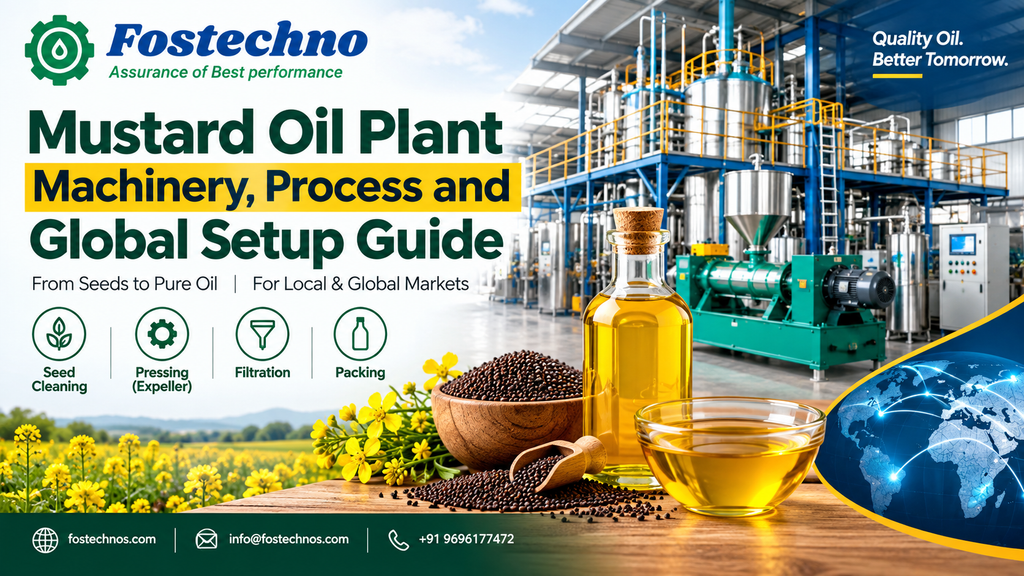
A bottle of mustard oil can travel a long way. It’s pressed in a small mill near the fields, poured into a pickle jar in a home kitchen, sold in a South Asian grocery in Toronto or London, and used as a massage oil by someone who has never cooked with it. Few oils cross cultures like this, and few are judged as sharply. People smell it, taste it, and know at once when something is off.
That makes a mustard oil plant an interesting project anywhere in the world. It also makes it an easy one to get wrong. Seed choice, expeller design, filtration and, above all, the rules of the market you plan to sell into all shape the result.
This guide covers what a mustard oil plant is, the machines it needs, how the process works, what drives yield and quality, and which regulations and certifications matter across different countries. It draws on a government-backed project report, technical pages from leading equipment manufacturers, and current food-safety information.
Quick Answer: What Is a Mustard Oil Plant?
A mustard oil plant is a processing facility that cleans mustard seed, conditions it, presses it in a screw expeller to extract crude oil, filters the oil and packs it for sale. The pressed cake left behind is sold separately, mainly as animal feed.
The core line has four stages: seed cleaning, pressing, filtration and filling. A compact unit crushing about 150 kg of seed per hour can fit in 1,500 to 2,000 sq ft and run on around 12 kW of connected power. Larger plants add conveyors, more pressing capacity, storage tanks, automation and, later, refining.
What Is a Mustard Oil Plant, Exactly?
Think of it as a short, tightly controlled production line with four jobs:
- Remove everything that isn’t seed.
- Condition the seed so it presses well.
- Squeeze the oil out mechanically.
- Clean, store and pack the oil.
Mustard seed is rich in oil. Manufacturers quote anywhere from about 38% to 45%, and some seed reaches 46–48% oil. Even with several pressing stages, some oil stays in the cake, commonly 6.5% to 8% according to different manufacturers. That residual figure matters more than most first-time buyers realise, and we’ll come back to it. Wikipedia
Pressed Mustard Oil vs Mustard Essential Oil
The words “mustard oil” cover two very different products, and confusing them is a classic mistake in export documents.
Pressed (expressed) mustard oil is the golden, pungent oil squeezed mechanically from the seed. This is what a mustard oil plant makes.
Mustard essential oil is a different product. It is made by steam distilling the seeds, and it’s used in tiny amounts as a flavouring. It needs different equipment and follows different rules. Mashed
Everything in this guide is about pressed mustard oil.
Kachi Ghani, Cold Pressed and Refined: What’s the Difference?
Kachi ghani is the traditional South Asian name for mustard oil that is pressed and filtered but not chemically refined. Outside South Asia you’ll see it sold as “cold pressed” or “expeller pressed”. It keeps the sharp, pungent aroma that its buyers want.
Refined mustard oil goes through extra steps such as degumming, neutralising, bleaching and deodorising. This removes much of the pungency and colour.
Most new plants start with kachi ghani or cold-pressed oil. The machinery is simpler, and the flavour is the selling point. Refining is usually added later, so a good layout leaves room for it.
Where Does Mustard Oil Sell? Global Demand at a Glance
Mustard oil doesn’t have one global market. It has several, and each one wants something different.
South Asian cooking. Mustard oil is a staple for frying, tempering and pickling across India, Bangladesh, Nepal and Pakistan. Many countries in the region still rely on it for frying, seasoning and pickling. Anderson International Corp
Diaspora and specialty food shops. Communities from South Asia have made mustard oil a familiar item in ethnic groceries around the world. In some countries it can only be sold with specific labelling (more on that below).
Massage and personal care. Restrictions on food use pushed mustard oil into skin and hair care formulations. Traditional body and hair oils are a real category in their own right. Anderson International Corp
Industrial and other uses. Depending on the grade, pressed mustard oil can also go into products beyond food.
By-products. Mustard cake is used as cattle feed and fertiliser. Some solvent extraction plants also buy the cake to recover the remaining oil.
Before you plan capacity, decide which of these markets you’re building for. It changes your seed choice, your quality targets, your packaging and your paperwork.
Mustard Oil Rules Around the World: Check Your Market First
This is the part many equipment brochures skip. Pressed mustard oil is treated very differently from country to country, mainly because of erucic acid, a fatty acid found in mustard and rapeseed. Natural forms of rapeseed and mustard can contain over 40% erucic acid in their fatty acids. Regulators disagree about how much of it is acceptable. europa
United States. Pressed mustard oil is not approved for sale as a cooking oil, and bottles on sale carry an “external use only” label. The FDA has approved one brand of edible mustard oil made from a cultivar bred for low erucic acid. Steam-distilled essential oil is treated separately. LegalClarityAnderson International Corp
European Union. The EU has set maximum limits for erucic acid in vegetable oils and fats since 1976. Rules on mustard-specific products have been updated since then, so check the current regulation with your importer. europa
Australia, New Zealand and others. Australia, New Zealand and many EU countries have set upper limits on tolerable intake of mustard oil. Medical News Today
South Asia. Mustard oil is a mainstream cooking oil, and each country sets its own standards. India, for example, has banned blended mustard oil since June 2021, so oil sold under that name must be pure. ForumIAS
What does this mean for a plant builder?
- Decide your market before you decide your machines. An edible-oil plant, a cosmetic-grade plant and an export plant may need different seed, documentation and packing.
- Consider low-erucic seed if you’re aiming at markets with strict limits. As one example, Canadian researchers developed low-erucic rapeseed in the 1950s, which became canola. Anderson International Corp
- Label honestly. Sell the product for the use the market allows, with the wording the local authority requires.
- Talk to your importer or local food authority early. Rules change, and this guide can’t replace current local advice.
Sourcing Mustard Seed Worldwide
Seed quality decides oil quality, so it’s worth understanding where seed comes from.
Mustard is grown across Asia, Europe and North America. Looking at FAO figures for mustard seed, Nepal ranked first in 2021, followed by Russia and Canada, and other significant producers include Myanmar, Ukraine, the United States, China and Kazakhstan. Rankings differ by source and by year, and much of the oilseed-type mustard grown in South Asia is often reported together with rapeseed, so treat any single list as a guide, not a rule. Helgi Library
Species and colour matter more to your oil than the country of origin:
- Brown, black or “Indian” mustard (Brassica juncea) gives the sharp, intense flavour that pungent mustard oil is known for. Seeds of this type are sharper than those of yellow mustard. Food Republic
- Yellow or white mustard (Sinapis alba) is the mildest type. It is usually chosen for milder condiment mustards. It’s less common for pungent pressed oil. Food Republic
Harvest timing also varies by region. South Asian mustard is a spring-harvested crop, while in the northern regions of Canada and Russia harvest falls in late summer. If you’re buying across regions, plan storage around when seed arrives.
Simple seed checks before you buy:
- Moisture content (around 8% or lower is a common storage target)
- Foreign matter, broken seed and weed seed
- Smell (musty or heated seed is a red flag)
- Variety and origin, in writing
- Traceability, so you can identify the lot if a problem appears later
Mustard Oil Plant Capacity: Which Size Is Right for You?
Capacity is the first big decision, and it shapes everything from the expeller you choose to the floor space you need.
| Scale | Seed capacity | Who it suits | What the setup usually includes |
|---|---|---|---|
| Mini / micro | 100–250 kg per hour (about 1–2 TPD) | First-time processors, local brands, custom milling for farmers | One expeller, kettle, filter press, basic handling |
| Small | Up to 5 TPD | Regional brands with own packing | Cleaner, conditioning, one or more expellers, filtration, storage, filling |
| Medium | 10–20 TPD | Established traders, cooperatives, export-oriented units | Automated cleaning and conveying, multiple expellers, vibro separator, filter presses, packing line |
| Large | 50 TPD and above | Industrial processors, often with refining | Fully automatic turnkey line |
One manufacturer lists small expellers rated from 1.4 to 20 tons per day, auto-temperature expellers from 1.4 to 12 tons per day, and multi-function expellers with built-in filter presses from 3.5 to 12 tons per day. That gives you a sense of how many options exist before you need an industrial line.
A useful rule: size the plant to your reliable seed supply and your target market, not to your ambition. A plant that runs steadily at moderate capacity beats one that sits half-idle. Small plants also have a natural advantage, since they can work on a custom-milling basis for local farmers and seed traders who bring their own seed.
Machinery Required for a Mustard Oil Plant
Here is what a properly equipped mustard oil plant needs, in process order.
Seed Cleaner
Mustard seed arrives with dust, stones, mud, leaves and weed seed. A seed cleaner, either a rotary type or a multi-deck vibrating sieve with aspiration and a dust collection box, removes these before the seed touches the expeller. Skip this and you’ll pay for it in worn expeller parts and dark, gritty oil.
Destoner
Stones are the silent killer of expeller worms. A destoner removes the heavy particles a sieve misses. Plants that skip it usually end up replacing worm shafts sooner than expected.
Cooker or Conditioning Kettle
Before pressing, seed is warmed and conditioned. Heating improves the amount of oil recovered and also improves the protein quality of the cake. Kettles are usually round, heavy-duty and mounted above or beside the expeller. If you condition with steam, you’ll also need a boiler or thermic fluid heater.
Mustard Oil Expeller Machine
This is the heart of the plant. Seed is pushed through a barrel by a rotating screw. Pressure builds, oil squeezes out through slots in the cage, and dry cake leaves at the far end. Expellers come in three practical types:
- Single-screw expellers are simple, sturdy and widely serviced. Good for mini and small plants.
- Auto-temperature expellers have an electrical control cabinet that regulates pressing temperature and seed moisture, which supports consistent yield.
- Multi-stage or cold-press expellers press the seed more than once and are built to run cooler, which keeps more pungency. Some designs use four pressing stages, others go up to six.
A published reference design for a compact plant uses a heavy-duty expeller with a 30″ × 5.5″ chamber, up to 250 kg per hour crushing capacity and a 20 HP motor. Whatever you choose, match it to your seed supply. An oversized machine running half-empty wastes power and hurts yield.
Oil Filtration Equipment
Freshly pressed oil carries fine particles called foots. To remove them, plants use a combination of:
- Vibro separator: a first, coarse screening of the crude oil, often mounted overhead so oil drains by gravity.
- Plate-and-frame filter press: the workhorse for clarity. Plates may be cast iron, stainless steel or polypropylene, and hydraulic pull-back systems make cleaning easier.
- Polish filter: a final micron-level pass that gives the oil its bright, clean look on the shelf.
Good filtration is what separates a shelf-ready product from a cloudy bulk one.
Bucket Elevator and Screw Conveyor
Beyond a mini unit, you don’t want workers carrying sacks between stages. Bucket elevators lift seed. Screw conveyors move seed and cake horizontally. Chain and belt types are available in mild steel or stainless steel. They reduce labour and spillage and keep the line running steadily.
Storage Tanks, Pumps and Pipelines
Oil should be held in food-grade stainless steel tanks with transfer pumps and pipework. Settling tanks give suspended particles time to drop out before final filtration. Keep tanks covered, clean and easy to drain fully.
Filling and Packing Machines
A volumetric filling machine measures each bottle, pouch or tin accurately. Accurate filling keeps your product consistent and helps you meet packaged-goods rules in your market. Depending on the market, you may add capping, sealing and labelling, bag filling or a jar filler for larger containers.
Control Panel and Electricals
A centralised panel with start/stop controls, motor protection, status lamps and alarms keeps operations safe and tidy. A compact plant typically draws about 12 kW. Where the grid is unreliable, some small plants run on a diesel generator.
How Does a Mustard Oil Plant Work? The Process, Step by Step
Step 1: Receive and dry the seed. Check moisture, foreign matter and smell before accepting any lot. Moisture spoils oil, so store seed dry, off the floor, and away from damp walls.
Step 2: Clean and de-stone. Sieves, aspiration and the destoner take out everything that isn’t seed. Clean seed gives clearer oil and longer machine life.
Step 3: Condition the seed. Seed is warmed in a kettle so oil flows more freely from the cells. This is where “cold pressed” often gets misunderstood. Some plants press with little or no added heat to protect flavour. Others condition gently to lift yield. Be clear about your approach, because it affects both taste and how you can honestly describe the oil on the label.
Step 4: Press. The expeller squeezes out crude oil and pushes out cake. Multi-stage pressing recovers more oil, and a well-tuned machine leaves roughly 7 to 8% oil in the cake. Watch the cake: it should come out firm, uniform and not burnt.
Step 5: Settle and filter. Crude oil flows to a holding tank, passes over a vibro screen to remove foots, then goes through a filter press and ideally a polish filter. The foots you collect can be pressed again.
Step 6: Store. Filtered oil rests in stainless steel tanks until it’s packed. Keep it away from heat and direct sunlight.
Step 7: Fill, seal and label. Bottles, pouches, jars or drums are filled by volume, sealed and labelled according to your target market’s rules.
Step 8: Handle the cake. Mustard cake is a genuine second product. Store it dry so it doesn’t spoil, and sell it as animal feed or to a solvent extraction plant, depending on local demand.
Cold Pressed, Expeller or Chillex: What’s the Difference?
People use these words loosely, so here is the plain version.
Expeller pressing uses a screw press and is the general mechanical method. Some heat is produced by friction and by conditioning.
Cold-press expellers are designed to run under controlled, cooler conditions. One manufacturer’s cold-press design is built to retain the oil’s pungency using a six-stage pressing operation. Others describe four-stage pressing that squeezes oil without adding chemicals.
Which should you choose? If your brand promise is “strong, pungent, traditional”, use a proper cold-press design and keep conditioning gentle. If you need steady volume with good pungency, an auto-temperature expeller with strong filtration is often enough. Either way, ask the supplier for a trial run on your own seed and taste the oil yourself.
How Much Oil Do You Actually Get From Mustard Seed?
Seed may hold 38 to 45% oil, but a mechanical press can’t recover all of it. In practice, expect roughly one-third of the seed weight as oil from a well-run multi-stage line, with the cake still holding about 7 to 8% oil. Your real result depends on four things:
- Seed variety and quality. Brown and black seed generally return more than yellow. Immature or damaged seed gives less.
- Moisture and conditioning. Seed that is too wet or too dry presses poorly. Consistent conditioning gives consistent yield.
- Expeller condition. Worn worms and cages let seed slip through without full pressure. Replace wear parts on schedule.
- Number of pressing stages. More stages recover more oil but need more equipment and care.
Treat published percentages as starting points. A published project report models its process output at 26 to 30% oil, which is a conservative planning figure. Ask your supplier to commit to a residual oil level in the cake and verify it during commissioning.
Space, Power and Manpower: Planning the Layout
Good layout saves labour every single day.
Space. A published reference design for a compact plant allows about 1,500 to 2,000 sq ft for the complete setup, including storage. For larger plants, plan separate zones for seed receiving and storage, cleaning, pressing, filtration, oil storage, packing and finished goods.
Flow. Design so seed moves in one direction, from receiving to packing, with no backtracking. Keep the oil section clean and away from the dust from cleaning and cake handling.
Power and voltage. A compact plant runs on roughly 12 kW, mostly for the expeller motor, kettle drive and filter press pump. Tell your supplier your local voltage, phase and frequency (50 Hz or 60 Hz) at the start so the motors, starters and panels are built to match. Retrofitting electricals later is slow and frustrating.
Working pattern. The reference model assumes one 8-hour shift, 300 days a year. A 150 kg per hour plant therefore handles about 1,200 kg of seed per shift.
People. The same model uses about 13 people across plant operators, a supervisor, skilled and unskilled workers, admin staff, a manager and an accountant. Conveyors and automation reduce manual roles in larger plants.
Climate. In hot, humid regions, plan good seed storage, ventilation and protection against moisture. In cold regions, protect pipes and tanks so oil doesn’t thicken or stall in transfer lines.
Quality Control and Certifications for Global Buyers
Customers judge mustard oil by aroma, colour, clarity and consistency. Buyers in export markets also ask for paperwork. Build simple checks into every shift:
- Incoming seed: moisture, foreign matter and smell.
- Cake condition: dry, firm and uniform cake means pressing is working. Wet or greasy cake signals lost oil.
- Oil temperature: watch it at the expeller outlet. Overheating dulls pungency.
- Clarity: hold a sample to the light after the filter press. Cloudiness means it’s time to check the filter cloth or plates.
- Fill volume: weigh sample packs regularly.
- Hygiene: clean tanks, pipes and filter cloths on a fixed schedule.
- Batch records: note seed lot, date and settings so you can trace any issue.
For serious export work, these systems are commonly requested by buyers and importers:
- GMP and HACCP food-safety practices
- ISO 22000 or FSSC 22000 certification
- Certificate of analysis for each batch, often including the fatty acid profile and erucic acid level
- Halal, kosher or organic certification where the market asks for it
- Traceability from seed lot to finished pack
Licences and Paperwork: What Most Countries Will Ask For
Names and agencies differ everywhere, but the categories are similar:
- Business registration and local trade permits.
- Food manufacturing licence or registration with your national or regional food authority, if the oil is sold for food.
- Environmental or factory permits. Boilers, noise and waste handling are the usual points of attention.
- Weights and measures rules for packaged goods.
- Labelling compliance for your destination market, including language, ingredients, net quantity and any required use statement.
- Export and import paperwork. Pressed mustard oil is generally classified under customs heading 1514 (rape, colza or mustard oil), and you’ll need a correct commercial invoice, packing list and certificate of origin.
- Machinery conformity. If your plant operates in the EU or UK, check that the equipment meets the applicable CE or UKCA requirements.
- Trademark for your brand, in the markets where you plan to sell.
Requirements change, so confirm current rules with your local authority and your importer before you finalise the plant.
How to Choose a Mustard Oil Plant Supplier (and What to Avoid)
Every manufacturer says “best quality”. Here’s what to ask instead, especially if the supplier is in a different country from you.
Ask for a guaranteed residual oil in cake. A serious supplier will commit to a figure, such as 7 to 8% in multi-stage pressing, and back it with a trial run on your seed.
Insist on a scope sheet. List every machine, motor rating, material of construction (mild steel or stainless, cast iron or polypropylene plates) and exactly what’s excluded, such as foundations, electrical work, installation and commissioning.
Confirm voltage, frequency and standards. Motors, panels and safety features should match your country.
Match the expeller to your seed supply. Oversized machines waste power and hurt yield.
Check spares and shipping. Worm shafts, cage sets and filter cloth are consumables. Ask how quickly spares can reach you and whether the supplier stocks them.
Ask about installation and training. Can the supplier send engineers, or support you remotely? Are manuals available in your language? Will your operators be trained on your own seed?
Visit a running plant, or ask for a live video. Photos don’t show noise, oil clarity or how an operator handles a blockage.
Don’t skimp on filtration. A weak filter press is the fastest way to end up with cloudy oil and lost repeat customers.
Plan for expansion. Leave room in the layout and the electrical design for a second expeller, a polish filter or a packing line.
Why Work with FOSTECHNO Process & Engineering Private Limited
Buying machines is the easy part. Making a plant work in your country, with your seed, your power supply and your market’s rules, is where planning matters. At FOSTECHNO Process & Engineering Private Limited, we start with your seed source, target capacity, site conditions, local power and the market you want to serve, and then work out the machinery, layout and process flow that fit. If your goal is a compact cold-press unit today with room to add filtration, packing or refining tomorrow, we plan the plant so expansion doesn’t mean tearing things out.
Frequently Asked Questions About Mustard Oil Plants
What is a mustard oil plant?
A mustard oil plant is a processing unit that cleans mustard seed, conditions it, presses it in an expeller, filters the crude oil and packs it for sale. The by-product, mustard cake, is sold as animal feed or fertiliser.
What machines are needed for a mustard oil plant?
The essential machines are a seed cleaner, cooker or conditioning kettle, oil expeller, filter press, storage tanks and a filling machine. Larger plants add a destoner, bucket elevators, screw conveyors, a vibro separator, a polish filter and a control panel.
How does a mustard oil plant work?
Seed is cleaned, conditioned and pressed in an expeller to release crude oil. The oil is settled and filtered through a vibro screen, filter press and polish filter, stored in tanks, and then filled into bottles, pouches, jars or drums.
How much oil do you get from mustard seed?
Mustard seed holds roughly 38–45% oil, but an expeller can’t extract all of it. With multi-stage pressing, expect about one-third of the seed weight as oil, with the cake still holding around 7–8% oil. Actual yield depends on seed variety, moisture and expeller condition.
Is mustard oil legal to sell as cooking oil everywhere?
No. Rules vary by country. In the US, pressed mustard oil isn’t approved as a cooking oil and is sold with an “external use only” label. The EU and several other countries set limits related to erucic acid. In South Asia it’s a mainstream cooking oil. Always check your target market first.
What is the difference between kachi ghani, cold pressed and refined mustard oil?
Kachi ghani and cold-pressed mustard oil are mechanically pressed and filtered, so they keep their strong pungent flavour. Refined oil goes through additional refining steps that remove pungency and colour. Cold-pressed is simpler to produce and easier to start with.
Which mustard seed is best for pungent oil?
Brown, black or “Indian” mustard (Brassica juncea) is the usual choice for sharp, pungent pressed oil. Yellow mustard is milder and more common in condiment mustard.
How much space and power does a mustard oil plant need?
A compact 150 kg per hour unit needs about 1,500–2,000 sq ft including storage and around 12 kW of connected power. Larger plants need more floor area, a stable three-phase supply and dedicated space for seed storage and finished goods.
Can I use one plant for other oilseeds?
Many expellers can also press seeds such as groundnut, sesame, sunflower, linseed and castor. Mustard has strong flavour, so clean the line thoroughly between seeds, and confirm with your supplier that the screw and cage settings suit each one.
What certifications do export buyers ask for?
Common requests include GMP and HACCP practices, ISO 22000 or FSSC 22000 certification, a certificate of analysis for each batch, and halal, kosher or organic certification in some markets. Traceability from seed lot to finished pack is increasingly expected.
Ready to Plan Your Mustard Oil Plant?
If you’re serious about building a mustard oil plant, start with a plan that fits your seed supply, your site and your target market, not just a brochure. FOSTECHNO Process & Engineering Private Limited can help you choose the right capacity, machinery and process flow.
Email us at info@fostechnos.com with your country, target capacity, seed source and intended market, and we’ll get back to you with a suitable plant proposal.



Leave a Reply