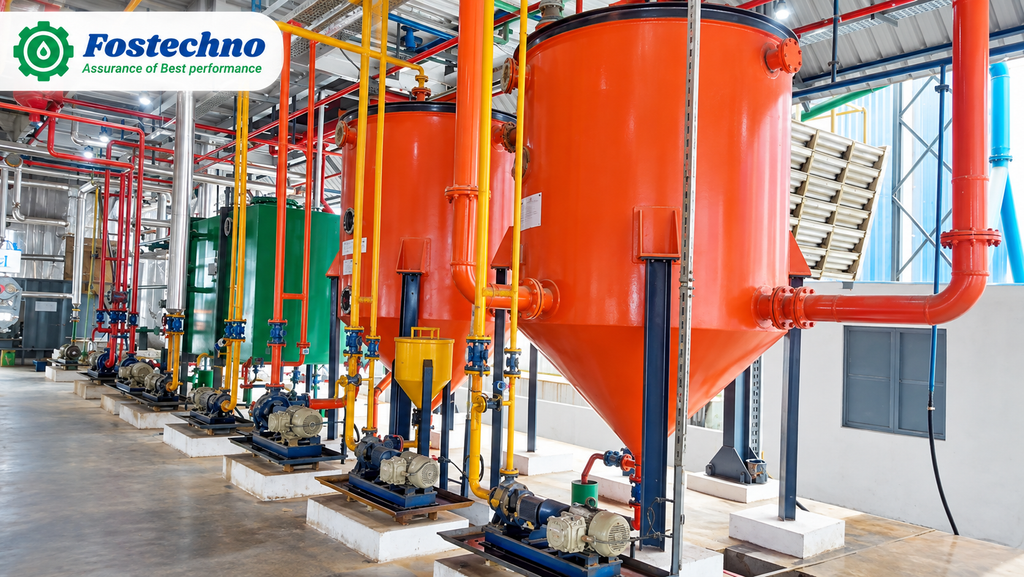
Solvent Extraction Plant: Complete Guide to Process, Machinery, Cost & Oil Recovery
In today’s competitive edible oil industry, maximising oil recovery from oilseeds is both a technical and economic priority. A solvent extraction plant offers one of the most efficient methods to extract oil from seeds and cakes — achieving recovery rates of 95–99% — making it the preferred choice for large-scale oil processors across India and globally.
This guide covers everything you need to know: the process, machinery, chemistry, troubleshooting, cost, regulatory approvals, and how to choose the right plant for your business.
1. What Is a Solvent Extraction Plant and How Does It Work?
Definition: A solvent extraction plant is an industrial facility that uses a chemical solvent — most commonly food-grade hexane (C₆H₁₄) — to extract oil from oilseeds, oil cakes, and other oil-bearing materials. Unlike mechanical pressing, it reduces residual oil in the meal to as low as 0.5–1%, compared to 6–8% in an expeller press, delivering superior oil yield from every tonne processed.
These plants are also referred to as solvent oil extraction plants, hexane extraction plants, or oilseed solvent extraction plants depending on the raw material and application.
Key facts at a glance:
Capacity range: 50 TPD to 5,000+ TPD
Oil extraction efficiency: 95–99%
Residual oil in meal: 0.5–1% (vs 6–8% in expeller pressing)
Primary solvent used: Food-grade n-Hexane (closed-loop recovery)
Hexane consumption in a well-maintained plant: 1–3 litres per tonne
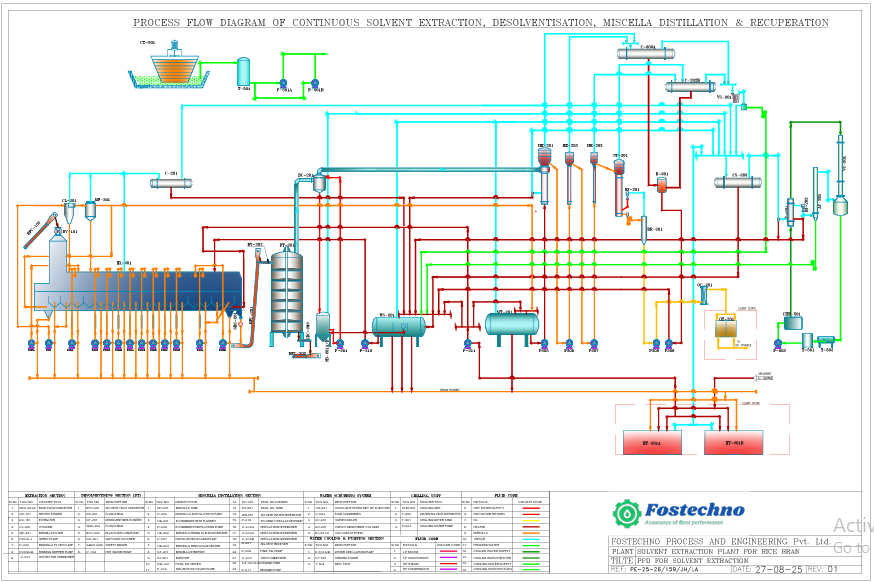
2. How Does a Solvent Extraction Plant Work? Step By Step
In brief: Oilseed material contacts hexane inside a sealed extractor. Hexane dissolves the oil to form a mixture called miscella. Miscella is then evaporated and distilled to recover crude oil. The hexane vapour is condensed and recycled. The meal is steam-treated in the DTDC to remove hexane traces, then dried and cooled for use as animal feed.
The complete 9-step process in a commercial solvent extraction plant:
Step 1 — Seed Cleaning & Pre-Treatment: Raw seeds are cleaned using rotary screens and destoners to remove foreign matter, dust, and oversized particles. Moisture is checked; target feed moisture: 8–10%.
Step 2 — Cracking & Flaking: Seeds are cracked using cracking rolls and then passed through flakers (corrugated rolls) to produce thin flakes of 0.25–0.30 mm thickness. Thin flakes maximise surface area for solvent contact.
Step 3 — Pre-Pressing (High-Oil Seeds Only): Seeds with oil content above 20% (e.g., sunflower, groundnut) go through pre-press expellers first to reduce oil content to 14–18% before extraction, improving extractor efficiency.
Step 4 — Solvent Extraction: Flakes or pre-pressed cake enter the extractor (rotary or loop type) and contact hexane in a counter-current flow. Hexane dissolves the oil, forming miscella (oil + solvent mixture). Residence time: typically 60–90 minutes.
Step 5 — Miscella Filtration & First-Stage Evaporation: The miscella is filtered to remove fines, then concentrated in a first-stage evaporator (falling film type). Hexane concentration in miscella rises from ~25% oil to ~65–70% oil.
Step 6 — Second-Stage Evaporation & Oil Stripping: Miscella enters a second-stage evaporator, then a steam stripper column where live steam (3.0–3.5 bar) removes residual hexane from crude oil. Target: hexane in crude oil below 50 ppm (verified by flash point test).
Step 7 — Meal Desolventisation (DTDC): Wet, hexane-laden meal enters the DTDC (Desolventiser-Toaster-Drier-Cooler). Steam at 100–110°C removes hexane from meal. The toaster section also inactivates anti-nutritional factors (e.g., urease in soybean). Target: meal moisture below 10%, urease activity below 0.05 pH rise.
Step 8 — Hexane Recovery: All hexane vapours from evaporators, strippers, and DTDC pass through condensers (cooled by water at 28–30°C). Condensed hexane is recycled back to the extractor. Non-condensable gases pass through a mineral oil absorber to capture residual hexane. A well-maintained plant achieves hexane recovery of 99.5% or higher.
Step 9 — Crude Oil Storage & Meal Handling: Solvent-free crude oil is stored in tanks, ready for refining. Meal is conveyed to bagging or bulk storage. Typical meal protein content: 44–48% for soybean meal.
3. The Chemistry Behind Hexane Extraction — Why Hexane Works
Core principle: Hexane (C₆H₁₄) is a non-polar hydrocarbon. Triglyceride oil molecules are also non-polar. Following the chemistry principle of “like dissolves like” (similia similibus solvuntur), hexane selectively dissolves oil while leaving behind the polar components — proteins, fibre, and starch — in the meal.
Key Chemical Properties of Food-Grade n-Hexane
| Property | Value | Significance for Extraction |
| Chemical Formula | C₆H₁₄ | Non-polar structure — dissolves triglycerides selectively |
| Boiling Point | 68–69°C | Easy recovery by simple heating — low energy cost per tonne |
| Flash Point | -22°C | Highly flammable — explains mandatory PESO and explosion-proof requirements |
| Solubility in Water | Practically insoluble (13 mg/L at 20°C) | Clean separation from aqueous meal moisture — no emulsification |
| Oil–Hexane Miscibility | Complete at room temperature | No heating needed for dissolution — energy efficient extraction |
| Approved Grade | Food-grade n-Hexane | Max residue in final oil: 1 mg/kg (FSSAI standard for edible oils) |
| Recovery Rate (well-maintained plant) | 99.5%+ | Only 0.5% hexane lost per cycle — economical and safer operation |
Hexane Recovery Rate Formula
Hexane Recovery Rate (%) = [ (Hexane Input − Hexane Lost) ÷ Hexane Input ] × 100
Target: ≥ 99.5% recovery (i.e., ≤ 0.5% loss per extraction cycle)
Industry benchmark for hexane loss: 1.0–1.5 litres per tonne of material processed
Why does moisture in seeds reduce extraction efficiency? When feed moisture exceeds 10%, water molecules form a thin film around oil cells, blocking hexane penetration into the seed matrix. This increases residual oil in meal from the target 0.5% to 2–3% and causes miscella cloudiness (emulsification). Always condition seeds to 8–10% moisture before extraction.
4. Which Raw Materials Can Be Processed in a Solvent Extraction Plant?
A well-designed solvent extraction plant can process a wide range of oil-bearing materials. Plant configuration varies based on the raw material’s oil content, moisture level, and pre-treatment requirements:
| Raw Material | Typical Oil Content | Residual Oil Target | Special Requirement |
| Soybean | 18–22% | ≤ 0.8% | Urease inactivation in DTDC (urease < 0.05 pH rise) |
| Rice Bran | 16–22% | ≤ 1.0% | High FFA (15–30%) — acid-resistant equipment required; rapid pre-treatment essential |
| Sunflower Seed / Cake | Pre-press cake: 14–18% | ≤ 1.0% | Pre-pressing mandatory before extraction due to high hull content |
| Mustard / Rapeseed | 38–44% | ≤ 1.0% | Glucosinolate preservation needed for some export markets; DTDC temperature controlled at 95–105°C |
| Cottonseed | Pre-press cake: 12–16% | ≤ 1.0% | Gossypol-containing — meal not suitable for all animal feeds |
| Groundnut Cake | 8–12% (post-press) | ≤ 0.8% | Pre-pressed cake only; high aflatoxin risk — quality control critical |
| Palm Kernel Cake | 5–8% | ≤ 1.0% | Hard kernel — requires conditioning at 70°C before flaking |
| Maize Germ | 48–52% | ≤ 1.0% | Wet milling germ — pre-drying to 8% moisture before extraction |
| Sesame Cake / Linseed | Post-press: 8–14% | ≤ 1.0% | Specialty seeds — batch processing may be preferred at small scale |
Important: Soybean and rice bran cannot be processed simultaneously in a single extractor line. Switching between them requires complete line washing and reconfiguration — typically 8–12 hours of downtime — due to incompatible free fatty acid levels and equipment compatibility requirements.
5. Main Equipment Used in a Solvent 5. Types of Solvent Extraction Plants
| Plant Type | Capacity Range | Best For | Key Feature |
| Continuous Solvent Extraction Plant | 100–5,000+ TPD | Large-scale, uninterrupted processing | Maximum throughput, lowest operating cost per tonne |
| Batch Type Solvent Extraction Plant | 10–100 TPD | Smaller capacities, varied seed types, seasonal operation | Flexible — easy to switch between seed types |
| Turnkey Solvent Extraction Plant | 50–5,000+ TPD | New project investors — complete solution | Civil + mechanical + electrical + commissioning in one contract |
| Integrated Extraction cum Refinery | 100–1,000+ TPD | Processors wanting crude + refined oil in one facility | Combines extraction with degumming, neutralisation, bleaching, deodorisation |
6. Main Equipment and Machinery in a Solvent Extraction Plant
| Equipment | Function | Key Specification |
| Rotary / Loop Extractor | Core extraction vessel — oil dissolved in hexane | Rotation speed: 8–12 RPM; residence time: 60–90 min |
| DTDC (Desolventiser-Toaster-Drier-Cooler) | Removes hexane from meal; toasts for quality | Toaster temp: 100–110°C (soybean); 95–105°C (mustard) |
| 1st Stage Evaporator (Falling Film) | Concentrates miscella from ~25% to ~65% oil | Operating temperature: 60–70°C under vacuum |
| 2nd Stage Evaporator | Further concentrates miscella to ~90%+ oil | Higher vacuum; temperature: 70–80°C |
| Steam Stripper / Distillation Column | Removes residual hexane from crude oil | Live steam: 3.0–3.5 bar; target: <50 ppm hexane in oil |
| Condenser & Cooling Tower | Condenses hexane vapour for recycling | Cooling water inlet: target ≤28°C; outlet: ≤32°C |
| Mineral Oil Absorber | Captures residual hexane from non-condensable vent gases | Absorber oil viscosity: replace when exceeds 15 cSt |
| Flaker | Rolls cracked seeds into thin flakes | Target flake thickness: 0.25–0.30 mm |
| Pre-Press Expeller | Reduces oil content of high-oil seeds before extraction | Press cake oil target: 14–18% |
| LEL Monitoring System | Detects hexane vapour concentration for safety | Alarm: 10% LEL; automatic shutdown: 25% LEL |
| Storage Tanks | Hexane, miscella, crude oil storage | Must be earthed and bonded; PESO-compliant |
7. What Is the Oil Recovery Efficiency of a Solvent Extraction Plant?
Direct answer: A well-designed solvent extraction plant achieves 95–99% oil recovery from oilseeds, leaving residual oil in the meal as low as 0.5–1%. This compares to 88–94% recovery in mechanical expeller pressing, which leaves 6–8% residual oil in the cake — a significant economic difference at commercial scale.
| Performance Metric | Typical Value | Impact |
| Oil extraction efficiency | 95–99% | Maximum commercial oil yield per tonne of seed |
| Residual oil in meal | 0.5–1% | High-protein meal with low fat — premium animal feed grade |
| Hexane consumption | 1–3 L/tonne (well-maintained) | Low operating cost; less flammability risk |
| Meal moisture (post-DTDC) | <10% | Safe for storage; prevents mould growth |
| Meal protein — soybean | 44–48% | Suitable for poultry, aquaculture, and cattle feed formulations |
| Hexane in crude oil | <50 ppm | Meets FSSAI and international quality standards |
| Power consumption | 15–25 kWh/tonne | Lower than equivalent expeller systems at same throughput |
8. Solvent Extraction Plant vs. Expeller Plant: Which Is Better for Your Business?
Short answer: For large-scale operations (>100 TPD), solvent extraction is superior in oil yield and operating cost per tonne. For small-scale or capital-constrained setups, expeller pressing is simpler to operate. Many processors use both: mechanical pre-pressing followed by solvent extraction of the residual cake (called the “pre-press + extraction” model), which gives the best of both technologies.
| Parameter | Expeller / Mechanical Press | Solvent Extraction Plant |
| Oil Recovery | 88–94% | 95–99% |
| Residual Oil in Cake | 6–8% | 0.5–1% |
| Capital Cost | Lower | Higher (but justified at scale) |
| Operating Cost (per tonne) | Higher per unit | Lower per unit at scale |
| Minimum Viable Scale | 1–50 TPD | 50–100 TPD (100 TPD recommended minimum for financial viability) |
| Chemical Use | None | Hexane (99.5%+ recovered and reused) |
| Meal Quality | Good (higher fat content) | Excellent — defatted, high-protein |
| Operator Skill Required | Lower | Higher (trained operators essential) |
| Safety Complexity | Low | High (PESO compliance, explosion-proof equipment) |
| Regulatory Approvals | Standard factory licence | PESO + SPCB + FSSAI + Fire NOC (6 approvals) |
| Best For | Small processors, rural units, startup phase | Commercial processors, integrated oil mills, export-oriented units |
9. Solvent Extraction Plant Capacity Options
| Scale | Capacity (TPD) | Typical Investment (INR) | Target Operator Profile |
| Small Scale | 50–100 TPD | INR 4–10 crore | Regional oil millers, agro-processing startups |
| Medium Scale | 100–500 TPD | INR 10–40 crore | Established oil millers, state-level processors |
| Large Scale | 500–1,000 TPD | INR 40–90 crore | National oil brands, export-oriented processors |
| Industrial Scale | 1,000–5,000+ TPD | INR 90 crore+ | Large integrated edible oil complexes |
Financial viability threshold: Based on Indian market economics (2026), a solvent extraction plant requires a minimum of 100 TPD capacity to be financially viable. Below 100 TPD, fixed costs (operators, boiler fuel, maintenance) per tonne become disproportionately high. At 100 TPD processing soybean, gross oil revenue (approx. INR 850–950 per tonne of oil) plus meal revenue (approx. INR 28–32 per kg) typically delivers payback in 3–5 years, assuming 300 operating days per year.
10. Solvent Extraction Plant Cost 10. How Much Does a Solvent Extraction Plant Cost in India? (2026 Breakdown)
Direct answer: A 100 TPD turnkey solvent extraction plant in India costs approximately INR 5–12 crore depending on three primary variables: (1) automation level — manual vs. fully automated PLC controls can add INR 1–3 crore; (2) civil infrastructure — greenfield vs. existing shed reduces cost by 20–35%; and (3) seed type — rice bran processing requires acid-resistant equipment, adding INR 1–2 crore vs. standard soybean configuration.
| Cost Component | Description | % of Total Project Cost |
| Machinery and Equipment | Extractor, DTDC, evaporators, strippers, condensers, absorber, instrumentation | 40–50% |
| Civil and Structural Work | Foundation, factory shed, control room, fire-resistant construction, hexane bund | 20–30% |
| Electrical and Instrumentation | Power panels, explosion-proof wiring, PLC/SCADA, safety interlocks, LEL monitors | 10–15% |
| Utilities | Steam boiler, cooling tower, compressed air system, water supply infrastructure | 8–12% |
| Hexane Storage Infrastructure | Bonded storage tanks, bunded area, fire suppression, earthing systems | 5–8% |
| Engineering, Erection & Commissioning | Project management, site erection, testing, startup support, operator training | 5–8% |
11. Land, Utility and Infrastructure Requirements
| Requirement | 50–100 TPD Plant | 500 TPD Plant |
| Land Area | 1–2 acres | 3–5 acres |
| Power Supply | 100–200 kW | 400–600 kW |
| Steam Generation | 3–5 tonnes/hour boiler | 15–20 tonnes/hour boiler |
| Cooling Water Requirement | 30–50 m³/hour (recirculating) | 150–250 m³/hour |
| Hexane Storage | 1–2 storage tanks (50–100 KL) | 3–5 tanks (300–500 KL) |
| Road Access | Minimum 6-metre wide access road | Dual-lane access preferred |
| Workers Required | 15–25 (including operators, supervisors) | 60–100 |
12. How Can You Minimize Hexane Loss in a Solvent Extraction Plant? (5 Proven Methods)
Direct answer: Hexane loss can be reduced to 1.0–1.5 litres per tonne of processed material by maintaining condenser cooling water below 30°C, inspecting all flange seals weekly, operating the mineral oil absorber within its pressure differential specification, maintaining negative pressure in the extractor hood, and following a monthly hexane audit protocol.
- Condenser Temperature Control: Maintain cooling water inlet at ≤28°C and outlet at ≤32°C. Above 32°C, hexane vapour condensation becomes inefficient, increasing vent losses. Install an automatic cooling tower fan speed controller tied to cooling water temperature.
- Weekly Flange and Seal Inspection: Soap-test all flanges 2 inches and above on hexane-containing lines every week. A single unchecked 2-inch flange leak can waste 50–100 litres of hexane per day. Replace graphite gaskets every 12–18 months as a preventive measure.
- Mineral Oil Absorber Maintenance: The absorber captures hexane from non-condensable vent gases. Replace absorber oil when viscosity exceeds 15 cSt (test monthly). Monitor vent gas flow rate — abnormally high flow indicates a process leak upstream.
- Extractor Hood Negative Pressure: Maintain a slight negative pressure (−2 to −5 mm WG) inside the extractor building using exhaust fans. This prevents hexane vapour from escaping into the plant atmosphere during loading/unloading operations.
- Monthly Hexane Audit: Track hexane purchased vs. hexane consumed per tonne processed every month. Any increase above 2 litres per tonne over the previous month’s baseline is an early warning of developing leaks or process inefficiency. Act before the next month’s audit.
13. Advanced Troubleshooting: Real Plant Scenarios & Solutions
The following scenarios cover the most common field problems encountered in commercial solvent extraction plants processing soybean, rice bran, and mustard — with measurable thresholds and corrective actions.
| Problem Symptom | Root Cause | Corrective Action | Measurable Threshold |
| Residual oil in meal exceeds 1.5% | Flake thickness too high (>0.35 mm); insufficient hexane contact time | Reduce flaker gap to 0.25–0.30 mm; verify extractor rotation speed (target: 8–12 RPM for rotary type); increase hexane-to-solid ratio | Check flake thickness hourly; residual oil target: ≤1.0% |
| Hexane smell detected in crude oil | Stripper steam pressure too low (<2.5 bar) OR condensate backup in steam lines | Increase live steam pressure to 3.0–3.5 bar at stripper inlet; manually drain condensate trap and check trap operation; verify stripper column temperature | Flash point test on crude oil: should be >150°C; hexane in oil <50 ppm |
| Meal moisture above 12% after DTDC | DTDC toaster temperature too low OR residence time insufficient | Raise DTDC toaster temp by 5°C (target: 105–110°C for soybean); reduce meal throughput by 10% to increase residence time in dryer section | Meal moisture: target <10% at DTDC exit; check every 2 hours |
| LEL alarm triggers repeatedly near condenser | Cooling water above 32°C; inadequate hexane condensation | Switch to standby cooling tower cell; inspect cooling tower fill packing for biological fouling; verify cooling water flow rate | LEL sensor: alarm at 10% LEL; automatic plant shutdown at 25% LEL |
| Miscella colour abnormally dark (brownish) | Feed moisture above 10% OR fines percentage above 8% in feed | Check conditioner temperature (target: 60–65°C pre-extraction); install rotary screen before extractor to reduce fines to below 5% by weight | Fines in feed: max 5% by weight; miscella should be pale yellow-green |
| High hexane consumption (>3 L/tonne) | Multiple small leaks at flanges OR mineral oil absorber inefficient | Soap-test all 2-inch+ flanges; replace absorber oil if viscosity exceeds 15 cSt; check vent gas flow rate vs. baseline | Target: hexane loss ≤1.5 L/tonne; monthly hexane audit mandatory |
| Poor soybean meal urease activity (>0.3 pH rise) | DTDC toaster temperature too low OR residence time too short | Increase toaster section temperature to 108–112°C; extend residence time by reducing throughput; verify steam distribution across all trays | Urease activity: target <0.05 pH rise (feed-grade standard); test each shift |
| Extractor cake too wet (hexane-laden meal >35% hexane) | Drain section choked with fines; inadequate draining time | Clean extractor drain screens; reduce feed rate by 15%; install fines return system to prevent accumulation on drain deck | Cake hexane content at extractor exit: target 25–30%; check daily |
14. What Are the Safety Requirements for a Solvent Extraction Plant in India?
Core requirement: Because hexane has a flash point of −22°C and forms explosive vapour-air mixtures at concentrations of 1.1–7.5% (LEL-UEL range), solvent extraction plants are classified as hazardous areas under Indian and international standards. All electrical equipment inside the extraction zone must be explosion-proof (flame-proof, Ex-d rated), and the plant must maintain continuous LEL monitoring with automatic shutdown systems.
- Explosion-proof electrical equipment: All motors, panels, junction boxes, and light fittings within the classified hazardous zone (Zone 1 and Zone 2 as per IS 5572) must be Ex-d or Ex-e rated
- LEL Monitoring System: Fixed LEL detectors at all critical points (extractor area, condenser room, hexane storage). Alarm at 10% LEL; automatic plant shutdown at 25% LEL
- Earthing and Bonding: All metal equipment, tanks, and pipelines must be earthed and bonded to prevent static discharge — a critical hexane ignition source
- Flame Detection System: UV/IR flame detectors linked to automatic CO₂ or dry powder suppression systems in the extractor building
- Fire Suppression: High-foam and CO₂ systems in hexane storage areas; sprinkler systems in general process areas; fire hydrant network at 45-metre intervals
- Ventilation: Minimum 20 air changes per hour in the extractor building; all exhaust fans explosion-proof; fresh air intakes located upwind
- PESO-Compliant Hexane Storage: Hexane stored in a separate bunded area with fire wall; tank capacity and spacing per Petroleum Rules 2002
- Effluent Treatment: Process wastewater containing hexane traces treated in an oil-water separator before discharge; compliant with SPCB norms
15. Which Government Approvals Are Required to Set Up a Solvent Extraction Plant in India?
Direct answer: Setting up a solvent extraction plant in India requires six primary approvals: (1) PESO approval for hexane storage, (2) State Pollution Control Board NOC, (3) Factory licence under the Factories Act, (4) Fire NOC from local fire authority, (5) FSSAI licence for edible oil processing, and (6) local building/layout approval from municipal or industrial authority. Allow 6–12 months for full approval clearance in most Indian states.
| # | Approval | Governing Authority | Applicable Act / Rule | Remarks |
| 1 | PESO Approval | Petroleum and Explosives Safety Organisation (PESO), Nagpur | Petroleum Act 1934; Petroleum Rules 2002 | Required for hexane storage above 1 KL; submit tank drawings and site plan |
| 2 | SPCB NOC | State Pollution Control Board | Environment Protection Act 1986; Water & Air Acts | Consent to Establish (CTE) before construction; Consent to Operate (CTO) before commissioning |
| 3 | Factory Licence | State Labour Department / Inspector of Factories | Factories Act 1948 | Classifies plant as a hazardous process factory; requires safety officer appointment |
| 4 | Fire NOC | District Fire Authority / Chief Fire Officer | State Fire Prevention Act | Fire escape routes, suppression systems, and extinguisher layout must be approved |
| 5 | FSSAI Licence | Food Safety and Standards Authority of India | Food Safety and Standards Act 2006 | Central FSSAI licence required for production >30,000 MT/year or multi-state distribution |
| 6 | Building / Layout Approval | Local municipal authority / MIDC / GIDC / state industrial development corporation | Local building by-laws | Approved plant layout with hazardous zone demarcation required before civil construction |
| 7 | BIS Compliance | Bureau of Indian Standards | IS standards for pressure vessels, piping, etc. | Equipment must conform to applicable IS standards; relevant for pressure vessels and boiler |
16. Government Approvals Required for Ins16. Solvent Extraction Plant Layout: Key Zones
A well-planned plant layout separates hazardous and non-hazardous zones, with clear buffer distances between them:
- Raw Material Receiving & Pre-Cleaning Area — grain pits, conveyors, cleaning screens
- Seed Conditioning & Flaking Section — conditioners, crackers, flakers, pre-press expellers
- Extractor Building — classified hazardous zone (Zone 1); explosion-proof equipment throughout
- DTDC & Meal Handling Area — adjacent to extractor; partially hazardous zone
- Distillation & Oil Recovery Section — evaporators, strippers, condensers, absorbers
- Hexane Bonded Storage Area — completely separate from process area; fire wall separation; bunded
- Crude Oil Storage Tanks — earthed and bonded; bunded area
- Boiler House & Utilities Area — located upwind from hexane area
- Control Room & Administrative Block — non-hazardous zone; pressurised to prevent vapour ingress
17. Applications of Solvent Extraction Technology Beyond Edible Oil
| Industry | Application | Product Extracted |
| Animal Feed | Defatted meal production | High-protein soya meal (44–48% protein), canola meal |
| Nutraceuticals & Pharma | Active ingredient extraction | Phytosterols, tocopherols, plant-based omega-3 |
| Cosmetics | Carrier oil & essential oil extraction | Jojoba, argan, sea buckthorn seed oils |
| Biodiesel | Feedstock oil extraction for transesterification | Crude non-edible oils (jatropha, karanja) |
| Fish Processing | Fish oil and fish meal production | Fish oil (omega-3 rich), defatted fish meal |
| Beverage Industry | Decaffeination | Caffeine from coffee and tea leaves |
18. Why Choose FOSTECHNO for Your Solvent Extraction Plant Project?
FOSTECHNO Process & Engineering Pvt. Ltd. is a leading turnkey project solution provider in the edible oil processing industry, with a proven track record across India and international markets:
- End-to-end turnkey capability: From concept and design to civil, mechanical, electrical, and commissioning
- In-house engineering team: Experienced process and mechanical engineers who design for maximum efficiency
- Quality-focused fabrication: Equipment manufactured to IS and international standards with stringent QC
- Wide capacity range: Plants from 50 TPD to 5,000+ TPD, tailored to your business scale
- Multi-seed expertise: Soybean, rice bran, sunflower, mustard, cottonseed, groundnut, and more
- Post-installation support: Operator training, annual maintenance contracts, and technical helpdesk
- Project financing guidance: Assistance with project reports for bank financing and government subsidy schemes
Contact FOSTECHNO today for a site-specific consultation and detailed project quotation.
19. Frequently Asked Questions (FAQs)
Q1. What is a solvent extraction plant?
A solvent extraction plant is an industrial facility that uses food-grade hexane to extract oil from oilseeds and oil cakes, achieving oil recovery rates of 95–99% — compared to 88–94% in mechanical expeller pressing.
Q2. Which solvent is used in oil extraction plants?
Food-grade n-Hexane (C₆H₁₄) is the standard solvent used globally. It is approved for edible oil processing with a maximum residue limit of 1 mg/kg in final oil (FSSAI standard). Hexane is recovered and recycled at 99.5%+ efficiency in a well-maintained plant.
Q3. What is the minimum capacity for financial viability in India?
A minimum of 100 TPD is recommended for financial viability in the Indian market (2026). Below 100 TPD, fixed costs per tonne become too high. At 100 TPD processing soybean, payback is typically 3–5 years on a turnkey investment of INR 6–10 crore, assuming 300 operating days per year.
Q4. What happens if seed moisture is above 10% during extraction?
Excess moisture above 10% causes water to form a film around oil cells, blocking hexane penetration. This increases residual oil in meal from the target 0.5% to 2–3% and causes miscella emulsification (cloudiness). Always condition seeds to 8–10% moisture before extraction.
Q5. Can soybean and rice bran be processed simultaneously?
No. They require separate processing campaigns due to incompatible free fatty acid levels (rice bran: 15–30% FFA vs. soybean: 0.5–1% FFA) and equipment compatibility. Switching between them requires 8–12 hours of line washing and reconfiguration.
Q6. What is the DTDC toaster temperature for soybean vs. mustard?
For soybean: 100–110°C with 20–25 minutes residence time to achieve urease activity below 0.05 pH rise (feed-grade standard). For mustard: 95–105°C to preserve glucosinolate levels required for specific export markets. Exceeding 115°C for any seed causes protein denaturation, reducing meal nutritive value.
Q7. How much land is required for a solvent extraction plant?
Approximately 1–2 acres for a 50–100 TPD plant and 3–5 acres for a 500 TPD plant, including process area, hexane storage, utilities, and administrative block.
Q8. How many government approvals are required in India?
Six primary approvals: PESO (hexane storage), SPCB NOC (environment), Factory Licence, Fire NOC, FSSAI Licence (edible oil), and building/layout approval. Allow 6–12 months for full clearance. BIS compliance for equipment is also applicable.
Q9. What is the typical hexane consumption in a well-run plant?
A well-maintained solvent extraction plant consumes 1.0–1.5 litres of hexane per tonne of material processed. Plants with poor sealing, high cooling water temperatures, or an inefficient mineral oil absorber may consume 3–5 litres per tonne — significantly increasing operating costs.
Q10. How do I estimate the capacity I need for my oilseed supply?
A 500-acre soybean farm yields approximately 600–750 tonnes per harvest season (at 1.2–1.5 tonnes/acre). For year-round operation, a 100 TPD plant requires steady procurement of approximately 3,000 tonnes of soybean per month from the market. Contact FOSTECHNO for a capacity and raw material feasibility study specific to your region.
Q11. What is the power consumption of a solvent extraction plant?
Power consumption is approximately 15–25 kWh per tonne of material processed, depending on plant capacity, automation level, and raw material type. Larger plants benefit from economies of scale — power cost per tonne decreases significantly above 200 TPD.
Q12. Is solvent extraction safe for edible oil production?
Yes, when designed and operated to standards. The extraction process uses a closed-loop hexane system. Residual hexane in crude oil is reduced to below 50 ppm by the steam stripper, and after refining, the final edible oil meets FSSAI and international food safety standards with hexane below 1 mg/kg.
20. Conclusion
A solvent extraction plant is the most efficient and commercially viable method for extracting oil from oilseeds at industrial scale. With oil recovery rates of 95–99%, hexane recovery above 99.5%, and the ability to process a wide range of raw materials — from soybean and rice bran to sunflower and mustard — solvent extraction technology delivers a strong return on investment for processors of all sizes.
Setting up a plant requires careful planning across six dimensions: capacity selection, raw material compatibility, machinery specification, site infrastructure, regulatory approvals, and operator training. Each of these has measurable thresholds and best-practice benchmarks — not just general descriptions.
Partnering with an experienced turnkey specialist like FOSTECHNO ensures your plant is designed to those exact benchmarks, giving your business a solid foundation for long-term profitability.
Ready to start your project? Contact FOSTECHNO Process & Engineering Pvt. Ltd. for a site-specific consultation, detailed capacity study, and customised project quotation tailored to your raw material, location, and budget.



Leave a Reply